The Prince's Education

Vidya - The Four Sciences of Kingship

Kautilya prescribed a rigorous curriculum for princes encompassing philosophy, religion, economics, and political science. Education shaped not just competent rulers, but wise ones.

The Making of a Mind

A young Mauryan prince studying anvikshiki philosophy with Chanakya

A crown prince inherits power, but not wisdom. Authority comes with the title, but judgment must be cultivated.

Kautilya understood that education was the foundation of good governance. An ignorant ruler makes disastrous decisions regardless of intentions. An educated ruler can discern truth from flattery, opportunity from threat, justice from expedience.

"Knowledge is power's foundation. Without it, authority becomes tyranny."

The Four Sciences (Vidyas)

Kautilya organized the curriculum around four essential disciplines:

1. Anvikshiki - Philosophy and Logic

Critical thinking, logic, epistemology, ethics, debate. Philosophy was the science of inquiry - how to think, evaluate arguments, and distinguish truth from sophistry.

A prince trained in anvikshiki could examine claims critically, detect logical fallacies in counsel, reason through complex situations, and understand competing philosophical systems.

Why it matters for freedom: Rulers who can't think critically are easily manipulated by advisors, priests, or courtiers. They mistake emotion for reason, tradition for truth. A king trained in logic can resist dogma, question unjust traditions, and evaluate policies on evidence rather than authority.

2. Trayi - The Vedas and Dharma

Sacred texts, ritual, ethics, moral philosophy, social norms. The Trayi encompassed the Vedic tradition - the ethical and moral framework of society.

Why it matters for freedom: Rulers need to understand what their subjects believe, even if they question it. You cannot govern people whose values you don't comprehend. Moreover, dharma provided moral constraints on power - a king served dharma, not the reverse.
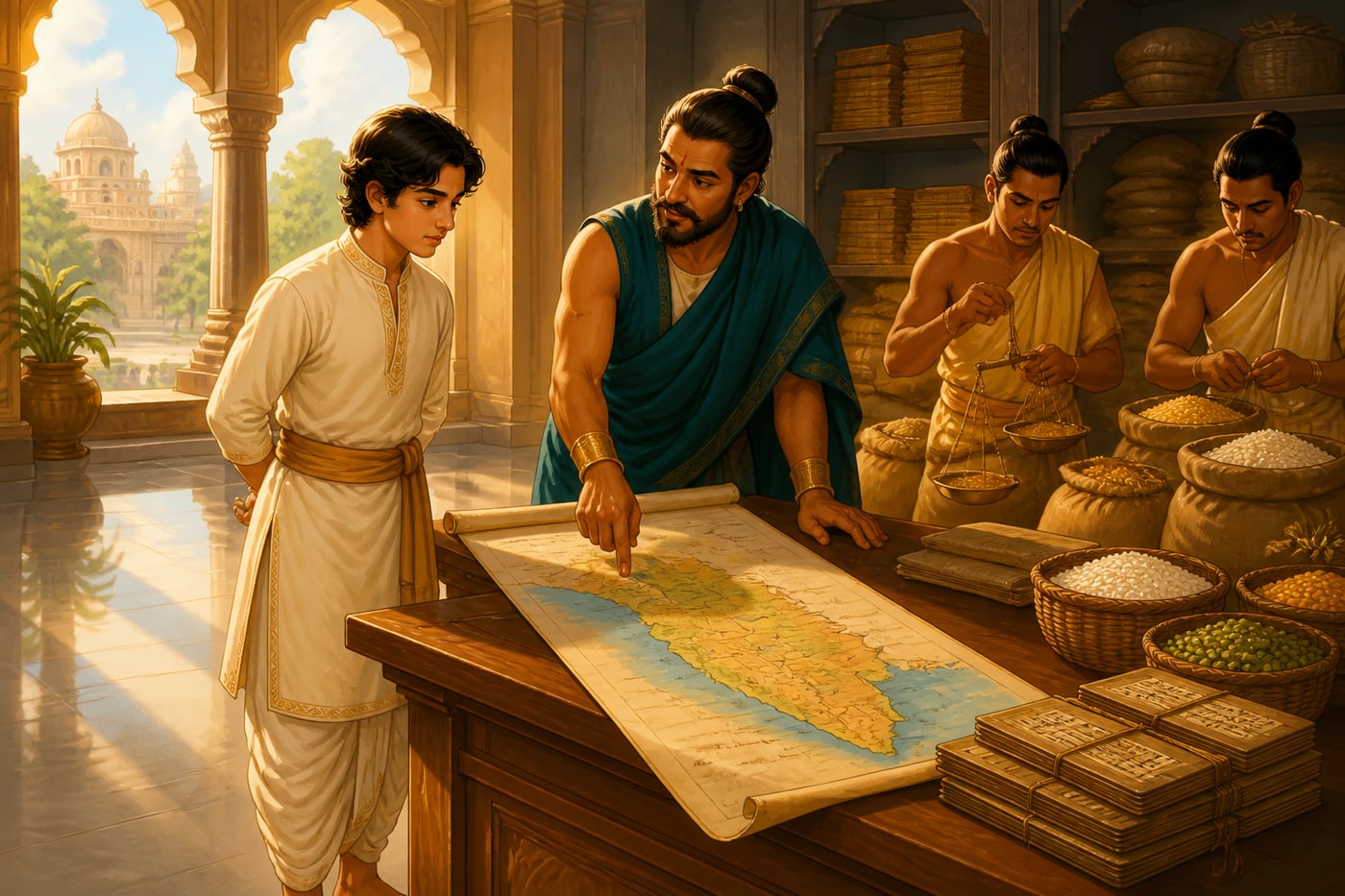
The prince learning varta economics in the royal granary office

3. Varta - Economics and Agriculture

Agriculture, trade, taxation, economic policy. Varta was the science of wealth creation - how societies produce, distribute, and grow prosperous.

Why it matters for freedom: Kautilya's most libertarian insight was that prosperity enables freedom. Poor societies become desperate, trading liberty for security. A ruler who understood economics would recognize that wealth comes from production, not confiscation, and that excessive taxation kills prosperity.

4. Dandaniti - Political Science and Statecraft

Governance, law, administration, diplomacy, military strategy. Dandaniti was the science of power - how to acquire it, maintain it, and wield it effectively.

Why it matters for freedom: Power exists. The question is whether it's wielded competently or incompetently, justly or arbitrarily. Dandaniti taught that force must serve justice, good administration minimizes arbitrary power, and clear laws protect subjects from official whim.

The Hierarchy of Knowledge

Kautilya ranked these sciences:

Anvikshiki was supreme - the "lamp of all sciences" - because it illuminated all others. Philosophy taught how to think about knowledge from other disciplines.

Dandaniti came second - practical governance synthesizing insights from the others.

Varta was third - essential for prosperity but dependent on good governance.

Trayi was fourth - important for moral grounding but not sufficient alone.

This ranking reveals Kautilya's priorities: reason over ritual, practical wisdom over theoretical knowledge.

Self-Mastery Before Ruling Others

Education wasn't just intellectual. It was moral formation.

Kautilya emphasized indriya-jaya - conquest of the senses. A prince must master lust, anger, greed, pride, arrogance, and impetuousness.

A ruler who couldn't control himself couldn't control a kingdom. Personal vice led to public disaster.

"He who cannot conquer himself will be conquered by his enemies."

The Libertarian Core

Marcus Aurelius inscribing meditations in his campaign tent

Kautilya's educational system reveals a profound libertarian insight: educated rulers threaten liberty less than ignorant ones.

An ignorant ruler doesn't understand economic consequences, can't distinguish advice from manipulation, mistakes force for authority, and violates rights through incompetence.

An educated ruler recognizes limits of central planning, understands prosperity requires freedom, values institutions over personal whim, and appreciates that stability comes from justice, not just force.

Modern Applications

Political Leaders: How many legislators understand basic economics or can think critically about policy proposals? Imagine if every elected official had to pass examinations in logic, constitutional law, economics, and history.

Business Leaders: MBA programs are modern Varta training. But Kautilya would add philosophy to think clearly and ethics to govern wisely.

Citizens: In democracies, every citizen is partly sovereign. The four sciences are citizenship education - critical thinking to evaluate claims, civic values, economic literacy, and understanding how government works. An educated citizenry is tyranny's nemesis.

The Ultimate Goal

Kautilya's curriculum aimed to produce rulers who were wise through philosophy, just through understanding dharma, prosperous through economic competence, powerful through statecraft mastery, and self-controlled through discipline.

Such a ruler would govern effectively while respecting limits, seeing subjects as people to serve, not resources to exploit.

The best check on power is knowledge - both in those who wield it and those who live under it.

Comprehensive education creates leaders who understand multiple dimensions of governance. Philosophy provides critical thinking tools to evaluate all other knowledge. Economics prevents disastrous policies born of ignorance. Ethics provides moral constraints. Statecraft enables effective execution. Narrow specialists lack the breadth to see connections and consequences across domains.

Critical thinking is a meta-skill that amplifies all other learning. A ruler who can reason clearly will apply economic knowledge wisely, interpret sacred texts thoughtfully, and execute statecraft strategically. Without philosophical training, even extensive factual knowledge becomes rigid dogma, vulnerable to manipulation by those who frame arguments cleverly.

Leaders who cannot control their own passions will be controlled by others who exploit those weaknesses. An angry king makes rash decisions. A greedy ruler bankrupts the treasury. A lustful leader becomes vulnerable to manipulation. Self-mastery isn't about personal virtue alone - it's about maintaining the judgment and independence necessary for effective governance.

Verses

आन्वीक्षिकी त्रयी वार्ता दण्डनीतिश्च विद्याः

ānvīkṣikī trayī vārtā daṇḍanītiś ca vidyāḥ

The sciences are philosophy, the Vedas, economics, and political science.

These four disciplines constitute complete education for governance. Together they develop critical thinking, moral grounding, economic understanding, and practical statecraft - all necessary for wise rule.

Book 1, Chapter 2, Verse 1 (R.P. Kangle)

प्रदीपः सर्वविद्यानामुपायः सर्वकर्मणाम् आन्वीक्षिकी

pradīpaḥ sarva-vidyānām upāyaḥ sarva-karmaṇām ānvīkṣikī

Philosophy is the lamp of all sciences and the means to all actions.

Critical thinking illuminates all other knowledge and guides all decisions. Without the ability to reason clearly, all other learning becomes mere memorization without understanding.

Book 1, Chapter 2, Verse 11 (L.N. Rangarajan)

इन्द्रियजयः विद्याविनयोपेतः

indriya-jayaḥ vidyā-vinayopetaḥ

Mastery over the senses comes through knowledge accompanied by discipline.

Education isn't just intellectual - it's moral formation. Knowledge without self-discipline produces clever fools.

Book 1, Chapter 5, Verse 1 (R. Shamasastry)

Case studies

Marcus Aurelius: The Philosopher-King

Marcus Aurelius became Roman Emperor in 161 CE after receiving extensive education in Stoic philosophy. Unlike many emperors who seized power through violence, he was chosen for his wisdom and trained specifically for rule.

Marcus embodied Kautilya's ideal: he studied philosophy (Anvikshiki), understood Roman law and tradition (Trayi), managed imperial economics (Varta), and mastered governance and military strategy (Dandaniti). His 'Meditations' show constant practice of indriya-jaya.

Despite constant wars and plague, Marcus ruled justly for nineteen years. His reign is remembered as the last of the 'Five Good Emperors.' He saw power as duty, not privilege, and governed according to philosophical principles.

Comprehensive education combining philosophy, ethics, economics, and statecraft produces rulers who see authority as service. Without philosophical grounding, even capable rulers become tyrants.

MBA programs increasingly add philosophy, ethics, and systems thinking to traditionally quantitative curricula. Stanford's "Designing Your Life" course and Harvard Business School's emphasis on leadership character reflect a growing recognition that narrow technical training produces capable managers but not wise leaders.

Marcus Aurelius ruled the Roman Empire for 19 years (161 to 180 CE), governing approximately 70 million people across 5 million square kilometers. His Stoic training began at age 11 under multiple tutors, spanning philosophy, law, rhetoric, and military strategy over 14 years.

The Failure of Narrow Technical Expertise

In the early 2000s, many financial institutions were run by quantitative experts - brilliant mathematicians who built complex models but lacked broader judgment. They understood math (narrow specialization) but not ethics, history, or systemic risk.

These leaders had deep Varta knowledge (economics/finance) but lacked Anvikshiki (philosophical wisdom to question models), Trayi (ethical grounding to see moral hazards), and Dandaniti (understanding of systemic consequences).

The 2008 financial crisis partially resulted from this narrow expertise. Smart people made mathematically 'optimal' decisions that were ethically questionable and systemically disastrous. Models failed because modelers couldn't think beyond their specialization.

Technical expertise without philosophical wisdom, ethical grounding, and systemic thinking produces competent fools. Kautilya's insistence on breadth prevents this dangerous narrow brilliance.

The AI safety community raises identical concerns today. Engineers who can build powerful AI systems but lack philosophical training in ethics, epistemology, and long-term consequences may create technologies that are technically impressive but systemically catastrophic. Breadth of education is not a luxury; it is a safeguard against dangerous narrow optimization.

The 2008 financial crisis destroyed over $2 trillion in global wealth. Mortgage-backed securities models assigned AAA ratings to instruments that defaulted at rates 200 times higher than predicted. Quantitative expertise without broader judgment contributed to systemic failure.

Historical context

c. 4th century BCE

Ancient India had sophisticated educational traditions centered on guru-shishya (teacher-student) relationships. Royal princes received education in ashrams or at court, studying with renowned teachers.

The parallel development of philosopher-ruler education in Greece (Plato's Republic) and India (Arthashastra) suggests universal recognition that good governance requires comprehensive learning.

Living traditions

Reflection

More in Vyasana: Calamities and Continuity

All lessons in Vyasana: Calamities and Continuity · Arthashastra: Science of Governance course