Self-Mastery Before Ruling Others

Indriya-Jaya

Before you can lead a kingdom, you must first conquer yourself. Kautilya's radical insight was that all external power is useless without internal mastery. The senses, left uncontrolled, will destroy what armies cannot touch.

The King Who Couldn't Stop
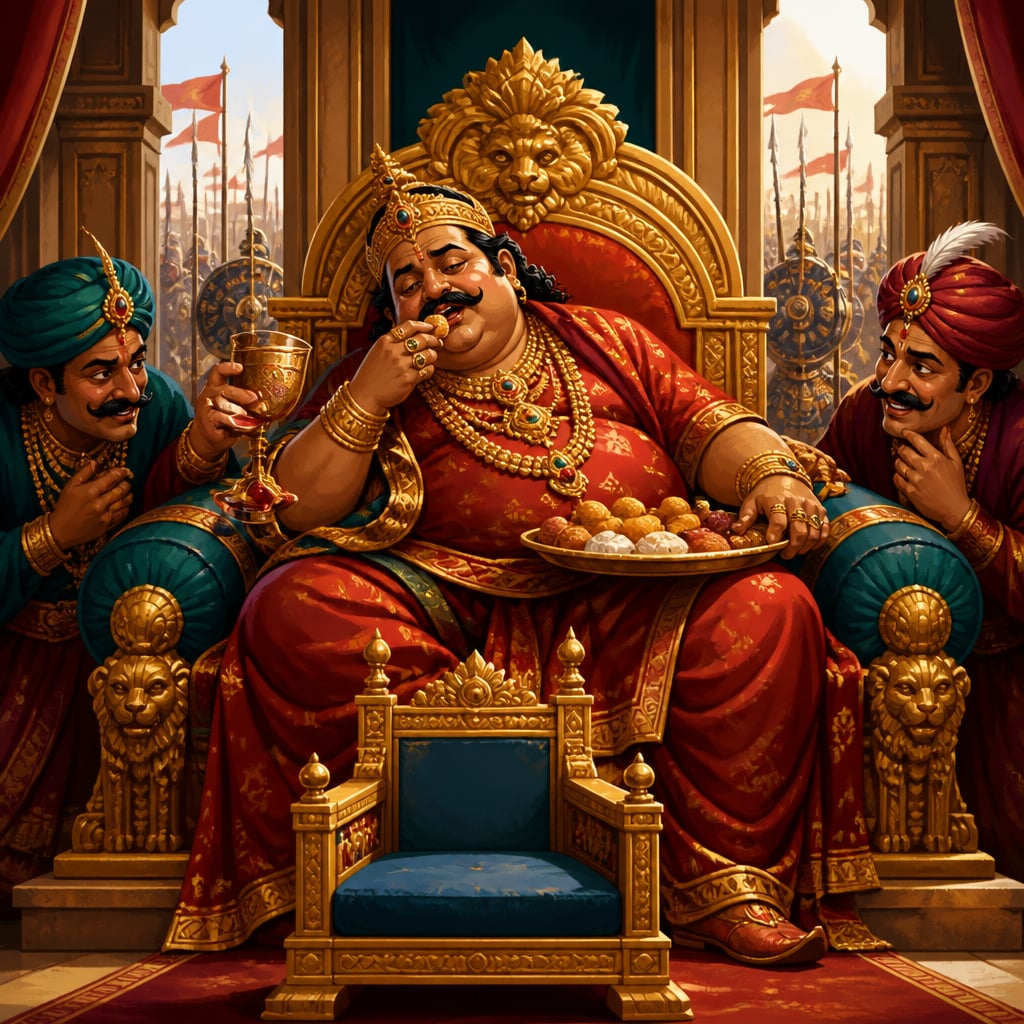
Dhana Nanda gluttonous in his Pataliputra court

Dhana Nanda had it all. The largest army India had ever assembled - 200,000 infantry, 80,000 cavalry, 8,000 war chariots. A treasury stuffed with gold extracted from every corner of his empire. Spies in every court from Taxila to the Bay of Bengal.

Yet within three years, a teenager named Chandragupta would sweep him from power.

"How?" people asked Kautilya years later. "How did you defeat such strength?"

Kautilya smiled. "Dhana Nanda defeated himself. His anger made enemies of potential allies. His greed made his subjects pray for deliverance. His pride made him dismiss warnings. I merely waited until his impulses finished the work."

"इन्द्रियजयं कुर्वीत कार्यज्ञानविनिश्चयात्" "One must achieve conquest over the senses through knowing one's duty."

This sutra opens Kautilya's discussion of leadership. Before armies, before treasury, before strategy - indriya-jaya. Victory over the senses.

What Indriya-Jaya Actually Means

Indriya-jaya isn't about suppressing desire. It's about command.

A master archer doesn't throw away his bow - he controls it with precision. The self-mastered leader doesn't eliminate desires but directs them. They feel anger but choose their response. They notice attraction but aren't hijacked by it. They want success but don't let wanting cloud their judgment.

Kautilya watched the Nanda court and catalogued exactly how uncontrolled senses destroyed rulers:

The Anger Trap: Dhana Nanda once executed a minister for delivering bad news. After that, no minister delivered bad news. The king ruled based on fantasy, not reality.

The Flattery Trap: He surrounded himself with people who told him what he wanted to hear. His actual enemies grew stronger while sycophants assured him everything was fine.

The Greed Trap: His excessive taxation funded a magnificent army that the people actively hoped would lose. What good is a military when your own subjects cheer for your defeat?

The Paradox of Power

Here is Kautilya's deepest insight: power without self-mastery is weakness.

The king who has everything except self-control actually has nothing. His wealth funds his vices. His authority lets him punish truth-tellers. His army enables wars started in anger. His advisors become enablers rather than counselors.

Meanwhile, Chandragupta - young, poor, exiled - had genuine power because he had self-discipline. His decisions served his actual interests. His relationships were based on truth. His energy went to productive ends.

Modern Parallels

Travis Kalanick built Uber into a $70 billion company. His drive, aggression, and competitiveness were legendary. But so was his temper. In 2017, a dashcam video showed him berating an Uber driver. It crystallized years of complaints: a toxic culture, harassment scandals, regulatory battles fought through bullying rather than diplomacy.

The board forced him out. Everything he'd built slipped from his control - not because competitors beat him, but because his impulses made governance impossible.

Contrast this with Satya Nadella at Microsoft. He inherited a company famous for internal warfare - executives sabotaging each other's products, a culture of fear. Nadella's response wasn't aggressive restructuring but emotional intelligence. He required his leadership team to read a book on empathy. He modeled curiosity rather than certainty.

Microsoft's market cap tripled. Indriya-jaya pays dividends.

How Self-Mastery Is Built

Kautilya didn't just describe the goal - he prescribed the training:

Young Chandragupta in pre-dawn bow practice at Taxila

Physical discipline comes first. Wake before dawn. Train the body. Maintain regular habits. These seem simple, but they establish the fundamental pattern: choosing difficult discipline over easy indulgence.

Study trains the mind. Philosophy develops critical thinking. Ethics develops moral reasoning. Practical subjects connect thought to reality. Each hour of study is an hour of delayed gratification, building capacity for the bigger tests.

Emotional regulation requires practice. Receiving criticism without reaction. Hearing flattery without being moved. Waiting before acting on impulse. This training never ends.

The Five Stages of Enslavement

Kautilya mapped exactly how impulses become prisons:

  1. Indulgence - You satisfy an impulse. It feels good.
  2. Habit - The satisfaction creates a pattern. Next time, you do it again.
  3. Necessity - You now need to indulge. You can't tolerate frustration.
  4. Enslavement - The impulse controls you. Others learn to manipulate you through it.
  5. Destruction - The accumulated consequences collapse your position.

Every uncontrolled impulse is a chain. Enough chains make a prison.

Your Turn

You can start building indriya-jaya today:

Notice without acting. Just observe: "I want to check my phone." "I'm feeling irritated." Name the impulse.

Pause between impulse and action. Count to ten. Wait until tomorrow to send that email. Create a gap.

Choose in the gap. Ask: "Is this action serving my actual interests? Or am I being controlled?"

Dhana Nanda had every external advantage. Chandragupta had self-discipline. History shows which mattered more.

Purpose-driven motivation and intrinsic versus extrinsic discipline

Marcus Aurelius writing Meditations in his campaign tent

Victor Frankl's logotherapy argues that meaning drives behavior more than pleasure or power. Simon Sinek's 'Start With Why' applies this to leadership. Modern habit research (Clear, Duhigg) confirms: habits connected to identity stick; habits as 'should' don't.

Kautilya integrates purpose into the discipline itself. It's not 'discipline plus purpose' but 'purpose as the mechanism of discipline.' This is more sustainable than willpower-based approaches and more practical than purely meaning-focused philosophies.

Gandhi's remarkable self-discipline - fasting, celibacy, simple living - was rooted in clear purpose: swaraj required personal purification. Without that purpose, such disciplines would be mere mortification. With it, they became powerful tools.

Embodied cognition and willpower as trainable capacity

Modern research confirms the mind-body connection. Baumeister's ego depletion studies show willpower as a muscle that strengthens with use. Military academies begin with physical training before strategic education. Stoics practiced discomfort intentionally.

Verses

इन्द्रियजयं कुर्वीत कार्यज्ञानविनिश्चयात्

indriya-jayaṃ kurvīta kārya-jñāna-viniścayāt

One should achieve conquest over the senses through determination in knowing one's duty.

Self-mastery isn't achieved through pure willpower but through clarity of purpose. When you know what you're trying to accomplish and why it matters, resisting distractions becomes natural.

Book 1, Chapter 6, Verse 1 (R.P. Kangle)

इन्द्रियाणां जये योगो योगानां परमं बलम्

indriyāṇāṃ jaye yogo yogānāṃ paramaṃ balam

Discipline is the means to conquer the senses; of all disciplines, this is the supreme strength.

Kautilya identifies self-mastery as the ultimate form of strength - more valuable than armies or wealth. A disciplined person with few resources will outperform an undisciplined person with every advantage.

Book 1, Chapter 6, Verse 4 (R. Shamasastry)

असंयतेन्द्रियो राजा विनश्यति न संशयः

asaṃyata-indriyo rājā vinaśyati na saṃśayaḥ

The king with unrestrained senses perishes - there is no doubt.

This is stated as certainty, not probability. Kautilya saw enough ruined kings to know: uncontrolled impulses are fatal to leadership.

Book 1, Chapter 6, Verse 5 (L.N. Rangarajan)

Case studies

The Two Alexanders: Conqueror and Conquered

Alexander the Great conquered the known world by age 30. His military genius was unmatched. Yet he died at 32, likely from illness complicated by years of heavy drinking. In his final years, he became increasingly erratic - executing loyal generals, adopting Persian court customs that alienated his men, and refusing to plan for succession. His empire fragmented within a decade of his death.

Kautilya would see Alexander as the perfect illustration of asaṃyata-indriya - uncontrolled senses. Alexander conquered the external world but was conquered by his own impulses. His drinking, his rage (he killed his friend Cleitus in a drunken fury), his grandiosity - these internal enemies did what Persia and India could not.

Alexander's conquests dissolved into warring successor kingdoms. His name lived on, but his empire did not. Meanwhile, Chandragupta - trained in self-discipline by Kautilya - built an empire that lasted generations and established administrative systems that influenced Indian governance for centuries.

External conquest without internal mastery creates nothing lasting. Alexander's military achievements were extraordinary, but his lack of self-control meant those achievements could not be preserved. Self-mastery is the prerequisite for building anything that endures.

Silicon Valley founders who flame out often follow Alexander's arc: brilliant execution paired with unchecked ego. Travis Kalanick at Uber and Adam Neumann at WeWork built extraordinary companies, then lost them because personal impulse control never kept pace with the scale of their power.

Alexander died at age 32 in 323 BCE. Within 20 years, his empire fragmented into four successor kingdoms. The Maurya Empire founded by Chandragupta lasted over 130 years (322 to 185 BCE) and governed roughly 5 million square kilometers at its peak.

Historical context

c. 4th century BCE

Kautilya's emphasis on self-mastery drew from deep Indian traditions. The Buddha (5th century BCE) had taught that desire is the root of suffering. The Upanishads described the chariot metaphor - the self as charioteer, the senses as horses that must be controlled. Yoga traditions were developing systematic practices for mental discipline. Kautilya adapted these spiritual insights for practical governance.

Kautilya wrote in an era of political chaos. The Nanda dynasty's corruption, Alexander's invasion, constant warfare - he had seen firsthand how poor character destroyed kingdoms. His emphasis on self-mastery wasn't idealistic; it came from observing what actually brought rulers down.

Living traditions

Reflection

More in The Ideal Leader

All lessons in The Ideal Leader · Arthashastra: Science of Governance course