Daily Discipline of a King
The Royal Schedule
Kautilya didn't leave self-mastery to chance. He prescribed a demanding daily schedule for kings that accounts for every hour. From pre-dawn rising to midnight rest, the royal routine builds discipline, ensures comprehensive governance, and prevents the drift into indulgence that destroys rulers.
The Schedule That Built an Empire
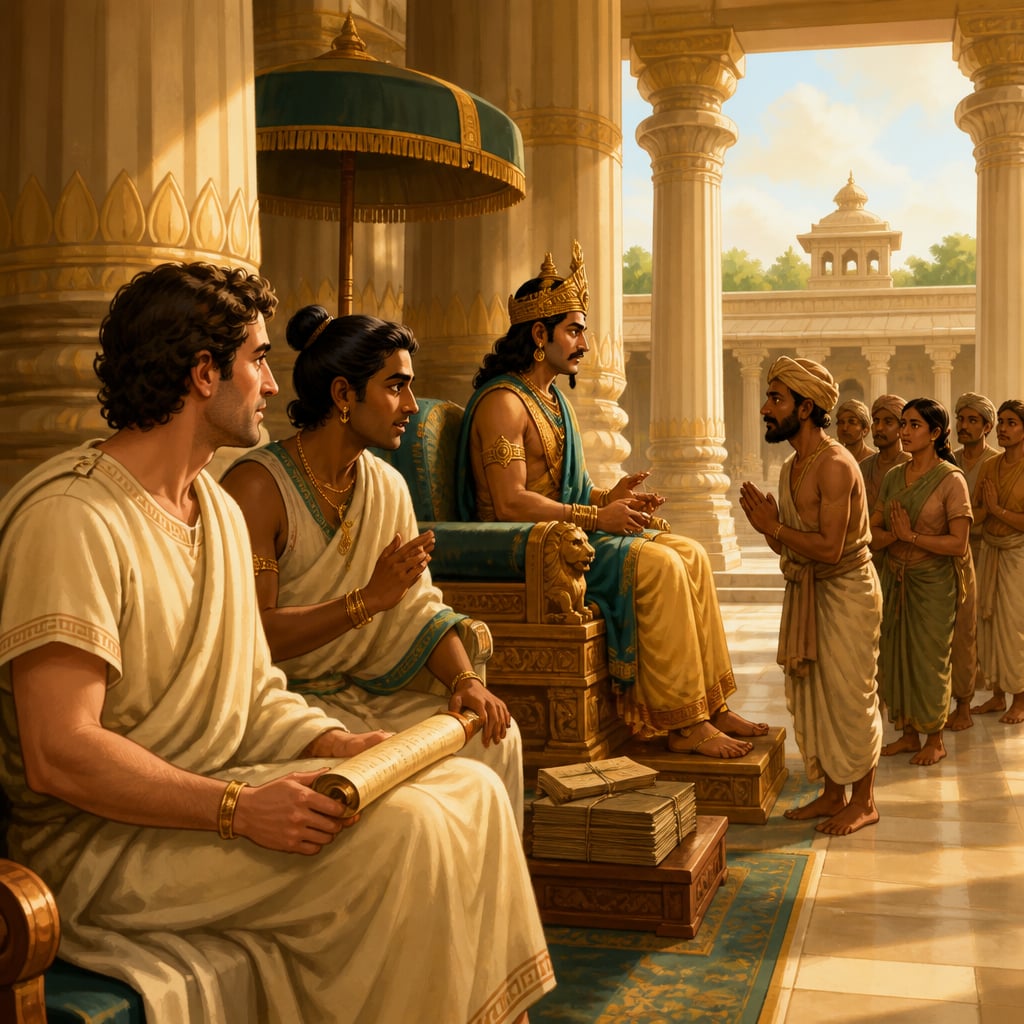
Megasthenes, the Greek ambassador to Chandragupta's court, couldn't believe what he was seeing. The emperor of India - the most powerful man on the subcontinent - lived like a monk with a stopwatch.
"He rises before the sun," Megasthenes wrote home to Seleucus. "His day is divided into periods as precise as your Greek hours. Every activity has its time. He meets spies before dawn, hears petitioners at mid-morning, reviews troops before dinner. The man who commands a million soldiers commands his own hours first."
The Greeks had never seen anything like it. Their kings held court when they felt like it, hunted when bored, feasted when hungry. Chandragupta operated like a machine - because his teacher had designed him to.
"अहोरात्रं विभजेत्काष्ठयामे" "The king should divide day and night into timed watches."
Kautilya's royal schedule wasn't suggestion. It was the operating system that made effective governance possible.
The Architecture of a Day
Kautilya divided each 24-hour period into eight yama - watches of roughly three hours each. Every yama had a purpose:
Pre-dawn (the sixth yama of night): The king rises while others sleep. He meets with intelligence agents - spies reporting what courtiers would never say publicly. This is when reality reaches the ruler unfiltered.
Early morning: Religious observance and strategic reflection. Before the court's demands begin, the king's mind is fresh. This is thinking time.
Mid-morning: Janata-darshana - public audience. Any citizen can present petitions. The king hears directly from his people, bypassing ministers who might filter inconvenient truths.
Midday: Personal maintenance. Bathing, moderate meals, brief rest. Even this is scheduled - not unlimited drift into indulgence.
Afternoon: Administrative work. Revenue review, official reports, treasury management. The unglamorous work that actually runs a kingdom.
Late afternoon: Council meetings with the mantri-parishad. Debate, deliberation, decision.
Evening: Military inspection. Every day, not just before wars. Troops who expect the king stay ready.
Night: Controlled recreation, dinner, sleep. Even pleasure has boundaries.
Why Structure Matters
"Consider the king without a schedule," Kautilya told Chandragupta. "What expands? What he enjoys. What shrinks? What the kingdom needs. Over time, hunting crowds out revenue review. Feasting crowds out petitioners. Entertainment crowds out intelligence."
The schedule made essential activities non-negotiable. Revenue review happened in its yama whether Chandragupta felt like it or not. Military inspection continued through peace and war alike. Strategic thinking had protected time.
Modern parallel: Cal Newport calls this "time blocking" - assigning specific activities to specific hours. The executives who practice it consistently outperform those who react to whatever arrives. Structure isn't constraint. It's capacity.
The Morning Intelligence Briefing

The pre-dawn meeting with spies deserves special attention. Why schedule intelligence gathering at 4 AM?
"Because," Kautilya explained, "you must know reality before ministers can shape your perception of it. Once court begins, everyone has agendas. Information gets filtered, spun, suppressed. The king who hears unfiltered truth at dawn can verify what ministers claim later."
Jeff Bezos reportedly reads customer complaint emails first thing each morning - before his leadership team can contextualize them away. The principle is identical. Access reality before others can curate it.
Public Audience: The People's Access

The janata-darshana - scheduled time for any citizen to present petitions - served multiple strategic purposes:
Information: The petitions revealed which officials were corrupt, which regions were suffering, which policies were failing. Better intelligence than any spy could provide.
Legitimacy: A king who listens maintains loyalty. One who hides behind ministers loses connection with the source of his power.
Accountability: Officials behave differently when citizens can appeal directly to the throne.
Justice: Common people can't afford long court processes. The king's direct intervention provides justice otherwise unavailable.
"उत्साहो राज्ञः अनुप्रजाः" "The subjects follow the king's energy."
The visible, accessible king sets the tone for the entire administration.
Bounded Recreation
Kautilya scheduled recreation - but bounded it. The sixth yama included music, gardens, conversation. But the list of restrictions was longer than the permissions:
- Limited wine (impairs judgment)
- No gambling (creates dependencies)
- Limited hunting (takes king away from duty)
- No association with disreputable persons (creates vulnerabilities)
"Recreation restores energy for work," Kautilya taught. "It doesn't become an end in itself. The king who cannot stop playing cannot start governing."
The Modern Application
You're not an emperor. But Kautilya's principles apply:
Time blocking: Assign specific activities to specific hours. Protect those blocks like appointments.
Morning strategic time: Do your most important thinking before the world demands reaction.
Scheduled review: Revenue review in the Mauryan court equals weekly metrics review in modern organizations.
Bounded leisure: Recreation without limits expands until it crowds out everything else.
Physical discipline: Kautilya started with wake-up time and bodily routine. Modern research confirms: people who control their morning control their day.
Your Turn
The king who cannot manage his own hours cannot manage a kingdom. The professional who cannot manage their own calendar cannot manage a career. The student who cannot manage their own schedule cannot manage their education.
Structure liberates. Chandragupta conquered India because he first conquered his own time.
What would your yama look like?
Benjamin Franklin's famous daily schedule. Modern time management (Cal Newport's time blocking, Getting Things Done methodology). Research on decision fatigue showing willpower depletes. Steve Jobs' uniform wardrobe eliminating trivial decisions.
Kautilya's schedule is more comprehensive than most modern systems - it covers the full 24 hours and integrates personal, administrative, strategic, and ceremonial functions. It's designed for maximal responsibility, not just personal productivity.
Frederick the Great of Prussia maintained a similarly rigorous schedule - rising at 4 AM, allocating specific hours for different responsibilities. He transformed a minor German state into a European power through disciplined execution.
Modern 'morning routine' culture - from Tim Ferriss to Hal Elrod's 'Miracle Morning.' Research shows willpower is highest in morning. Successful people consistently cite early hours as crucial to their effectiveness.
Kautilya specifies what to do with early hours - intelligence briefings, not just personal development. The morning isn't for self-help; it's for understanding reality before making decisions. This is more actionable than generic 'be productive' advice.
Chandragupta reportedly heard intelligence briefings before dawn. This practice allowed him to understand threats before court assembled, making him consistently better informed than those seeking to manipulate him.
Verses
अहोरात्रं विभजेत्काष्ठयामे
ahorātraṃ vibhajet kāṣṭha-yāme
The king should divide day and night into timed watches.
This simple instruction contains a profound principle: time must be actively managed, not passively experienced. The king who divides his time commands it; the king who doesn't is commanded by it.
Book 1, Chapter 19, Verse 1 (R.P. Kangle)
उत्थाय राजा प्रथमे याम प्रेक्षेत गुप्तचरान्
utthāya rājā prathame yāme prekṣeta guptacarān
Having risen, in the first watch the king should meet with his secret agents.
The day begins with intelligence - understanding reality before acting on it. The king who starts the day with briefings operates from truth.
Book 1, Chapter 19, Verse 3 (R. Shamasastry)
उत्साहो राज्ञः अनुप्रजाः उत्साहो राज्ञो हि क्षयः प्रजानां क्षयः
utsāho rājñaḥ anuprajāḥ utsāho rājño hi kṣayaḥ prajānāṃ kṣayaḥ
The subjects follow the king's energy. Indeed, the decline of the king's energy means the decline of the subjects.
The king's discipline - or lack thereof - radiates throughout the kingdom. An energetic, disciplined king creates energetic, disciplined subjects.
Book 1, Chapter 19, Verse 9 (L.N. Rangarajan)
Case studies
Jeff Bezos and the Two-Pizza Meeting
Amazon's Jeff Bezos structures his time deliberately. He schedules 'high-IQ' meetings requiring deep thinking in the morning and never schedules important decisions after 5 PM. He limits meeting size to what two pizzas can feed. He protects time for reading and thinking, famously spending mornings in unstructured exploration before his first meeting at 10 AM.
Bezos implements Kautilyan principles: time blocking (scheduling demanding cognitive work when energy is highest), protected time for strategic thinking, and systematic rather than ad hoc time allocation. Like the royal schedule, his approach ensures comprehensive coverage while respecting human energy patterns.
Amazon grew from online bookstore to one of the world's most valuable companies under Bezos's leadership. His disciplined approach to time enabled him to maintain strategic direction while managing enormous organizational complexity.
Systematic time management scales. Whether governing an empire or running a global corporation, the principle holds: protect time for what matters most, schedule demanding work for peak energy, and maintain structure that ensures nothing essential is neglected.
Cal Newport's "Deep Work" thesis and the growing corporate pushback against open-plan offices both validate this principle. Companies like Basecamp that protect employee focus time report higher output per person than firms where constant meetings and Slack interruptions fragment attention.
Amazon grew from $15.7 billion in revenue (2007) to over $574 billion (2023) under Bezos. His 'two-pizza rule' limits meeting size to roughly 6 people. He schedules all high-judgment decisions before 10 AM and makes no major decisions after 5 PM.
Historical context
c. 4th century BCE
The Mauryan Empire required unprecedented administrative sophistication. Ruling from the Hindu Kush to Bengal, from the Himalayas to Karnataka, demanded systematic governance impossible through ad hoc decisions. Kautilya's schedule was an answer to scale - how to govern millions through disciplined individual practice.
The Arthashastra's royal schedule influenced Indian governance for centuries. Later treatises, including those of the Guptas and Mughals, show similar attention to structured time. The principle - that effective leadership requires systematic time management - proved durable across dynasties and centuries.
Living traditions
- Executive Time Blocking: Modern CEO operating rhythms with protected time for strategic work directly continue Kautilya's royal schedule of dedicated yamas for different functions.
- Dinacharya (Daily Routine) Practice: Traditional Ayurvedic daily routines maintained in ashrams and households continue the structured approach to time that Kautilya adapted for governance.
- Military Operating Rhythms: Armed forces worldwide maintain structured schedules that mirror Kautilya's royal routine, with specific times for briefings, training, and administration.
- Harvard Business School Executive Education: Programs on executive effectiveness including time management and leadership rhythms
- Ashrams following traditional daily schedules: Spiritual communities maintaining structured daily routines based on ancient principles
- Vidhan Soudha (Karnataka State Legislature): This magnificent legislative building exemplifies Kautilyan governance principles with its inscription 'Government Work is God's Work.' The structured legislative sessions, committee schedules, and administrative rhythms continue the royal schedule tradition of dedicated time blocks for different governance functions.
- Takshashila Archaeological Site: The ancient university where Kautilya both studied and taught represents the institutional foundation of structured leader education. Students followed rigorous daily schedules combining physical discipline, intellectual study, and practical training - the template Kautilya later prescribed for royal education.
Reflection
- If you tracked every hour of your last week, what would it reveal about your actual priorities? How different are they from your stated priorities?
- Is extreme discipline like Kautilya prescribes necessary for effective leadership? Or can effective leaders maintain flexibility and spontaneity? What's the right balance?
- What is one activity essential to your success that you don't currently protect with scheduled time? What would happen if you blocked time for it like Kautilya blocks time for janata-darshana?