Leading by Example
The Power of Modeling
People follow what you do, not what you say. Kautilya understood that the king's behavior sets the standard for the entire kingdom. The ripple effect of leadership example is perhaps the most powerful - and most overlooked - tool of governance. What the ruler models, the kingdom becomes.
The Day Everything Changed
The administrator of Taxila's western district was corrupt. Everyone knew it. He extracted bribes from merchants, skimmed from taxes, and lived far beyond his official salary. But nothing happened because corrupt administrators were normal. The previous kings had been corrupt themselves.
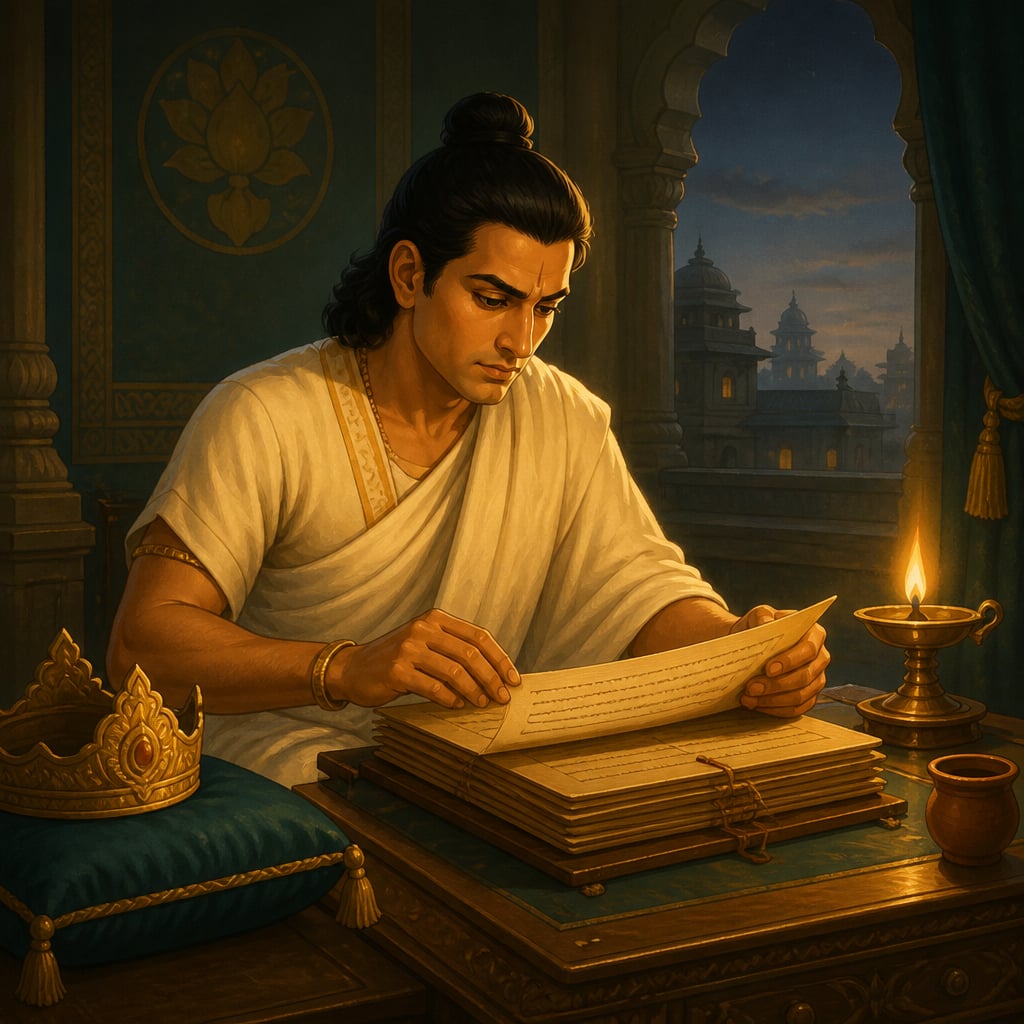
Then Chandragupta took power.
The emperor didn't issue proclamations about integrity. He didn't give speeches about ethics. He simply followed his schedule - rising before dawn, hearing petitions personally, demanding documentation for every expenditure. When complaints about the Taxila administrator reached his public audience, Chandragupta investigated. When the investigation proved the corruption, he removed the administrator publicly.
The message cascaded through the empire. Not "the emperor says corruption is wrong" - that was cheap talk. "The emperor removes corrupt administrators" - that was consequential information.
Within a year, the character of Mauryan administration had transformed. Not because of new rules, but because the ruler demonstrated what he expected.
"यथा राजा तथा प्रजा" "As the king, so the people."
Why Example Beats Proclamation
Kautilya understood something about human nature: we watch, more than we listen.
People are uncertain what's actually valued. Official policies say one thing; actual rewards may indicate another. The leader's own behavior resolves this uncertainty. When the king skips revenue review to go hunting, everyone knows what the king actually prioritizes - regardless of what he says.
Permission: The leader's behavior implicitly permits similar behavior in others. If the king arrives late to meetings, ministers feel permitted to arrive late.
Information: The leader's actions reveal what's truly rewarded and tolerated. Actions don't lie.
Respect: People commit to leaders they respect. Respect emerges from demonstrated virtue, not claimed virtue.
Imitation: Humans are wired to copy those in authority. This happens without deliberate choice.
The Cascade Effect
Leadership example doesn't just affect direct reports. It cascades:
King → Ministers → Officials → Local administrators → Citizens
At each level, the example compounds. What the king does, the kingdom eventually becomes.

Positive cascade: A disciplined king creates disciplined ministers who create disciplined officials who create an orderly kingdom.
Negative cascade: A corrupt king creates corrupt ministers who create corrupt officials who create a corrupted kingdom.
The asymmetry: negative examples cascade faster. One corrupt leader at any level permits corruption below. Positive examples cascade slower - they require consistent demonstration over time.
Modern Parallels
Ray Dalio at Bridgewater Associates created a culture of "radical transparency" - but not by proclaiming it. He recorded his own mistakes and shared them. He invited junior employees to critique his reasoning publicly. He modeled the vulnerability he asked of others.
Contrast with Wells Fargo under John Stumpf. The CEO spoke about ethics while the company's incentive structure rewarded fraud. Employees opened millions of fake accounts to hit sales targets. Stumpf's words said one thing; the organization's structure - which he controlled - said another. The example won.
In families: Children learn from watching, not listening. The parent who preaches honesty but lies on the phone teaches that honesty is negotiable. The parent who demonstrates calm under stress teaches emotional regulation better than any lecture.
In teams: The manager who answers emails at midnight signals that boundaries don't exist. The manager who protects their own time models that others can protect theirs.
The Hypocrisy Trap
Nothing destroys leadership faster than asking of others what you don't demand of yourself.
Kautilya warned against:
- Preaching frugality while living lavishly
- Demanding punctuality while arriving late
- Speaking of justice while protecting favorites
- Calling for sacrifice while exempting yourself
Hypocrisy destroys authority because it reveals priorities. What you do when you could do otherwise shows what you truly value. The hypocritical leader reveals that stated values are mere rhetoric.
Kautilya's prescription: the king must hold himself to a higher standard than he holds others. Not morality - strategy. The king who asks more of himself maintains authority. The king who asks less loses it.
The Weight and the Opportunity
"Leadership is always on," Kautilya taught. There is no off-duty. Every action communicates, models, permits, shapes.
This is the weight. But it's also the opportunity.

If example is so powerful, then a single leader can transform a culture. Chandragupta proved it. By embodying Kautilya's teachings - discipline, justice, self-mastery - he created an empire known for effective governance. His example cascaded through the administration, creating standards that persisted for generations.
Your Turn
You may not rule a kingdom. But you model behavior constantly - for children, colleagues, friends, subordinates.
Ask yourself:
- What does my behavior permit others to do?
- What do my actions reveal about what I actually value?
- Am I demonstrating what I'm asking of others?
- What would my organization/family/team become if everyone behaved as I do?
Kautilya's final teaching: you can change the world by changing yourself. Not by lecturing others, not by imposing rules - but by becoming the example of what you wish others to be.
As the king, so the people. As you, so those who watch you.
Verses
यथा राजा तथा प्रजा
yathā rājā tathā prajā
As the king, so the people.
This may be the most concise statement of leadership by example ever written. The people will become what the king demonstrates.
Book 1, Chapter 19, Verse 34 (R.P. Kangle)
उद्योगे राज्ञः प्रजोद्यमः तदलस्ये प्रजापि च
udyoge rājñaḥ prajodyamaḥ tad-alasye prajā api ca
When the king is energetic, the subjects are also energetic. When he is lazy, they too become lazy.
Energy cascades. The leader's vigor creates organizational vigor; the leader's slack creates organizational slack.
Book 1, Chapter 19, Verse 9 (R. Shamasastry)
राजा प्रकृतिरञ्जनात् राज्यं रञ्जयेत्
rājā prakṛti-rañjanāt rājyaṃ rañjayet
The king should make the kingdom flourish by keeping its constituents happy.
The king's purpose is the people's welfare. This isn't selfless sacrifice - it's strategic alignment.
Book 1, Chapter 7, Verse 5 (L.N. Rangarajan)
Case studies
Satya Nadella's Cultural Transformation at Microsoft
When Satya Nadella became Microsoft CEO in 2014, the company was known for internal competition, defensiveness, and resistance to change. Nadella sought to create a 'growth mindset' culture of learning and collaboration. Rather than just announce the change, he modeled it - publicly acknowledging his own learning journey, admitting mistakes, praising competitors' products, and visibly collaborating across divisions.
Nadella applied 'yathā rājā tathā prajā' directly. He didn't just proclaim growth mindset - he demonstrated it. When the CEO publicly admits mistakes and celebrates learning from failure, executives feel permitted to do the same. When executives model it, managers follow. The culture shifted not because of mandate but because of visible, consistent example from the top.
Microsoft transformed from a declining tech giant to one of the world's most valuable companies. The culture shift from 'know-it-all' to 'learn-it-all' enabled innovation in cloud services, collaboration tools, and AI. Nadella's leadership by example proved that even giant, established cultures can change - if the leader models the change.
Cultural transformation requires visible leadership example. Nadella couldn't transform Microsoft's culture through memo or mandate - he had to embody the change himself, publicly and consistently. His willingness to model vulnerability, learning, and collaboration made it safe for others to do the same.
Remote work culture amplified this principle. Companies where executives visibly model trust, flexibility, and asynchronous communication see it adopted organization-wide. Where leaders demand camera-on surveillance while enjoying their own flexibility, resentment and attrition spike.
Microsoft's market capitalization rose from approximately $300 billion when Nadella became CEO in February 2014 to over $3 trillion by early 2024, a tenfold increase. Azure cloud revenue grew from under $1 billion to over $50 billion annually during his tenure.
The Fall of Enron: Leadership Example in Reverse
Enron's leadership modeled aggressive deal-making, creative accounting, and contempt for rules. CEO Jeffrey Skilling famously said 'I've never not been competitive in anything.' Leaders competed ruthlessly, manipulated numbers, and lived lavishly. This example cascaded through the organization.
Enron demonstrates 'yathā rājā tathā prajā' in negative form. When leaders modeled aggressive corner-cutting, employees followed. When leaders showed that results mattered more than ethics, employees optimized for results regardless of ethics. The leadership example didn't just permit malfeasance - it created competitive pressure toward it.
Enron collapsed in one of history's largest corporate frauds. Billions in value destroyed, thousands of employees lost retirement savings, executives went to prison. The company that celebrated aggressive leadership example became a case study in how example creates culture - including destructive culture.
Example works both ways. The leader who models integrity creates culture of integrity; the leader who models cutting corners creates culture of cutting corners. Enron's leaders got exactly the organizational behavior they modeled - and it destroyed them.
The Boeing 737 MAX crisis followed this pattern. When leadership shifted Boeing's culture from engineering excellence to stock-price optimization, engineers stopped flagging safety concerns. Two fatal crashes and billions in losses traced directly to a leadership example that valued cost-cutting over craft.
Enron's stock price fell from $90.75 per share in August 2000 to $0.26 by November 2001. CEO Jeffrey Skilling was sentenced to 24 years in prison (later reduced to 14). CFO Andrew Fastow served 6 years for his role in the fraud.
Historical context
c. 4th century BCE
Leadership by example has deep roots in Indian tradition. The concept of dharma includes not just right action but right example - the leader as embodiment of values. The epics repeatedly show that a king's character shapes the kingdom - Rama's dharmic rule creates Ram Rajya; Duryodhana's vices create catastrophe.
Kautilya wrote for a new empire that needed to establish standards quickly. Example was the fastest way to cascade values through the organization. A single disciplined ruler could, through the mechanism of example, shape the behavior of millions.
Living traditions
- Management by Walking Around (MBWA): Leaders being visibly present and engaged continues Kautilya's emphasis on the king's visible example cascading through the organization.
- Servant Leadership Practice: Leaders demonstrating service to those they lead continues the Kautilyan principle that the king exists for the people's welfare, not the reverse.
- Tone at the Top Governance: Corporate governance emphasis on leadership example setting organizational ethics directly applies Kautilya's cascade principle.
- Sabarmati Ashram: Gandhi's ashram where he demonstrated the simple living he preached
- West Point Military Academy: Premier military leadership institution emphasizing 'Lead by Example'
- Sabarmati Ashram: Gandhi's ashram is a living testament to leadership by example. Here, Gandhi didn't merely preach simplicity - he spun his own cloth, cleaned toilets, and lived the values he advocated. The ashram demonstrates that the most powerful leadership comes from embodying what you ask of others, the core of Kautilya's 'yatha raja tatha praja.'
- Raj Ghat and Associated Gandhi Memorials: The memorial at Gandhi's cremation site represents the ultimate testament to leadership by example. The inscription 'Hey Ram' and the eternal flame remind visitors that Gandhi's influence came not from power or charisma but from consistent embodiment of his principles until death.
Reflection
- If everyone you lead adopted exactly your behavior - your work ethic, your treatment of others, your honesty, your discipline - would the result be better or worse than the current reality?
- Is it possible to lead people to standards you don't personally meet? Can you effectively demand excellence while demonstrating adequacy? What are the limits of 'do as I say, not as I do'?
- What is one behavior you want to see more of in your team, family, or community? What would it look like for you to model that behavior more visibly and consistently?