Rajarshi

The Philosopher King

What makes a leader truly great? Kautilya's answer is the rajarshi - the sage-king who combines the wisdom of a philosopher with the power of a ruler. Before leading others, one must first master oneself. This ancient ideal remains the gold standard for leadership.

The Moment That Made an Empire
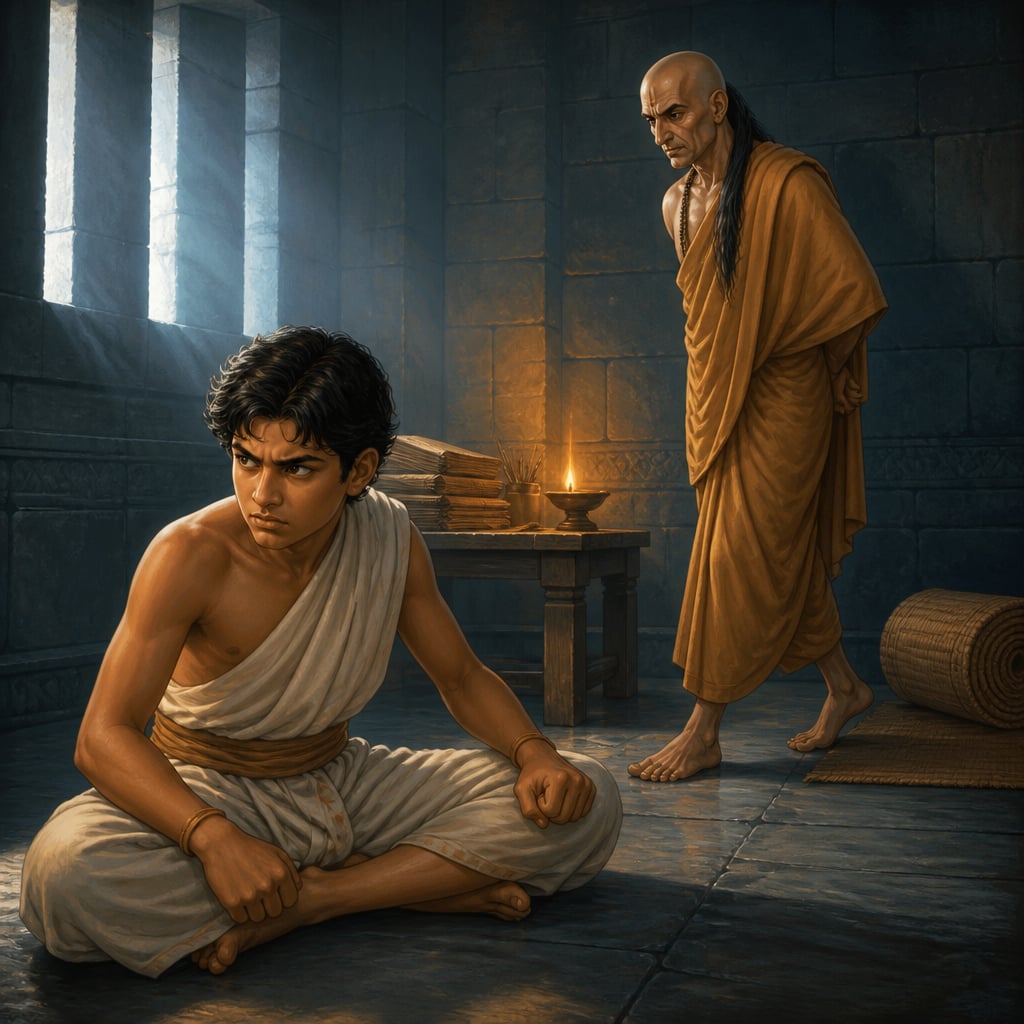
Young Chandragupta in Kautilya's Taxila chamber

The young prince knelt on the cold stone floor of Kautilya's chamber in Taxila. Outside, the Nanda army controlled most of northern India. Inside, a sixteen-year-old named Chandragupta was learning what kind of king he needed to become.

"You have rage," Kautilya observed, circling his student. "Rage at the Nandas who killed your family. Rage that fuels your ambition. But rage alone will destroy you before you destroy them."

Chandragupta clenched his fists. "Then what should I feel?"

"Everything - but controlled. You must become a rajarshi - a sage-king who rules first over himself."

This conversation launched one of history's most remarkable transformations. Within a decade, Chandragupta would overthrow the Nandas, defeat Alexander's successors, and unite most of India. But none of that could happen until he conquered a different enemy first: himself.

The Philosophy Behind the Word

Kautilya's term rajarshi combines two words most people think can't coexist. Raja means king - power, action, worldly success. Rishi means sage - wisdom, self-control, philosophical depth. Put them together and you get Kautilya's revolutionary ideal: the leader who is both supremely effective AND morally grounded.

This wasn't poetic fancy. Kautilya had watched the Nanda kings up close. They had the largest army India had ever seen. Treasury vaults overflowing with gold. But their greed and arrogance were eating their empire from within.

"प्रजासुखे सुखं राज्ञः प्रजानां च हिते हितम्" "In the happiness of the subjects lies the king's happiness; in their welfare, his welfare."

This sutra captures the rajarshi philosophy in seventeen syllables. The king who oppresses his people destroys his own foundation. The king who serves them builds something that lasts.

What Makes a Rajarshi Different

Kautilya identified specific qualities that separate the rajarshi from ordinary rulers:

The rishi dimension: Self-mastery over the six internal enemies - lust, anger, greed, pride, delusion, and envy. Without this, every decision is distorted by impulse. The angry king makes enemies needlessly. The greedy king taxes his realm into poverty. The proud king surrounds himself with flatterers.

The raja dimension: Practical competence in governance. Understanding economics, security, diplomacy, and law. The king who can't administer justice, manage revenue, or lead armies won't survive long enough for his wisdom to matter.

The integration: These aren't separate competencies but mutually reinforcing. Self-control enables clear thinking. Clear thinking enables better decisions. Better decisions build trust. Kautilya trained Chandragupta in both dimensions simultaneously.

Modern Parallels

Warren Buffett has run Berkshire Hathaway for over five decades with legendary returns. But what distinguishes him isn't just financial acumen - it's character. He lives in the same modest house he bought in 1958. He admits mistakes publicly in annual letters. The rishi dimension (integrity, self-knowledge, long-term thinking) enables the raja dimension (exceptional business results).

Contrast this with executives who generated short-term returns through fraud - Enron's Jeffrey Skilling, WeWork's Adam Neumann. Raja without rishi. Temporary success followed by spectacular collapse.

The pattern holds in families too. The parent who provides materially but never develops self-control models chaos for their children. The parent who has values but can't function practically leaves their family insecure. The rajarshi parent does both.

The Training Program

Kautilya didn't just describe the ideal - he created a systematic training program. Future kings studied four disciplines:

Notice the balance. Two disciplines develop the rishi side; two develop the raja side. You can't lecture someone into wisdom - you build it through systematic practice across years.

Why This Still Matters

Ashoka on the Kalinga battlefield at dusk

The rajarshi ideal answers a question every society struggles with: who deserves power?

Some say: whoever can take it. But pure power-seekers destroy what they rule.

Others say: whoever is born to it. But birth guarantees nothing about competence.

Kautilya's answer: whoever has developed both wisdom AND effectiveness. Power should flow toward the prepared, the disciplined, the self-mastered - regardless of birth.

This is why Kautilya, a Brahmin, could mentor Chandragupta, whose exact origins remain disputed. What mattered wasn't lineage but capacity. Could this young man become a rajarshi? If yes, he could become king.

Your Turn

You may never rule a kingdom. But you will face situations requiring leadership - in your family, workplace, community. The rajarshi ideal applies at every scale.

Ask yourself Kautilya's questions: Which internal enemy has the most power over me? What skills do I lack for the responsibilities I've taken on? Am I developing both dimensions - or letting one atrophy?

Chandragupta spent years under Kautilya's guidance before challenging the Nandas. The rajarshi path isn't quick. But as the Maurya Empire proved, it's the only path to lasting success.

Character-based leadership and emotional intelligence as strategic assets

Plato teaching at the Academy in Athens

Machiavelli focused on appearing virtuous while being pragmatic; Plato's philosopher-king required years of philosophical training. Modern leadership theory emphasizes 'Level 5 Leadership' (Jim Collins) - combining personal humility with fierce resolve.

Kautilya's framework is more systematic than Machiavelli's opportunism and more practical than Plato's idealism. He provides specific enemies to conquer (shadripu) and measurable disciplines rather than abstract virtues.

The Nanda dynasty had vast armies and treasury but fell because its rulers were intemperate and arrogant. Chandragupta, with fewer resources but superior self-discipline under Kautilya's guidance, toppled them in months.

Stakeholder alignment and servant leadership as competitive advantage

Adam Smith's invisible hand aligns self-interest with public good through markets. Modern stakeholder theory (Freeman) argues companies must serve all stakeholders. Servant leadership (Greenleaf) inverts traditional hierarchy.

Verses

इन्द्रियजयं कुर्वीत कार्यज्ञानविनिश्चयात्

indriya-jayaṃ kurvīta kārya-jñāna-viniścayāt

One should achieve conquest over the senses through determination in knowing one's duty.

Self-mastery isn't achieved through willpower alone but through clarity of purpose. When you know your duty clearly, resisting distractions becomes natural.

Book 1, Chapter 6, Verse 1 (R.P. Kangle)

प्रजासुखे सुखं राज्ञः प्रजानां च हिते हितम्

prajā-sukhe sukhaṃ rājñaḥ prajānāṃ ca hite hitam

In the happiness of his subjects lies the king's happiness; in their welfare, his welfare.

This is perhaps the most important statement in the Arthashastra. True leadership means your success is defined by others' success.

Book 1, Chapter 7, Verse 1 (R. Shamasastry)

षड्रिपवर्गं जयेद्राजा विजित्येन्द्रियसंयमात्

ṣaḍ-ripu-vargaṃ jayed rājā vijitya indriya-saṃyamāt

The king should conquer the group of six enemies through restraining the senses.

The six internal enemies - lust, anger, greed, pride, delusion, and over-excitement - are conquered not by fighting them directly but by mastering the senses that feed them. Cut off the supply, and the enemies weaken.

Book 1, Chapter 6, Verse 3 (L.N. Rangarajan)

Case studies

Ashoka's Transformation: From Chandashoka to Dharmashoka

Ashoka, grandson of Chandragupta, initially ruled as a brutal conqueror. After the devastating Kalinga War, witnessing the carnage he had caused, he transformed completely - becoming a ruler focused on dharma, non-violence, and his subjects' welfare.

Ashoka's story demonstrates both the danger of ignoring the rajarshi ideal and the possibility of transformation. His early reign showed the six enemies unchecked - ambition, violence, pride. His later reign exemplified praja-sukhe sukham rajnah - finding happiness in his people's welfare.

Ashoka's later reign is remembered as one of history's most enlightened periods of governance. His edicts promoting welfare, religious tolerance, and non-violence remain carved in stone across the subcontinent. His transformation shows that the rajarshi ideal can be achieved even after serious moral failures.

It's never too late to become a rajarshi. The path requires honest self-assessment, genuine transformation, and reorienting one's purpose toward others' welfare. The most powerful testimony to the ideal may be those who struggled to achieve it.

Corporate turnaround stories follow this pattern repeatedly. Howard Schultz returned to Starbucks, Satya Nadella transformed Microsoft's toxic culture. Leaders who undergo genuine self-reckoning and reorient toward stakeholder welfare consistently outperform those who double down on what made them successful initially.

The Kalinga War (c. 261 BCE) caused an estimated 100,000 deaths and 150,000 deportations, making it one of the deadliest battles in ancient Indian history. Ashoka's 33 rock and pillar edicts, inscribed across the subcontinent, survive as the oldest deciphered Indian inscriptions.

Historical context

c. 4th century BCE

The era before Chandragupta saw numerous small kingdoms with rulers of varying quality. The Nanda dynasty, though powerful, was known for oppressive taxation and the low character of its kings. Kautilya witnessed firsthand how poor leadership destroyed kingdoms and harmed people.

Kautilya wrote during a time when he could shape a ruler from youth. His teachings to Chandragupta weren't theoretical - they were tested in the creation of India's greatest empire. The rajarshi ideal proved its worth in practice.

Living traditions

Reflection

More in The Ideal Leader

All lessons in The Ideal Leader · Arthashastra: Science of Governance course