Character vs Charisma

Substance Over Style

Some leaders dazzle but disappoint. Others seem unremarkable until you see what they build. Kautilya firmly preferred substance over style - the steady strength of character over the flashy appeal of charisma. True leadership emerges from who you are, not from how you present yourself.

The Speech That Changed Nothing
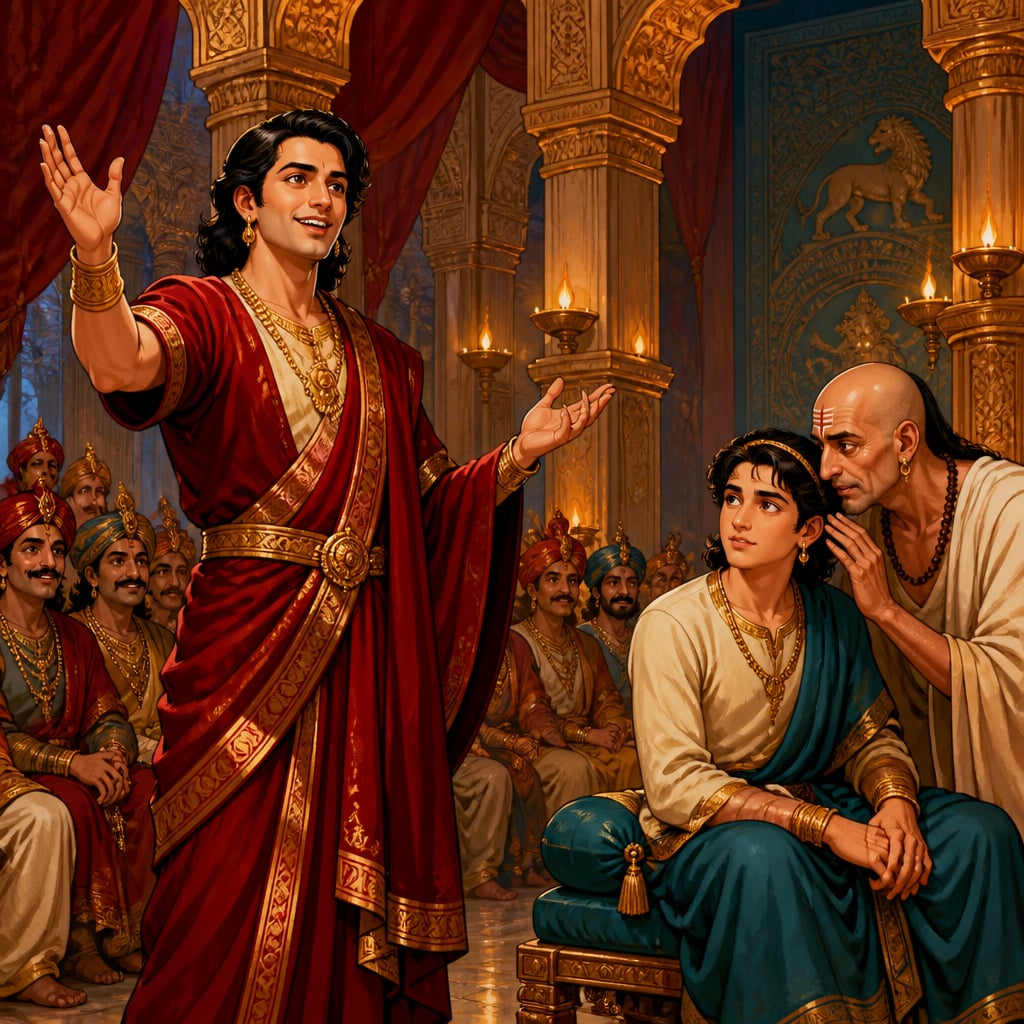
Charismatic minister mid-speech as Chandragupta watches

The minister spoke brilliantly. His voice rose and fell with perfect rhythm. His arguments built to stirring conclusions. When he finished, the court erupted in applause. Kautilya, sitting in the shadows, remained still.

"Master," young Chandragupta whispered, "was that not magnificent?"

"It was beautiful," Kautilya acknowledged. "Now tell me: what did he actually say?"

Chandragupta paused. He could remember the feeling of the speech - the inspiration, the excitement. But the content? The specific proposals? The logic of the arguments?

"I... I'm not certain."

"Exactly," Kautilya said. "That is charisma. It moves the heart but leaves the mind empty. Never confuse it with character."

"शीलं प्रमाणं सर्वेषां प्रमाणानां परीक्षायाम्" "Character is the measure of all measures in examination."

The Distinction That Matters

Kautilya watched ministers come and go. The pattern was always the same. The brilliant ones dazzled everyone - until their first real crisis. The steady ones seemed unremarkable - until you looked at what they actually built.

Charisma is immediate impact. The magnetism that draws people in. The confidence that commands a room. It operates on emotion.

Character is demonstrated consistency. The same person under pressure as at ease. The same person in private as in public. It operates on evidence.

Charisma asks: "Do you feel inspired?"

Character asks: "Can you trust me?"

These are very different questions.

Why Charisma Fails

Kautilya's skepticism wasn't prejudice - it was pattern recognition. He'd watched the charismatic failure cycle too many times:

Stage 1: The charismatic leader enters. Everyone is impressed. They speak beautifully about what they'll accomplish.

Stage 2: Initial success. The leader takes credit (whether deserved or not). Doubters are dismissed.

Stage 3: Cracks appear. Difficult situations require more than performance. Substance - or its absence - becomes visible.

Stage 4: Cover-up. The charismatic leader uses their skills to manage perception rather than solve problems.

Stage 5: Collapse. Reality eventually wins.

Modern parallel: Elizabeth Holmes at Theranos had charisma that captivated investors, journalists, and board members. She spoke compellingly about revolutionizing healthcare. The substance behind the performance? Fraudulent technology that didn't work. Charisma without character ended in federal prosecution.

Contrast with Satya Nadella at Microsoft. No one would call him the most charismatic CEO in tech. But his consistent judgment, emotional intelligence, and strategic clarity transformed a declining company into one of the world's most valuable. Character compounds.

The Tests That Reveal

Kautilya planting an arthopadha test of greed at dusk

Kautilya didn't rely on interviews. Words are cheap. He designed tests - upadhā - that revealed character through action:

Dharmopadha (Test of Integrity): Create situations where doing right costs something. Will they sacrifice personal interest for principle?

Bhayopadha (Test of Fear): Place them in danger or uncertainty. Do they remain steady, or does the performance collapse?

Arthopadha (Test of Greed): Offer bribes, luxury, easy wealth. Can they resist, or does acquisition control them?

Kamopadha (Test of Desire): Create temptations. Do they maintain boundaries, or does wanting override judgment?

These tests work because character reveals itself through pressure. Charisma is a performance that breaks when stakes become real.

What Kautilya Actually Valued

When selecting ministers, Kautilya prioritized specific qualities:

Notice what's absent: eloquence, charm, impressive appearance. Useful, perhaps. Essential, never.

The Character Leader's Trajectory

George Marshall reading reports at his Pentagon desk

The character-based leader follows a different path:

Stage 1: Quiet beginning. Competent, reliable, unremarkable. Some overlook them entirely.

Stage 2: Steady results. Not dramatic announcements - consistent delivery. Track record accumulates.

Stage 3: Earned trust. Others learn they can be relied upon. Commitments are kept.

Stage 4: Expanded responsibility. Trust creates opportunity.

Stage 5: Lasting impact. Systems that work. Successors who are trained. Institutions that outlive the founder.

Less dramatic. Far more valuable.

The Hiring Mistake Everyone Makes

"Never judge a minister by how well they speak," Kautilya warned. "Judge them by what they've done."

Modern research confirms his instinct. The correlation between interview performance and job performance is remarkably weak. Great interviewers aren't necessarily great employees. The skills are different.

Google discovered this the hard way. Their hiring process once emphasized brain teasers and interview performance. They eventually analyzed what actually predicted success. Answer: demonstrated past performance, not interview dazzle.

Character cannot be assessed in a conversation. It reveals itself through time, through pressure, through consistent action.

Your Turn

Ask yourself:

When choosing people to trust: Am I responding to how they make me feel, or to what they've demonstrated?

When developing yourself: Am I investing in genuine capability, or in impression management?

When evaluating leaders: Am I looking at their words, or their track record?

Kautilya's test for any leader: What remains when they leave?

The charismatic leader often leaves little - organizations dependent on their presence collapse.

The character-based leader leaves much - systems that work, successors who are trained, values embedded in culture.

Character is the only thing that lasts.

Verses

शीलं प्रमाणं सर्वेषां प्रमाणानां परीक्षायाम्

śīlaṃ pramāṇaṃ sarveṣāṃ pramāṇānāṃ parīkṣāyām

Character is the measure of all measures in examination.

When evaluating anyone - for employment, partnership, or trust - character is the ultimate criterion. All other qualities matter less if character is lacking.

Book 1, Chapter 9, Verse 2 (R.P. Kangle)

गुणसंपन्नो हि अल्पशक्तिरपि महापराक्रमं जयति

guṇa-sampanno hi alpa-śaktir api mahā-parākramaṃ jayati

One endowed with good qualities, even with little power, conquers great might.

Character multiplies power. A person of strong character with modest resources will outperform a person of weak character with vast resources.

Book 1, Chapter 10, Verse 8 (R. Shamasastry)

वाक्पटुता न प्रमाणं कर्म प्रमाणम्

vāk-paṭutā na pramāṇaṃ karma pramāṇam

Eloquence is not the measure; action is the measure.

Judge people by what they do, not by what they say. The ability to speak well proves only the ability to speak well.

Book 1, Chapter 9, Verse 12 (L.N. Rangarajan)

Case studies

Elizabeth Holmes and the Charisma Trap

Elizabeth Holmes, founder of Theranos, was extraordinarily charismatic. She wore Steve Jobs-style black turtlenecks, spoke with compelling vision, and convinced powerful investors and partners to back her blood-testing technology. Her charisma attracted over $700 million in investment and partnerships with major pharmacy chains - despite the technology not working as promised.

Kautilya would see Holmes as a textbook case of charisma without character. Investors evaluated presentation over performance. No one applied the 'karma pramāṇam' test - actually checking whether the technology worked. The impressive fundraising and partnerships were based on eloquence (vāk-paṭutā), not demonstrated results.

Theranos collapsed when journalists and regulators finally examined actual results. Holmes was convicted of fraud. Investors lost hundreds of millions. Patients received unreliable test results. The charisma-based house of cards fell completely.

No amount of charisma compensates for absence of substance. Those who invested in Holmes did so based on impression rather than verification. Kautilya's principle - judge by actions, not words - would have saved them. When evaluating anyone for significant commitment, verify claims, check track records, ignore the charm.

The pattern persists in tech fundraising. Investors in FTX, WeWork, and Nikola all prioritized charismatic founders over verified fundamentals. Due diligence teams that insist on audited financials and working prototypes before committing capital consistently avoid these blowups.

Theranos raised over $700 million from investors at a peak valuation of $9 billion. Holmes was convicted on 4 counts of investor fraud in January 2022. The company's blood-testing device could reliably perform only 12 of the 200+ tests it claimed.

George Marshall: The Anti-Charismatic Leader

George Marshall, U.S. Army Chief of Staff during World War II and architect of European reconstruction, was notably uncharismatic. He refused to ingratiate himself, rarely smiled, and was known for absolute honesty even when it was uncomfortable. He never sought publicity and often deflected credit to others.

Marshall exemplified Kautilya's character-based ideal. His qualities - integrity, judgment, selflessness, competence - were demonstrated through decades of steady service. He passed every test of character: refusing opportunities for personal gain, speaking truth to powerful people, taking responsibility for failures while deflecting credit for successes.

Marshall became the only general to win the Nobel Peace Prize. He built the modern American military, managed the largest mobilization in U.S. history, and created the Marshall Plan that rebuilt Europe. Winston Churchill called him 'the organizer of victory.' His influence persists decades after his death.

Character enables lasting impact. Marshall had none of the traits that make someone 'impressive' in conventional terms. But his character made him perhaps the most trusted American of his era. Presidents from both parties relied on him. His reputation for integrity gave his word tremendous power. Substance created influence that style could never achieve.

Tim Cook at Apple exemplifies this pattern today. He lacks Steve Jobs's showmanship but has quietly grown Apple's revenue from $170 billion to over $380 billion through operational excellence and steady judgment. Markets increasingly reward boring, competent leadership over charismatic risk-takers.

George Marshall managed the expansion of the U.S. Army from 190,000 soldiers in 1939 to over 8.2 million by 1945. The Marshall Plan (1948-1952) invested $13.3 billion (roughly $170 billion in 2024 dollars) to rebuild 16 European nations.

Historical context

c. 4th century BCE

Ancient India had extensive traditions analyzing character. The Dharmasutras classified people by qualities (guṇas). The epics provided endless examples of character - Yudhishthira's truthfulness, Rama's duty, Karna's tragic loyalty. Kautilya adapted this rich tradition into practical selection criteria.

Kautilya wrote during political chaos when the wrong leader could destroy everything. His emphasis on character over charisma wasn't idealistic moralizing - it was survival strategy. Choosing the wrong minister based on impressive presentation could cost the kingdom.

Living traditions

Reflection

More in The Ideal Leader

All lessons in The Ideal Leader · Arthashastra: Science of Governance course