Recovering Maritime Memory: India's Trade Renaissance
From Ancient Stitched Ships to Modern Trade Corridors
In December 2025, INSV Kaundinya, a ship built using 2,000-year-old stitched construction techniques, sailed from Porbandar to Muscat, retracing ancient trade routes. This voyage symbolizes India's broader trade renaissance: recovering maritime memory to shape economic future.
The Ship That Sailed Through Time
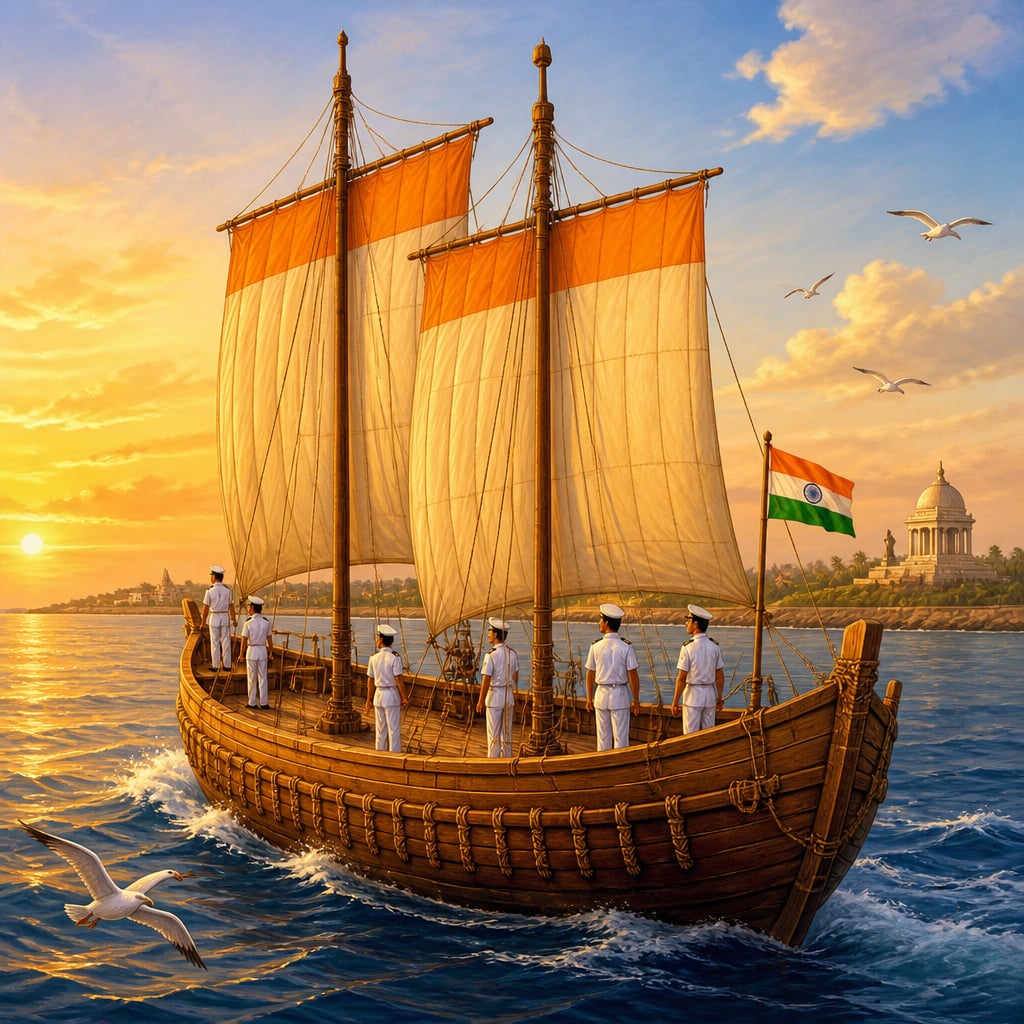
On December 29, 2025, a remarkable vessel departed from Porbandar, Gujarat, Mahatma Gandhi's birthplace, bound for Muscat, Oman. INSV Kaundinya wasn't just any sailing ship. It was built using the ancient stitched ship technique: wooden planks tied together with coir rope and coconut fiber, sealed with natural resin. No nails. No modern materials.

The design came from Cave 17 of Ajanta, a 5th-century mural depicting a merchant vessel. Master shipwright Babu Sankaran and Prathamesh Dandekar, working with the Indian Navy, recreated a ship that hadn't sailed for 1,500 years.
The vessel's name honors Kaundinya, a legendary first-century Indian mariner who sailed to Southeast Asia, married Queen Soma of Funan (modern Cambodia), and founded a kingdom. Indians weren't just traders, they were civilization-builders across the seas.
As Prime Minister Modi noted, INSV Kaundinya's maiden voyage "reaffirms India's deep-rooted maritime legacy." But the voyage represents something larger: the recovery of maritime memory as national strategy.
"Beyond the technical experiment, the project carries a broader historical objective. Indian history has often been portrayed as passive, overlooking centuries of maritime activity, trade, and exploration. Long before the Phoenicians, Indians were sailing across the Indian Ocean." , Sanjeev Sanyal, Member, Economic Advisory Council to the Prime Minister
Why Maritime Memory Matters
India's relationship with the sea was severed twice: first by colonial powers who controlled oceanic trade, then by post-independence policies that turned inward. The result was collective amnesia about India's maritime heritage.
But India was never a land-locked civilization. For two millennia:
- Indian merchants dominated Indian Ocean trade from East Africa to Indonesia
- Tamil guilds established trading posts across Southeast Asia
- Indian ships pioneered the monsoon sailing routes
- Indian textiles, spices, and steel commanded premium prices in Rome and China
The Arthashastra itself reflects this: Kautilya's preference for water routes over land routes, his detailed treatment of port management, and his emphasis on foreign trade all assume a maritime civilization.
INSV Kaundinya's voyage is a declaration: India remembers. And remembering, it can rebuild.
The Intellectual Foundation: Sanjeev Sanyal's Historical Economics

Sanjeev Sanyal, economist and historian, has spent decades building the intellectual case for India's maritime revival. His books, The Ocean of Churn, The Land of Seven Rivers, document what most economics textbooks ignore: India's historical prosperity through trade.
As Principal Economic Advisor to the Government of India (2022-present), Sanyal has shaped policy with a distinctive insight:
"India was not historically a poor country that became rich through modern development. It was a wealthy trading civilization that became poor through colonial extraction and post-colonial isolation."
This reframing matters. If India was historically poor, economic policy is about modernizing a backward society. If India was historically prosperous, policy is about removing obstacles to natural strength.
The Economic Surveys under Sanyal's influence reflect this historical consciousness:
- Trade as growth engine (not threat to be managed)
- Infrastructure as strategic investment (not expenditure)
- Integration over isolation (not protectionism)
- Civilizational confidence (not catching up to Western models)
From IMEC to INSV: Recovery in Action
The recovery of maritime memory operates at multiple levels:
Symbolic: INSV Kaundinya The stitched ship itself, a 5th-century vessel sailing 21st-century seas, demonstrates that India's maritime knowledge can be recovered. The ship features Gandabherunda motifs, Simha Yali on the bow, and a Harappan-style stone anchor. It's not replica but resurrection.
Strategic: IMEC Corridor The India-Middle East-Europe Economic Corridor, announced at the 2023 G20 Summit, creates modern trade infrastructure following ancient patterns. Rail and sea routes connecting India to Europe via UAE, Saudi Arabia, and Israel, exactly the paths Kaundinya's successors sailed.
Policy: Economic Survey Official economic doctrine now incorporates historical perspective. Trade policy references civilizational precedent. The shift from defensive protectionism to confident engagement reflects recovered maritime consciousness.
Cultural: Public Awareness India's maritime history is entering public consciousness. Books, exhibitions, and naval projects like INSV Kaundinya remind Indians that they were seafarers, traders, and explorers, not just passive recipients of foreign influence.
The R.C. Dutt Legacy: Completing the Story
Romesh Chunder Dutt (1848-1909) was the first to document colonial economic extraction. His Economic History of India showed how British policies deindustrialized India and created the poverty colonizers claimed to be alleviating.
Dutt's work was foundational. But it focused on destruction, what colonialism stole. Sanyal's work asks the necessary next question: what existed before that was worth stealing?
| Perspective | R.C. Dutt | Sanjeev Sanyal |
|---|---|---|
| Focus | Colonial extraction | Pre-colonial prosperity |
| Narrative | What was destroyed | What can be recovered |
| Policy implication | Reverse colonial damage | Reconnect to historical trade networks |
Both are essential. Dutt documented the crime; Sanyal documents what was stolen and how to recover it. Together, they provide complete economic history.
Five Principles for Trade Renaissance
From INSV Kaundinya to IMEC, from Sanyal's books to Economic Survey, a coherent doctrine emerges:
1. History Is Strategy Understanding India's historical trade networks reveals natural advantages that can be recovered. The past isn't nostalgia, it's intelligence.
2. Maritime Memory Is National Asset A civilization that forgets it was a seafaring power approaches trade defensively. A civilization that remembers approaches trade from strength.
3. Physical Recovery Enables Mental Recovery INSV Kaundinya isn't just symbolic. Building the ship required recovering lost knowledge, shipbuilding techniques, sailing methods, navigation. Physical reconstruction forces knowledge reconstruction.
4. Trade Routes Can Be Created IMEC demonstrates that strategic geography isn't fixed. Infrastructure investment creates new possibilities. India needn't accept routes shaped by others.
5. Civilizational Confidence Shapes Policy The shift from 'developing country' mindset to 'recovering civilization' mindset changes everything: what's possible, what's worth pursuing, how to engage with the world.
Your Turn: Recovering Your Own Maritime Memory
The principle applies beyond nations:
- Career: What strengths did you have earlier that you've forgotten? What 'trade routes' (skills, connections) have you abandoned that could be recovered?
- Organization: What was your company/institution good at historically? What disrupted it? What could be rebuilt?
- Learning: What intellectual traditions have you neglected? What 'ancient knowledge' in your field deserves recovery?
INSV Kaundinya proves that recovery is possible. Ships that hadn't sailed for 1,500 years can sail again. Knowledge thought lost can be reconstructed. Maritime memory, once recovered, enables maritime future.
In Lesson 7, we look forward. Relevance in 2026 and Beyond brings together everything we've learned, asking how Kautilya's trade principles apply to AI-driven commerce, digital trade infrastructure, and the economic challenges ahead.
Economic historians like Angus Maddison documented India's historical share of global GDP (25-30% in 1700). Sanyal goes further: he asks what created that wealth (trade networks) and what could recover it.
Sanyal's approach is distinctively Indian: treating historical consciousness not as nostalgia but as strategic asset. Understanding what made India prosperous historically reveals natural advantages to leverage.
India's share of global GDP: ~25% (1700) → ~4% (1950) → ~7% (2024). The recovery trajectory suggests historical levels are achievable, not utopian.
The EU demonstrates this: Franco-German economic integration made war unthinkable. Military alliances (NATO) are important but economic integration (EU single market) created deeper peace.
IMEC applies this principle: trade infrastructure with UAE, Saudi Arabia, and Israel creates economic interdependence that political shifts are less likely to disrupt than purely diplomatic ties.
India-UAE trade: $85 billion (2024). This economic relationship creates diplomatic weight that political agreements alone could not.
Key terms
- Deśakālavibhāga
- The analysis of place (desha) and time (kala); strategic assessment of geographic and temporal context
- Yogakṣema
- Acquisition (yoga) and preservation (kshema) of prosperity; the dual goals of economic policy
- Vāṇijyasaṁghāta
- Trade alliance; diplomatic relationships built on commercial interdependence
- Rāṣṭravṛddhi
- Growth of the nation; prosperity and development of the kingdom
Verses
षाड्गुण्यं समाहितः राजा क्षेमं वर्धयेत्। देशकालविभागज्ञः योगक्षेमं च चिन्तयेत्॥
ṣāḍguṇyaṁ samāhitaḥ rājā kṣemaṁ vardhayet | deśakālavibhāgajñaḥ yogakṣemaṁ ca cintayet ||
The king equipped with the six-fold policy should increase prosperity. Knowing the distinctions of place and time, he should consider acquisition and preservation.
Sanyal's approach embodies this: historical knowledge (kala) informs geographic strategy (desha). Understanding India's place in Indian Ocean trade history reveals its natural strategic position.
Arthashastra, Book 7, Chapter 1, Verse 1 (R.P. Kangle (1965))
परदेश्यानां वणिजां प्रतिषेधः न कार्यः। ते हि राष्ट्रवृद्धिकराः॥
paradeśyānāṁ vaṇijāṁ pratiṣedhaḥ na kāryaḥ | te hi rāṣṭravṛddhikarāḥ ||
Foreign merchants shall not be obstructed, for they bring growth to the realm.
Sanyal's Economic Survey positions have consistently argued against reflexive protectionism. This verse provides the Kautilyan foundation: foreign commerce enriches, not endangers.
Arthashastra, Book 2, Chapter 16, Verse 24 (L.N. Rangarajan (1992))
वाणिज्यसंघातः बलसंघातादधिकः। वाणिज्येन हि कोशो वर्धते कोशेन दण्डः॥
vāṇijyasaṁghātaḥ balasaṁghātādadhikaḥ | vāṇijyena hi kośo vardhate kośena daṇḍaḥ ||
An alliance through trade is superior to an alliance through military force. For trade grows the treasury, and the treasury sustains military power.
IMEC embodies this principle: the corridor creates economic interdependence with UAE, Saudi Arabia, Israel, and Europe. These trade-based relationships may prove more durable than purely military alignments.
Arthashastra, Book 7, Chapter 12, Verse 20 (Patrick Olivelle (2013))
Key figures
Sanjeev Sanyal
Principal Economic Advisor, Government of India (2022-present); economist and economic historian
Romesh Chunder Dutt
Indian civil servant, economic historian, and nationalist leader; author of *Economic History of India*
Kautilya (Chanakya)
Author of Arthashastra; Chief Minister to Chandragupta Maurya
Case studies
The Economic Survey: Historical Consciousness in Policy
India's Economic Survey, the government's official assessment of the economy, traditionally resembles surveys elsewhere: GDP analysis, sectoral breakdowns, fiscal metrics. It's technical economics. Under Sanyal's influence as Principal Economic Advisor, the Surveys have taken a distinctive turn. The 2022-23 Survey included: - Historical context for trade patterns (comparing current exports to historical baselines) - Civilizational perspective on economic development - Emphasis on trade-led growth rather than import substitution - Infrastructure as strategic investment, not expenditure - Reference to India's historical role in global commerce The Survey argued that India's export growth trajectory could achieve historical GDP shares, not as nostalgia but as realistic projection based on geographic and demographic fundamentals.
The Survey approach reflects Kautilyan principles: **1. Deshakala Consciousness** Kautilya mandated understanding context (place and time). The Survey's historical perspective applies this: what does India's historical trade pattern reveal about current potential? **2. Trade as Strength** Kautilya viewed trade as growth enabler, not threat. The Survey's emphasis on export growth and FTAs reflects this: international engagement creates prosperity. **3. Infrastructure as Investment** Kautilya judged infrastructure by treasury growth (koshavriddhih). The Survey analyzes infrastructure spending through returns lens, not expenditure lens. **4. Civilizational Confidence** The Survey doesn't present India as catching up to a Western model but as recovering its historical position. This reflects Kautilya's assumption of Indian agency, not dependency. The dharmic insight: economic policy grounded in civilizational self-understanding differs fundamentally from policy based on importing foreign models.
The Survey's influence: - **Trade emphasis**: India signed multiple FTAs (UAE, Australia, EFTA) reflecting Survey's trade-positive framing - **Infrastructure push**: Record infrastructure spending supported by Survey's returns-based analysis - **Export growth**: Goods exports reached $450 billion in FY24, validating trade-led growth thesis - **Policy framing**: Historical perspective now features in official discourse More broadly, the Survey helped shift Indian economic discourse from defensive protectionism to confident engagement, exactly the mindset shift Kautilyan economics requires.
Economic policy documents can embody civilizational perspective. The Economic Survey demonstrates that historical consciousness isn't academic, it informs practical policy direction. Understanding India's trade history shaped contemporary trade strategy.
India's Economic Survey increasingly draws on historical trade data to argue for export-led growth, a shift from the post-independence emphasis on import substitution. The framing matters: positioning trade as indigenous strength rather than Western imposition changes the political acceptability of open markets.
India's exports: $105 billion (2006) → $450 billion (2024). The trajectory suggests that trade-led growth, which the Survey emphasizes, is working.
Historical context
Contemporary India (2000-present)
India's economic discourse has evolved from Nehruvian planning (1950s-80s) through liberalization debates (1990s) to current emphasis on trade engagement and infrastructure. Sanyal represents a new synthesis: historically grounded but forward-looking, confident but not isolationist.
Other nations draw on economic traditions (Singapore's development state, Japan's industrial policy, Germany's ordo-liberalism). Sanyal argues India should similarly draw on its Arthashastra-era trade traditions rather than importing foreign models wholesale.
India's share of global GDP: 4.2% (1950) → 3.8% (2014) → 7.2% (2024). The recovery trajectory accelerated as trade-led growth policies gained influence.
Sanyal's approach demonstrates that ancient economic wisdom can inform contemporary policy. The connection between Arthashastra principles and current trade strategy isn't academic, it shapes actual decisions affecting millions.
Living traditions
Sanyal's work has influenced how India thinks about its economic future. The emphasis on trade history, infrastructure as investment, and civilizational confidence now features in official discourse, a significant shift from earlier defensive framing.
- Economic Survey Preparation: The annual process of analyzing India's economy and projecting direction. Under Sanyal's influence, this now includes historical context and civilizational perspective.
- G20 Sherpa Coordination: India's preparation for G20 presidency included extensive historical research on India's global economic role, past and potential.
- North Block, New Delhi: Houses the Finance Ministry where Economic Surveys are prepared. The building's colonial architecture now produces documents with civilizational perspective.
- Lothal, Gujarat: Ancient Indus Valley port that Sanyal references in his historical work. The 4,400-year-old dock demonstrates India's ancient maritime trade orientation.
- Bharat Mandapam: India's premier convention center, hosting the 2023 G20 Summit, represents modern infrastructure for international economic diplomacy. The design incorporates traditional Indian architectural elements, connecting contemporary global engagement with civilizational heritage that Sanyal's work emphasizes.
- Lothal Archaeological Site: The 4,400-year-old Indus Valley dock that Sanyal references demonstrates India's ancient maritime orientation. Standing at Lothal connects visitors to the deep history of Indian trade infrastructure that contemporary policy seeks to revive.
Reflection
- Sanyal argues that India's economic strategy should recover historical trade networks rather than simply imitate Western development models. Is this valid? Can historical patterns inform future strategy, or is the global economy so changed that historical precedent is irrelevant? What other nations successfully draw on historical economic traditions?
- Sanyal uses historical knowledge as strategic intelligence. In your own field, career, industry, discipline, what historical patterns could inform your current strategy? What was your field 'good at' historically? What disrupted it? What could be recovered?