Panya-Niti: Principles of Trade Governance
The Art of the Superintendent of Trade
Kautilya's Panyadhyaksha was no mere customs officer, he was the architect of India's commercial prosperity. Learn how this 2,300-year-old role anticipated modern trade ministries, and why its principles still guide commerce today.
The Merchant Who Changed Everything
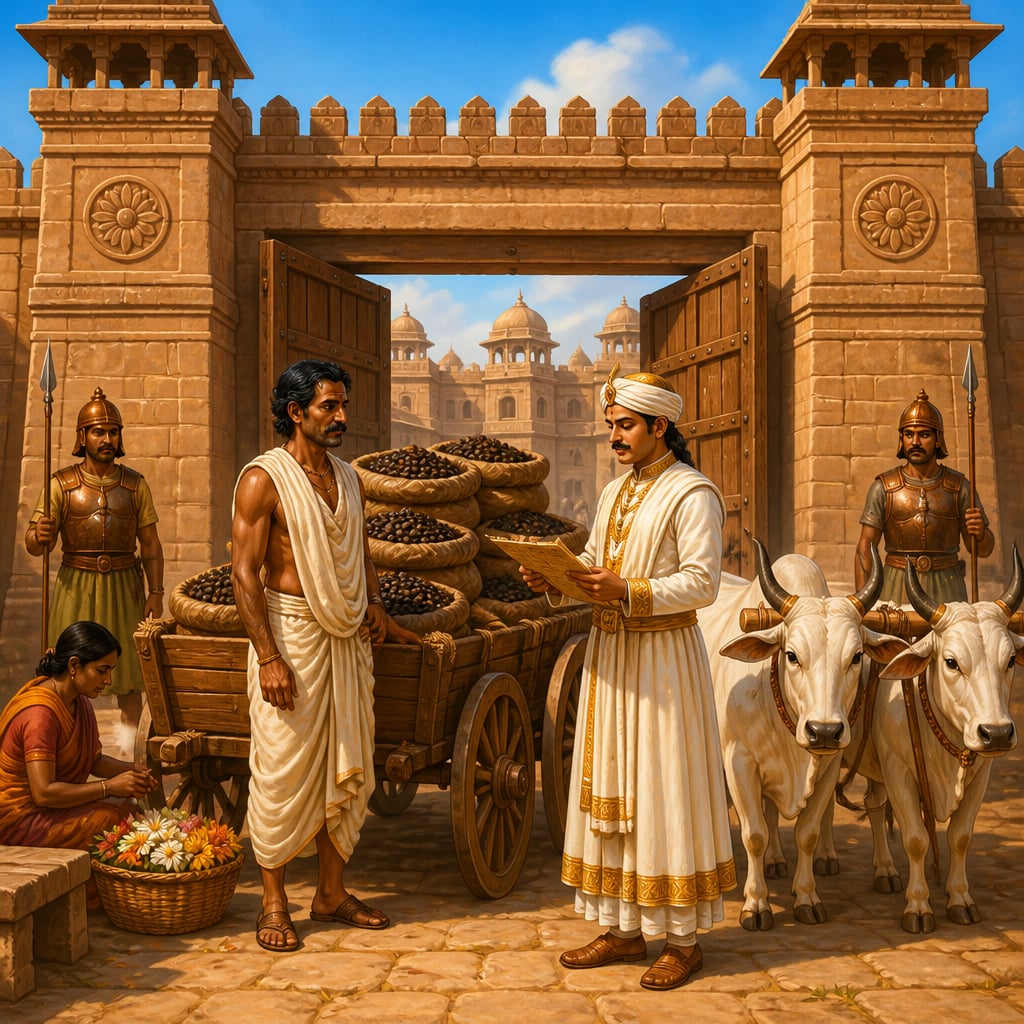
In the third century BCE, a merchant named Vasudeva stood at the gates of Pataliputra, his bullock carts laden with pepper from Kerala. The monsoon had been kind, the roads safer than memory served, and his cargo, worth more than a village's annual harvest, awaited buyers in the empire's greatest marketplace.
But between Vasudeva and his profit stood a man who would change Indian commerce forever: the Panyadhyaksha, the Superintendent of Trade.
This wasn't a shakedown. The Panyadhyaksha's assistant inspected the pepper, verified its quality, assigned a fair price ceiling, and stamped Vasudeva's goods for sale. The fee was modest, a percentage Kautilya had calculated to fund state services without crushing commerce. Within hours, Vasudeva's pepper was selling at guaranteed prices, protected from fraud by state seal.
This was not bureaucracy. This was civilization.
The Architecture of Ancient Trade Governance
Kautilya devoted Book 2, Chapters 16 of the Arthashastra to the Panyadhyaksha, and with good reason. In an age when merchants faced bandits, fraudsters, and predatory local lords, the state's ability to protect commerce determined its prosperity.
The Panyadhyaksha's responsibilities were staggering:
- Price Intelligence: Knowing the cost, origin, and quality of every traded commodity
- Quality Certification: Preventing adulteration and fraud through state inspection
- Market Timing: Deciding when goods could be sold to prevent gluts or scarcities
- Trade Route Management: Ensuring roads and waterways remained open and safe
- Foreign Merchant Relations: Welcoming traders from abroad with protected status

यथा मधुकरो पुष्पात् पुष्पात् रसमिवाचिनुयात्। तथा राष्ट्रात् कोशं संचिनुयात् पार्थिवः॥
"As the bee gathers honey from flower to flower without harming the bloom, so should the king collect revenue from his realm." , Arthashastra 5.2.70
This wasn't mere poetry. The honeybee doctrine mandated that trade taxation be calibrated precisely, enough to fund state functions, never enough to crush the merchant. Kautilya specified rates: typically 5% on local goods, 10% on imports. Compare this to Roman provinces where tax farmers routinely extracted 25-40%.
Global Perspectives on Trade Governance
Kautilya's Panyadhyaksha anticipated debates that wouldn't emerge in Europe for nearly two millennia.
Jean-Baptiste Colbert (1619-1683), Louis XIV's legendary Finance Minister, created French mercantilism, state-managed trade designed to maximize national power. Colbert established state manufactures, protected French industries, and regulated commerce with obsessive detail. His ordonnances specified everything from cloth width to dye quality.
Yet Colbert came 1,900 years after Kautilya. And crucially, Colbert's mercantilism aimed to drain wealth from rivals. Kautilya's system aimed to grow wealth for all participants.
Adam Smith (1723-1790) later attacked Colbert's approach in The Wealth of Nations, arguing for free trade over state management. But Smith created a false binary. Kautilya had already solved this: the state enables trade through infrastructure, standards, and protection, but doesn't monopolize it.
Friedrich List (1789-1846), the German economist, came closest to Kautilya. List argued that developing nations needed strategic protectionism, not permanent barriers, but temporary measures to build domestic capacity. This is precisely what the Arthashastra prescribes for strategic goods.
| Thinker | Core Principle | Kautilyan Parallel |
|---|---|---|
| Colbert | State control maximizes power | Panyadhyaksha enables, doesn't monopolize |
| Smith | Free markets self-regulate | Markets need state infrastructure to function |
| List | Strategic protection builds industry | Temporary controls on strategic commodities |
The Arthashastra synthesized what Europe would debate for centuries: markets work best when the state creates conditions for trust, not when it controls outcomes.
Modern Resonance: Piyush Goyal and India's Trade Renaissance
In 2024, Union Commerce Minister Piyush Goyal faced a challenge Kautilya would recognize: how does India compete globally while protecting domestic capacity?
Goyal's answer echoes the Panyadhyaksha:

- FTA Negotiations: India signed trade agreements with UAE, Australia, and EFTA nations, but with strategic carve-outs for sensitive sectors. Not free trade absolutism, not protectionist isolation: calibrated engagement.
- DPIIT Reforms: The Department for Promotion of Industry and Internal Trade streamlined approvals, reducing the bureaucratic friction Kautilya warned against
- PLI Schemes: Production-Linked Incentives for electronics, semiconductors, and pharmaceuticals mirror Kautilya's approach to strategic industries, state support to build capacity, not permanent subsidies
India's goods exports crossed $450 billion in FY24. The Panyadhyaksha's ghost would approve: trade grew, but strategic sectors remained protected.
The Panyadhyaksha's Timeless Principles
Kautilya didn't just describe a bureaucratic role. He articulated principles that define successful trade governance across millennia:
1. Information Asymmetry is the Enemy The Panyadhyaksha's first duty was knowing, prices, qualities, origins, routes. Modern equivalents: trade databases, market intelligence, real-time pricing. A state that doesn't know can't govern.
2. Standards Enable Trust State certification of weights, measures, and quality created the trust infrastructure for commerce. Today: BIS standards, FSSAI certification, SEBI regulations. Different acronyms, same principle.
3. Strategic Goods Require Strategic Management Kautilya restricted exports of war elephants and strategic metals. India today restricts semiconductor technology transfers. The category changes; the logic doesn't.
4. Foreign Merchants Strengthen, Not Threaten The Arthashastra gave foreign traders special protections, faster dispute resolution, guaranteed security. The logic: their presence signals a healthy economy and brings knowledge. Today's parallel: India's liberalized FDI norms.
Your Turn: The Panyadhyaksha Within
You may never run a trade ministry. But the Panyadhyaksha's principles apply at every scale:
- Know your market: Before any transaction, understand what you're buying, from whom, at what quality
- Create standards in your domain: Whether you manage a team or a family budget, clear standards prevent disputes
- Protect strategic assets: Not everything should be for sale. Identify what's irreplaceable in your life and career
- Welcome the foreign: New ideas, outside perspectives, and diverse suppliers strengthen rather than threaten
The merchant Vasudeva prospered under the Panyadhyaksha's watch. His grandchildren exported pepper to Rome. Three generations of wealth, built on institutional trust.
In Lesson 2, we enter the customs house. The Shulkadhyaksha, Superintendent of Customs, awaits, with lessons on how ancient India managed its borders, prevented smuggling, and built the revenue base for empire.
George Akerlof's 'Market for Lemons' (1970) showed how information asymmetry causes market failure. Friedrich Hayek argued that markets aggregate dispersed information better than central planners. Both insights are present in Kautilya.
Kautilya doesn't choose between market information and state information, he uses state intelligence to enable market function. The Panyadhyaksha gathers information not to control markets but to set conditions (standards, fraud prevention) that allow markets to work.
India's DGFT (Directorate General of Foreign Trade) today maintains databases on 8,000+ tariff lines across 200+ countries, exactly the information infrastructure Kautilya prescribed.
Arthur Laffer's famous curve (1974) showed that beyond a certain point, higher tax rates reduce total revenue by killing economic activity. But Laffer quantified what Kautilya had intuited 2,300 years earlier.
Kautilya's metaphor adds a dharmic dimension missing from Laffer: it's not just that excessive taxation is inefficient, it's adharma. Killing the flower harms the ecosystem. The state exists within society, not above it.
Kautilya specified 5% duty on local goods, 10% on imports. Compare to Roman Egypt's 25% tariff or medieval European tolls of 20-40%. Lower rates, higher compliance, greater trade.
Key terms
- Paṇyādhyakṣa
- Superintendent of Trade; the official responsible for overseeing all commercial activity within the state
- Paṇya
- Commodity, merchandise; any goods that can be bought or sold
- Mūlya
- Price, value; the worth of a commodity expressed in currency or exchange
- Vaṇij
- Merchant, trader; one who engages in buying and selling for profit
Verses
यथा मधुकरो पुष्पात् पुष्पात् रसमिवाचिनुयात्। तथा राष्ट्रात् कोशं संचिनुयात् पार्थिवः॥
yathā madhukaro puṣpāt puṣpāt rasamivācinuyāt | tathā rāṣṭrāt kośaṁ saṁcinuyāt pārthivaḥ ||
As the bee gathers honey from flower to flower without harming the bloom, so should the king collect revenue from his realm.
This anticipates the Laffer Curve by 2,000 years, the insight that excessive taxation reduces overall revenue by killing economic activity. Optimal taxation lies at the point where the bee gets honey without killing the flower.
Arthashastra, Book 5, Chapter 2, Verse 70 (Patrick Olivelle (2013))
पण्याध्यक्षः स्थानीयमिति कोशवृद्धिकरणम्। देशकालप्रमाणमूल्यवृद्धिहानिं ज्ञात्वा...॥
paṇyādhyakṣaḥ sthānīyamiti kośavṛddhikaraṇam | deśakālapramāṇamūlyavṛddhihānīṁ jñātvā... ||
The Superintendent of Trade shall know the increase and decrease in the price of goods by place, time, and quantity, for this knowledge grows the treasury.
This describes what we now call market intelligence, systematic data collection on price movements, supply chains, and trade flows. Modern trade ministries maintain exactly this: databases of commodity prices, import/export volumes, and market trends.
Arthashastra, Book 2, Chapter 16, Verse 1-3 (R.P. Kangle (1965))
परदेश्यानां वणिजां प्रतिषेधः न कार्यः। ते हि राष्ट्रवृद्धिकराः॥
paradeśyānāṁ vaṇijāṁ pratiṣedhaḥ na kāryaḥ | te hi rāṣṭravṛddhikarāḥ ||
Foreign merchants shall not be obstructed, for they bring growth to the realm.
This counters mercantilist zero-sum thinking. Foreign trade isn't a threat to be managed but a growth engine to be cultivated. Modern parallel: India's liberalized FDI policy and trade agreement push under the Modi government.
Arthashastra, Book 2, Chapter 16, Verse 24 (L.N. Rangarajan (1992))
Key figures
Kautilya (Chanakya)
Author of Arthashastra; Chief Minister to Chandragupta Maurya
Piyush Goyal
Union Minister of Commerce and Industry; Union Minister of Textiles (Government of India)
Jean-Baptiste Colbert
Controller-General of Finances under Louis XIV; architect of French mercantilism
Case studies
India's FTA Strategy: The Panyadhyaksha Returns
In February 2022, India signed the Comprehensive Economic Partnership Agreement (CEPA) with UAE, its first major FTA in a decade. By December 2024, India had added Australia, EFTA (Switzerland, Norway, Iceland, Liechtenstein), and was negotiating with the UK and EU. The challenge was acute: India's 1991 liberalization had opened markets but left domestic industry exposed. The 2000s-era FTAs with ASEAN and Korea had allowed cheap imports to devastate sectors like electronics and steel. Critics argued India should abandon FTAs entirely. Commerce Minister Piyush Goyal faced the Panyadhyaksha's eternal dilemma: how to welcome foreign commerce (which brings growth) while protecting strategic sectors (which ensure sovereignty).
Kautilya's Panyadhyaksha would analyze this through calibrated engagement: 1. **Information first**: Which sectors can compete globally? Which need protection? India's detailed sector-by-sector analysis before each FTA mirrors the Panyadhyaksha's market intelligence mandate. 2. **Strategic carve-outs**: Just as Kautilya restricted exports of war elephants, India protected dairy, agriculture, and sensitive manufacturing through longer tariff reduction timelines. 3. **Foreign merchant welcome**: The UAE FTA gave Indian services (IT, professionals) access to Gulf markets, reciprocal openness that grows the whole. Conventional economics offers only two options: free trade absolutism or protectionist isolation. The Arthashastra offers a third: strategic engagement based on information, calibration, and long-term prosperity.
India-UAE trade crossed $85 billion in FY24, up 16% from pre-FTA levels. Indian jewelry, textiles, and engineering goods gained tariff-free access; UAE investment in India surged. The Australia FTA similarly boosted wine and wool imports while opening doors for Indian pharma and IT. Critically, India's domestic manufacturing grew simultaneously, PLI schemes ensured that openness didn't mean dependence. Electronics production reached $115 billion in 2024, with Apple manufacturing $14 billion worth of iPhones domestically. The Panyadhyaksha's balance: welcome foreign commerce, protect strategic capacity, grow the ecosystem.
Trade governance is neither free-trade ideology nor protectionist reflex, it's information-driven calibration that welcomes growth-creating commerce while protecting sovereignty-essential sectors. Kautilya solved this 2,300 years ago.
India's FTA strategy is now explicitly sector-calibrated, signing agreements that open markets where Indian firms can compete while protecting sensitive agriculture and dairy. This approach contrasts with the blanket liberalization many Western economists recommend, following instead the information-driven calibration Kautilya prescribed.
India's goods exports reached $450 billion in FY24, a 25% increase from FY21, while domestic manufacturing value-add grew 15% annually. The Panyadhyaksha's balance proved achievable.
Historical context
Mauryan Empire (322-185 BCE)
The Mauryan Empire represented India's first pan-subcontinental state. Its road network (the Uttarapatha from Taxila to Pataliputra), standardized weights and measures, and centralized administration created the infrastructure for continental trade. The Arthashastra was written as a manual for governing this unprecedented entity.
Contemporary economies, Ptolemaic Egypt, Seleucid Persia, Carthage, relied heavily on royal monopolies and tax farming. Kautilya's system was more sophisticated: state-enabled markets rather than state-controlled extraction. This may explain why Indian merchants dominated Indian Ocean trade for the next 1,500 years.
Megasthenes reported that Pataliputra had 64 gates and 570 towers, a city of perhaps 400,000 people, larger than Rome at the time. Its markets required sophisticated administration, which the Panyadhyaksha provided.
The Mauryan administrative system created templates that endured for millennia. The Panyadhyaksha's functions, quality certification, price intelligence, foreign merchant relations, appear in Gupta, Chola, and Mughal administrations. Modern India's trade governance inherits this institutional memory.
Living traditions
India's trade governance apparatus, Commerce Ministry, DPIIT, DGFT, BIS, FSSAI, performs the Panyadhyaksha's core functions at scale. The 2023-24 push for FTAs, PLI schemes, and ease-of-doing-business reforms represents a return to Kautilyan principles: state-enabled commerce through information, standards, and calibrated protection.
- Bureau of Indian Standards (BIS) certification: BIS certification for products continues the Panyadhyaksha's quality certification function, state verification that enables market trust.
- DGFT Export Licenses: The Directorate General of Foreign Trade manages export controls for strategic goods, exactly what Kautilya mandated for war elephants and strategic metals.
- Pataliputra archaeological site (Kumrahar), Bihar: The Mauryan capital where Kautilya's Panyadhyaksha operated. Excavations reveal the massive pillared hall (possibly an assembly hall) and urban infrastructure of a city that was the world's largest.
- Bharat Mandapam, New Delhi: India's newest convention center, which hosted the G20 Summit in 2023. A symbol of modern India's return to global trade centrality.
- Jagannath Temple Trade Legacy: Puri was historically a major trade port connected to Southeast Asian maritime networks. The temple's prosperity derived partly from trade revenues, demonstrating the Panyadhyaksha's role in connecting commerce to dharmic prosperity. Merchants sought blessings before voyages and donated from trading profits.
- Meenakshi Amman Temple: Madurai was a major trade center on the southern trade routes described in Arthashastra. The temple served as a marketplace and dispute resolution center, combining religious and commercial functions that the Panyadhyaksha would oversee.
Reflection
- Kautilya believed that 'foreign merchants bring growth to the realm', yet many today fear globalization as a threat to local prosperity. When does openness to foreign commerce strengthen an economy, and when does it hollow it out? What determines the difference?
- The Panyadhyaksha's first duty was information, knowing prices, qualities, and market movements before making decisions. In your own life (career, investments, major purchases), where are you making decisions without adequate information? What would a 'personal Panyadhyaksha' approach look like?