Bahirvyapara: Foreign Trade Policies

The State's Sacred Duty to Commerce

Kautilya believed the state must protect merchants trading abroad as fiercely as it protects soldiers at war. Learn why foreign trade policy in the Arthashastra wasn't just economics, it was statecraft, and why India's Act East Policy echoes these ancient principles.

The Merchant Who Almost Lost Everything
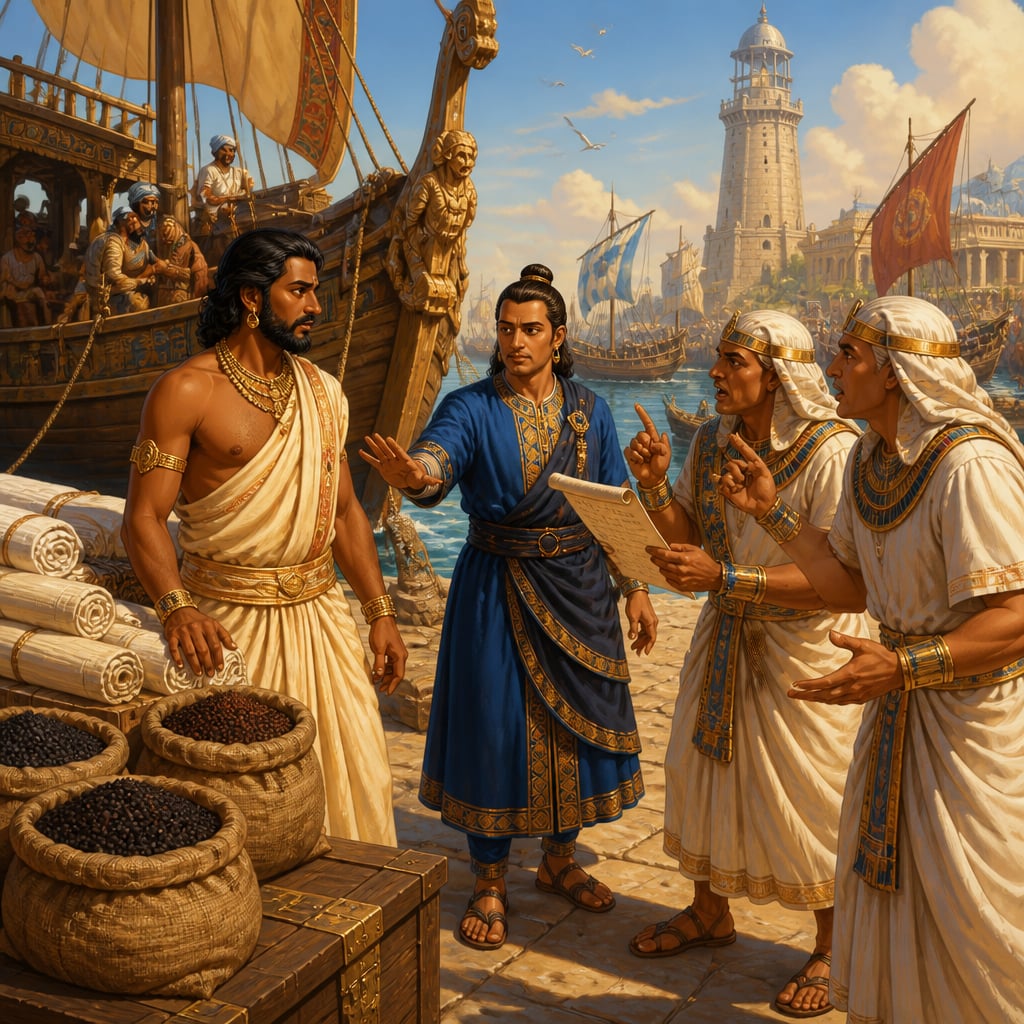
Tamil merchant Kannagi rescued by a Mauryan emissary at Alexandria

In 280 BCE, a Tamil merchant named Kannagi sailed from Muziris with a cargo of pepper, textiles, and iron ingots bound for the Ptolemaic port of Berenice on the Red Sea. The journey was profitable, Roman traders paid premium prices for Indian goods. But on the return voyage, Egyptian officials at Berenice seized Kannagi's gold payment, claiming unpaid port dues from a voyage three years prior.

Kannagi had never made that earlier voyage. The claim was fabricated, a shakedown.

What happened next would have surprised those Egyptian officials. A Mauryan diplomatic mission arrived within months. They carried a message from the Panyadhyaksha: the Indian merchant was under state protection. Either return the gold, or face restrictions on Egyptian traders in Indian ports.

The gold was returned. Kannagi's story became legend.

This was not diplomacy. This was the state fulfilling its sacred duty to commerce.

The Architecture of Foreign Trade Protection

Kautilya's Arthashastra is explicit: the state's duty to protect merchants doesn't end at its borders. Book 2, Chapter 16 extends the Panyadhyaksha's responsibilities to traders operating abroad:

परदेशगतानां वणिजां रक्षणं राज्ञः परमो धर्मः। स्वदेशे यथा रक्षति तथा परदेशेऽपि रक्षेत्॥

"The protection of merchants who have gone to foreign lands is the king's highest duty. As he protects them in his own realm, so must he protect them abroad." , Arthashastra 2.16.28

This wasn't mere rhetoric. The Arthashastra specifies mechanisms:

The logic was strategic: trade generates the wealth that funds armies. A state that abandons its merchants abroad undermines its own power.

The Science of Strategic Openness

Kautilya's foreign trade policy rejected both extremes, neither isolation nor naive openness:

What to Encourage:

What to Restrict:

यत् स्वदेशे न विद्यते तत् परदेशात् आनयेत्। यत् स्वदेशे विद्यते तत् निर्यमेत् न वा स्वदेशार्थम्॥

"What is not available in one's own country should be imported. What is available should be exported, unless needed domestically." , Arthashastra 2.16.15

This principle anticipates modern 'strategic trade policy', the insight that not all trade is equal, and states should shape trade flows to maximize strategic advantage.

Global Perspectives: Zheng He and the Cost of Withdrawal

Zheng He (1371-1433) commanded the greatest naval expeditions in history before Columbus. Between 1405 and 1433, his fleets, some with 300 ships and 28,000 men, sailed from China to Southeast Asia, India, Arabia, and East Africa.

Zheng He's Ming dynasty treasure ship crossing the Indian Ocean

Zheng He's expeditions weren't conquest; they were trade diplomacy. He established tribute relationships, opened markets for Chinese goods, and collected intelligence on foreign lands. At their peak, Ming China dominated Indian Ocean trade.

Then, in 1433, everything stopped.

The Ming court, influenced by Confucian officials who viewed trade as beneath imperial dignity, banned overseas voyages. The treasure ships were destroyed. China turned inward for centuries.

The result? Within 70 years, Portuguese ships arrived in the Indian Ocean. Within 150 years, European powers dominated the seas China had abandoned. China's self-imposed isolation contributed to its 'century of humiliation' when Western powers forced unequal treaties on a weakened empire.

Kautilya would have predicted this. The Arthashastra treats foreign trade as a pillar of state power, not a luxury to be abandoned when inconvenient. Withdrawal from commerce is withdrawal from power.

Aspect Ming China (post-1433) Mauryan India Outcome
Policy Isolation, trade banned Active engagement, merchant protection China declined; India dominated Indian Ocean trade for 1,500 more years
Merchant status Viewed as inferior class Protected by state as strategic asset Chinese merchants constrained; Indian merchants thrived globally
Information Burned exploration records Maintained diplomatic/trade networks Lost maritime knowledge; Indian networks survived
Strategic goods Hoarded (silver, porcelain) Traded strategically Missed opportunities; built alliances through trade

The contrast is stark: two great civilizations, two approaches to foreign commerce, two very different historical trajectories.

Modern Resonance: S. Jaishankar and India's Return to Trade Statecraft

Indian foreign minister at a multilateral summit table

External Affairs Minister Dr. S. Jaishankar has articulated a foreign policy doctrine that Kautilya would recognize: trade is not separate from diplomacy, it is diplomacy.

Jaishankar's concept of 'multi-alignment', engaging with all major powers without exclusive alliance, echoes Kautilya's mandala theory: cultivate relationships based on interest, not ideology.

Key expressions of this doctrine:

1. Act East Policy (2014-present) The transformation of 'Look East' into 'Act East' meant moving from observation to engagement. India now has FTAs or negotiations underway with most ASEAN nations, Japan, South Korea, and Australia.

2. IMEC (India-Middle East-Europe Corridor) Announced at the 2023 G20 Summit, IMEC creates a trade corridor connecting India to Europe via UAE, Saudi Arabia, and Israel, a 21st-century spice route bypassing traditional chokepoints.

3. Chabahar Port India's development of Iran's Chabahar port creates an alternative route to Central Asia, bypassing Pakistan. Strategic geography, enabled by trade infrastructure.

4. Rupee Trade Arrangements Bilateral trade in rupees with Russia, UAE, and others reduces dollar dependency, exactly the kind of strategic autonomy Kautilya valued.

Jaishankar has stated: "The world is best navigated by a combination of strategic autonomy and issue-based alignments." This is the Arthashastra's mandala diplomacy, articulated for the 21st century.

The State's Duty: A Timeless Principle

Kautilya's foreign trade principles transcend their era:

1. Merchants Are Strategic Assets The state that abandons its traders abroad abandons its future prosperity. Modern application: export promotion agencies, trade missions, commercial diplomacy.

2. Reciprocity Is Policy Treat foreign merchants well, and demand the same treatment for yours. Modern application: bilateral investment treaties, WTO dispute resolution, retaliatory tariffs.

3. Strategic Goods Require Strategic Management Not all trade is equal. Some goods, whether war elephants then or semiconductors now, require state attention. Modern application: export controls, technology transfer restrictions, strategic reserves.

4. Isolation Is Suicide Zheng He's China chose isolation and paid for centuries. States that withdraw from trade networks weaken themselves. Modern application: India's post-1991 integration, FTA push, and rejection of autarky.

Your Turn: The Foreign Trader Within

These principles apply at every scale:

Kannagi's gold was returned because a state understood its duty. The merchant's prosperity was the empire's prosperity. The principle remains: protect your traders, and trade protects you.

In Lesson 4, we build the roads. The Vanijpatha, Developing Trade Routes, reveals how Kautilya viewed infrastructure as the foundation of commerce. Strategic geography wasn't given; it was built.

Extraterritorial Protection and Commercial Diplomacy

Modern states maintain extensive infrastructure for protecting citizens abroad: embassies, bilateral investment treaties, and organizations like the Overseas Private Investment Corporation. But these institutions developed late, Britain's systematic commercial diplomacy began only in the 18th century.

Kautilya established merchant protection abroad as a 'highest duty' (paramo dharma), not optional but obligatory. This elevated status for commerce was unusual in ancient governance and anticipated modern recognition of trade as strategic.

India has signed Bilateral Investment Treaties with 90+ countries, providing legal protection for Indian investors abroad, institutionalizing Kautilya's principle.

The 'commercial peace' theory (Norman Angell, 1909) argued that economic integration makes war irrational. The European Union was explicitly designed to make war between France and Germany impossible through economic interdependence.

Kautilya went further: trade alliances are not just peace-preserving but power-generating. They grow the treasury that funds everything else. Military alliances drain resources; trade alliances generate them.

Key terms

Bahirvyāpāra
Foreign trade; commerce conducted with parties outside one's own territory
Maṇḍala
Circle; in statecraft, the theory of concentric circles of allies and enemies surrounding a state
Paradeśa
Foreign country; territory outside one's own kingdom
Saṁdhi
Treaty, alliance, agreement; a formal pact between states governing their relations

Verses

परदेशगतानां वणिजां रक्षणं राज्ञः परमो धर्मः। स्वदेशे यथा रक्षति तथा परदेशेऽपि रक्षेत्॥

paradeśagatānāṁ vaṇijāṁ rakṣaṇaṁ rājñaḥ paramo dharmaḥ | svadeśe yathā rakṣati tathā paradeśe'pi rakṣet ||

The protection of merchants who have gone to foreign lands is the king's highest duty. As he protects them in his own realm, so must he protect them abroad.

This anticipates the concept of 'extraterritorial protection' that modern states provide through embassies, trade missions, and bilateral investment treaties. The principle that a state's duty follows its citizens abroad was radical in ancient times, and remains contested today.

Arthashastra, Book 2, Chapter 16, Verse 28 (R.P. Kangle (1965))

यत् स्वदेशे न विद्यते तत् परदेशात् आनयेत्। यत् स्वदेशे विद्यते तत् निर्यमेत् न वा स्वदेशार्थम्॥

yat svadeśe na vidyate tat paradeśāt ānayet | yat svadeśe vidyate tat niryamet na vā svadeśārtham ||

What is not available in one's own country should be imported. What is available should be exported, unless needed domestically.

This anticipates David Ricardo's theory of comparative advantage (1817) by 2,100 years, with an important addition. Ricardo argued for unrestricted trade based on comparative advantage; Kautilya adds strategic restraint. Not everything should be traded, even if profitable.

Arthashastra, Book 2, Chapter 16, Verse 15 (L.N. Rangarajan (1992))

वाणिज्यसंघातः बलसंघातादधिकः। वाणिज्येन हि कोशो वर्धते कोशेन दण्डः॥

vāṇijyasaṁghātaḥ balasaṁghātādadhikaḥ | vāṇijyena hi kośo vardhate kośena daṇḍaḥ ||

An alliance through trade is superior to an alliance through military force. For trade grows the treasury, and the treasury sustains military power.

This anticipates the 'commercial peace' theory, the idea that trade interdependence reduces conflict. Modern applications include the EU (war between France and Germany became unthinkable after economic integration) and arguments for engaging China rather than containing it.

Arthashastra, Book 7, Chapter 12, Verse 20 (Patrick Olivelle (2013))

Key figures

Kautilya (Chanakya)

Author of Arthashastra; Chief Minister to Chandragupta Maurya

Dr. S. Jaishankar

External Affairs Minister of India (2019-present); former Foreign Secretary; architect of India's contemporary foreign policy doctrine

Zheng He

Ming Dynasty admiral; commander of seven major maritime expeditions across the Indian Ocean

Case studies

Act East Policy: Kautilya's Mandala in the Indo-Pacific

In 1991, India initiated the 'Look East' policy, recognizing that decades of Cold War non-alignment had left it disconnected from the fastest-growing economies in Asia. By 2014, Prime Minister Modi transformed this into 'Act East', a shift from observation to engagement. The challenge was strategic: China's Belt and Road Initiative was reshaping Asia's economic geography. Southeast Asian nations faced pressure to align with Beijing. India risked being marginalized in its own neighborhood. Act East responded by deepening trade and investment ties with ASEAN, Japan, South Korea, and Australia. It wasn't just economics, it was Kautilya's mandala theory in action: strengthen relationships with the neighbors of your most challenging neighbor. The numbers tell the story: India-ASEAN trade grew from $2 billion (1992) to $130 billion (2024). Indian investment in Southeast Asia quintupled. And critically, India gained strategic partners who share concerns about over-dependence on a single power.

Kautilya's mandala theory provides the framework: 1. **The Neighbor Principle**: Your immediate neighbor is likely a competitor; your neighbor's neighbor is likely a partner. China is India's challenging neighbor; ASEAN, Japan, and Australia are neighbors of China, natural partners. 2. **Trade as Alliance**: 'An alliance through trade is superior to military alliance.' Act East builds economic interdependence that creates durable bonds, harder to break than mere security guarantees. 3. **Strategic Autonomy**: Kautilya warned against dependence on any single power. Act East diversifies India's relationships, ensuring no single partner has excessive leverage. 4. **Merchant Protection**: India's FTAs and investment treaties with Act East partners protect Indian businesses operating abroad, Kautilya's 'highest duty' institutionalized. The dharmic insight: foreign policy isn't separate from trade policy. Both are expressions of strategic engagement that protects prosperity.

Act East outcomes (2014-2024): - **Trade**: India-ASEAN bilateral trade reached $130 billion (2024) - **Investment**: Japanese FDI in India exceeded $40 billion cumulative - **Connectivity**: India-Myanmar-Thailand trilateral highway near completion - **Partnerships**: Comprehensive Strategic Partnerships with Japan, Australia, Indonesia - **QUAD**: Security cooperation with US, Japan, Australia institutionalized - **Supply chains**: India emerging as alternative to China for manufacturing Act East created what Kautilya would recognize: a mandala of trade-based alliances that enhance strategic autonomy while generating wealth. The policy demonstrates that 2,300-year-old strategic principles remain applicable.

Effective foreign policy integrates trade, investment, and diplomacy. Act East succeeded because it applied Kautilya's insight: alliances built on mutual economic benefit are stronger than those built on shared fears. Trade creates the interdependence that sustains partnerships.

India's Act East partnerships now include semiconductor supply chain agreements with Japan and defense technology sharing with ASEAN nations. The economic logic of building alliances with neighbors of competitors remains as relevant in the Indo-Pacific as it was in Kautilya's mandala framework.

India's trade with Act East partners grew 6x from 1991-2024. With China, it grew 30x but created dependencies. Diversification through Act East restored balance, Kautilya's strategic autonomy, achieved.

Historical context

Mauryan Empire and Indian Ocean Trade (300 BCE - 1500 CE)

Indian merchants dominated Indian Ocean trade for nearly 2,000 years, from the Mauryas through the Cholas to the arrival of Europeans. This wasn't geography alone; it was sustained policy of merchant protection, treaty-making, and strategic engagement that Kautilya articulated and successor states maintained.

While China withdrew from maritime trade after Zheng He, and Rome eventually fell, Indian commercial networks persisted. When the Portuguese arrived in 1498, they found Indian merchants operating from East Africa to Southeast Asia, evidence of the durability Kautilya's approach enabled.

Indian textiles found in Egyptian tombs (c. 1000 BCE), Roman trading posts in Kerala (c. 100 CE), Tamil merchant guilds in Southeast Asia (c. 900 CE), continuous evidence of protected foreign trade spanning 2,000 years.

India's sustained trade dominance wasn't automatic, it required the kind of state support Kautilya prescribed. The contrast with China's self-imposed isolation after Zheng He demonstrates the consequences of abandoning these principles.

Living traditions

India's Ministry of External Affairs has 'economic diplomacy' as a stated priority. Trade missions, investment promotion, and commercial dispute resolution are core functions, exactly what Kautilya prescribed for the Panyadhyaksha's foreign-facing responsibilities.

Reflection

More in Trade & Commerce Regulation

All lessons in Trade & Commerce Regulation · Arthashastra: Economic Principles course