Antahshulka: Internal Trade and Customs

The Art of the Customs Superintendent

Kautilya's Shulkadhyaksha wasn't just a tax collector, he was the architect of fair trade across borders. Learn how 2,300-year-old customs principles shaped India's journey from ancient toll gates to GST and faceless assessment.

The Smuggler's Dilemma
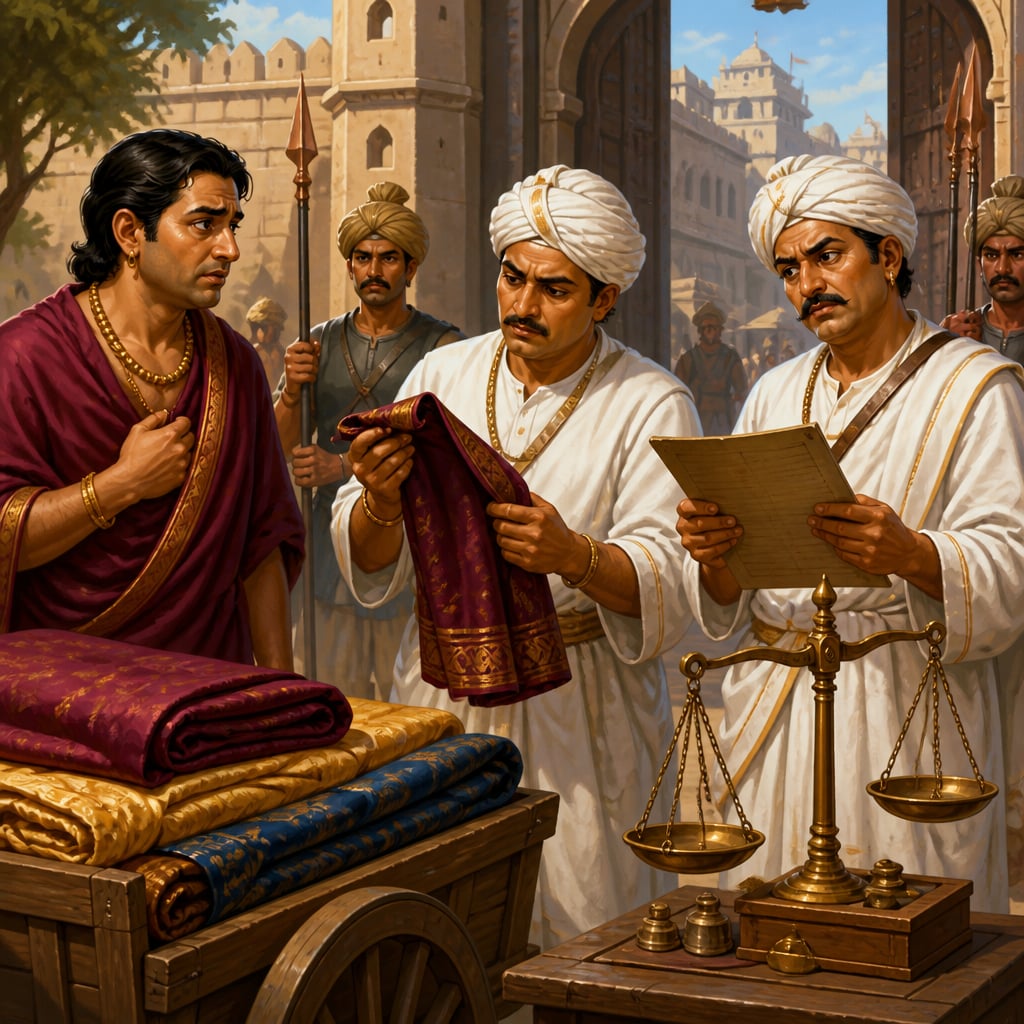
Shulkadhyaksha inspectors examine merchant Devadatta's silk at a city gate

The merchant Devadatta had a problem. His caravan carried silk from the northwest, legally acquired, properly taxed at the border. But somewhere in the foothills of the Vindhyas, a local chieftain demanded a second toll. Pay, or his goods would be 'inspected' until they rotted.

This wasn't the Mauryan way.

Within days, the Shulkadhyaksha, Superintendent of Customs, dispatched inspectors. The chieftain was reminded, firmly, that the Arthashastra mandated a single, standardized toll system across the empire. One payment at designated gates. One set of rates. No double taxation, no extortion.

Devadatta's silk reached Pataliputra. The chieftain's 'customs post' was dismantled.

This was not taxation. This was civilization protecting commerce.

The Architecture of Ancient Customs

Kautilya devoted Book 2, Chapter 21 of the Arthashastra to shulka, customs duties, and the official who administered them. The Shulkadhyaksha's domain was precise: the boundary where goods entered or exited a territory, and the revenue the state could legitimately extract.

But Kautilya understood something that many modern policymakers forget: the purpose of customs isn't revenue maximization, it's trade facilitation with sustainable revenue.

The Shulkadhyaksha's responsibilities included:

शुल्काध्यक्षः द्वारदेशपण्यशुद्धिं कारयेत्। न च व्यवहारं विलम्बयेत्॥

"The Superintendent of Customs shall verify goods at the gate, but shall not delay commerce." , Arthashastra 2.21.1

This single instruction encapsulates Kautilya's genius: customs must be rigorous AND fast. Slow clearance kills trade as surely as high tariffs.

The Science of Sustainable Duties

Kautilya's customs rates weren't arbitrary. They reflected sophisticated economic reasoning:

Import Duties (10-20%):

Export Duties (5-10%):

Internal Transit (2-5%):

An orchard keeper harvesting ripe mangoes while leaving the tree intact

शुल्कं न अतिभारं कुर्यात्। वाणिज्यं रक्षेत् यथा वृक्षं फलकामः॥

"Duties should not be excessive. Protect trade as one who desires fruit protects the tree." , Arthashastra 2.21.24

The tree-and-fruit metaphor complements the honeybee doctrine: sustainable extraction requires keeping the source alive and productive.

Global Perspectives on Customs Systems

Napoleon Bonaparte (1769-1821) weaponized customs in ways Kautilya would have understood, but ultimately rejected.

Napoleon's Continental System (1806-1814) attempted to destroy Britain through trade blockade. All European ports under French control would refuse British goods. Customs became warfare by other means.

The result? Widespread smuggling, economic hardship across Europe, and the system's eventual collapse. Napoleon discovered what Kautilya had warned: customs that ignore market realities create black markets, not compliance.

Alexander Hamilton (1755-1804), America's first Treasury Secretary, designed a customs system closer to Kautilyan principles. His tariff system funded the federal government while protecting nascent American industry, strategic protection, not blockade.

Sir Robert Walpole (1676-1745), Britain's first effective Prime Minister, reformed customs to fight smuggling through simplification and rate reduction. His insight: lower rates with higher compliance yield more revenue than high rates with mass evasion.

Approach Napoleon Hamilton Walpole Kautilya
Goal Destroy rival Fund government + protect industry Maximize revenue through compliance Enable trade with sustainable revenue
Method Blockade Strategic tariffs Simplification Standardization + facilitation
Outcome Collapse Success Success 1,500+ years of trade dominance

The Arthashastra's approach combines Hamilton's strategic protection with Walpole's compliance focus, two millennia before either was born.

Modern Resonance: Vivek Johri and India's Customs Revolution

In 2020, India's Central Board of Indirect Taxes and Customs (CBIC) faced a Kautilyan challenge: how do you collect duties fairly while preventing the corruption and delays that had plagued Indian customs for decades?

Vivek Johri, CBIC Chairman from 2021-2023, led a transformation that the Shulkadhyaksha would recognize:

1. Faceless Assessment (2020) Customs assessments were randomized across the country. A shipment arriving in Mumbai might be assessed by an officer in Chennai. No merchant knew which officer would review their goods, eliminating the corruption that plagued face-to-face interactions.

2. Turant Customs (Immediate Customs) Automatic clearance for low-risk importers based on past compliance. Trusted traders, like Kautilya's shreshti merchants, earned expedited processing.

3. Single Window Integration Multiple government agencies (food safety, plant quarantine, drug control) integrated into one clearance system. No more running between departments, exactly what Kautilya mandated when he prohibited customs delays.

The results speak: India's average customs clearance time dropped from 44 hours (2019) to under 24 hours (2024). The World Bank's Trading Across Borders ranking improved from 146th to 68th.

The Shulkadhyaksha's Anti-Corruption Genius

Kautilya's customs system had a built-in anti-corruption architecture:

1. Rotation: Officers rotated frequently to prevent relationship-building with merchants 2. Surveillance: Secret inspectors (gudhapurusha) monitored customs posts 3. Harsh Penalties: Corrupt officers faced fines multiples of the bribe received 4. Merchant Grievance System: Traders could appeal assessments to higher authorities

Modern Indian customs operations center with digital cargo screens

The Faceless Assessment Scheme of 2020 is essentially technology-enabled rotation, Kautilya's principle implemented through algorithm.

Your Turn: The Shulkadhyaksha Within

Customs principles apply far beyond borders:

Devadatta's silk reached its market because an ancient system prioritized legitimate commerce over petty extraction. The principle remains: sustainable systems protect the productive.

In Lesson 3, we go global. The Bahirvyapara, Foreign Trade Policies, reveals how Kautilya managed India's engagement with the wider world. Not isolation, not naive openness, but strategic commerce that made India the world's richest economy for centuries.

Modern trade economics recognizes that time delays function as tariffs. The World Bank estimates each day of customs delay reduces trade by 1%. The WTO's Trade Facilitation Agreement (2017) addresses exactly this issue, two millennia after Kautilya.

Kautilya didn't just identify the problem, he mandated the solution. The Shulkadhyaksha who delayed commerce was failing his duty, period. Modern India's Turant Customs and single-window systems finally implement this ancient mandate.

India's average customs clearance time: 44 hours (2019) → 24 hours (2024). Each hour saved represents millions in reduced trade costs, Kautilya's insight, quantified.

The European Union's single market (1993) eliminated internal customs precisely because cascading border taxes fragmented commerce. India's GST (2017) addressed the same problem, multiple state and central taxes replaced by one unified system.

Kautilya established single-point taxation as a principle, not just a convenience. The Arthashastra treats additional levies as crimes punishable by fines, stronger enforcement than most modern systems.

Pre-GST India had 17 different taxes on goods and services. GST unified them into one. Logistics costs dropped from 14% to 10% of GDP, the efficiency gain Kautilya promised.

Key terms

Śulkādhyakṣa
Superintendent of Customs; the official responsible for collecting duties at borders and trade gates
Śulka
Customs duty, toll, tariff; the fee charged by the state for goods crossing boundaries
Dvāra
Gate, door, entry point; specifically, the official customs checkpoint at territorial boundaries
Gūḍhapuruṣa
Secret agent, undercover inspector; officials who monitored customs posts for corruption without revealing their identity

Verses

शुल्काध्यक्षः द्वारदेशपण्यशुद्धिं कारयेत्। न च व्यवहारं विलम्बयेत्॥

śulkādhyakṣaḥ dvāradeśapaṇyaśuddhiṁ kārayet | na ca vyavahāraṁ vilambayetat ||

The Superintendent of Customs shall verify goods at the gate, but shall not delay commerce.

Modern customs economics calls this 'trade facilitation', the insight that clearance delays impose costs equivalent to tariffs. The World Bank estimates that each day of delay reduces trade by 1%. Kautilya understood this 2,300 years ago.

Arthashastra, Book 2, Chapter 21, Verse 1 (R.P. Kangle (1965))

शुल्कं न अतिभारं कुर्यात्। वाणिज्यं रक्षेत् यथा वृक्षं फलकामः॥

śulkaṁ na atibhāraṁ kuryāt | vāṇijyaṁ rakṣet yathā vṛkṣaṁ phalakāmaḥ ||

Duties should not be excessive. Protect trade as one who desires fruit protects the tree.

This anticipates the economic concept of 'deadweight loss', the destruction of economic activity caused by excessive taxation. Kautilya's tree metaphor captures the insight that the tax base must be nurtured, not stripped.

Arthashastra, Book 2, Chapter 21, Verse 24 (L.N. Rangarajan (1992))

एकत्र शुल्कं गृह्णीयात्। द्वितीयं न प्रणयेत्। पथि यः शुल्कं पुनर्याचेत् तस्य दण्डः प्रथमसाहसः॥

ekatra śulkaṁ gṛhṇīyāt | dvitīyaṁ na praṇayet | pathi yaḥ śulkaṁ punaryācet tasya daṇḍaḥ prathamasāhasaḥ ||

Collect duty at one place only. A second levy is forbidden. He who demands duty again on the road shall be fined the first-level penalty.

Multiple taxation points destroy trade by raising costs unpredictably. This verse anticipates the core innovation of GST (2017): one nation, one tax, one market. The problem Kautilya solved, cascading duties at multiple checkpoints, is exactly what GST addressed.

Arthashastra, Book 2, Chapter 21, Verse 30-31 (Patrick Olivelle (2013))

Key figures

Kautilya (Chanakya)

Author of Arthashastra; Chief Minister to Chandragupta Maurya

Vivek Johri

Former Chairman, Central Board of Indirect Taxes and Customs (CBIC), Government of India (2021-2023)

Napoleon Bonaparte

Emperor of the French; architect of the Continental System (1806-1814)

Case studies

Faceless Assessment: Kautilya's Anti-Corruption Principle, Digitized

For decades, Indian customs clearance worked through personal interaction. A merchant's shipment arrived at Mumbai port; the same local officer assessed every shipment from that merchant. Over time, relationships formed, and with relationships, corruption. The pattern was predictable: faster clearance for those who paid, delays and harassment for those who didn't. Honest importers faced a dilemma: pay bribes and stay competitive, or refuse and watch competitors clear goods faster. In August 2020, CBIC launched Faceless Assessment. Now, when a shipment arrives at Mumbai, the assessment might be done by an officer in Chennai, Delhi, or Kolkata. No merchant knows which officer will review their goods. No officer knows which shipment they'll assess next. The relationship channel for corruption was severed by algorithm.

Kautilya addressed this exact problem through rotation and surveillance: 1. **Rotation**: Officers were moved frequently to prevent relationship-building 2. **Gudhapurusha**: Secret inspectors posed as merchants, testing officers with bribe offers 3. **Harsh Penalties**: Corrupt officers faced multiples of the bribe as fines Faceless Assessment achieves through technology what Kautilya achieved through procedure: making corruption structurally difficult rather than relying on individual virtue. The dharmic insight: systems should be designed assuming people will be tempted, not assuming they'll be virtuous. The Shulkadhyaksha's job wasn't to hire incorruptible officers, it was to make corruption impossible.

Results after three years of Faceless Assessment: - **Corruption complaints**: Down 60% at major ports - **Average clearance time**: Reduced from 44 hours to 24 hours - **Revenue collection**: Up 15% (fewer goods evading duty through corrupt channels) - **Business confidence**: Improved ease-of-doing-business rankings The system worked because it addressed the structure of corruption, not just its symptoms. Merchants who once paid bribes for speed now get speed through compliance, exactly the incentive shift Kautilya designed.

Anti-corruption measures succeed when they make corruption structurally difficult, not when they rely on individual virtue or harsher punishments. Kautilya's gudhapurusha and rotation systems anticipated what technology now enables at scale.

India's faceless assessment model is being studied by tax administrations in Africa and Southeast Asia as a low-cost way to reduce corruption without requiring a cultural transformation. The principle scales: any process where officer identity creates leverage can be anonymized through technology.

Over 95% of Indian customs assessments are now faceless. The remaining 5% (requiring physical inspection) are randomly assigned, maintaining the anti-corruption principle.

India-UAE Customs Cooperation: The Modern Passport System

The India-UAE Comprehensive Economic Partnership Agreement (CEPA), signed in February 2022, included something unprecedented: mutual recognition of Authorized Economic Operator (AEO) status. An Indian company certified as AEO by Indian customs would receive expedited treatment at UAE customs, and vice versa. Two sovereign customs authorities agreed to trust each other's assessments. This created a problem: how do you verify that the other country's 'trusted trader' certification is genuine? How do you prevent fraud while maintaining speed? The answer lay in data sharing, joint verification protocols, and, crucially, trust built through institutional cooperation.

Kautilya's passport system (*mudra*) solved the same problem within the Mauryan Empire: 1. **Single Payment**: A merchant paid shulka once at the border and received a stamped document 2. **Universal Validity**: This document was honored at all internal checkpoints 3. **Verification Protocol**: Officers could verify the stamp's authenticity without re-assessing the goods The India-UAE AEO mutual recognition extends this principle across national boundaries. The 'passport' is now a digital certification, but the principle remains: trust, once established, should flow. Kautilyan insight: trade requires trust infrastructure. The Shulkadhyaksha's job was not just collecting revenue but building the systems that made commerce possible.

India-UAE trade outcomes post-CEPA (2022-2024): - **Bilateral trade**: Grew from $72 billion to $85 billion (+18%) - **Clearance time for AEO traders**: Under 4 hours (vs. 24+ for standard) - **Indian jewelry exports to UAE**: Up 40% with tariff elimination - **UAE investment in India**: Doubled, attracted by trade facilitation The customs cooperation created a 'trust corridor' that benefited both nations, exactly the positive-sum outcome Kautilya's system was designed to achieve.

Customs facilitation across borders requires mutual trust infrastructure, shared standards, data exchange, and recognition of each other's certification. Kautilya's internal passport system pioneered this principle; modern trade agreements scale it globally.

India now has AEO mutual recognition with 7 countries, and each new agreement reduces clearance times and costs for certified traders. As global supply chains restructure post-COVID, trusted trader programs become competitive advantages for nations that implement them well.

India has AEO mutual recognition agreements with 7 countries as of 2024. Each agreement extends Kautilya's passport principle to new territories.

GST: Kautilya's Single-Point Taxation, Realized

Before July 1, 2017, a truck carrying goods from Gujarat to Tamil Nadu faced a gauntlet of taxation. Central excise at the factory. State VAT in Gujarat. Entry tax at Maharashtra border. Octroi in Mumbai. Another VAT in Karnataka. More checkpoints, more delays, more bribes. A journey that should take 3 days took 7. Trucks spent 60% of their time stationary, at tax checkpoints, not traffic jams. India had become what Kautilya explicitly warned against: a territory where cascading duties strangled commerce. The numbers were staggering: 17 different taxes. 500+ exemptions. Tax-on-tax cascading that added 25-30% to product costs. And at every checkpoint, an opportunity for extraction. On July 1, 2017, India implemented GST, the Goods and Services Tax. One nation, one tax, one market.

GST is the most direct modern implementation of Kautilya's Arthashastra 2.21.30-31: > *'Collect duty at one place only. A second levy is forbidden.'* The pre-GST system violated every Kautilyan principle: - **Multiple extraction points** where Kautilya mandated one - **Unpredictable cascading** where merchants couldn't plan costs - **Corruption opportunities** at every checkpoint - **Commerce delayed** instead of facilitated GST implemented Kautilya's vision: 1. **Single tax** replacing 17 2. **Input tax credit** eliminating cascading 3. **Digital invoicing** reducing face-to-face corruption 4. **Seamless interstate movement** honoring the 'one gate, one duty' principle The dharmic insight: India's economic fragmentation wasn't destiny, it was a departure from ancient principles. GST was less innovation than restoration.

GST outcomes after seven years (2017-2024): - **Tax base**: Grew from 6.6 million to 14+ million registered taxpayers - **Monthly collections**: Crossed ₹2 lakh crore consistently (2024) - **Logistics costs**: Dropped from 14% to 10% of GDP - **Truck travel time**: Reduced 20-30% with checkpoint elimination - **Compliance**: E-invoicing covers 90%+ of B2B transactions - **Formalization**: Millions of businesses entered the formal economy Critically, revenue grew despite rate reduction, exactly what Kautilya's honeybee doctrine predicted. When extraction is calibrated, the tax base expands. The World Bank cited GST as evidence of India's improving business environment. The reform that took 17 years of political negotiation implemented a 2,300-year-old principle.

India's greatest post-independence economic reform was implementing ancient wisdom: one market, one tax, one system. Kautilya's single-point taxation principle, when finally applied, unlocked growth that decades of piecemeal reform couldn't achieve.

India's logistics costs have dropped from 14% to under 10% of GDP since GST eliminated internal checkpoints. The remaining gap with developed nations (8%) represents the opportunity that further customs and infrastructure reform can unlock.

Pre-GST: 17 taxes, average effective rate 25-30% with cascading. Post-GST: 1 tax, effective rate 18% average, no cascading. Revenue up 70% in real terms. Kautilya's math, proven.

Historical context

Mauryan Empire (322-185 BCE)

The Mauryan Empire needed a customs system that could function across diverse territories, from the Indus valley to Bengal, from the Himalayas to the Deccan. Local rulers had traditionally extracted tolls at will. Kautilya's standardization represented a revolutionary centralization of trade governance.

Contemporary customs systems, Persian satrapy tributes, Ptolemaic royal monopolies, Roman tax farming, were primarily extractive. Kautilya's system was facilitative: designed to enable trade, not just tax it. This may explain why Indian Ocean trade remained largely in Indian hands for the next millennium.

The Arthashastra specifies standard rates: 5% on local goods, 10% on most imports, 20% on luxury items. By contrast, the Roman portoria (customs duty) averaged 25% at major ports, with additional local taxes on top.

The Shulkadhyaksha system created institutional infrastructure for trade that outlasted the Mauryan Empire itself. Successor states, Sungas, Satavahanas, Guptas, Cholas, maintained variants of this system, enabling India's continued trade dominance into the medieval period.

Living traditions

India's CBIC (Central Board of Indirect Taxes and Customs) directly descends from colonial customs administration, which in turn built on Mughal and earlier systems. The core functions, gate verification, rate standardization, fraud prevention, trade facilitation, remain continuous with what the Arthashastra prescribed.

Reflection

More in Trade & Commerce Regulation

All lessons in Trade & Commerce Regulation · Arthashastra: Economic Principles course