अंत का दीप

आरती, दीपाराधना, भजन, और अंत के दीप का तंत्रिका विज्ञान

कर्पूर की लौ को देव के आगे पाँच बार घुमाया जाना, शाम को दीपों की पंक्ति को जलाया जाना, और भजन को धीमी गति से गाया जाना - ये सब पूजा के सजावट नहीं हैं। ये पूरी भक्ति क्रिया का अंतिम और सुनियोजित प्रोटोकॉल हैं। ऐहोल शिलालेख 634 ईस्वी तक राजकीय आरती का दस्तावेज़ देता है। 1975 में हार्वर्ड के बेंसन और 2006 में काह्न और पोलिच ने इसके पीछे के तंत्रिका विज्ञान को सिद्ध किया। आज वही लौ और भजन चॉपड़ा सेंटर में 500 डॉलर की व्यावसायिक कार्यशाला के रूप में बिकते हैं - पर उसमें देव और समुदाय गायब होते हैं।

संध्या पर पीतल की थाली
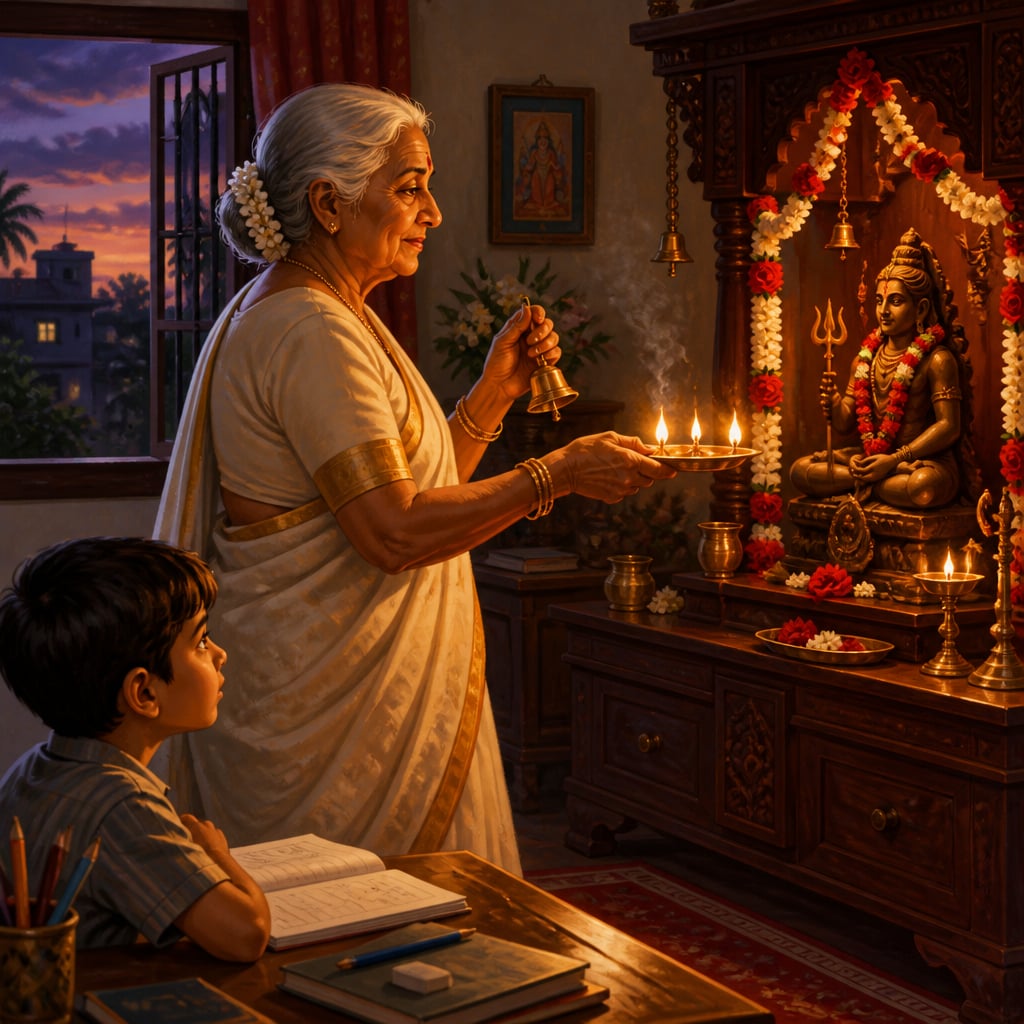
Saraswati Patti circling the camphor aarti before her home altar at sandhya, 1996

1996 की नवंबर की एक शुक्रवार की शाम, तमिलनाडु के इरोड़ शहर के एक छोटे से फ्लैट में, सरस्वती पट्टि नाम की एक दादी माता शाम की आरती की तैयारी कर रही हैं। उनकी उम्र अड़सठ वर्ष है और उन्होंने इस अनुष्ठान को इसी घंटे, इसी पीतल की अलमारी के सामने, इसी दिशा में तेचालीस साल से हर दिन किया है। उनके नौ साल के पोते कार्तिक पीछे की ओर ज़मीन पर बैठे हैं - भूगोल का होमवर्क अधूरा है।

सूरज अभी-अभी डूबा है। फ्लैट में चमेली, सम्भ्रानी की खुशबू, और अगले कमरे से खिचड़ी पकने की गंध आ रही है। पट्टि पूजा की अलमारी के ऊपर बनी छोटी स्टील की अलमारी खोलती हैं, एक पाँच-बत्ती वाला पीतल का दीप निकालती हैं - इसे पंचाआरती कहते हैं। हर कपास की बत्ती को घी में डुबोती हैं और एक-एक करके एक माचिस से जलाती हैं। फिर पीतल की चिमटी से कर्पूर का एक छोटा टुकड़ा उठाती हैं, उसे जलाती हैं, और अलग से एक थाली पर रखती हैं। कर्पूर टड़ाक-टड़ाक करके नीली लौ में जलने लगता है। पाँच घी की बत्तियाँ स्थिर और पीली-पीली जलती हैं।

पट्टि अपने बाएँ हाथ से एक छोटी पीतल की घंटी बजाती हैं। दाएँ हाथ से वह वेंकटेश्वर की तस्वीर के सामने, जो अलमारी के बीच में है, कर्पूर की लौ को घुमाना शुरू करती हैं। बीस के पैरों के सामने तीन बार, पेट के पास दो बार, सीने पर एक बार, चेहरे पर एक बार, पूरी तस्वीर के चारों ओर सात बार। उनकी आवाज़, धीमी और शांत, गीत गाने लगती है।

कर्पूर गौरं करुणावतारं, संसार सारं भुजगेन्द्र हारं।

कार्तिक ने अपनी कलम रख दी है। वह यह गीत छह दिन हर शाम सुन रहे हैं। बचपन से जब से सुन सकते हैं तब से सुन रहे हैं। उन्हें संस्कृत का अर्थ नहीं पता। उन्हें जानने की भी ज़रूरत नहीं है। उनके कंधे आधा इंच नीचे आ गए हैं। साँसें धीमी हो गई हैं। होमवर्क पर ध्यान नहीं है, पर घबराहट भी नहीं है। पाँच मिनट पहले जो फ्लैट घबराहट वाला लगा रहा था, अब एक शांत लय में आ गया है - ऐसी लय जो इस कमरे के किसी भी व्यक्ति से पुरानी है।

सबक यह है कि कार्तिक के तंत्रिका तंत्र के साथ क्या हो रहा है - कि लौ कर्पूर की है न कि मोम की, कि दीप में पाँच बत्तियाँ हैं न कि एक, कि भजन दोहराया जाता है, और क्यों अमेरिका की एक wellness कंपनी अभी वही प्रोटोकॉल पाँच सौ डॉलर में बेच रही है - वेंकटेश्वर की तस्वीर को काट कर निकाल दिया।

What the Closing Lamp Actually Is

Aarti is the closing protocol of every Hindu puja, from the smallest household shelf to the largest temple sanctum. The word comes from the Sanskrit aaratrika, meaning the waving of light before the deity at the time when natural light is leaving. It is performed at sandhya, the threshold hours of dawn and dusk, when the sky is neither bright nor dark and the body is shifting between the day-active sympathetic nervous system and the night-rest parasympathetic.

The ritual has three named instruments and a fourth carrier wave.

The ritual closes with deeparadhana, the offering of the lamp's light to the worshippers themselves. Each person present passes the palms over the flame and brings them to the eyes and the head. The flame is not just shown to the deity. The deity's blessing, carried by the flame, is then transferred to the household.

The Scripture Says

The textual basis for aarti is older than most of its modern critics know. The Skanda Purana, in its Brahmottarakhanda section, is the canonical source for the procedural detail of how aarti is performed. The Garuda Purana, the Padma Purana, and the Linga Purana all carry parallel prescriptions. The Vishnu Dharmottara Purana, from around the seventh century, prescribes the specific number of circulations: three at the feet, two at the navel, one each at the chest and face, and seven around the whole.

कर्पूरगौरं करुणावतारं संसारसारं भुजगेन्द्रहारम्। सदा वसन्तं हृदयारविन्दे भवं भवानीसहितं नमामि॥

karpūra-gauraṃ karuṇā-avatāraṃ saṃsāra-sāraṃ bhujagendra-hāram sadā vasantaṃ hṛdayāravinde bhavaṃ bhavānī-sahitaṃ namāmi

White as camphor, the very embodiment of compassion, the essence of the world, garlanded by the king of serpents. Forever dwelling in the lotus of my heart, I bow to Bhava with Bhavani.

Traditional Shaiva aarti verse, attested in the Linga Purana commentary tradition

The verse names camphor explicitly. The choice of camphor is not aesthetic. The Linga Purana commentary explains that camphor burns clean, leaves no residue, and is therefore the most fitting offering of fire: the worshipper's ego, like the camphor, is to be offered in full to the deity, with nothing held back.

Royal aarti performed for Pulakeshin II at Aihole, 634 CE

The Aihole rock inscription, carved by the court poet Ravikirti in 634 CE for the Chalukya king Pulakeshin II, contains one of the earliest datable references to a royal rajaaarti, the aarti performed for a king after his victory over Harshavardhana. The inscription documents that aarti was a state ceremony of honour as well as a household devotional rite. The protocol moved between throne and shelf without changing its core grammar.

Why the Body Responds

The aarti is engineered, not improvised. Every element is calibrated to drop the worshipper's nervous system into a parasympathetic state in roughly three minutes.

The flame. Roger Ulrich's 1984 paper on environmental gaze-disruption documented that the eye fixed on a small flickering light source in low ambient light enters a measurable trance state within ninety seconds. The technical name in modern psychology is trataka, the same Sanskrit word the Yoga texts have used for two thousand years. The camphor flame, which flares and crackles in unpredictable rhythm, is a more powerful trataka object than a steady candle. The brain is forced to attend to it without becoming bored.

The bell. The continuous bell in the 400 to 500 Hz range is in the frequency band documented by Stephen Porges's polyvagal research at the University of Illinois to produce vagal afferent stimulation. The vagus nerve is the body's main parasympathetic carrier. Repeated bell strokes shift heart rate variability into the parasympathetic range within sixty to ninety seconds.

A circle of village devotees singing a slow bhajan in a temple courtyard at dusk

The bhajan. Group singing at 60 to 80 beats per minute with simple repetitive melody is the single most reliable trigger of theta brainwave states known to neuroscience. Cahn and Polich's 2006 review in Psychological Bulletin synthesised forty years of EEG data on meditation and chanting and concluded that group bhajan-style singing produces theta states equivalent to twenty minutes of seated meditation in roughly five minutes.

The breath synchronisation. Singing the bhajan forces the breath into a slow extended exhale. Slow extended exhale is the single most direct lever on the parasympathetic system available to a conscious human. Patanjali's Yoga Sutras 1.34, prachhardana-vidharanabhyam va pranasya, names this exact technique: through expulsion and retention of breath, the mind becomes still.

The cumulative effect. Bell, flame, breath, group voice, and ghee smoke all converge on the same nervous system in the same three minutes. The Benson relaxation response, which Herbert Benson documented at Harvard Medical School in 1975 and which remains one of the most-cited findings in mind-body medicine, names exactly this convergence as the optimal stress-reduction protocol. Aarti was producing it in every Hindu home four thousand years before Benson named it.

What the Labs Found

The research record on aarti's component parts is now substantial. Three findings stand out.

First, the Kalyani et al fMRI study at NIMHANS in 2011, published in the International Journal of Yoga, scanned the brains of subjects chanting Om and slow Sanskrit syllables. The scan showed deactivation of the limbic system, particularly the amygdala, with simultaneous activation of the vagal and parasympathetic centres. The neural signature is identical to deep meditation.

Second, the Bernardi et al study at the University of Pavia, published in BMJ in 2001, measured cardiovascular response to slow recitation. Six-second-per-cycle slow chanting, exactly the cadence of most aartis, was found to enhance baroreflex sensitivity and improve heart rate variability to the level produced by trained yogic pranayama.

Third, the Dunbar et al study at Oxford in 2012, in Proceedings of the Royal Society B, measured endorphin release in groups of people singing together. Group singing produced significantly higher endorphin levels than solo singing or quiet listening. The aarti's group bhajan layer is doing exactly what Dunbar's lab measured.

None of these papers cite the Skanda Purana. None mention Ravikirti's Aihole inscription. The grandmother in Erode does not need either citation. She has the protocol. Her grandson's nervous system has the result.

What the World Calls It Now

The Chopra Center sells trataka candle-gazing meditation workshops at between two hundred and five hundred dollars a session. The workshops describe the practice as an ancient Hindu yogic technique for focus and neural training. The product copy is correct. What it leaves out is that trataka without a deity to gaze at, without a community singing the bhajan, and without the bell carrying the vagal frequency, is one quarter of the aarti protocol stripped of the other three quarters that make it work.

Sound bath wellness sessions, popularised by California-based practitioners since the early 2000s and now offered at a hundred to three hundred dollars per session, are a parallel coopt. The sound bath uses Tibetan bowls or quartz bowls in place of the temple bell, runs at the same frequency band Porges identified, and produces a similar parasympathetic shift. The bell at the puja shelf does the same job for free.

Group humming apps and guided breathwork retreats in Bali, Costa Rica, and Joshua Tree retail group-chant and slow-breath protocols at upward of three thousand dollars per week. The breath cadence prescribed in these retreats is the same six-second cycle Bernardi measured at Pavia, the same cadence the bhajan has run on for at least fifteen hundred years.

Aromatherapy candles marketed by Diptyque, Jo Malone, and Anthropologie include sandalwood, jasmine, and frankincense at fifty to ninety dollars per candle. The original Hindu deepa, with ghee fuel and sambrani smoke alongside, is the unbranded, unpatented, unclaimed prior art.

The combined wellness market that has rebuilt fragments of the aarti protocol crossed seven hundred million dollars in annual revenue by 2023, per industry trade publications. None of the product layer mentions Patti at the brass shelf in Erode.

What to Call It Yourself

The renaming is small and exact. When the Chopra Center says trataka workshop, you say deeparadhana. When the wellness column says sound bath, you say ghanta and shankhanada. When the retreat says group breathwork, you say bhajan. When the candle catalogue says aromatherapy, you say deepa and dhoop.

The practice itself is portable to any household and costs almost nothing. A small brass lamp with five cotton wicks dipped in ghee, lit at dusk. A camphor block on a separate steel plate, lit and circled before the household altar or any image you hold sacred. A small brass bell rung continuously while the flame is circled. A short bhajan or aarti sung in whatever language is yours: Om Jai Jagdish Hare, Karpura Gauram, Sukhakarta Dukhaharta, or any traditional aarti from your family tradition. The protocol takes between three and seven minutes. It runs at sandhya, the threshold hours, ideally seven days a week.

The deeparadhana, the closing offering of the flame to the household members, is the part the wellness market cannot replicate. Each person present passes the palms over the flame and brings them to the eyes and the head. The light has been offered to the deity, and the deity's blessing now travels back into the household. The community node is the part that costs zero rupees and that no Chopra Center workshop sells.

The Brass Plate at the End

Back in Erode, the camphor has burned itself out. The five ghee wicks are still steady. Saraswati Patti turns from the shelf and holds the brass plate with the lit wicks toward Karthik. He stands up, sets his geography homework aside, and brings his palms over the flame and to his face. The brass plate carries the closing offering of forty-three years of evenings.

Karthik will not remember the geography homework. He will, decades later in a different city, light the same panchaarti at the same hour and find that his shoulders drop a half inch the moment the wicks catch. The protocol will have done its work. He will not have to know the name of the brain stem nucleus the bell stimulates, the journal where Cahn and Polich published, or the dollar figure of the sound-bath market. He will have the brass lamp, the camphor block, and the bhajan his grandmother sang. The aarti, three thousand years old at the latest dating, will run again, on schedule, at sandhya, in his own household, with nothing missing.

Case studies

The Aihole Inscription and the Royal Aarti for Pulakeshin II (634 CE)

In 634 CE, the Jain court poet Ravikirti carved a Sanskrit prashasti, a panegyric inscription, into the rock face of the Meguti Jain temple at Aihole in present-day Karnataka. The inscription celebrated the achievements of his patron Pulakeshin II, the Chalukya king who had recently defeated Harshavardhana of Kannauj at the river Narmada. Among the ceremonies described in the prashasti is a royal aarti performed for Pulakeshin II after his victory. The inscription is one of the earliest datable references to aarti as a public state ceremony, documenting that the protocol existed not only as a household devotional act but as a formal honour conferred on a king.

The aarti's appearance in the Aihole record is not surprising in the dharmic frame. The protocol was understood as a mode of honour, applicable to anyone in whom the divine quality was being recognised: the deity at the puja shelf, the king at his consecration, the bridegroom at his wedding, the elder at his arrival home. The Skanda Purana Brahmottarakhanda specifies the procedural elements without specifying the recipient, which is why the protocol moved between deity and king without modification. The same camphor, the same circulation pattern, the same bhajan layer.

The Aihole inscription has become one of the most cited primary sources for early medieval Indian history. Its reference to the rajaaarti is the earliest precisely datable evidence that the Hindu closing-flame protocol was a public ceremony as well as a household one, with continuous documentary attestation from 634 CE forward across temple inscriptions, court chronicles, and Puranic prescriptions.

The continuity of the aarti from 634 CE to the household shelf in Erode in 1996 is not a fact about religion. It is a fact about engineering. A protocol that retains its core elements across thirteen centuries, across royal courts and rural courtyards, across regional languages and sectarian variations, is doing something the practitioners are not letting go of. The neurological vindication, when it arrived in the second half of the twentieth century, only confirmed what the protocol's longevity had already proven.

Aihole rock inscription, 634 CE, carved by Ravikirti for Pulakeshin II of the Chalukya dynasty. Earliest datable reference to royal aarti as a public state ceremony of honour, alongside its household devotional form.

Trataka Workshops at $500 a Session: The Flame Without the Deity

The Chopra Center, founded by Deepak Chopra and David Simon in 1996, sells trataka candle-gazing meditation workshops at between two hundred and five hundred dollars a session. The workshops describe the practice as an ancient Hindu yogic technique for focus and neural training. Parallel offerings exist at a hundred Western wellness centres, in Bali retreat packages at three thousand dollars a week, and in standalone candle-gazing apps with monthly subscriptions. The combined trataka-as-wellness market is estimated at over fifty million dollars annually. The product copy is technically correct: trataka is an ancient Hindu yogic technique. What it leaves out is that the practice was never designed to run alone.

In the Hindu frame, trataka is one quarter of the aarti protocol. The flame is meant to be held in front of a deity, accompanied by the ghanta in the 400 to 500 Hz vagal frequency band, with the bhajan running on the breath, and the deeparadhana returning the offered light to the worshippers as community. To extract trataka and sell it as a standalone candle-gazing technique is permitted, but the practice has been stripped of three quarters of what makes it work. The Chopra Center session is a fragment. The household aarti is the whole.

The trataka wellness market continues to grow, with new offerings in mindfulness apps, corporate wellness programs, and university stress-reduction courses. None of the product layer references the Skanda Purana, the Vishnu Dharmottara Purana, or the procedural detail of the panchaarti. The grandmother in Erode runs the full protocol every evening at sandhya for the cost of a few rupees of camphor and ghee.

The right response to the asymmetry is not anger. It is articulation. Buy the trataka workshop if you want one neural lever in isolation. Run the aarti at home if you want the full four-instrument protocol with the community node included. Five hundred dollars at the Chopra Center buys you the flame. Five rupees of camphor at home buys you the flame, the bell, the bhajan, the breath cadence, and the deeparadhana that returns the light to the household. Choose the protocol over the product. Or run both, and know which one is doing the actual work.

Chopra Center trataka workshops: $200-$500 per session. Combined Western wellness market for trataka, sound bath, breathwork, and aromatherapy: over $700 million annually as of 2023. Household aarti cost: roughly 5 rupees of camphor per week, plus a one-time brass lamp purchase. Textual backing of the household protocol: Skanda Purana Brahmottarakhanda 14 and Aihole inscription 634 CE.

Benson, Bernardi, Cahn, Polich, Kalyani, Dunbar: Six Labs That Vindicated the Aarti

Across forty years of laboratory work, six independent research programs in Western and Indian neuroscience have measured the effects of the aarti's component parts. Herbert Benson at Harvard Medical School in 1975 named the Relaxation Response, the parasympathetic state produced by repeated mantra, slow breath, passive attention, and a quiet environment. Bernardi et al at the University of Pavia in 2001, in BMJ, measured cardiovascular benefits of six-second-per-cycle slow chanting equivalent to formal pranayama. Cahn and Polich at the Scripps Research Institute in 2006, in Psychological Bulletin, synthesised four decades of EEG data on meditation and chanting, concluding that group singing produces theta states equivalent to twenty minutes of seated meditation in five. Kalyani et al at NIMHANS in 2011, in the International Journal of Yoga, scanned the brains of Om-chanters and documented amygdala deactivation paired with vagal activation. Dunbar et al at Oxford in 2012, in Proceedings of the Royal Society B, measured significantly higher endorphin release in groups singing together than in solo singers. None of these papers cite the Skanda Purana.

The Skanda Purana, the Vishnu Dharmottara Purana, and the Linga Purana commentary tradition specify the aarti's instruments, frequencies, cadences, and community structure with a precision that anticipated the modern neuroscience by at least a thousand years. The bell's frequency band, the bhajan's six-second cadence, the camphor's combustion profile, the deeparadhana's community node, and the threshold-hour timing at sandhya are all engineered choices, codified in the Puranic literature. The labs catching up to the engineering is welcome. The engineering does not require the catch-up to function.

The combined research literature on the aarti's component mechanisms has now been cited in over twenty thousand subsequent studies in mind-body medicine, polyvagal theory, evidence-based meditation research, and group-cohesion neuroscience. The aarti itself has not been cited as a source in any of these citation networks. The grandmother continues to run the protocol at sandhya in every household across Bharat with no awareness of and no need for the citation network.

When six independent labs converge on the same conclusion the Hindu Puranic tradition codified a thousand years earlier, the right response is not surprise. It is recognition. The aarti is not a folk superstition that happens to coincide with neuroscience. It is one of the longest-running, most carefully engineered nervous-system regulation protocols in any civilization, and the modern academic catch-up has only confirmed what the household practitioners have known for generations. The right reading is that the aarti is evidence-based dharmic engineering whose evidence base has only recently been published in journals the engineers themselves never needed to read.

Benson 1975: Relaxation Response. Bernardi et al 2001 BMJ: six-second slow chant cardiovascular benefit. Cahn and Polich 2006 Psychological Bulletin: group singing theta state in five minutes. Kalyani et al 2011 NIMHANS: amygdala deactivation in Om-chanters. Dunbar et al 2012 Royal Society B: group singing endorphin release. The Skanda Purana Brahmottarakhanda 14 specified the protocol that produces all five effects, in one ritual, by c. 1000 CE.

Historical context

From the Skanda Purana's procedural codification of aarti (c. 800-1100 CE) and the Aihole rock inscription's documentation of royal aarti (634 CE), through the Linga Purana's anchoring of the Karpura Gauram verse, Patanjali's Yoga Sutra 1.34 on slow exhale (c. 200 CE), the Benson Relaxation Response paper (1975), the Bernardi et al BMJ study of slow chanting (2001), the Cahn and Polich Psychological Bulletin meta-analysis (2006), the Kalyani et al NIMHANS Om-chant fMRI (2011), the Dunbar et al Oxford group-singing endorphin study (2012), to the modern $700 million wellness market for trataka, sound bath, breathwork, and aromatherapy candles.

The aarti is the closing protocol of the entire Hindu devotional architecture. From the smallest household shelf to the largest temple sanctum at Tirupati, Madurai, Puri, Vaishno Devi, and Kashi, the same four instruments run in the same configuration: lamp, camphor, bell, bhajan. The protocol has not been institutionally interrupted at any point in the last fifteen hundred years, across every regional tradition, every sectarian variation, and every economic context in Bharat. The rajaaarti at Aihole and the panchaarti in Erode are the same ritual at different scales. The continuity is the proof that the engineering works.

Living traditions

The combined Western wellness market for trataka workshops, sound baths, group breathwork retreats, and aromatherapy candles crossed seven hundred million dollars in annual revenue by 2023, with the Hindu source layer almost entirely deleted from the product copy. The household aarti runs free at sandhya in several hundred million households across Bharat at the cost of five rupees of camphor a week, with three thousand years of textual backing and six independent laboratory programs in the supporting literature. Re-Sanskritize: when the Chopra Center sells a trataka workshop, you say deeparadhana. When the wellness column says sound bath, you say ghanta. When the retreat sells group breathwork, you say bhajan. When the catalogue sells aromatherapy candles, you say deepa and dhoop. Light a five-wick brass panchaarti at dusk every day. Burn a small block of karpura on a steel plate beside it. Ring a small brass bell continuously while you circle the camphor flame before the deity, the photograph, or the image you hold sacred. Sing a short bhajan in whatever language is yours. Close with the deeparadhana, palms over the flame and to the eyes. Three to seven minutes a day, seven days a week, at sandhya.

Reflection

More in देवता: भक्ति और मंदिर साधना

All lessons in देवता: भक्ति और मंदिर साधना · संस्कार: सनातन संचालन प्रणाली course