Swayam-Poshita: The Economics of Self-Sufficiency

How Villages Produced Everything They Needed

Understand the economic foundations of village self-sufficiency, local production of food, goods, and services that enabled villages to thrive independently while remaining connected to larger trade networks.

The Complete Village
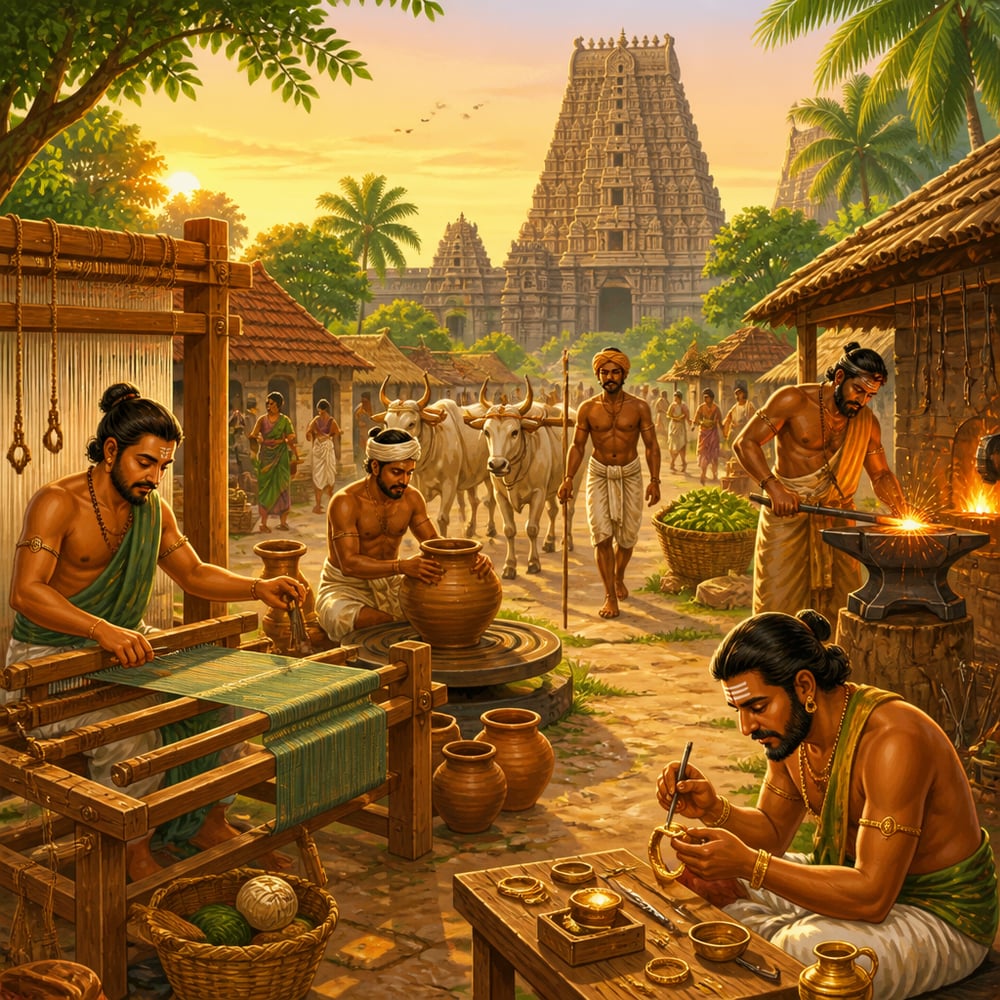
An 11th-century Tamil village at Gangaikondacholapuram with all trades at work

In the village of Gangaikondacholapuram in 11th century Tamil Nadu, a visiting merchant would find something remarkable: everything the villagers needed for daily life was produced within walking distance. The rice in their fields, the cloth on their looms, the pots from their kilns, the tools from their smithy, the carts from their carpenters, all local.

This wasn't primitive isolation. Gangaikondacholapuram was the capital of an empire that traded with Southeast Asia, China, and Arabia. The choice of local self-sufficiency in basics was strategic, not backward. It meant that when monsoons failed or trade routes closed, villagers still ate.

What Self-Sufficiency Actually Meant

The Sanskrit term swayam-poshita (self-nourishing) captures the economic philosophy: a village should produce what it needs for survival, trading for what it cannot produce but never becoming dependent on external supply for essential goods.

Self-Sufficient In:

Trading For:

The village was self-sufficient in necessities while participating in trade for specialties, a balanced model avoiding both isolation and dependency.

The Occupational Foundation
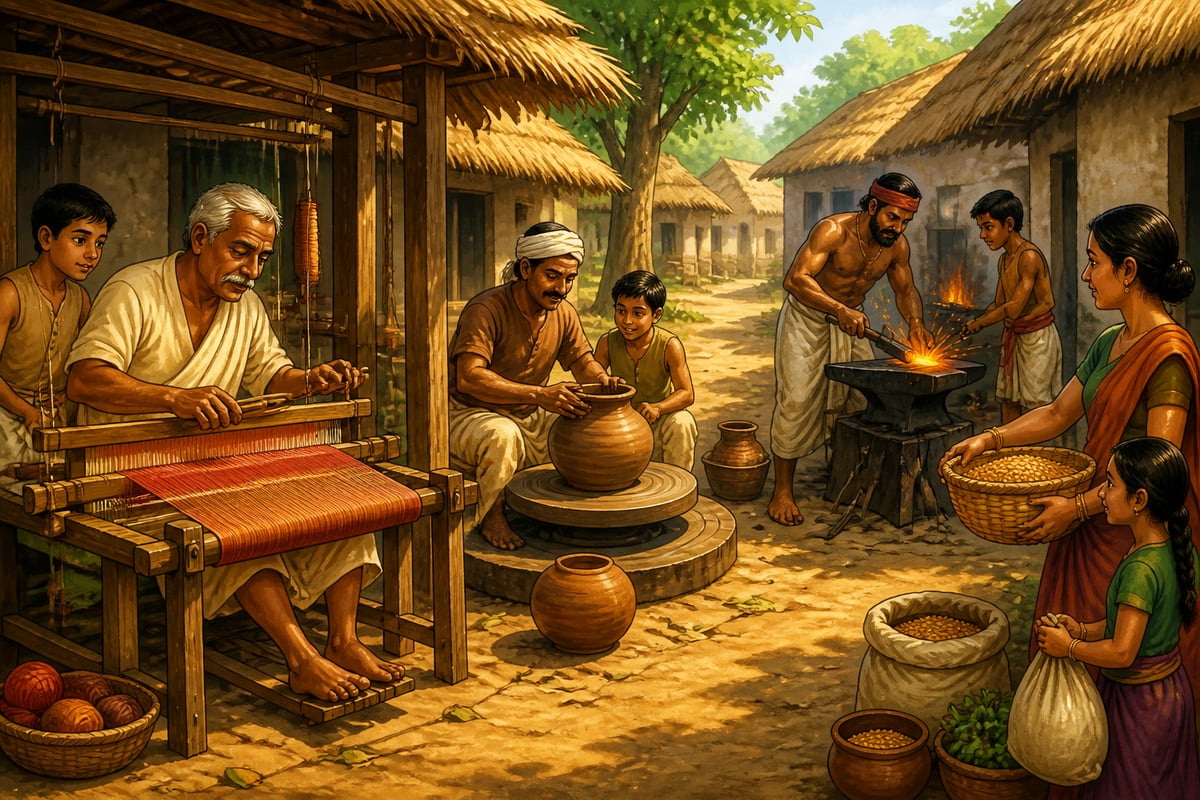
A medieval Indian craftsmen's lane with weaver, potter and blacksmith at work

Self-sufficiency required a complete set of occupations within each village. The Arthashastra describes the ideal village composition, and inscriptions confirm this pattern:

Agricultural Base:

Manufacturing:

Services:

This wasn't accidental, it was designed. The Arthashastra recommends that when founding a new settlement, these occupations should be present from the beginning.

The Economics of Mutual Obligation

How did villagers obtain services from each other without constant cash transactions? Through the jajmani system, a network of hereditary service relationships where families provided services to each other across generations.

The blacksmith didn't sell each ploughshare for cash. He supplied tools to farming families who, in return, provided him with grain at harvest. The relationship was ongoing, not transactional, creating stability and reducing market dependence.

We'll explore the jajmani system in detail in our next chapter, but its economic function was clear: it enabled self-sufficiency without requiring monetization of every exchange.

Why Self-Sufficiency Mattered

Resilience Against External Shocks: When trade routes closed, whether from war, monsoon failure, or political disruption, self-sufficient villages survived. They might lose luxuries but kept necessities.

Bargaining Power in Trade: A village that could survive without external trade entered markets from a position of strength. They traded when terms were favorable, not out of desperate need.

Protection Against Exploitation: When you don't need someone's goods to survive, they can't extort you. Self-sufficiency was economic power.

Preservation of Skills: Local production maintained craft knowledge across generations. Skills weren't outsourced to distant specialists who might disappear.

The Balance: Not Autarky

Importantly, Indian villages were not autarkic, completely closed and self-sufficient. They actively participated in trade:

Weekly Markets (haat): Villagers gathered at regional markets to exchange surpluses and obtain goods from other areas.

Itinerant Traders: Merchants traveled between villages, bringing goods unavailable locally.

Temple Trade Networks: Temples connected villages to larger commercial networks through their procurement and distribution activities.

Specialized Production for Export: Many villages produced specialty goods (particular textiles, metalwork, spices) for distant markets while remaining self-sufficient in basics.

The model was strategic self-sufficiency in essentials combined with active trade participation in specialties, not isolation.

Global Perspectives on Local Self-Sufficiency

Western economic thought has oscillated between celebrating free trade and recognizing the value of local production. Several thinkers arrived at insights similar to swayam-poshita:

Wendell Berry (1934-present), the American farmer and essayist, argues in 'The Unsettling of America' (1977) that healthy communities require local economic self-sufficiency. Berry critiques the 'get big or get out' model that destroyed American family farms, the same process that disrupted Indian villages under colonial rule.

Jane Jacobs (1916-2006), in 'The Economy of Cities' (1969), demonstrated that economic vitality comes from import replacement, communities learning to produce locally what they previously imported. Her research showed that cities (and by extension, villages) that developed diverse local production were more resilient than those that specialized.

Friedrich List (1789-1846), the German economist, argued against free trade orthodoxy in 'The National System of Political Economy' (1841). He showed that Britain preached free trade only after building its own manufacturing capability behind protectionist walls, strategic self-sufficiency first, then trade.

Thinker Key Insight Swayam-Poshita Parallel
Berry Local production sustains community Village self-sufficiency maintained social fabric
Jacobs Import replacement drives growth Villages produced locally before trading
List Strategic capability before trade integration Self-sufficiency in essentials, trade in specialties

The Indian village anticipated all these insights, and practiced them successfully for millennia.

A Living Example: 2025

A women-led FPO processing centre grading turmeric and millet in 2024

In November 2024, the Ministry of Agriculture reported that Farmer Producer Organizations (FPOs) with strong local processing capabilities showed 40% higher incomes during supply chain disruptions than those dependent on distant markets for processing.

The ancient wisdom survives in modern data: communities that process their own produce locally have resilience that pure market integration doesn't provide.

The Atmanirbhar Bharat (Self-Reliant India) initiative, launched in 2020, explicitly echoes this philosophy, not isolation from global trade, but strategic capability in essential sectors.

Your Turn: Strategic Self-Sufficiency

The village model wasn't about rejecting trade but about never being dependent on it for survival. The principle scales:

For individuals: Build skills that remain valuable regardless of employer. Maintain savings that cover essentials. Don't become so specialized that you're helpless without your current job.

For organizations: Ensure critical capabilities are in-house or under your control. Outsource for efficiency, but not for survival-critical functions.

For nations: The semiconductor discussion, the vaccine manufacturing push, the defense indigenization, all reflect ancient wisdom about strategic self-sufficiency.

In our next lesson, we'll examine grama-niyama, the regulations and norms that governed village trade and commerce.

Modern supply chain theory now emphasizes 'strategic reshoring' of critical goods, exactly what Indian villages practiced instinctively.

The Indian model wasn't ideological but pragmatic: trade when beneficial, but never trade away the ability to survive independently.

Post-COVID, countries that maintained domestic capacity for essential goods (PPE, vaccines, semiconductors) fared better, validating the ancient insight.

Jane Jacobs' 'The Economy of Cities' argues that economic diversity creates resilience. Indian villages intuited this principle millennia earlier.

The Indian approach embedded diversity into social structure through occupation-based communities (jatis), making it self-perpetuating rather than requiring constant planning.

Research on economic complexity (Ricardo Hausmann, MIT) shows that diversified economies are more resilient, the village model at national scale.

Key terms

Swayam-Poshita
Self-nourishing or self-sustaining, the quality of an economic unit that produces what it needs for survival without depending on external supply.
Shilpi
Craftsman, artisan, one skilled in a particular craft or trade, essential for village self-sufficiency in manufactured goods.
Haat
Weekly market where villagers gathered to trade surpluses and obtain goods not produced locally, the interface between village self-sufficiency and regional trade.
Jajmani
The system of hereditary service relationships between families of different occupations, a network of mutual obligations that enabled village self-sufficiency without constant cash transactions.

Verses

ग्रामो जनपदस्याधारः कृषिगोरक्षव्यापारैर्वर्तते

Gramo janapadasyaadhaarah krishi-goraksha-vyapaaraih vartate

The village is the foundation of the territory; it sustains itself through agriculture, cattle-keeping, and trade.

The three pillars, agriculture, animal husbandry, and trade, form a complete economic system. Each village should have all three rather than specializing in just one.

Arthashastra, Book 2, Chapter 1, Verses 1-5 (R.P. Kangle)

कार्यकुशलाः सर्वे ग्रामे वसन्तु शिल्पिनः

Karya-kushalah sarve grame vasantu shilpinah

Let all craftsmen skilled in their work dwell in the village.

Self-sufficiency requires planned diversity of occupations, not specialization into monoculture. The village should be economically complete.

Shukraniti, Chapter on Village Planning (B.K. Sarkar)

Key figures

Chanakya (Kautilya)

Author of the Arthashastra, which provides detailed prescriptions for village economic organization · 4th century BCE

The Arthashastra's sections on village planning show that self-sufficiency was not accidental but designed. Chanakya recommends specific occupations for each village and describes how villages should relate to state and market.

R. Vaidyanathan

Professor of Finance at IIM Bangalore, researcher on indigenous Indian economic systems · Present (born 1949)

Through works like 'India Uninc' and numerous papers, Vaidyanathan has documented how India's informal economy, rooted in village patterns of local production and mutual obligation, continues to function alongside the formal economy.

Wendell Berry

American farmer, poet, and agrarian philosopher advocating for local economies and land stewardship · Present (born 1934)

In works like 'The Unsettling of America' (1977) and 'What Are People For?' (1990), Berry argues that healthy communities require local economic self-sufficiency, particularly in food production. He critiques the 'get big or get out' model of industrial agriculture as destructive to both land and community, echoing what happened when colonial policies disrupted Indian village self-sufficiency.

Case studies

Taiwan's Semiconductor Strategy: Modern Swayam-Poshita at National Scale

In the 1980s, Taiwan faced an existential strategic problem. A small island of 23 million people, claimed by China and protected only by implicit American support, needed a way to make itself indispensable to the world economy. The solution, championed by technocrat K.T. Li and industrialist Morris Chang, was to become the world's essential producer of advanced semiconductors. Taiwan didn't try to be self-sufficient in everything, that was impossible for a small island. Instead, it identified ONE strategic capability and achieved near-monopoly: advanced chip manufacturing. By 2024, TSMC (Taiwan Semiconductor Manufacturing Company) produces over 90% of the world's most advanced chips. Every iPhone, every AI server, every advanced weapon system depends on Taiwanese production. This wasn't accidental. Taiwan invested heavily in semiconductor education, created science parks with favorable conditions, and deliberately built capabilities that couldn't easily be replicated. When China threatened, when COVID disrupted supply chains, Taiwan's semiconductor monopoly gave it global protection.

The Arthashastra's principle of swayam-poshita wasn't about total isolation, it was about strategic capability in essentials. Taiwan applied this principle at national scale: be self-sufficient (actually, be world-leading) in something so essential that others depend on YOU. The dharmic insight is about bargaining power. The ancient Indian village could survive without external trade because it produced its essentials locally. Taiwan reversed this: it made itself so essential to global technology that the world cannot afford to let it be threatened. Both strategies, local self-sufficiency and indispensable specialization, achieve the same goal: independence through capability, not through isolation.

Taiwan's semiconductor strategy has provided remarkable security. When Russia invaded Ukraine in 2022, the global response was muted compared to concerns about Taiwan, because a Taiwan conflict would crash the global economy. The US has invested $52 billion in the CHIPS Act (2022) partly to reduce dependence on Taiwan, but replicating decades of capability takes time. India has recognized this lesson. The PLI (Production-Linked Incentive) scheme for semiconductors (2021-24) allocated ₹76,000 crore to build domestic chip manufacturing, explicitly citing strategic self-reliance. The Tata-Powerchip fab in Gujarat and the Micron facility in Sanand represent India's attempt to build swayam-poshita in this critical sector.

Strategic self-sufficiency isn't about producing everything locally, it's about controlling capabilities that matter. Taiwan identified semiconductors as the modern equivalent of village grain production: something so essential that controlling it provides security. India's Atmanirbhar Bharat strategy follows the same logic, identify critical sectors (semiconductors, pharmaceuticals, defense) and build local capability.

Taiwan's chip strategy is being replicated globally. The US CHIPS Act (2022), the EU Chips Act, and India's semiconductor PLI scheme all pursue strategic self-sufficiency in critical capabilities. The ancient village insight that controlling essential production provides security now operates at geopolitical scale.

TSMC controls 90%+ of advanced chip manufacturing (sub-7nm). India's PLI scheme has attracted ₹1.5 lakh crore investment commitments in electronics manufacturing, applying swayam-poshita principles to 21st-century technology.

Historical context

Across Indian history (from Mauryan period to colonial disruption)

Village self-sufficiency was a civilizational constant across dynasties and regions. The system adapted to local conditions, rice villages in the south, wheat in the north, millets in the Deccan, while maintaining the core principle of local production of essentials.

Contemporary European manorial villages were similarly self-sufficient but under feudal control, not self-governance. The Chinese village was more market-integrated and state-directed. India's combination of self-sufficiency with self-governance was distinctive.

British revenue records from the 1800s document villages containing 12-15 distinct occupational groups, confirming the ancient prescriptions for economic completeness.

Understanding village self-sufficiency reveals that the modern focus on supply chain resilience and strategic self-reliance (Atmanirbhar Bharat) has deep indigenous roots.

Living traditions

The Atmanirbhar Bharat (Self-Reliant India) initiative explicitly echoes village self-sufficiency philosophy, applying it at national scale to strategic sectors.

Reflection

More in The Self-Sufficient Village Republic

All lessons in The Self-Sufficient Village Republic · Grama Swarajya: Village Economics course