Grama-Sabha: Democratic Economic Decision-Making
When the Village Gathered, Everyone Had a Voice
Explore how the grama sabha, the village assembly, functioned as a democratic economic institution, making binding decisions on land allocation, water rights, taxation, and dispute resolution through collective deliberation.
Under the Banyan Tree
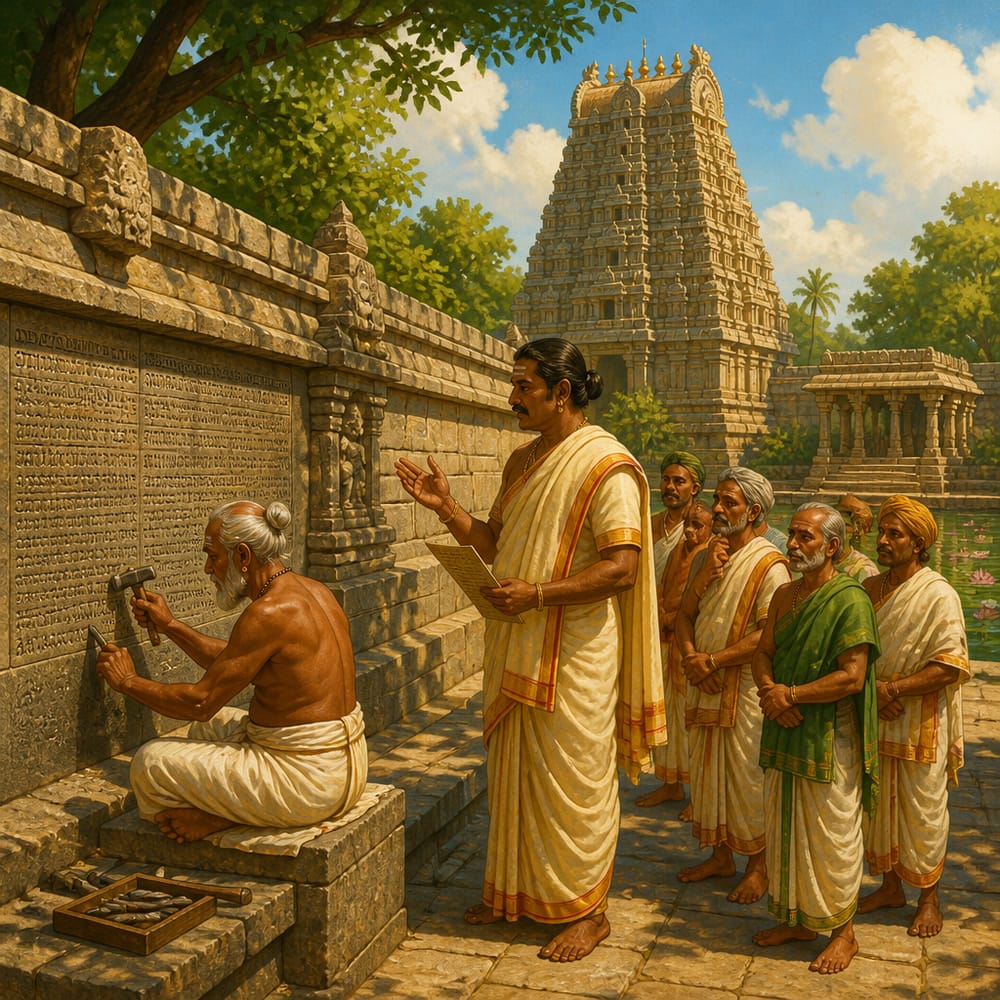
In the village of Uttaramerur, near present-day Chennai, a remarkable inscription from 920 CE records something extraordinary: detailed rules for village elections, term limits for committee members, and disqualification criteria for corruption. This wasn't Athenian democracy reaching India, it was grama sabha democracy that had been functioning for centuries.
The Uttaramerur inscription, carved during the reign of Chola king Parantaka I, gives us an unusually detailed window into how Indian villages governed themselves economically. And what we see challenges any notion that democratic decision-making is a Western invention.
The Heart of Village Economics
The grama sabha (village assembly) was not merely a gathering, it was the supreme economic authority within the village. In Sanskrit texts, its decisions were considered sabha-dharma: the righteous law of the assembly.
Consider what this meant in practice. The Narada Smriti, a legal text from around the 5th century CE, declares:
"सभायां धर्मं आचक्षीत सभैव धर्मनिश्चयः" "Sabhayam dharmam achakshita sabhaiva dharma-nishchayah" "Let dharma be declared in the assembly; the assembly itself determines what is dharma."
This wasn't abstract philosophy, it was constitutional law. The village assembly's economic decisions were binding, and even kings hesitated to overrule them.
What the Grama Sabha Actually Decided
Land Allocation and Tenure: When a family died without heirs, or new land was brought under cultivation, the grama sabha determined who would farm it. This wasn't arbitrary, the assembly considered need, capability, and contribution to community welfare.
Water Rights and Irrigation: In a monsoon-dependent economy, water was life. The grama sabha scheduled irrigation turns, organized tank maintenance, and adjudicated water disputes. The Tamil word for this collective water management, kudimaramat, literally means "community repair."
Taxation and Revenue: The village received a collective tax demand from the state. The grama sabha allocated individual shares based on landholding, ability to pay, and special circumstances. A family facing hardship might receive relief; one prospering would pay more.
Dispute Resolution: Most conflicts, land boundaries, unpaid debts, property inheritance, commercial disagreements, were resolved in the grama sabha. The principle of panch parmeshwar ("the five are god") meant the assembly's verdict carried divine sanction.
The Uttaramerur Model

The 920 CE inscription provides astonishing administrative detail:
Election Process: Committee members (variyar) were chosen annually by lot from eligible candidates. Names were written on palm leaves and drawn by a child, ensuring randomness and divine selection.
Term Limits: No one could serve consecutive terms. "He who has been on any committee in the last three years" was ineligible.
Disqualification Criteria: Those who had committed offenses, failed to submit accounts, or been involved in corruption were permanently barred.
Specialized Committees: The village had separate committees for tank management (eri-variyar), gardens (totta-variyar), and general administration (samvatsara-variyar).
Global Perspectives on Collective Governance
While Indian villages practiced assembly democracy, contemporary civilizations operated differently. In Carolingian Europe, the manorial lord decided, peasants had no voice. In Tang China, imperial bureaucrats governed even small villages. In the Abbasid Caliphate, the qadi (judge) came from outside, appointed by the caliph.
Western political thought eventually developed theories that validate the grama sabha's practice, but centuries later:
James Madison (1751-1836), in Federalist No. 10, argued that 'factions' (interest groups) could be managed through representative government. But the grama sabha went further, it wasn't representative but participatory, with all householders directly deliberating. Madison feared direct democracy; Indian villages practiced it successfully.
Elinor Ostrom (1933-2012), the first woman to win the Nobel Prize in Economics (2009), demonstrated that communities can successfully govern common resources without central authority or privatization. Her 'design principles' for successful commons governance, clear boundaries, collective-choice arrangements, conflict resolution mechanisms, describe exactly what grama sabhas had institutionalized.
James C. Scott (1936-present), in Seeing Like a State (1998), showed how centralized planners fail because they lack 'metis', practical, local knowledge. The grama sabha was an institution designed specifically to harness metis: those who worked the land decided how to manage it.
| Thinker | Key Insight | Grama Sabha Practice |
|---|---|---|
| Madison | Factions need management | Direct participation eliminates factional capture |
| Ostrom | Communities can govern commons | Collective water/land management for millennia |
| Scott | Local knowledge beats central planning | Decisions made by those with metis |
The Economics of Collective Decision-Making
Why did assembly governance work economically? Several principles were embedded:
Information Advantage: Villagers knew their land, water, and neighbors better than any distant official could. Their decisions incorporated local knowledge impossible to centralize.
Accountability Proximity: Decision-makers lived with consequences. A grama sabha member who allocated water unfairly would face his neighbors' anger daily.
Risk Pooling: Collective responsibility for taxation meant the village absorbed individual shocks. One family's bad harvest didn't mean ruin, the community covered the shortfall.
Legitimacy: Decisions made collectively commanded respect that imposed rules could not. When the entire village agreed, enforcement was mostly unnecessary.
A Living Tradition in 2025

In October 2024, the Ministry of Panchayati Raj announced that 2.8 lakh gram sabhas had conducted social audits of MGNREGA works, villagers examining government expenditure in their communities, exactly as ancient grama sabhas would have.
The principle survives particularly strongly in tribal areas under the PESA Act (1996), where gram sabhas have significant powers over land, forests, and development plans. In states like Kerala, gram sabhas now approve or reject development projects, a direct echo of ancient authority.
Your Turn: Assembly Wisdom
The grama sabha teaches that those closest to a problem often have the best solutions, if given the authority to decide. In your context:
Consider a decision currently made by distant authorities that affects you directly. What would change if those affected decided collectively? What knowledge do you have that the decision-makers lack?
In our next lesson, we'll examine what foreign observers, from Megasthenes to Hiuen Tsang, recorded about these village republics, providing external validation of India's unique governance system.
Behavioral economists like Erez Yoeli have shown that perceived procedural fairness dramatically affects compliance, people follow rules they helped make. The grama sabha intuited this millennia ago.
Indian tradition added religious sanction ('panch parmeshwar') to collective decisions, creating even stronger legitimacy than purely procedural fairness.
Elinor Ostrom's research found that user-designed rules had compliance rates 80%+ higher than externally imposed regulations across diverse commons settings.
Friedrich Hayek's 1945 paper 'The Use of Knowledge in Society' argued that central planning fails because knowledge is dispersed. The grama sabha operationalized this insight two millennia earlier.
India didn't just recognize dispersed knowledge theoretically, it built institutions (the grama sabha) that systematically harvested local knowledge for governance.
Studies of forest management in India find that community-managed forests (van panchayats) often have better outcomes than both government-managed and private forests.
Key terms
- Grama Sabha
- The village assembly, the collective gathering of all adult householders with authority to make binding decisions on village affairs, from land allocation to dispute resolution.
- Panch Parmeshwar
- Literally 'the five are god', the principle that the collective judgment of a panel (typically five people) carries divine authority and must be accepted as final.
- Kudimaramat
- Community repair, the Tamil tradition of collective responsibility for maintaining village irrigation infrastructure, especially tanks and channels.
- Variyar
- Committee member in the Chola-era village governance system, elected representatives who managed specific aspects of village administration such as tanks, gardens, or general governance.
Verses
सभायां धर्मं आचक्षीत सभैव धर्मनिश्चयः
Sabhayam dharmam achakshita sabhaiva dharma-nishchayah
Let dharma be declared in the assembly; for the assembly itself is the arbiter of what is righteous.
Collective decision-making incorporates distributed knowledge and creates legitimacy that imposed rules cannot achieve, key advantages in resource governance.
Narada Smriti, Introduction, Verse 10 (Richard Lariviere)
पञ्च निश्चिनुयुः कार्यं तन्निश्चयात् न चलेत्
Pancha nishchinuyuh karyam tan-nishchayat na chalet
Let five determine the matter; from their determination, let none deviate.
Finality of decisions reduces transaction costs. When all parties accept that assembly verdicts are binding, litigation and dispute escalation are minimized.
Brihaspati Smriti, Chapter on Sabha (P.V. Kane)
N/A (Tamil original)
Variyar-perumakkal nilaiyil muppatu naal irukkalam
Committee members may serve for one year; they must not serve again for three years thereafter.
Term limits prevent entrenchment, ensure diverse participation, and reduce opportunities for corruption, principles now standard in modern corporate governance.
Uttaramerur Inscription, 920 CE, Tamil Nadu (K.V. Subrahmanya Aiyer)
Key figures
Parantaka I Chola
Chola king during whose reign the Uttaramerur inscription was created · 907-955 CE
The Uttaramerur inscriptions from his reign record election procedures, term limits, corruption prevention mechanisms, and specialized committees, showing that sophisticated democratic governance existed in Indian villages over a thousand years ago.
Elinor Ostrom
Political economist, Nobel Prize in Economics 2009 · 1933-2012
Through studying fisheries, forests, and irrigation systems worldwide, Ostrom demonstrated that neither government regulation nor privatization necessarily outperforms community-based management. Her 'design principles' for successful commons governance read like descriptions of grama sabha practice.
Devendra Fadnavis
Deputy Chief Minister of Maharashtra, former Chief Minister, advocate of gram sabha empowerment · Present (born 1970)
The Jalyukt Shivar program required each village's gram sabha to identify water conservation sites, prioritize works, and contribute shramdan (voluntary labor). By 2019, over 22,000 villages had become 'water neutral' through this gram sabha-driven model. Fadnavis has explicitly cited the Hiware Bazar and Ralegan Siddhi models as inspiration, scaling village assembly-led development to state policy.
Case studies
Mendha-Lekha: When a Gram Sabha Defeated the Forest Department
In 1992, the Gond tribal village of Mendha-Lekha in Maharashtra's Gadchiroli district faced an existential threat. The Forest Department planned to harvest bamboo from their ancestral forests, bamboo the village depended on for livelihood. The villagers had no legal title to the land their ancestors had inhabited for centuries. Rather than protest or petition, the village took an extraordinary step. Under the leadership of Devaji Tofa, the gram sabha passed a resolution: 'Our village, our rule' (Amhi amchya gavache swatah sarkar). They declared that no external authority could extract resources from their forests without gram sabha consent. The Forest Department dismissed this as legally meaningless. The gram sabha then did something remarkable, they documented every tree, every bamboo clump, every stream in their forest. They created their own management plan. When officials came to mark trees for felling, villagers, citing gram sabha resolutions, prevented entry. For years, the standoff continued.
The Narada Smriti declares 'the assembly itself determines what is dharma.' Mendha-Lekha's gram sabha acted on this principle, they did not ask for permission or wait for rights to be granted. They asserted that the community's collective decision was itself the source of legitimate authority. This is not civil disobedience (which accepts the state's authority while violating specific laws); it is a deeper claim that the grama sabha has inherent sovereignty over local resources. Conventional legal thinking would say they had no standing. The dharmic principle says: those who live with the forest, depend on the forest, and will protect the forest, they have standing that no distant bureaucracy can override.
In 2009, Mendha-Lekha became the first village in India to receive Community Forest Rights under the Forest Rights Act (2006), legal title to 1,800 hectares of forest. Their gram sabha now has legal authority to manage the forest, approve or reject harvesting, and benefit from its resources. In 2013, they became the first community to legally harvest and sell bamboo, earning Rs. 15 lakh in the first year. The village's gram sabha meets weekly, not quarterly. They have banned alcohol, settled all internal disputes without police involvement since 1996, and have zero pending court cases. Their forest is healthier than comparable government-managed forests, because those who depend on it protect it.
Rights are not only granted, they can be claimed. The gram sabha's authority predates modern law; when modern law finally recognized it (through FRA 2006), it was catching up to what the village had already established through practice. Collective assertion, backed by collective responsibility, creates facts on the ground that law eventually recognizes.
Indigenous land rights movements worldwide, from the Maori in New Zealand to First Nations in Canada, follow the same playbook Mendha-Lekha pioneered. Communities that assert governance first and seek legal recognition second tend to achieve stronger, more durable protections than those who wait for the state to grant rights.
Mendha-Lekha's forest cover increased from 70% to 85% under gram sabha management, while adjacent government-managed forests saw deforestation. Community governance outperformed bureaucratic management.
Historical context
Chola Period (9th-13th centuries CE) with roots extending back millennia
The Chola period represents a high point of village institutional development, with the grama sabha system documented through numerous inscriptions. The empire's prosperity was built on productive agriculture organized through village-level collective management.
Contemporary European villages were governed by feudal lords; Chinese villages by imperial bureaucrats; Islamic communities by appointed qadis. India's village assembly democracy was distinctive in its scope and institutional sophistication.
The Uttaramerur inscription records 30+ specific procedural rules for village governance, more detailed than many modern local government charters.
The grama sabha tradition shows that democratic self-governance is not a Western invention but an indigenous Indian practice with deep roots, a fact relevant to contemporary debates about democracy and development.
Living traditions
The principle of gram sabha consent for major decisions has been strengthened through PESA (1996) and the Forest Rights Act (2006), particularly in tribal areas where communities have won significant victories protecting their rights.
- Social Audit in MGNREGA: Village assemblies examine government expenditure, verify work done, and identify irregularities, a direct application of grama sabha oversight principles to modern welfare programs.
- Gram Sabha approval for mining/industry: In scheduled areas under PESA, gram sabha consent is legally required before mining or industry projects, giving ancient-style authority to modern assemblies.
- Uttaramerur Village, Tamil Nadu
- Mendha-Lekha Village, Maharashtra
- Uttaramerur Temple Complex: The temple walls contain the famous 920 CE inscriptions detailing village election procedures, term limits, and governance rules, the most complete record of ancient grama sabha democracy
- Airavatesvara Temple: Contains inscriptions documenting village administrative committees and their economic decision-making powers during the Chola period
Reflection
- The grama sabha derived its authority from being a genuine collective, decisions emerged from deliberation, not voting by people who hadn't engaged. In modern democratic institutions, is deliberation or voting more important, and what happens when we emphasize one over the other?
- Think of a decision recently made by authorities that affects your daily life. If a 'grama sabha' of those affected had made this decision instead, what would have been different? What local knowledge would have been incorporated?