Grama-Niyama: Village Regulations and Trade

The Rules That Made Markets Work

Discover how villages developed and enforced their own economic regulations, from quality standards for goods to weights and measures, from trade protocols to credit norms, creating functional markets without state intervention.

The Problem Every Market Faces
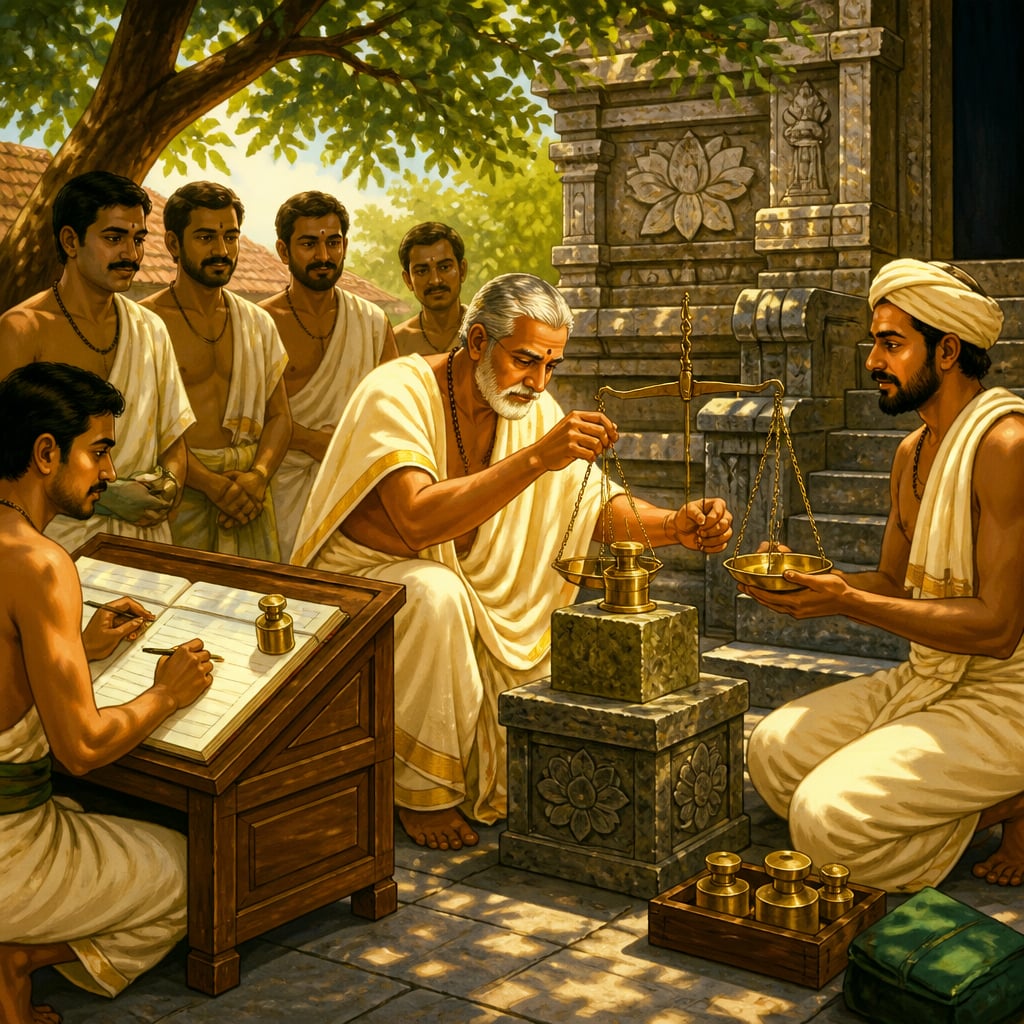
A village elder verifying a merchant's brass balance against the temple-standard

How do you trust a stranger in a transaction? In the village of Srirangam during the Chola period, a weaver selling cloth faced this daily: How could the buyer be sure the cloth was the quality claimed? How could the seller be sure the coins were pure metal? How could both be confident that disputes would be resolved fairly?

Modern economics calls this the 'trust problem' and spends enormous energy on contracts, courts, and regulation. Indian villages solved it through grama-niyama, village regulations developed and enforced by the community itself.

What Village Regulations Covered

The grama-niyama (village rules) formed a comprehensive legal framework for economic activity:

Quality Standards (Guna-Parimana)

Guild inscriptions from Aihole and other trading towns reveal detailed quality standards:

Textiles: Cloth was classified by thread count, weight, and finish. A 'first-class' muslin had specific requirements. Misrepresenting grade was punishable.

Metals: Gold, silver, and copper had purity standards. Coins were tested at guild halls. Debasement was severely punished.

Agricultural Products: Grain had moisture and purity standards. Mixing good grain with inferior was fraud.

Weights and Measures (Tula-Mana)

Every market had standardized weights and measures, maintained by the village or guild:

The Village Standard: A tula (balance) at the temple or market square served as the reference. Disputes about weight were settled against this standard.

Regular Verification: Merchants' weights were periodically checked against village standards. Using false weights meant expulsion from the market.

Regional Harmonization: Inscriptions show efforts to align village standards with regional norms, facilitating inter-village trade.

Trade Protocols (Vyapara-Vyavastha)

Market Days and Hours: Villages designated specific days for markets. Trading outside these times faced restrictions.

Pricing Norms: While prices weren't fixed, dramatic price manipulation during shortages was considered immoral and could be punished.

Credit Terms: Villages developed norms for interest rates, collateral, and debt recovery that applied to local lending.

Contracts: While many transactions were verbal, significant deals were recorded and witnessed, with the grama sabha serving as notary and court.

How Enforcement Worked

Village regulations had teeth because of three enforcement mechanisms:

Social Sanction (Samaja-Danda)

The most powerful enforcement was social. A merchant known for cheating faced:

In a face-to-face community, social sanction was devastating.

Economic Sanction (Arthika-Danda)

Collective Enforcement (Samghika-Danda)

Guilds and the grama sabha could collectively enforce rules:

This collective enforcement made village markets safer than anonymous urban markets might be.

The Guild System's Role

Senior guild masters certifying a young apprentice goldsmith in a stone-pillared hall

Merchant and artisan guilds (shreni or naigama) played a crucial role in regulation:

Setting Standards: Guilds established quality and conduct standards for their trade.

Training and Certification: Artisans trained through guild apprenticeships; guild membership certified competence.

Dispute Resolution: Trade disputes often went first to the relevant guild before reaching the grama sabha.

Collective Bargaining: Guilds negotiated with rulers on taxation and trade privileges.

The Aihole inscription (634 CE) describes guilds with autonomous judicial powers over their members, a remarkable delegation of state authority to private associations.

Global Perspectives on Private Regulation

Western economic thought has debated for centuries whether markets can regulate themselves or require state intervention. Indian villages demonstrated a third way, community regulation that was neither pure market nor state control.

George Stigler (1911-1991), the Nobel laureate, developed 'capture theory', showing how state regulators often serve the industries they regulate rather than the public. The Indian village avoided this by keeping regulation at the community level where capture was harder.

Avner Greif (1955-present), studying medieval Maghribi traders, demonstrated that reputation networks could enforce cooperation across vast distances without formal legal systems. His 'coalition enforcement mechanism' describes exactly what Indian guilds practiced, collective punishment of cheaters through information sharing and boycott.

Oliver Williamson (1932-2020), another Nobel laureate, showed that 'governance structures' between pure market and pure hierarchy often work better than either. The shreni (guild) was precisely such an intermediate structure, not government, not pure market, but organized community.

Thinker Key Insight Grama-Niyama Parallel
Stigler State regulation can be captured Community regulation harder to capture
Greif Reputation networks enforce cooperation Guild information sharing punished cheaters
Williamson Intermediate governance structures work Shreni neither market nor state, but community

The Indian village anticipated modern institutional economics by two millennia.

Comparison with State Regulation

The Arthashastra recognizes village and guild regulatory autonomy:

"ग्रामव्यवहारः ग्रामेण एव निर्णीयते" "Village transactions are adjudicated by the village itself."

Information Advantage: Villagers knew local conditions, traders, and goods better than any distant regulator could.

Flexible Adaptation: Rules could be adjusted to local needs without bureaucratic process.

Lower Costs: No need for a paid regulatory apparatus, the community monitored itself.

Credibility: Rules made by the community commanded more respect than imposed rules.

The Limits of Self-Regulation

Village regulation worked well for local trade but had limits:

Long-Distance Trade: When traders came from far away, village reputation mechanisms were weaker. Here, guilds and temples provided guarantees.

Power Imbalances: Self-regulation could favor established interests against newcomers.

Cross-Village Disputes: When parties from different villages clashed, whose rules applied?

For these situations, higher-level institutions, royal courts, inter-village assemblies, temple authorities, stepped in.

A Living Tradition: 2025

A SEBI industry-body arbitration panel hearing a market misconduct case in 2024

In October 2024, SEBI (Securities and Exchange Board of India) approved new regulations allowing industry bodies to conduct first-level dispute resolution before formal arbitration, essentially recognizing what village and guild systems practiced for millennia.

The informal economy, estimated at 80%+ of Indian enterprises, still operates significantly on reputation and community enforcement rather than formal contract law. The village model persists.

Your Turn: Designing Good Rules

The village system teaches that effective regulation requires:

Consider your own context: What rules or standards would work better if the affected community designed and enforced them?

In our next lesson, we'll examine modern research, particularly Sanjeev Sanyal's work, on how these indigenous village systems contributed to India's economic resilience.

Modern regulatory theory (George Stigler, capture theory) shows that centralized regulators often lack local knowledge. The ancient Indian solution was to keep regulation local.

Indian villages didn't theorize about information asymmetry, they simply recognized that neighbors understood local trade better than distant officials.

Studies of regulatory effectiveness consistently find that local enforcement outperforms centralized enforcement for local violations.

Game theory shows that in repeated interactions, reputation effects enforce cooperation better than one-shot legal enforcement. Online reputation systems (eBay, Uber) rediscover this.

Indian villages created reputation systems organically through tight community bonds. Modern platforms engineer what villages had naturally.

Research shows reputation systems on platforms like eBay reduce transaction failure rates by 40-60%, validating ancient wisdom.

Key terms

Grama-Niyama
Village regulations, the rules developed and enforced by village communities governing economic activity, social conduct, and dispute resolution.
Shreni
Guild, an association of merchants or artisans practicing the same trade, with powers to set standards, train members, resolve disputes, and collectively bargain.
Tula-Mana
Weights and measures, the standardized units maintained by village or guild authority to ensure fair transactions.
Samaja-Danda
Social sanction or community punishment, the enforcement of norms through reputation damage, social ostracism, and exclusion from community activities rather than formal legal penalty.

Verses

ग्रामव्यवहारः ग्रामेण एव निर्णीयते

Grama-vyavaharah gramena eva nirneeyate

Village transactions are adjudicated by the village itself.

Subsidiarity in regulation, decisions made at the lowest capable level, reduces information costs and increases compliance.

Arthashastra, Book 2, Chapter 16 (R.P. Kangle)

श्रेणीधर्मान् न लोपयेत् राजा विवादेषु च

Shrenee-dharman na lopayet raja vivaadeshu cha

The king should not violate guild laws, even in disputes that come before him.

Private regulatory bodies with specialized knowledge can govern better than generalist state regulation, a principle now recognized in modern administrative law.

Brihaspati Smriti, Chapter on Guilds (P.V. Kane)

Key figures

The Aihole Inscription Guild Leaders

Guild leadership that created one of the most detailed surviving records of guild regulations · 634 CE

The inscription shows guilds functioning as autonomous legal bodies with their own courts, punishments, and standards, demonstrating the sophistication of non-state economic governance in ancient India.

Avner Greif

Economic historian at Stanford, researcher on medieval trade institutions · Present (born 1955)

Through studying Maghribi traders and other medieval merchant communities, Greif showed how reputation networks and collective punishment sustained long-distance trade without formal legal enforcement, the same mechanisms Indian guilds used.

P.V. Narasimha Rao

Prime Minister of India (1991-1996), architect of economic liberalization · 1921-2004

The 1991 reforms under Rao and Finance Minister Manmohan Singh reduced the 'license raj' and created space for self-regulatory organizations (SROs) in sectors like securities (SEBI-recognized exchanges), insurance (IRDAI-approved bodies), and telecom. The Geographical Indications Act (1999), passed during his reforms' implementation, formalized traditional quality standards like those for Kanchipuram silk, essentially giving legal force to what weaver guilds had enforced for centuries.

Case studies

Kanchipuram Silk GI: Ancient Guild Standards Become Modern Law

For over 400 years, the weavers of Kanchipuram in Tamil Nadu have produced silk sarees renowned for their quality, heavy silk, pure zari (gold/silver thread), and distinctive patterns. But by the 1990s, the tradition faced a crisis. Cheap imitations from power looms in other states flooded markets, labeled 'Kanchipuram silk' despite using inferior silk, artificial zari, and machine production. The weaver cooperatives, direct descendants of ancient shrenis, faced ruin. A genuine Kanchipuram saree required 3-7 days of skilled handloom work and cost ₹15,000-50,000. Imitations sold for ₹3,000-5,000. Consumers couldn't distinguish genuine from fake. The reputation that weaver guilds had built over centuries was being destroyed. In 2005, the Kanchipuram Silk Weavers' Association applied for Geographical Indication (GI) protection under India's GI Act (1999). The application detailed the traditional specifications that weaver guilds had maintained for generations: mulberry silk of specific denier, real silver/gold zari, hand-tied korvai technique, specific weight-to-length ratios.

The GI certification process essentially asked weaver cooperatives to codify what their shrenis had always known, the guna-parimana (quality standards) that distinguished authentic Kanchipuram silk. The ancient guild had enforced these through samaja-danda: weavers who used inferior materials faced social ostracism and exclusion from cooperative membership. The dharmic insight is that quality standards don't come from external bureaucrats, they emerge from communities that stake their livelihood and reputation on maintaining them. The GI Act didn't create these standards; it recognized and gave legal force to what weaver guilds had maintained for centuries. The state's role was not to define quality but to protect the community's right to define it themselves.

Kanchipuram Silk received GI certification in 2005, India's first textile GI. The certification specifies: only handloom, only pure mulberry silk, only real zari, only traditional techniques. Enforcement combines traditional and modern: cooperative inspectors check member production (guild-style monitoring), while GI violation is now legally actionable. The results validated the ancient model. By 2024, a GI-certified Kanchipuram saree commands 30-40% premium over uncertified equivalents. The Kanchipuram cluster employs 50,000+ weaver families. Similar success followed for Darjeeling Tea (GI 2004), Chanderi Silk (GI 2005), and Basmati Rice (GI 2016), traditional quality standards formalized as legal protection. Critically, enforcement still relies heavily on community mechanisms. The cooperative monitors members more effectively than any government inspector could, because weavers' livelihoods depend on protecting the collective reputation.

The GI system works because it builds on existing community regulation rather than replacing it. Ancient guild standards, developed through centuries of practice, became the legal definition of authenticity. The state's role is to protect community-defined standards, not to impose bureaucratic definitions. Grama-niyama and shreni-dharma survive in modern intellectual property law.

The EU's Protected Designation of Origin system for Champagne, Parmesan, and Darjeeling tea operates on identical principles. In the age of AI-generated fakes and counterfeit goods flooding e-commerce, community-verified quality standards are becoming more valuable, not less. Blockchain-based provenance tracking is essentially digitizing what guild inspections once did.

India has 500+ registered GIs as of 2024, more than most countries. Most are traditional products with community-maintained quality standards, essentially formalizing ancient grama-niyama and shreni-dharma as modern legal protections.

Historical context

Throughout Indian history (with rich inscriptional evidence from 5th-12th centuries CE)

Village and guild regulation coexisted with state law, each operating in its sphere. The state focused on inter-regional matters, taxation, and major crimes; villages and guilds handled local commerce and craft standards.

Medieval European guilds had similar regulatory powers, but under closer state supervision. Chinese guilds were more state-controlled. Indian guilds and villages enjoyed unusual autonomy, reflected in texts like the Brihaspati Smriti that explicitly protected guild law from state interference.

Over 200 inscriptions from South India alone document guild activities, rules, and disputes, suggesting that formal record-keeping of private regulation was common.

Understanding village and guild regulation reveals that effective economic governance doesn't require the state, communities can create and enforce their own rules, often more effectively.

Living traditions

India's informal economy, estimated at 80%+ of enterprises, operates primarily on reputation and community enforcement rather than formal contract law, the village model continues.

Reflection

More in The Self-Sufficient Village Republic

All lessons in The Self-Sufficient Village Republic · Grama Swarajya: Village Economics course