Grama-Rajya: The Village as Self-Governing Unit

Where Empires Rose and Fell, Villages Remained

Discover how India's 700,000 villages functioned as self-governing republics for millennia, creating a decentralized system that outlasted every empire and provided the foundation for civilizational resilience.

The Untold Story of India's Foundation
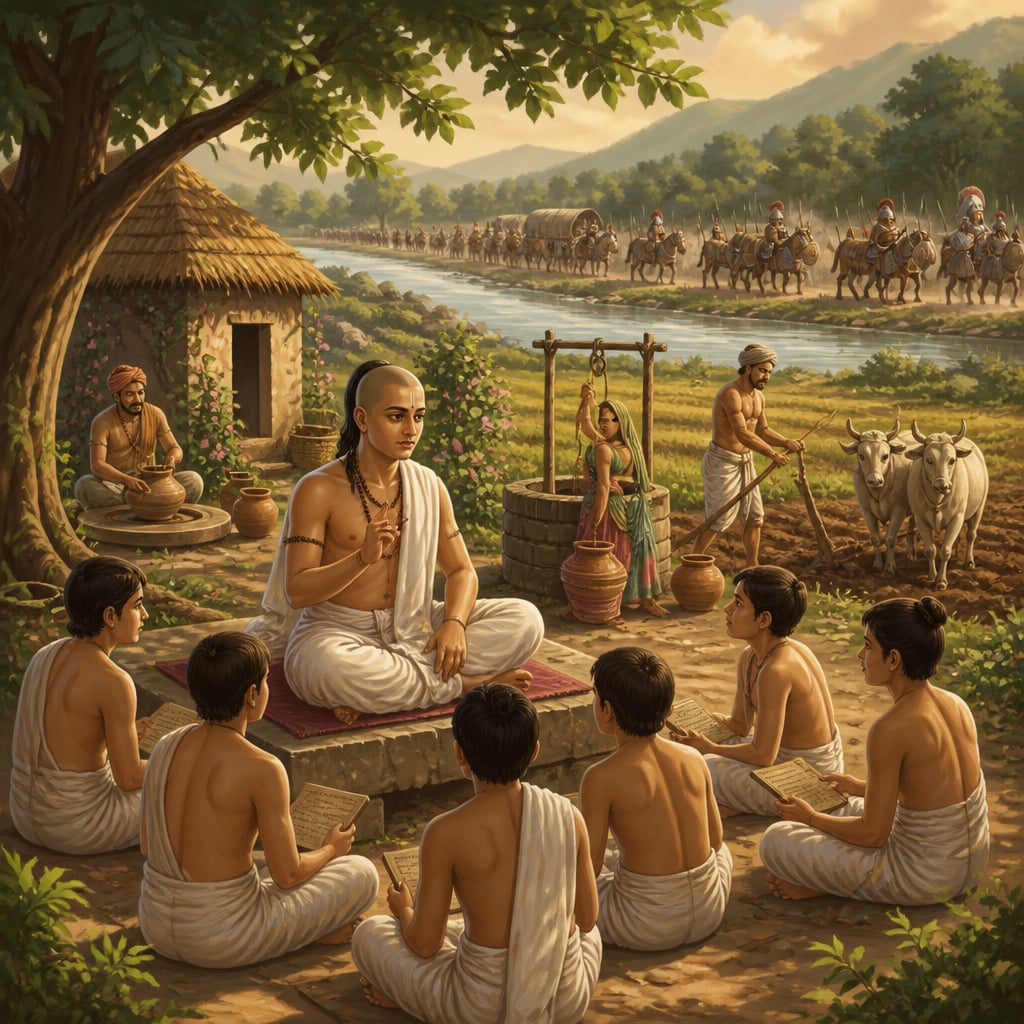
Chanakya teaching at a Punjab village courtyard as Alexander's army retreats

In 326 BCE, as Alexander the Great's exhausted army retreated from the banks of the Beas River, a young Brahmin named Chanakya was teaching students in Takshashila about a truth the Greek conqueror would never understand: India could not be conquered by capturing cities alone. The real India lived in its 700,000 villages, each one a grama-rajya, a village republic that governed itself.

The Architecture of Self-Governance

What Alexander encountered was not a single nation-state but a civilization organized around the most radical idea in pre-modern governance: local self-rule. The Sanskrit texts called it grama-swarajya, the self-sovereignty of the village.

Consider what this meant in practice. In a typical village of the Maurya period, the gramani (village headman) was not appointed by the emperor in distant Pataliputra. He emerged from the village itself, often through a combination of hereditary position and community acceptance. The Arthashastra captures this principle:

"ग्रामस्य स्वामी ग्रामणीः, स च ग्रामेण निर्वृत्तः" "Gramasya svami gramaniah, sa cha gramena nirvrtah" "The lord of the village is the village headman, and he is chosen by the village itself."

This wasn't mere theory. Archaeological evidence from Mauryan-era settlements shows villages with their own granaries, water management systems, and craft workshops, functioning economic units that could survive and thrive regardless of who sat on the throne of Magadha.

How It Actually Worked

The village republic operated through three interlocking institutions:
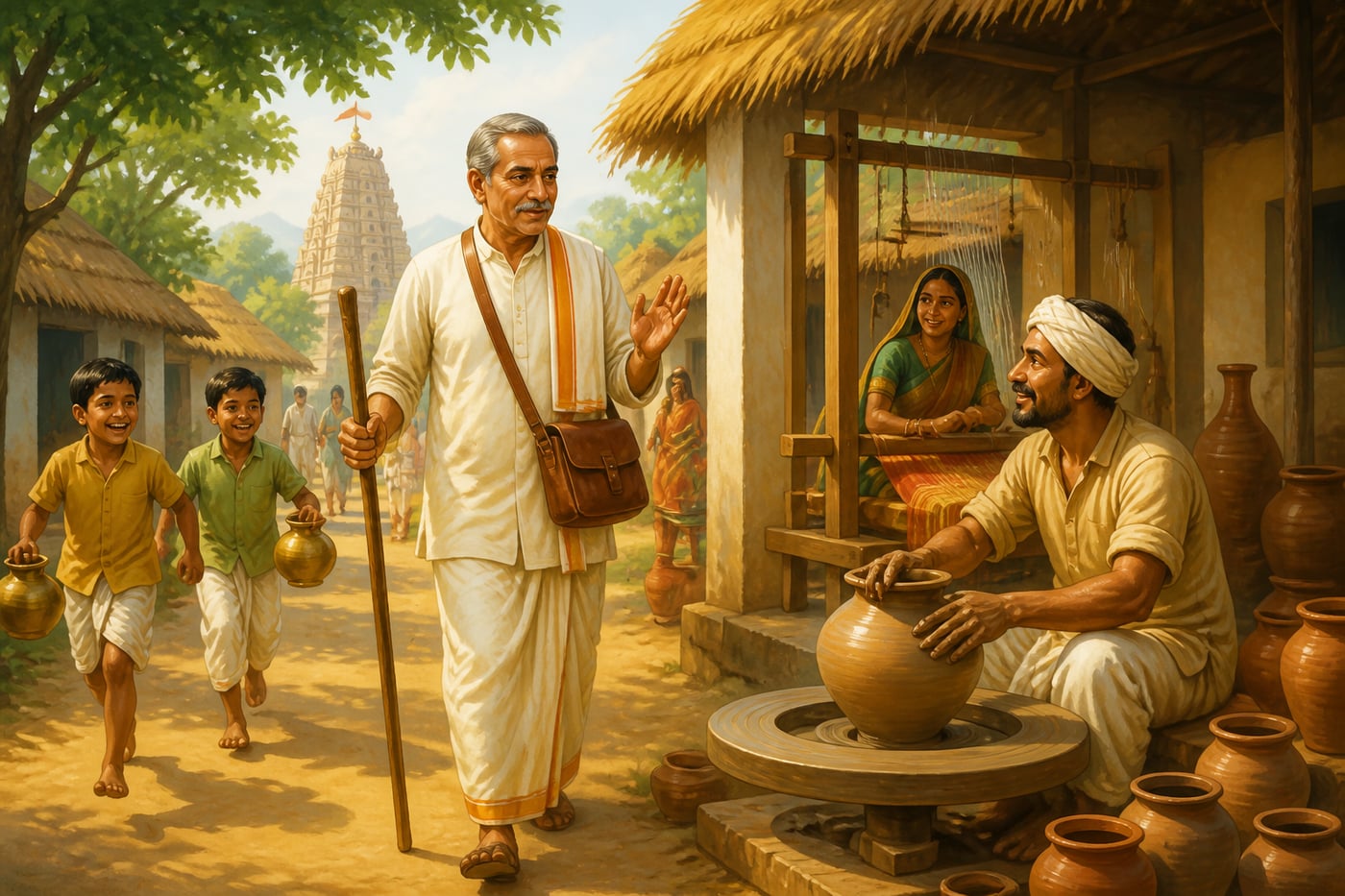
The village gramani walking the lane greeting potters and weavers

The Gramani (Headman): Responsible for maintaining order, collecting the village's tax contribution, and representing the village to external authorities. Crucially, he was answerable to the village, not the king.

The Grama Sabha (Village Assembly): All adult householders gathered to decide matters of common interest, land allocation, water rights, dispute resolution, and festival organization. The principle of panch parmeshwar (the five are god) meant that collective decisions carried divine authority.

The Kula Panchayats (Family/Caste Councils): Specialized matters, craft standards, marriage disputes, inheritance, were handled by occupational or kinship groups within the village.

Global Perspectives on Local Self-Governance

Western political thought arrived at similar insights, but much later, and often theoretically rather than practically.

Alexis de Tocqueville (1805-1859), observing American democracy, argued that local self-governance was the foundation of democratic health. In Democracy in America (1835), he wrote that townships were 'the source of free and strong government.' Yet American townships never achieved the economic self-sufficiency of Indian villages, they remained dependent on state and federal structures.

E.F. Schumacher (1911-1977), after studying Gandhian economics in India, wrote Small is Beautiful (1973), arguing that human-scale, decentralized economic units were more sustainable than centralized systems. Schumacher explicitly acknowledged his debt to Indian village economics, the grama-rajya model he encountered during his visits.

Elinor Ostrom (1933-2012), the first woman to win the Nobel Prize in Economics (2009), demonstrated through rigorous research that communities can successfully manage common resources without central authority or privatization. Her work on commons governance essentially validated what Indian villages had practiced for millennia, collective management through local institutions like the grama sabha.

Thinker Key Insight Grama-Rajya Parallel
Tocqueville Local governance enables democracy Grama sabha as foundation of collective decision-making
Schumacher Human-scale economics is sustainable Village self-sufficiency in essentials
Ostrom Communities can govern commons effectively Collective water/land management without central control

The difference? These Western thinkers proposed theories; Indian civilization built functioning systems that lasted millennia.

A Living Legacy in 2025

Hiware Bazar's drought-revived terraced fields and check-dams in 2024

In December 2024, Finance Minister Nirmala Sitharaman announced increased allocations for gram panchayats under the 15th Finance Commission. The policy discussion explicitly referenced grama swaraj, Gandhi's term for village self-rule, which itself drew on ancient models.

The principle survives in unexpected places. India's 6.3 crore (63 million) Self-Help Groups (SHGs) function remarkably like ancient village assemblies, local bodies making collective economic decisions without central direction. The cooperative movement, particularly AMUL in Gujarat, demonstrates that the village republic model scales.

Your Turn: The Principle in Practice

The lesson of grama-rajya is not nostalgia but strategy. Any system that depends entirely on central functioning has a single point of failure. The village republic model distributes capability so that dysfunction at the top doesn't mean collapse at the base.

Consider your own situation: What decisions in your work or community are currently centralized that could be handled locally? What would it take to build more distributed resilience?

In our next lesson, we'll explore the grama sabha in detail, how the village assembly actually made economic decisions, from land allocation to dispute resolution.

Distributed systems theory and resilience economics

Nassim Taleb's 'antifragility' concept and Friedrich Hayek's arguments for decentralized knowledge both echo this ancient insight, systems without single points of failure are more robust.

Indian thought went further by institutionalizing decentralization into governance structure, not just recognizing it theoretically.

India maintained roughly 25% of world GDP throughout the first millennium CE despite multiple dynastic changes, suggesting resilience built into the system.

Modern public choice theory (Buchanan, Tullock) argues that leaders accountable to those they serve make better decisions than distant bureaucrats, rediscovering what Indian villages practiced for millennia.

The Indian system combined hereditary knowledge (experience) with community acceptance (accountability), getting benefits of both continuity and responsiveness.

Key terms

Grama-Sabha
The village assembly, a gathering of all adult householders to deliberate and decide on matters of common interest, from land disputes to festival planning.
Grama-Rajya
Village kingdom or village republic, the self-governing village as a political unit with its own governance, economy, and social organization.
Gramani
The village headman or chief, the leader of the village republic who coordinated governance, represented the village externally, and ensured tax collection.
Swarajya
Self-rule, self-governance, the principle that a community should govern its own affairs without external control.

Verses

ग्रामस्य स्वामी ग्रामणीः, स च ग्रामेण निर्वृत्तः

Gramasya svami gramaniah, sa cha gramena nirvrtah

The village's master is its headman; and he is chosen by the village itself.

Local accountability creates better governance than distant appointment. When leaders answer to those they govern, they're incentivized to serve local interests.

Arthashastra, Book 2, Chapter 1 (R.P. Kangle)

ग्रामं दशग्रामाधिपं विंशत्यधिपतिं तथा

Gramam dasha-gramadhipam vimshaty-adhipatim tatha

For the village, a village chief; for ten villages, a lord of ten; for twenty, a lord of twenty.

Subsidiarity, the principle that decisions should be made at the lowest capable level, was embedded in Indian political thought two millennia before it became a principle of EU governance.

Manusmriti, Chapter 7, Verse 80 (Patrick Olivelle)

Key figures

Chanakya (Kautilya)

Political economist and author of the Arthashastra · 4th century BCE

Codified the relationship between state and village, establishing that while the king was sovereign, the village was self-governing in matters of local concern. His writings show villages managing their own justice, water, markets, and social welfare.

Sanjeev Sanyal

Economic historian, Member of the Economic Advisory Council to the Prime Minister · Present (born 1971)

Through books like 'The Ocean of Churn' and 'Land of the Seven Rivers,' Sanyal has documented how village-level self-governance created civilizational resilience, allowing India to maintain economic productivity even when empires collapsed.

E.F. Schumacher

British-German economist and author of 'Small is Beautiful' · 1911-1977

In his landmark 1973 book 'Small is Beautiful: Economics as if People Mattered,' Schumacher argued that human-scale, decentralized economic units are more sustainable and humane than giant corporations or state enterprises. He explicitly drew on Gandhian village economics, having visited India and studied its village traditions.

Case studies

Hiware Bazar: A Drought-Prone Village Becomes a Model of Grama Swarajya

In 1989, Hiware Bazar in Maharashtra's Ahmednagar district was a dying village. Annual rainfall averaged just 350mm, wells had run dry, 90% of families lived below the poverty line, and migration had hollowed out the community. When Popatrao Pawar returned as sarpanch in 1990, the village had 22 liquor dens and rampant illegal felling of trees. Rather than seeking government handouts or waiting for external solutions, Pawar convened the gram sabha and asked a simple question: 'What can WE do with what WE have?' The gram sabha made radical collective decisions. They banned liquor, stopped open grazing (allowing vegetation regrowth), and implemented shramdan (voluntary community labor) for watershed development. Every household contributed labor to build check dams, contour trenches, and percolation tanks. The village banned bore wells to prevent groundwater depletion, a decision that would be impossible without genuine collective buy-in. Over 15 years, they built 52 earthen bunds and planted over 200,000 trees.

Conventional development economics would prescribe external intervention, government schemes, NGO projects, subsidies. The dharmic approach embedded in grama swarajya starts differently: the village is the agent, not the beneficiary. Pawar's first move wasn't technical; it was moral (banning liquor) and procedural (empowering the gram sabha). The Arthashastra's principle that 'the village's master is chosen by the village itself' meant that decisions had legitimacy. When the gram sabha decided to ban bore wells, people complied because THEY had decided, not because an outsider mandated it. This is the difference between imposed development and self-governed transformation.

By 2024, Hiware Bazar has become India's model village. Groundwater levels rose from 20 feet below surface to 6 feet. Per capita income increased from Rs. 830 (1995) to over Rs. 30,000. Milk production rose from zero to over 4,000 liters per day. Migration reversed, families returned. The village now has 60+ crorepatis (those with assets over Rs. 1 crore). In 2020, during the pandemic, while urban India struggled, Hiware Bazar was self-sufficient in food, water, and employment. PM Modi has visited twice, and the village has hosted delegations from 58 countries studying its model.

External resources matter less than internal governance. Hiware Bazar received no special government allocation, it used existing schemes more effectively because decisions were made collectively through a functioning gram sabha. The grama-rajya model isn't ancient nostalgia; it's a working template for 21st-century resilience.

Hiware Bazar's gram sabha model mirrors how successful open-source communities govern today. Projects like Linux thrive not because of top-down mandates but because contributors collectively set norms and enforce standards. The principle holds: systems where participants govern themselves outperform those managed by distant authorities.

From 90% below poverty line (1989) to 60+ crorepati families (2024), a transformation achieved primarily through gram sabha-led water conservation and collective decision-making, not external investment.

Historical context

Mauryan Period (322-185 BCE) and beyond

India during the Mauryan period was the world's largest economy, comprising approximately 32% of global GDP according to Angus Maddison's estimates. The sophisticated village administration system contributed to agricultural productivity and social stability.

Contemporary civilizations, Greek city-states, Roman Republic/early Empire, Chinese Qin/Han dynasties, had more centralized local governance. India's village republic model was distinctive in its degree of local autonomy.

Archaeological evidence suggests Mauryan-era villages ranged from 100 to 500 households, with settlements showing granaries, water management infrastructure, and craft production areas, physical evidence of self-sufficiency.

Understanding the village republic model reveals that India's political decentralization was not a weakness but a deliberate design that created civilizational resilience across millennia.

Living traditions

The 73rd Constitutional Amendment (1992) constitutionalized village-level governance, and initiatives like the Gram Swaraj Abhiyan (2018) explicitly invoke the grama-rajya ideal in policy language.

Reflection

More in The Self-Sufficient Village Republic

All lessons in The Self-Sufficient Village Republic · Grama Swarajya: Village Economics course