Megasthenes-Sakshya: Foreign Accounts of Village Republics
What Greek, Chinese, and Arab Travelers Saw
Examine the testimony of foreign observers across two millennia, from Megasthenes to Al-Biruni, who consistently documented India's village self-governance, providing external validation of a uniquely Indian institution.
The Astonished Greek
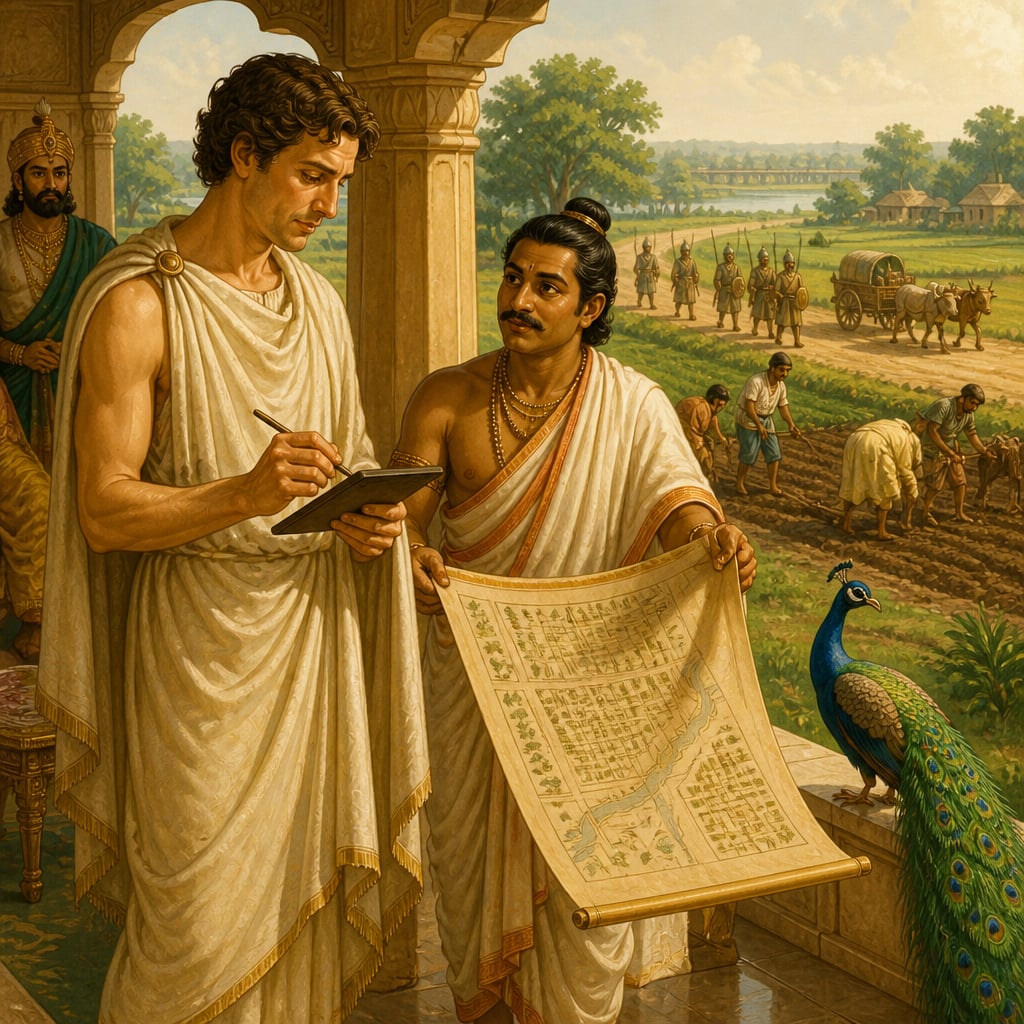
In 302 BCE, the Greek ambassador Megasthenes completed his term at the court of Chandragupta Maurya in Pataliputra. He had spent years observing what was then the world's largest empire, and what struck him most wasn't the magnificent capital or the massive army. It was something that seemed impossible to a Greek accustomed to city-state governance: Indian villages continued their work undisturbed even while armies marched past.
"The husbandmen... are not harmed by war," Megasthenes wrote in his Indica, "for the combatants allow those engaged in agriculture to remain unmolested."
This observation, preserved in fragments by later Greek and Roman writers, captures something fundamental about India's village system. It was so autonomous, so self-contained, that it operated in a parallel universe from military and political events.
A Millennium of Testimony
What makes the foreign accounts remarkable is their consistency across cultures, centuries, and purposes. Visitors from Greece, China, Persia, and the Arab world, each with different languages, religions, and political systems, all noted the same phenomenon: Indian villages governed themselves.
Megasthenes (c. 350-290 BCE)
The Greek ambassador's observations reveal:
"The cultivators are never disturbed by war... They cultivate their lands undisturbed, while battles are fought in their neighborhood."
What Megasthenes saw was the principle of gramakshemata, village immunity from external conflict. Kings might fight, but the village's economic life continued.
Fa-Hien (337-422 CE)
The Chinese Buddhist pilgrim traveled India during the Gupta period, seven centuries after Megasthenes. He found:
"The people are very well off, without poll tax or official restrictions. Only those who till the king's land have to pay. The inhabitants are rich and prosperous."
Note the specifics: no poll tax (unlike China), no burdensome regulation, and prosperity he considered noteworthy. The village economic system was working.
Hiuen Tsang (602-664 CE)
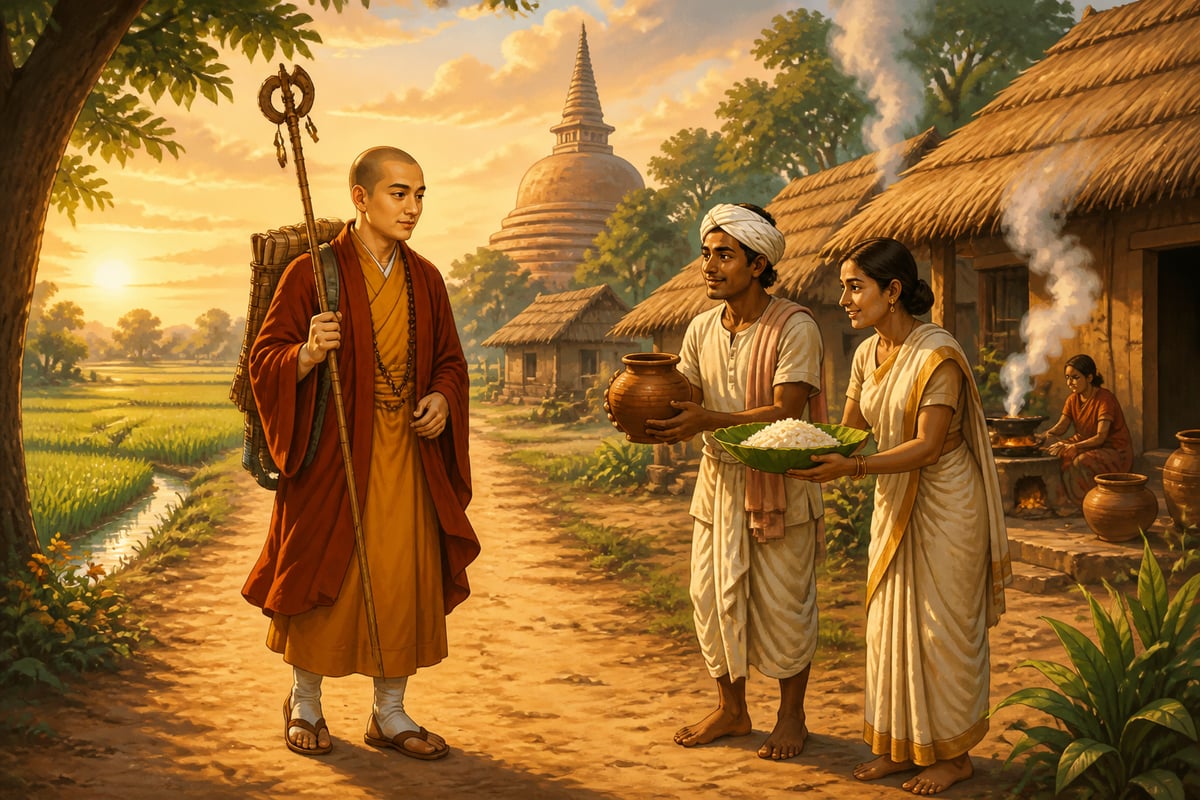
Another Chinese pilgrim, two centuries after Fa-Hien, spent 17 years in India. He documented:
"Each district has its own chief... The people are distinguished for straightforwardness and honesty. They do not practice deceit or treachery."
The local chief he describes is the gramani, the village headman. The moral characteristics he notes (honesty, straightforwardness) reflect a society where people dealt with known neighbors, not anonymous strangers.
Al-Biruni (973-1048 CE)

The Persian polymath studied India for decades. His analysis was more systematic:
"The Hindus had a complete system of local government... Villages were virtually independent republics, managing their own affairs with little interference from the central authority."
Al-Biruni explicitly uses the term "republic" (jumhuriya in Arabic), recognizing the democratic character of Indian village governance.
The Pattern They All Saw
| Observer | Period | Key Observation |
|---|---|---|
| Megasthenes | 4th c. BCE | Villages undisturbed by wars |
| Fa-Hien | 5th c. CE | Light taxes, prosperity |
| Hiuen Tsang | 7th c. CE | Local chiefs, honest people |
| Al-Biruni | 11th c. CE | "Independent republics" |
Across 1,300 years, visitors from three different civilizations observed the same system. This consistency is itself evidence, it's unlikely that Greeks, Chinese, and Persians would all invent the same fiction about India.
Why Their Testimony Matters
Foreign accounts have unique evidentiary value:
No Nationalist Agenda: These weren't Indians praising their own civilization. They were outsiders recording what they saw, often with critical observations alongside praise.
Comparative Perspective: Each visitor implicitly compared India to their homeland. When Fa-Hien notes the absence of poll tax, he's contrasting with China where such taxes were normal.
Historical Continuity: The same observations across millennia prove this wasn't a temporary phenomenon but a stable institutional pattern.
Cross-Cultural Validation: Greeks, Chinese, and Persians had no common literary tradition about India, each observed independently.
The Economics Behind the Observations
Why did foreign visitors notice village autonomy? Because it was economically unusual:
In the Persian Empire: Villages were administrative units taxed directly by satrap officials.
In the Chinese Empire: Villages were governed by imperially-appointed functionaries; the li-chia system organized households for state control.
In the Roman/Byzantine world: Villages (pagi) were administrative subdivisions with externally-appointed leaders.
In India: Villages largely governed themselves. State contact was limited to collecting a share of produce (typically one-sixth) through the headman. Everything else was local.
This difference was visible and noteworthy to visitors from centralized empires.
The Contrast with Colonial Narratives
Later colonial writers, though they too documented village republics (as we saw with Metcalfe), often framed them as "backward" or "stagnant." The ancient accounts carry no such judgment.
Megasthenes saw efficiency in villages continuing to produce during wars. Fa-Hien saw prosperity in light taxation. Al-Biruni saw sophisticated political organization in village republics. The condescension was a colonial addition.
A Living Legacy in 2025
In November 2024, during the G20 discussions in Brazil, Indian delegates cited the gram sabha model as an example of grassroots democracy relevant to climate governance, local communities making decisions about local resources.
The foreign travelers' testimony matters today because it establishes that India's village governance was not an accident or a failure to develop "proper" centralized states, but a distinctive and functional civilizational choice.
Your Turn: Seeing Through Outside Eyes
The foreign accounts teach us to examine our own institutions with fresh perspective. What aspects of contemporary Indian governance would a visitor from another civilization find distinctive or surprising?
Consider: What would Megasthenes think of MGNREGA's social audits, where villagers examine government expenditure? What would Al-Biruni make of panchayati raj?
In our next lesson, we'll explore swayam-poshita, the economics of self-sufficiency that made these village republics possible.
Modern research methodology emphasizes multi-source validation. Historians since Leopold von Ranke have prioritized primary sources from different perspectives.
India is unusually fortunate in having continuous foreign accounts across millennia, Greece, China, Persia, Arabia, providing external checkpoints for internal histories.
Across 1,300 years (Megasthenes to Al-Biruni), at least four major civilizations documented Indian village self-governance independently.
Geneva Conventions (1949) now require protection of civilian populations and economic infrastructure during war. Megasthenes observed an Indian version 2,300 years earlier.
The Indian approach was embedded in cultural practice, not just formal law, making it more resilient because it didn't depend on treaties that combatants might ignore.
Despite numerous wars across Indian history, there are remarkably few accounts of systematic agricultural devastation compared to European or Central Asian conflicts.
Key terms
- Gramakshemata
- Village immunity or village welfare, the principle that villages were protected zones, exempt from the disruptions of warfare and political conflict.
- Indica
- Megasthenes' account of India, written after his embassy to Chandragupta Maurya's court, the earliest substantial foreign description of Indian society and governance.
- Sakshya
- Testimony, witness, evidence, particularly evidence from direct observation, as distinguished from hearsay or tradition.
- Yavana-Sakshya
- Testimony of the Greeks (or foreigners), evidence about India from external observers, particularly valued for its independence from Indian literary traditions.
Verses
N/A (Greek original)
Hoi georgoi polemou ou blaptontai
The farmers are not harmed by war; the combatants allow those engaged in agriculture to remain unmolested.
Protecting agricultural production from war's disruptions was sound policy, it maintained the economic base that funded military campaigns. The principle also reflects the village's position as a semi-autonomous unit.
Megasthenes' Indica (fragment), Preserved in Strabo's Geography (J.W. McCrindle)
N/A (Chinese original)
Ren min yin shi, bu ke kou shui
The people are very well off, without poll tax or official restrictions. Only those who till the king's land have to pay.
The absence of poll taxes (taxes on persons rather than land or production) meant the poor weren't penalized for being alive, a regressive tax avoided. This contributed to the prosperity Fa-Hien observed.
Fa-Hien's Travels, Chapter on Madhyadesa (James Legge)
N/A (Arabic original)
al-qura jumhuriyat mustaqilla
The villages were virtually independent republics, managing their own affairs with little interference from central authority.
The word 'jumhuriya' (republic) implies collective self-governance, not feudal lordship. Al-Biruni recognized the democratic character of Indian village economics.
Al-Biruni's Kitab al-Hind, Chapter on Administration (Edward Sachau)
Key figures
Megasthenes
Greek ambassador to the Mauryan court, author of the Indica · c. 350-290 BCE
His observation that farmers remained undisturbed during wars captures a key principle of Indian governance: the village as an autonomous economic unit protected from political disruption. Though the original Indica is lost, preserved fragments shaped Western understanding of ancient India.
Al-Biruni
Persian polymath, scholar of Indian civilization · 973-1048 CE
Unlike casual travelers, Al-Biruni learned Sanskrit and systematically studied Indian texts. His comparison of Indian villages to republics showed sophisticated political analysis, he recognized the democratic character of Indian local governance when European villages were under feudal lordship.
Bibek Debroy
Economist, translator, Chairman of the Economic Advisory Council to the Prime Minister · Present (born 1955)
In his translations of the Arthashastra, Mahabharata, and other texts, Debroy frequently cites Greek, Chinese, and Arab accounts to corroborate ancient Indian claims. His work demonstrates how foreign testimony strengthens rather than challenges indigenous historical narratives. As economic advisor, he has advocated for policies drawing on India's decentralized governance heritage.
Case studies
The World Bank Discovers Kerala: When Modern Foreign Observers Validated Village Governance
In 1996, the World Bank published a study that puzzled development economists worldwide. Kerala, one of India's poorest states by per-capita income, had achieved health and education outcomes comparable to developed nations. Life expectancy was 74 years (vs. India's 62), literacy was 94% (vs. India's 65%), and infant mortality was among the lowest in the developing world. The Bank's researchers, led by economist Jean Drèze and Nobel laureate Amartya Sen, couldn't explain this through conventional development metrics. Kerala had no special resources, no unusual foreign investment, no particularly efficient central government. What they found instead was something that would have been familiar to Megasthenes: powerful local governance. Kerala's gram sabhas and panchayats had real authority over education and health decisions. Village assemblies decided where schools would be built, which teachers would be hired, and how health centers would operate. The state had decentralized not just funds but decision-making power to the village level.
The World Bank study is a modern version of yavana-sakshya, external validation by foreign observers. Just as Megasthenes noted that Indian villages functioned independently of central authority, the Bank's researchers documented that Kerala's development happened because of, not despite, village-level decision-making. Conventional development economics assumes that expert technocrats in capitals know best. The dharmic principle embedded in grama swarajya suggests the opposite: those who will live with the consequences, the villagers themselves, make better decisions about schools and hospitals than distant planners.
The 'Kerala Model' became internationally famous. In 2001, Kerala launched the People's Plan Campaign, formally devolving 35-40% of state plan funds directly to panchayats. By 2024, Kerala's Human Development Index (0.782) exceeds that of many middle-income countries. The state has been cited in over 200 World Bank and UNDP reports as a model of participatory development. Critically, the foreign validation changed domestic perception. Indian policymakers who might have dismissed village governance as 'backward' took it seriously when the World Bank endorsed it. The 73rd Amendment (1992) and subsequent decentralization policies were influenced by Kerala's documented success.
Foreign observers continue to validate Indian village governance, just as they did two millennia ago. The Kerala study shows that yavana-sakshya remains relevant, external recognition can overcome domestic skepticism and accelerate policy change. What Megasthenes saw, the World Bank rediscovered.
Kerala's outcome anticipated the 'Bhutan model' of measuring Gross National Happiness over GDP. Today, as WHO and OECD push wellbeing indices alongside economic metrics, the lesson is clear: decentralized governance focused on human outcomes can outperform centralized GDP-maximizing approaches at a fraction of the cost.
Kerala spends 40% of state plan funds through panchayats, the highest in India. Its Human Development Index (0.782) matches developed nations despite per-capita income of only $3,100.
Historical context
Mauryan through medieval periods (4th century BCE - 11th century CE)
This period spans India's greatest empires (Maurya, Gupta) and numerous regional kingdoms. The consistency of foreign observations across these different political arrangements suggests village autonomy was a civilizational constant, not dependent on particular rulers.
Contemporary foreign accounts of China, Persia, and the Roman world don't describe equivalent village autonomy, suggesting India's system was distinctive, not universal. This comparison strengthens the evidentiary value of the observations.
At least seven major foreign accounts of India survive from this period (Megasthenes, Ptolemy, Fa-Hien, Hiuen Tsang, I-Tsing, Al-Masudi, Al-Biruni), providing unusual documentation density for ancient social history.
Foreign testimony provides independent validation that India's village governance was not retroactive myth-making but observable reality witnessed by neutral outsiders across millennia.
Living traditions
The foreign observers' tradition continues through academic comparative politics (studying India's decentralization) and international development research (examining panchayati raj effectiveness).
- Comparative governance research: Modern scholars like Elinor Ostrom studying village commons management continue the tradition of external observation of Indian local governance.
- World Bank/UNDP village studies: International development organizations regularly study and document Indian panchayat governance, creating modern equivalents of ancient traveler accounts.
- Pataliputra (Patna) Archaeological Sites
- Nalanda University Ruins
- Patna Sahib Gurudwara: Located in ancient Pataliputra where Megasthenes served as ambassador, this site connects to the Mauryan capital he documented in his Indica
- Nalanda Mahavihara: Extensively documented by Chinese pilgrims Fa-Hien and Hiuen Tsang, this ancient university site exemplifies the institutions foreign travelers recorded
Reflection
- The foreign observers came from centralized empires (Greek, Chinese, Persian) and found India's village autonomy remarkable. What aspects of contemporary India might seem remarkable to a visitor from a very different political system, and what might that reveal about unstated assumptions?
- Megasthenes noted that farmers were protected during wars. In your industry or field, what 'productive activities' should be protected during organizational conflicts or competitive battles? How might the principle of gramakshemata apply?