Sthala: Community Land and Resource Concepts
The Rules That Made Commons Work
Indian villages didn't just manage commons, they classified them with surgical precision. From devabhumi (deity's land) to shamshan (cremation grounds), every inch had a category, a purpose, and rules. This classification system, codified in the Dharmashastras, explains why Indian commons succeeded while European commons collapsed.
The Boundary Stone That Witnessed Everything
In 1814, a British revenue officer named Thomas Munro was surveying a village in South India for tax purposes. He encountered something that puzzled him: a stone pillar at the edge of the village pasture, decorated with vermilion and flowers, with a small lamp burning before it.
"Why worship a boundary marker?" he asked the village headman.
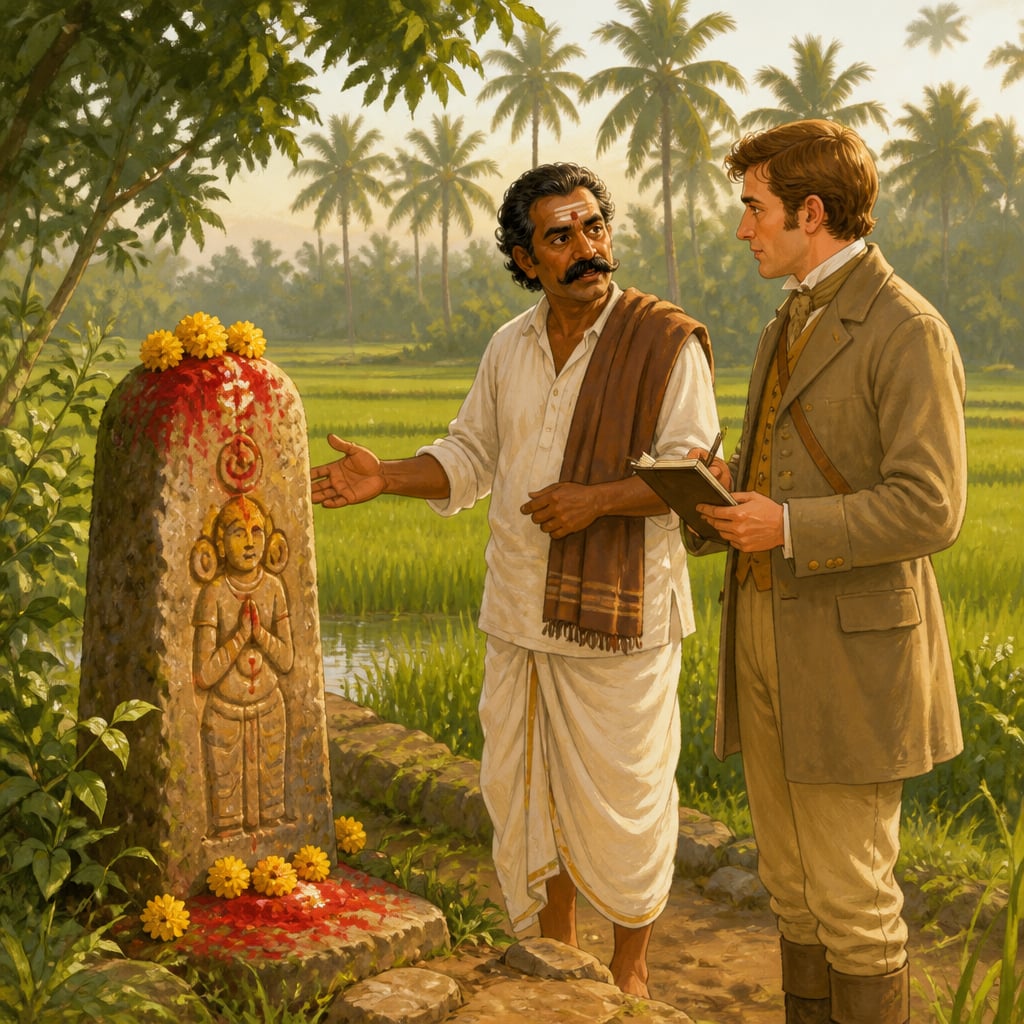
The elder explained: This was a sima-devata, a boundary deity. It had witnessed every land transaction, every dispute, every judgment in living memory. To move it, or lie before it, was to invite divine wrath. The stone wasn't just marking territory; it was enforcing it.
Munro noted in his report that these villages had fewer land disputes than any district in England. The reason wasn't better courts, it was better classification.
The Architecture of Land Classification
The Manusmriti, compiled around the 2nd century BCE, didn't just list moral rules, it provided a complete land classification system that Indian villages followed for two millennia:
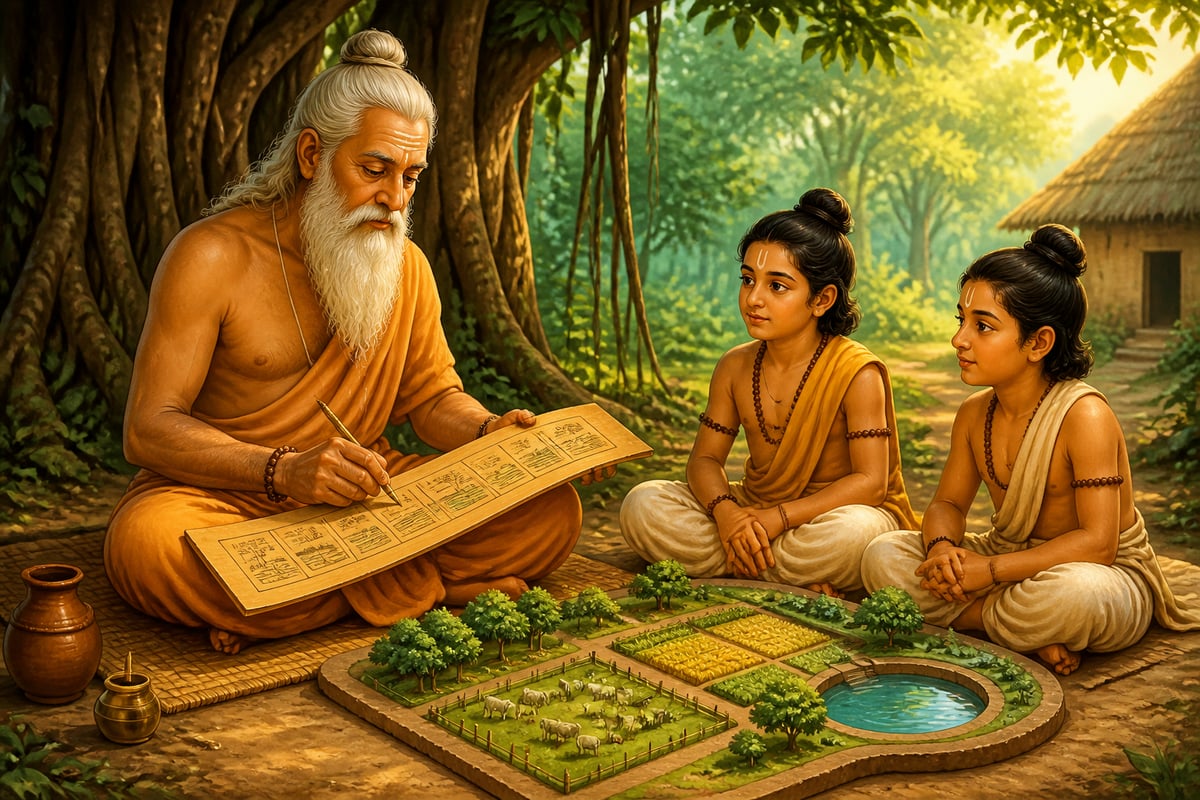
क्षेत्रं दशविधं प्राहुः ग्रामं चैवाष्टधा बुधाः "Kshetram dashavidham prahuh gramam chaivashtadha budhah" "The wise declare ten types of land, and eight types of village territory."
This wasn't abstract philosophy. Each category carried specific rights, restrictions, and governance rules:
1. Devabhumi (Deity's Land): Land belonging to temples or village deities. Income supported religious functions. No one could sell, mortgage, or encroach, the deity was the permanent owner.
2. Gauchar (Common Pasture): Grazing land for all village cattle. Governed by seasonal rotation rules set by the grama sabha. No individual could fence or cultivate.
3. Jalashaya (Water Bodies): Ponds, tanks, and streams. Access was universal, but extraction rules (how much, when, for what purpose) were strictly defined. Priority went to drinking, then cattle, then irrigation.
4. Vana (Forest Commons): Village forests for timber, fuel, and forest produce. The grama sabha determined which trees could be cut and by whom. Certain groves were entirely prohibited, sacred groves or aranya.
5. Shamshan (Cremation Ground): Land reserved for funerals. No other use was permitted, this protected both practical function and ritual sanctity.
6. Gocara (Cattle Paths): Designated routes for moving livestock between village and pasture. Buildings were prohibited, the path was permanent infrastructure.
7. Khala (Threshing Ground): Common space for grain processing after harvest. Shared seasonally among all farming families. Rotation rules prevented monopolization.
8. Sabhasthal (Assembly Ground): Where the grama sabha met, often under a great banyan or pipal tree. This space was politically sacred, even enemies couldn't fight here.
Why Classification Matters: The Lock Without a Key
This classification system was brilliant for a simple reason: it removed certain questions from negotiation entirely.
When land is simply "property," every use is negotiable. Can I build here? Can I fence this? Can I drain that pond? Each question requires a transaction, a dispute, a court case.
But when land is classified, when the gauchar is defined as gauchar since ancestral memory, the question doesn't arise. No one asks "Can I build on the cremation ground?" The category answers before the question is asked.
This is what modern economists call "transaction cost reduction." Indian villages achieved it through classification, not litigation.
Global Perspectives: Locke, Labor, and the Missing Category
John Locke (1632-1704), the English philosopher, formulated the most influential Western theory of property in his Two Treatises of Government (1689). His argument: property rights arise when someone "mixes their labor" with unowned land. You plow a field, you own it. You build a fence, it's yours.
This theory justified the English enclosures, converting commons to private property, and later, colonial land grabs worldwide. If natives weren't "laboring" on land in European-recognized ways, the land was "empty" and claimable.
What Locke's theory lacked was a category for community property.
In Lockean logic, land is either private (owned by an individual) or unowned (available for claiming). There's no stable middle category, no gauchar that belongs to the village as a village, no devabhumi that belongs to a deity in perpetuity.
Indian land classification provided exactly this missing category. The Manusmriti's ten types of land included multiple community categories that were neither private nor state-owned. They were governed, not owned.
| Framework | Property Categories | Commons Status |
|---|---|---|
| Lockean (Western) | Private vs. Unowned | Unstable, tends toward privatization |
| Dharmic (Indian) | Private, Community, Sacred, State | Stable, community categories are permanent |
| Colonial (British in India) | Private vs. Government | Destroyed community categories |
Hernando de Soto (born 1941), the Peruvian economist, argued in The Mystery of Capital (2000) that the key to development is converting informal land rights to formal titles. But he missed what Indian villages knew: community title (held by the grama sabha, not individuals) can be more stable and productive than individual title.
The Digital Gauchar: Wikipedia and Open Source
The classification principle isn't just history, it's alive in 2025's most successful digital commons.

Wikipedia operates exactly like a village gauchar. The content is samanya-sampada (common wealth), no one can claim exclusive ownership. But it's not a free-for-all. There are strict classification rules:
- Who can edit (registered users for some pages, established editors for others)
- What counts as valid content (verifiability, neutral point of view)
- How disputes are resolved (talk pages, arbitration committees, modern grama sabhas)
- What's protected (locked pages function like sacred groves, no editing allowed)
The Wikimedia Foundation doesn't "own" Wikipedia content any more than a village headman "owned" the gauchar. It governs, classifies, and maintains boundaries.
Open source software follows the same pattern. Linux, the operating system running most of the internet, is governed by classification rules:
- Core kernel (managed by a small group of trusted maintainers, like village elders)
- Contribution rules (code must meet quality standards, like the grama sabha's resource use rules)
- Licensing boundaries (what can and cannot be done with the code, like land use classifications)
Linus Torvalds, Linux's creator, functions like a gramani, he doesn't own Linux, but he governs its development through classification and rule-enforcement.
Your Turn: What's Classified in Your World?
The lesson of sthala is not about ancient land law, it's about the power of classification to prevent conflict.
Consider your own environment: What's implicitly classified? In your home, certain spaces have understood purposes (the kitchen, the bedroom, the common areas). At work, certain resources are governed (meeting rooms, shared drives, communal coffee). In your city, parks and roads are public, homes are private.
But where is classification missing? Where do conflicts arise because use-rights are ambiguous? Those are your ungoverned commons, and the Manusmriti's solution might apply.
In our next lesson, we'll explore gramakshema, how temples became the infrastructure managers of village welfare, from water to education to social security.
Transaction cost economics and property rights clarity
Ronald Coase argued that clear property rights reduce transaction costs. Hernando de Soto emphasized formal titling. But both focused on individual property, missing how clear classification of community property serves the same function.
Indian classification covered all categories, private, community, sacred, state. By classifying commons (not just private land), it prevented the disputes that destroyed European commons during the enclosures.
British colonial records show that villages with intact sima-devata traditions had 60% fewer land disputes than those where traditional boundary systems had collapsed (Madras Presidency, 1870s).
Modern conservation easements and land trusts attempt what devabhumi achieved: permanent protection from market forces. But they rely on legal structures; Indian villages used theological structures that lasted millennia.
Divine ownership created perfect inalienability, no heir could sell grandfather's donation, no crisis could justify encroachment. The theological framework was more durable than any legal one.
Key terms
- Sthala
- Place, ground, or land, specifically, land classified by its designated purpose and the rules governing its use.
- Devabhumi
- Deity's land, property belonging to temple deities, managed by trustees but owned by the divine, placing it permanently outside human claims.
- Sima
- Boundary, limit, or border, the demarcation between different land classifications and ownership zones.
- Sima-Devata
- Boundary deity, a divine presence associated with land boundaries, invoked during disputes and honored to maintain the integrity of classifications.
Verses
क्षेत्रस्य सीमां कुर्वीत नदी वापी तथा द्रुमैः
Kshetrasya simam kurvita nadi vapi tatha drumaih
Mark land boundaries with rivers, tanks, and trees, permanent witnesses that speak when humans forget.
Natural boundary markers reduce enforcement costs to near zero. A river doesn't need a court order to prove where it flows. This is transaction cost minimization through intelligent design.
Manusmriti, Chapter 8, Verses 245-246 (Patrick Olivelle)
सीमावृक्षांश्च सीमालिङ्गानि च न नाशयेत्
Simavrikshamsh cha simalingani cha na nashayed
Never destroy boundary trees or markers, they are the silent guardians of village peace.
Protecting boundary infrastructure is investing in institutional capital. The cost of maintaining markers is far less than the cost of disputes that arise without them.
Manusmriti, Chapter 8, Verse 262 (Patrick Olivelle)
देवद्रव्यं न हर्तव्यं न भोक्तव्यं कदाचन
Devadravyam na hartavyam na bhoktavyam kadachana
What belongs to the gods may never be taken or consumed, it exists beyond human claim.
Divine ownership is the ultimate trust structure, a way to create permanent endowments that no human generation can dissolve. Modern land trusts and conservation easements attempt the same function.
Narada Smriti, Chapter 11, Verse 8 (Richard Lariviere)
Key figures
Manu (Author of Manusmriti)
Legendary lawgiver; author/compiler of the Manusmriti (Laws of Manu) · c. 2nd century BCE - 2nd century CE (text compilation)
Codified the ten-fold land classification system, rules for boundary establishment and protection, dispute resolution procedures, and the principle of graduated rights in commons. While the text contains controversial social provisions, its land governance chapters represent sophisticated economic thinking.
Jimmy Wales
Co-founder of Wikipedia, pioneer of digital commons governance · Present (born 1966)
Established Wikipedia's governance structure: content policies (what counts as valid knowledge), editing rules (who can contribute and how), dispute resolution (talk pages, arbitration), and protection levels (locked pages for contested content). These parallel the grama sabha's management of village commons.
John Locke
English philosopher, author of Two Treatises of Government · 1632-1704
Argued that property rights arise when individuals 'mix their labor' with unowned resources. This theory justified the English enclosures and colonial land claims. However, it provided no stable category for community property, treating commons as either proto-private or unowned, a gap Indian land classification explicitly filled.
Case studies
Wikipedia: The Digital Gauchar
In 2001, Jimmy Wales and Larry Sanger launched Wikipedia with an audacious premise: anyone could edit an encyclopedia. Traditional economic theory predicted disaster, a 'tragedy of the digital commons' where trolls, vandals, and propagandists would destroy any valuable content. Twenty-four years later, Wikipedia has over 60 million articles in 300+ languages, is the 7th most visited website globally, and is considered more accurate than traditional encyclopedias in independent studies. No company owns it. No one is paid to write it. It succeeds precisely because it functions as a governed commons, with rules remarkably similar to an Indian village's gauchar. How does it prevent the 'tragedy'? Through classification and rule-based governance: - **Content categories** (articles, talk pages, user pages) with different rules for each - **User classifications** (anonymous, registered, established, administrators) with graduated editing rights - **Protected pages** (high-traffic or controversial articles locked from editing, like sacred groves) - **Dispute resolution** (talk page discussions, then mediation, then arbitration, like the grama sabha escalation process)
Lockean property theory would predict Wikipedia's failure, if no one owns it, no one will invest in it. But dharmic commons governance shows another path: collective ownership with clear classification creates investment without privatization. Wikipedians don't 'own' their contributions, once submitted, content belongs to the commons under Creative Commons licensing. Yet millions contribute millions of hours. Why? Because the governance structure (classification, rules, reputation systems) creates the same incentives that made village commons work: visible reputation, community standing, and the satisfaction of contributing to samanya-sampada. The Manusmriti's principle, each land type has its own rules, is exactly how Wikipedia operates. Talk pages have different norms than article pages. Protected pages have different rules than open pages. Administrators have different powers than new users. Classification enables cooperation.
Wikipedia has become the world's largest repository of human knowledge, valued at an estimated $80 billion if it were a commercial enterprise, yet it operates on a $150 million annual budget from donations. The economic value created by volunteer labor under commons governance exceeds what any proprietary encyclopedia ever achieved. Crucially, Wikipedia has survived challenges that destroyed other commons: vandalism (through classification and graduated user rights), edit wars (through dispute resolution processes), and commercial pressure (through the non-profit Wikimedia Foundation structure, a modern devabhumi where the 'owner' can never sell).
Commons governance isn't ancient nostalgia, it's cutting-edge 21st century organization. The same principles that made village gauchars work (classification, boundaries, graduated rights, collective maintenance) make Wikipedia work. The 'tragedy of the commons' isn't inevitable; it's a design failure that proper classification prevents.
Wikipedia's governance model has been adopted by open-source projects, creative commons repositories, and even blockchain-based DAOs (Decentralized Autonomous Organizations). The challenge these digital commons face is identical to what village gauchars managed: preventing overuse, maintaining quality, and ensuring that collective resources serve the community rather than a few extractors.
Wikipedia's 60+ million articles represent an estimated $500+ billion in content value created through commons governance, more than any private encyclopedia company ever achieved.
Historical context
Classical Period (500 BCE - 500 CE) through Colonial Period
Indian villages maintained elaborate land classification systems across diverse regions, from the eri (tank) systems of Tamil Nadu to the johad systems of Rajasthan to the kul irrigation of Himachal. Each region had local terminology but followed similar governance principles.
While European commons were destroyed by enclosure movements (16th-19th centuries), Indian commons largely survived until colonial intervention. The key difference was classification: Indian villages had stable community property categories that European law lacked.
British revenue surveys from the 1800s document over 40 distinct land categories in Indian villages (various types of commons, temple lands, tank lands, forest types, etc.), compared to the simple private/crown dichotomy that British law recognized.
The success of modern digital commons (Wikipedia, Linux, Creative Commons) proves that classification-based governance works beyond agriculture. Understanding the principles allows us to build new commons for the 21st century.
Living traditions
Digital commons like Wikipedia and open-source software demonstrate that classification-based governance works in the 21st century. India's digital public infrastructure (UPI, Aadhaar) can be understood as governed commons with clear classification of access rights and use rules.
- Poramboke Land Recognition: Tamil Nadu's traditional classification of unassessed village commons, grazing lands, pathways, water bodies, that are neither private nor government property. Recent court cases have affirmed poramboke as a continuing legal category.
- Community Forest Rights Documentation: Under the Forest Rights Act (2006), tribal communities are documenting traditional forest classifications, sacred groves, resource zones, rotation areas, to establish legal community rights.
- Sthala Purana villages, Tamil Nadu
- Kudumbashree Offices, Kerala
- Chidambaram Nataraja Temple: Temple inscriptions document elaborate land classification systems including devadana (temple lands), brahmadeya (Brahmin grants), eri lands (tank irrigation), and various categories of commons, a comprehensive record of traditional property classifications
- Vaitheeswaran Koil: This temple's inscriptions preserve detailed records of poramboke and other community land classifications; the temple tank (eri) served as the center of an irrigation system whose water rights demonstrate multi-layered property systems
Reflection
- John Locke's theory of property, that you own what you labor on, became the basis for colonial land claims worldwide. The Indian framework recognized community ownership as equally valid to individual ownership. Which framework better serves long-term sustainability, and why?
- Identify a shared resource in your life (at home, work, or community) that suffers from unclear classification, where conflicts arise because no one knows the rules. What categories would you create, and what rules would each category carry?