Gramakshema: Village Welfare Systems
When Temples Were Banks, Hospitals, and Schools
Temples in ancient India weren't just places of worship, they were the complete infrastructure of village welfare. From irrigation to education to social security, temples managed the commons. The world's oldest functioning dam was built not by a government but by a king for temple lands. This is the original CSR, but with a very different logic.
The Dam That Fed Ten Million
In the parched Kaveri delta of Tamil Nadu, there stands a dam that has been watering fields continuously for nearly 2,000 years. No concrete. No steel. Just stone, earth, and an understanding of hydrology that modern engineers study with wonder.
This is the Kallanai, the Grand Anicut, built by Karikala Chola around 150 CE. At 329 meters long, it is one of the oldest water-diversion structures in the world still in use. But here's what textbooks often miss: the Kallanai wasn't a state infrastructure project in the modern sense. It was built to irrigate lands dedicated to temples, devadana lands, whose produce supported the vast welfare network that temples provided.
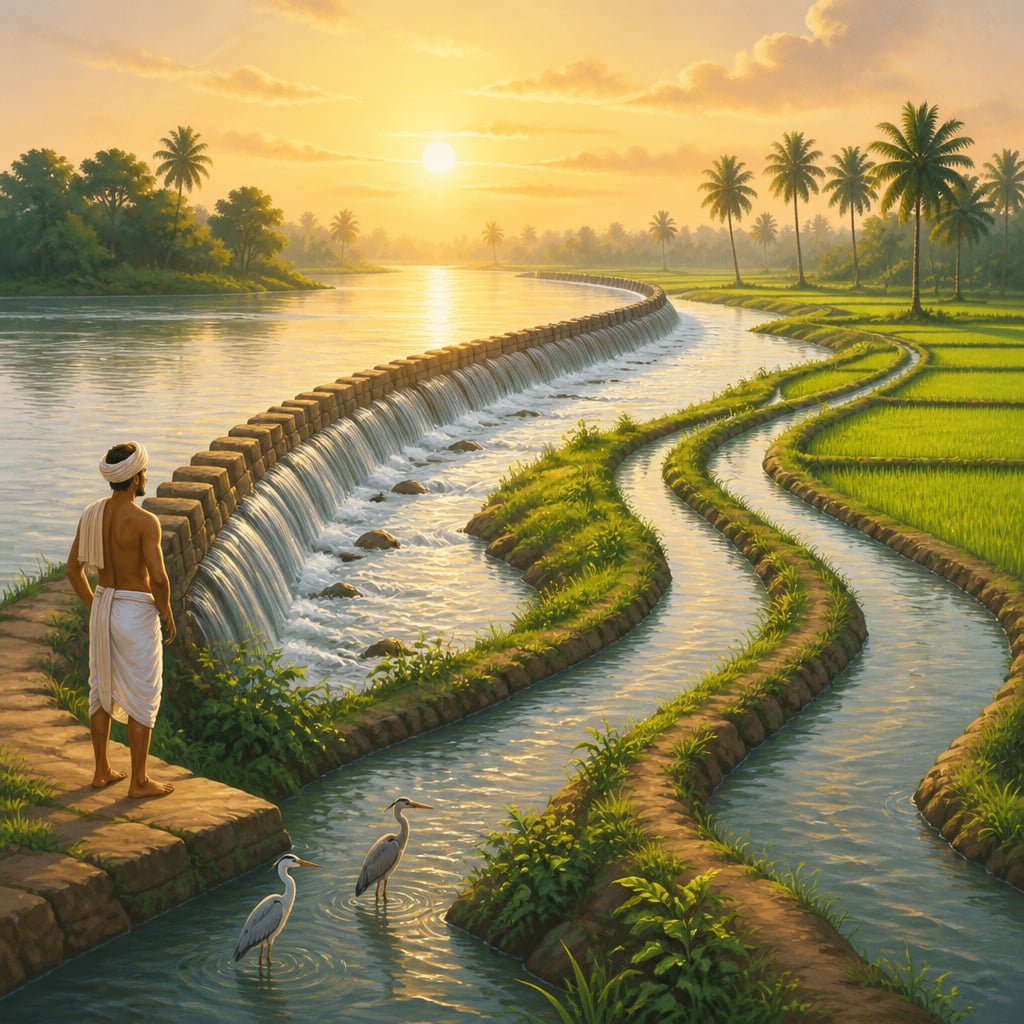
The dam was the hardware. The temple was the software.
The Temple as Total Institution
We moderns compartmentalize: government handles infrastructure, charities handle welfare, banks handle finance, schools handle education, hospitals handle health. Ancient Indians saw temples as the institution that integrated all these functions.
A major temple like Thanjavur's Brihadeeswara (built 1010 CE) wasn't just a place to worship Shiva. According to inscriptions, it employed:
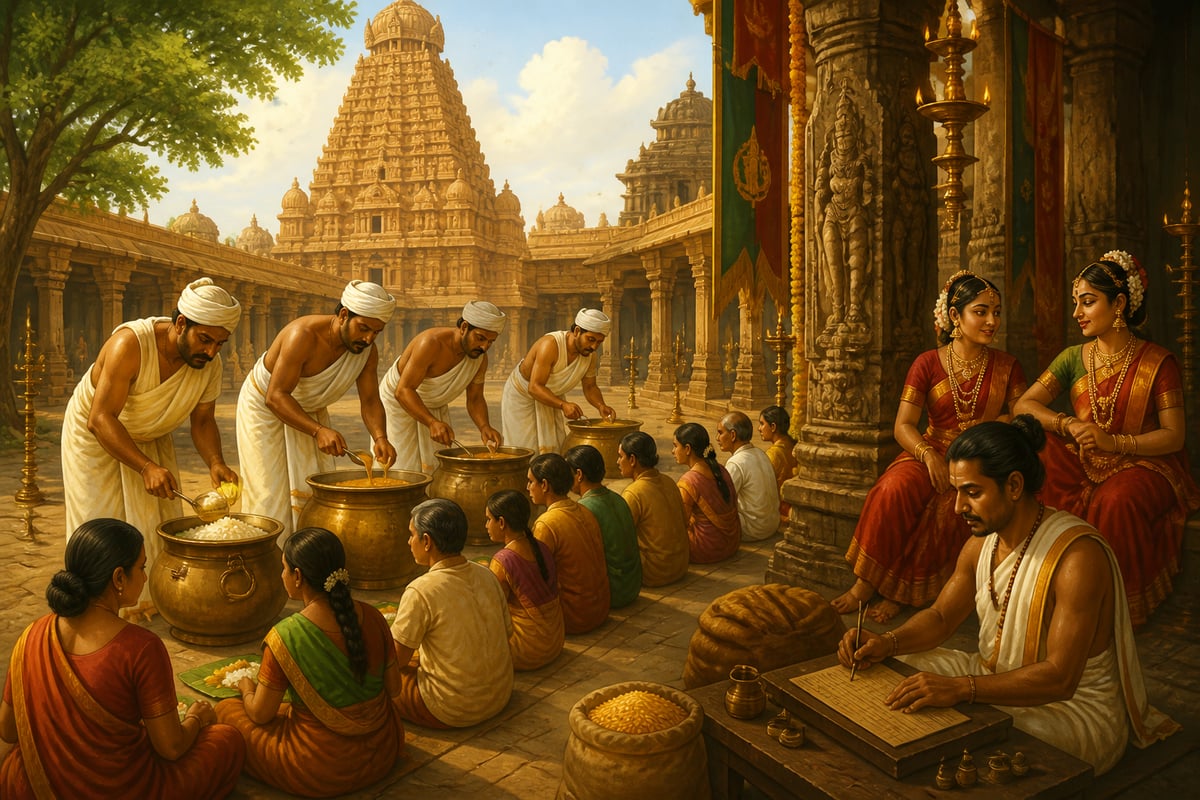
- 400 temple dancers (devadasis)
- 212 workers for various services
- 57 musicians
- Numerous cooks for daily annadana (free meals)
- Teachers for attached pathshalas (schools)
- Physicians for healing the sick
Who paid for all this? The temple's economic engine: lands donated by kings and devotees, tanks that irrigated those lands, and the surplus that flowed through the temple back to the community.
देवद्रव्येण दीनानां अन्नदानं परं तपः "Devadravyena dinanam annadanam param tapah" "Feeding the poor with the deity's wealth is the highest austerity."
This wasn't charity in the modern sense, it was dharmic redistribution. Wealth flowed to the temple as dana (donations), and flowed out as seva (service) to the community. The deity was the trustee of collective wealth.
The Economics of Temple Infrastructure
How did temples sustain this welfare network for centuries? Through a sophisticated economic model:
1. Permanent Endowments (Devadana): Land gifted to temples was removed from market circulation permanently. The Chola inscriptions record thousands of acres donated as devadana, the deity's property. Since the deity never dies, sells, or divides property, these endowments were perpetual.
2. Tank Irrigation Systems: Temples managed vast networks of eris (tanks) that collected monsoon water. The Chola kingdom alone had over 10,000 temple-managed tanks. The temple ensured maintenance through collective labor (shramdan) and appointed water managers (neerkatti).
3. Redistribution Through Ritual: The temple didn't simply store wealth, it circulated it. Daily prasad distribution fed the poor. Festival expenses employed artisans, musicians, and laborers. Annadana kitchens provided meals regardless of caste.
4. Banking Functions: Temples accepted deposits, made loans, and even issued credit instruments. Inscriptions from the Thanjavur temple record interest rates (typically 12-15% annually), loan terms, and collateral requirements, a fully functioning financial system.
Global Perspectives: CSR vs. Dharmic Dana
Modern corporations have adopted "Corporate Social Responsibility" (CSR) as their approach to community welfare. How does this compare to the temple model?
Milton Friedman (1912-2006), the Nobel-winning economist, famously argued in 1970 that "the social responsibility of business is to increase its profits." CSR, in this view, is either marketing or a distraction from the real purpose of corporations.
Michael Porter (born 1947), the Harvard strategist, proposed "Creating Shared Value" (CSV) in 2011, the idea that companies should address social problems only where solving them also creates business value.
The temple model operates on entirely different logic:
| Dimension | Modern CSR | Temple Dana |
|---|---|---|
| Purpose | Brand enhancement, risk management | Dharmic duty, merit accumulation |
| Source of funds | After-profit allocation | Before-profit dedication |
| Duration | Annual programs, changeable | Perpetual endowments |
| Accountability | To shareholders | To the deity (and community) |
| Integration | Separate from core business | Core function of institution |
The critical difference: CSR is an add-on to the profit motive. Temple dana was built into the economic structure. You didn't donate surplus, you dedicated a portion before calculating surplus. The deity was a stakeholder, not an afterthought.
A Living Legacy: Tirumala Tirupati Devasthanams
The temple model isn't ancient history, it's operating at scale in 2025.
Tirumala Tirupati Devasthanams (TTD), which manages the Lord Venkateswara temple at Tirupati, is the world's richest religious institution with an annual budget exceeding ₹8,000 crore ($1 billion). It demonstrates how traditional temple economics scales:

- S.V. Annadana Trust: Serves 100,000+ free meals daily, the world's largest free feeding program
- S.V. Institute of Medical Sciences: 1,300-bed hospital providing subsidized and free healthcare
- S.V. Vedic University: Preserving and teaching traditional knowledge
- S.V. Higher Secondary School: Education for thousands of students
- Housing colonies for employees and pilgrims
- Direct employment for 25,000+ people
TTD doesn't ask for government subsidies, it generates its own revenue through hundi donations, property income, and service fees, then redistributes it according to traditional priorities: annadana (food), vidyadana (education), aushadhadana (medicine).
Your Turn: What Would Dharmic Infrastructure Look Like?
The temple model suggests that infrastructure and welfare aren't purely government functions or corporate afterthoughts, they can be community functions embedded in institutional design.
Consider: What if your workplace, your community association, or your professional network operated on temple principles? What would it mean to:
- Create permanent endowments for community benefit?
- Integrate welfare into core operations rather than treating it as CSR?
- Make redistribution a religious duty rather than a tax burden?
In our next lesson, we'll explore a specific piece of temple infrastructure that exemplifies this integration: the devakula-tadaga, the temple tank that served as water supply, community gathering place, and ecological reserve all at once.
Milton Friedman's shareholder primacy model makes redistribution a residual afterthought, CSR happens after profits. Michael Porter's 'Creating Shared Value' integrates social good only where profitable. Neither builds redistribution into core institutional purpose.
The temple model made redistribution primary, wealth flowed TO the deity specifically FOR redistribution. There was no tension between 'profit' and 'purpose' because the purpose WAS redistribution.
TTD's annadana program has operated continuously for 40+ years, serving 100,000+ meals daily regardless of economic conditions, demonstrating the reliability of structurally embedded welfare vs. discretionary charity.
Long-term infrastructure investment as moral obligation
Modern infrastructure investment is often evaluated by short-term ROI, leading to deferred maintenance and crumbling systems. The temple model invested for centuries, not quarterly returns.
By making infrastructure sacred duty rather than optional investment, Indian kingdoms built for permanence. Karikala's Kallanai has operated for 2,000 years, can any modern dam claim such longevity?
Key terms
- Gramakshema
- Village welfare, the collective well-being of the village community, encompassing economic prosperity, physical safety, and spiritual fulfillment.
- Devadana
- Gift to the deity, land or wealth permanently donated to a temple, managed by trustees but owned by the divine, creating perpetual endowments for community welfare.
- Annadana
- Gift of food, the practice of providing free meals, considered the highest form of dana (charity) in Hindu tradition.
- Neerkatti
- Water manager, the village official responsible for managing irrigation water distribution from temple tanks, ensuring equitable access according to established rules.
Verses
देवद्रव्येण दीनानां अन्नदानं परं तपः
Devadravyena dinanam annadanam param tapah
To feed the hungry with the wealth of the gods is the supreme spiritual practice.
By framing redistribution as spiritual practice rather than burden, this principle ensured consistent welfare provision across centuries. Donors gave expecting merit; the temple redistributed expecting divine blessing. Both sides had incentive alignment.
Dharmashastra compilation, Various smritis on dana (P.V. Kane)
श्रीविमानस्य अर्चनार्थं भूमिं ददामि नित्यम्
Shrivimanasya archanartham bhumim dadami nityam
I give this land perpetually for the worship of the sacred temple.
The word 'nityam' (perpetual) is key. Unlike modern grants with expiry dates, temple endowments were designed to last forever. This created a permanent welfare infrastructure independent of political changes.
Thanjavur Brihadeeswara Temple Inscription, Rajaraja I inscription, c. 1010 CE (Archaeological Survey of India)
सेतुबन्धः परमं धर्मं राज्ञः प्रजापालने
Setubandhah paramam dharmam rajnah prajapalane
Building dams and embankments is the supreme duty of a king in protecting his people.
By elevating infrastructure to dharmic duty, the Arthashastra ensured that irrigation investment wasn't dependent on short-term political calculation. Kings competed to build tanks and dams for religious merit.
Arthashastra, Book 2, Chapter 1 (L.N. Rangarajan)
Key figures
Karikala Chola
Chola king, builder of the Kallanai (Grand Anicut) · c. 120-150 CE (early Chola dynasty)
The Kallanai (329 meters long) diverted Kaveri waters to irrigate the delta, transforming it into India's rice bowl. The dam was built to irrigate devadana lands whose produce supported temple welfare networks. Nearly 2,000 years later, it still functions, having been upgraded but never replaced. British engineers who studied it called it 'the pride of civil engineering.'
TTD Administration (Institutional)
Tirumala Tirupati Devasthanams, the world's largest temple trust · 1932-Present
TTD manages Lord Venkateswara's temple at Tirupati, serving 60,000-100,000 pilgrims daily. Its welfare programs include: Annadana Trust (100,000+ free meals daily), S.V. Institute of Medical Sciences (1,300-bed hospital), S.V. Vedic University, and housing for 25,000+ employees. It's a living proof that temple-centered welfare can operate at modern scale.
Milton Friedman
American economist, Nobel laureate (1976) · 1912-2006
Friedman argued that corporations spending money on 'social responsibility' beyond legal requirements were essentially taxing shareholders without consent. This view dominated corporate governance for decades and still shapes CSR debates. The temple model offers a structural alternative: institutions where welfare is the core function, not an afterthought.
Case studies
Tirumala Tirupati Devasthanams: Temple Economics at $1 Billion Scale
The Tirumala temple of Lord Venkateswara receives 60,000 to 100,000 pilgrims on ordinary days and up to 300,000 during festivals. The donations, dropped anonymously into the temple's hundi (donation box), totaled over ₹3,500 crore ($420 million) in 2023-24 alone. Add property income, services, and other sources, and TTD's annual budget exceeds ₹8,000 crore ($1 billion). Unlike a corporation maximizing shareholder value, TTD operates on the ancient devadana model: all wealth belongs to the deity, and the trust's duty is redistribution. The scale of redistribution is staggering: - **S.V. Annadana Trust:** Operates the world's largest free feeding program, serving 100,000+ meals daily. During festivals, this number doubles. Food is prepared in massive kitchens using traditional recipes, served to all regardless of caste, religion, or ability to pay. - **S.V. Institute of Medical Sciences:** A 1,300-bed super-specialty hospital providing cardiac surgery, cancer treatment, and emergency care at subsidized or free rates. The hospital performs over 10,000 surgeries annually. - **S.V. Vedic University:** Preserves traditional Sanskrit learning while offering modern degrees. Students receive free education, boarding, and stipends. - **S.V. Arts & Science College, S.V. Engineering College:** Multiple educational institutions serving thousands of students. - **Housing & Employment:** TTD directly employs 25,000+ people and provides housing colonies for employees and pilgrims.
Friedman's shareholder primacy model would analyze TTD as inefficient, it 'wastes' resources on welfare instead of maximizing returns. But the dharmic model inverts this logic: TTD exists FOR redistribution. The deity is not a shareholder seeking returns but a trustee holding wealth for community benefit. Critically, TTD's welfare programs aren't discretionary CSR. They're mandatory functions encoded in the trust's founding documents and religious tradition. When donations increase, welfare increases, automatically, not strategically. The contrast with modern CSR is stark: - CSR: Optional, variable, PR-driven, after-profit - TTD: Mandatory, structural, dharma-driven, before-profit TTD doesn't calculate ROI on its hospital. It builds hospitals because healing the sick with the deity's wealth is param tapah, supreme spiritual practice.
TTD demonstrates that traditional temple economics can operate at modern scale. Key metrics: - 50+ million pilgrims annually (more than any Disney park) - $1 billion+ annual operations - 100,000+ free meals daily (365 days/year) - 10,000+ surgeries annually at subsidized rates - 25,000+ direct employment - Zero government subsidy for core operations The model is self-sustaining: devotees donate because they trust the wealth will be redistributed; the temple redistributes, building trust; trust brings more donations. It's a virtuous cycle that has operated for centuries and now functions at billion-dollar scale.
The choice isn't between efficiency and welfare, it's between institutions designed for extraction (maximizing returns to owners) and institutions designed for redistribution (maximizing service to community). TTD proves that redistribution-first institutions can operate at massive scale, serve millions, and remain financially sustainable for centuries.
TTD's model of surplus redistribution finds modern parallels in corporate social responsibility mandates and India's 2% CSR law. But TTD's approach is structurally different: redistribution is not an afterthought but the institution's core design. This mirrors the growing 'stakeholder capitalism' movement where companies like Patagonia restructure ownership to prioritize community over shareholder returns.
TTD's Annadana Trust serves 100,000+ free meals daily, 36.5 million meals annually, making it the world's largest continuous free feeding program, operating without government subsidy for over 40 years.
Historical context
Early Chola Period (c. 150 CE) through Medieval Chola Empire (850-1279 CE)
The Chola period (850-1279 CE) represents the high point of temple-centered economics. Over 10,000 temples were built or renovated, each functioning as an economic institution with attached lands, tanks, schools, and welfare programs. The Chola bureaucracy integrated temple administration into state governance without controlling religious functions.
Medieval European monasteries performed similar functions, managing lands, providing education, caring for sick. But the European model was disrupted by the Reformation and state appropriation of church property. Indian temple endowments largely survived until colonial intervention, demonstrating greater institutional resilience.
Chola inscriptions record the employment of over 600 people at Brihadeeswara temple alone, including 400 temple dancers, 212 workers, 57 musicians, plus cooks, teachers, and physicians, a complete welfare institution.
Understanding temples as economic institutions (not just religious sites) reveals an alternative model of welfare provision: community-based, self-sustaining, and structurally designed for redistribution rather than extraction.
Living traditions
Temple-inspired welfare models influence modern institutions: the Akshaya Patra Foundation (feeding 2 million+ children daily) draws on annadana traditions; ISKCON temples worldwide operate free kitchens; the Sikh Langar tradition serves millions. These represent the temple welfare model adapted for modern scale.
- Daily Annadana: Free meal distribution continues at thousands of temples across India. Major temples like Tirupati, Puri Jagannath, and Golden Temple (Langar) serve tens of thousands daily.
- Temple Tank Festivals: Annual festivals celebrating temple tanks (teppotsavam/float festivals) maintain community connection to traditional water infrastructure.
- Tirumala Temple & TTD Institutions
- Kallanai (Grand Anicut)
- Brihadeeswara Temple, Thanjavur
- Sri Venkateswara Temple (Tirumala): The world's richest temple and the most complete modern implementation of gramakshema, managing $1B+ annually for education, healthcare, food security, and employment while demonstrating that dharmic economics scales to modern conditions
- Kallanai (Grand Anicut) and Brihadeeswarar Complex: The 2,000-year-old dam built to irrigate devadana (temple lands) whose surplus supported the Brihadeeswarar Temple's massive welfare network, the physical infrastructure and institutional structure designed as integrated system
Reflection
- Milton Friedman argued that business should focus solely on profit; social responsibility is government's job. The temple model integrates welfare as primary purpose. Which approach creates more reliable, sustainable community welfare, and why might modern institutions struggle to adopt the temple model?
- TTD serves 100,000+ free meals daily without government subsidy. What would it take to create similar self-sustaining welfare institutions in your community? What would need to change in how we think about charity, donation, and institutional purpose?