Samanya-Durghatana-Nivarana: Preventing Tragedy of Commons
What Went Wrong, and How to Fix It
Garrett Hardin's 'tragedy of the commons' wasn't a natural law, it was a description of what happens when governance fails. Indian commons worked for millennia; they collapsed during colonialism when governance was stripped away. This lesson examines why the tragedy happened, how it can be prevented, and what the ocean's empty fisheries teach us about the stakes.
The Year the Tanks Died
In 1836, a British engineer named Arthur Cotton arrived in South India with a mission: modernize irrigation. What he found astonished him, an intricate network of over 40,000 tanks, cascading across the landscape, supporting millions of farmers. "The natives," he wrote, "understood irrigation better than we do."
But Cotton's admiration didn't translate into policy. The British colonial administration had different priorities: revenue collection and canal irrigation for export crops. Tanks were complicated, maintained by village assemblies, governed by traditional rules, generating no direct revenue for the state. Canals were simpler, state-owned, centrally managed, producing taxable water.
Over the next century, colonial policy systematically neglected tanks:
- Zamindari system (1793) transferred village governance to landlords, who had no incentive to maintain common infrastructure
- Revenue prioritization meant canal construction received 90% of irrigation budgets while tank maintenance received almost nothing
- Abolition of traditional offices eliminated roles like neerkatti (water manager) that were essential for tank operation
- Legal changes made tank lands "government property," removing community ownership and accountability
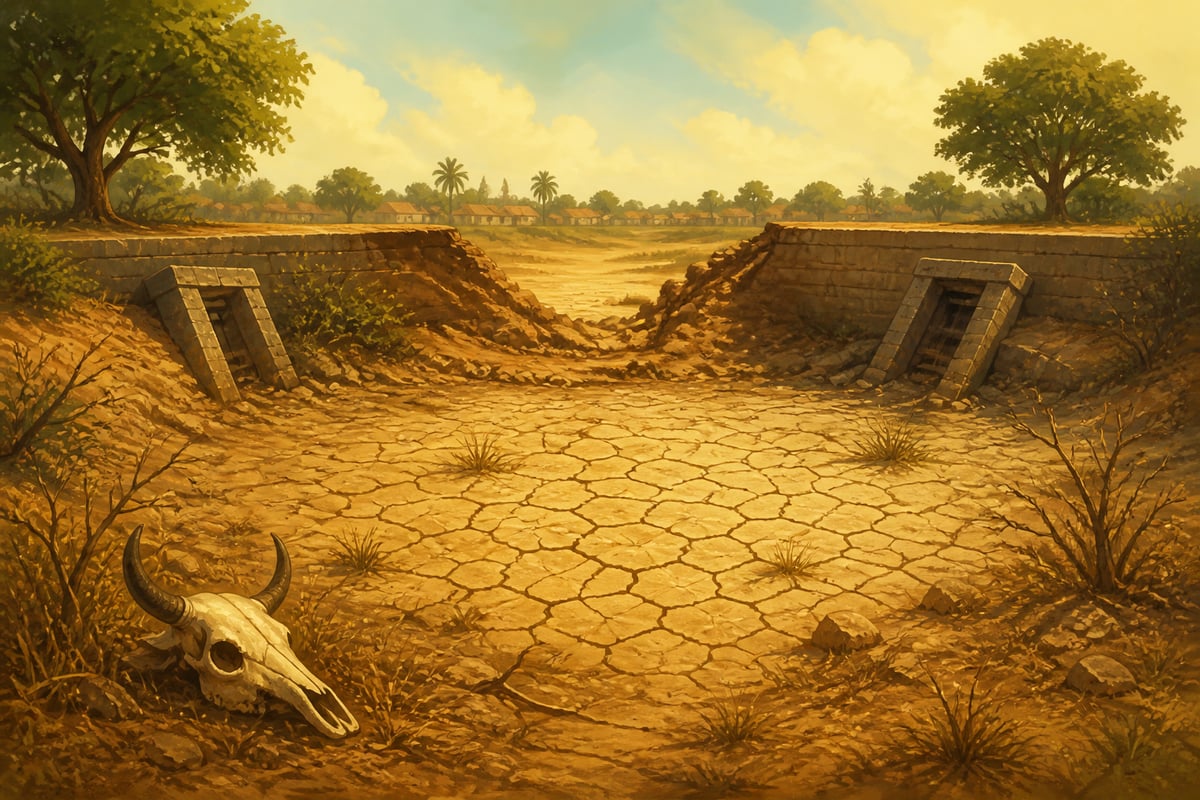
By 1900, thousands of tanks had silted up, breached, or been encroached. The "tragedy of the commons" that Garrett Hardin would describe in 1968 wasn't theoretical, it had already happened in India, engineered by colonial policy.
Why the Tragedy Isn't Inevitable
Hardin's famous 1968 essay argued that commons are inherently unstable: rational individuals will always over-exploit shared resources until they collapse. His solution: privatize or nationalize.
But Hardin made a critical error. He didn't describe commons, he described ungoverned commons. His famous example of the pasture that each herder degrades by adding one more cow only works if there are no rules, no limits, no governance.
Indian commons had governance. The grama sabha set usage rules. The neerkatti controlled water distribution. The eri kuttam maintained tanks. Violation brought social sanction, economic penalty, and religious disapproval.
When colonialism removed governance, the tragedy occurred. When governance remained, commons thrived.
This is the key insight: the tragedy of the commons is not a law of nature, it's a governance failure. Prevent the failure, prevent the tragedy.
The Eight Design Principles: Ancient Wisdom, Modern Validation
Elinor Ostrom (1933-2012), studying successful commons worldwide (including India), identified eight design principles that prevent tragedy. Remarkably, every principle has an analog in traditional Indian commons governance:
| Ostrom's Principle | Indian Practice |
|---|---|
| 1. Clearly defined boundaries | Sima (boundary markers), sima-devata (boundary deities) |
| 2. Rules match local conditions | Local grama sabha decisions, not distant mandates |
| 3. Collective choice arrangements | Eri kuttam (tank assembly), grama sabha (village assembly) |
| 4. Monitoring | Neerkatti (water manager), kaval (forest guard) |
| 5. Graduated sanctions | Social disapproval → fines → exclusion → divine punishment |
| 6. Conflict resolution mechanisms | Village elders, caste panchayats, oath before sima-devata |
| 7. Recognition by higher authorities | Kings granted, not interfered with, village governance |
| 8. Nested enterprises | Household → village → watershed governance layers |
Ostrom won the Nobel Prize for discovering what Indian villages had practiced for millennia.
Global Perspective: The Ocean's Empty Nets

The ocean is the world's largest commons, and its fisheries are collapsing. According to the FAO, over 35% of global fish stocks are now overfished, with many species at risk of commercial extinction.
Why is the ocean failing where Indian village tanks succeeded?
The ocean lacks what Indian commons had:
- No boundaries: Anyone can fish anywhere in international waters
- No local governance: No grama sabha for the Atlantic
- No graduated sanctions: Illegal fishing faces minimal enforcement
- No monitoring: The ocean is too vast to police
Contrast this with traditional Indian fishing communities. In Kerala, kadakkodi (sea courts) governed fishing:
- Boundaries: Each community had designated fishing zones
- Seasonal restrictions: Certain areas closed during breeding seasons
- Gear limitations: Net mesh sizes and boat sizes regulated
- Collective decision: Kadakkodi assemblies set and enforced rules
These systems weren't perfect, but they prevented collapse for centuries. When trawlers arrived in the 1960s, operating outside traditional governance, fish stocks crashed within decades.
The ocean's tragedy is a governance failure, not an inevitability.
Modern Prevention: Maharashtra's Groundwater Revolution
If the colonial period shows how to cause tragedy, modern Maharashtra shows how to prevent it.
Groundwater is the ultimate commons, invisible, shared across farm boundaries, impossible to fence. When borewells proliferate, aquifers deplete. India faces a groundwater crisis: over 60% of districts have declining water tables.
But in parts of Maharashtra, communities have prevented the tragedy through aquifer-level governance.

The Paani Foundation and similar organizations have facilitated community agreements on groundwater:
- Aquifer mapping: Scientific mapping shows the shared resource
- Community assembly: All farmers in an aquifer zone meet to understand the commons they share
- Collective agreements: Communities agree on:
- Crop choice (water-intensive crops limited)
- Borewell restrictions (new wells require community approval)
- Recharge investment (shramdan for water harvesting)
- Social monitoring: Neighbors monitor neighbors, social pressure enforces rules
- Watershed-level coordination: Multiple villages coordinate at the aquifer level
The results are striking:
- Villages with aquifer governance see water tables stabilize or rise
- Neighboring villages without governance see continued decline
- The difference is purely institutional, same geology, same rainfall, different governance
This is the dharmic principle in modern form: the commons thrives when governed, collapses when ungoverned.
The Formula: Governance = Boundaries + Rules + Monitoring + Sanctions
Across all successful commons, Indian villages, Ostrom's case studies, Maharashtra's aquifers, four elements appear consistently:
1. Boundaries: Clear definition of who belongs to the commons and what the commons includes. Without boundaries, there's no community to govern.
2. Rules: Locally appropriate regulations on use, how much, when, by whom. Rules must match local conditions, not be imposed from outside.
3. Monitoring: Someone watches. The neerkatti watches the tank, the kaval watches the forest, the neighbor watches the neighbor. Without monitoring, rules are unenforceable.
4. Sanctions: Graduated consequences for violations, social disapproval, fines, exclusion, and in traditional systems, divine punishment. Without sanctions, monitoring is pointless.
Remove any element and the system degrades:
- No boundaries → outsiders exploit the resource
- No rules → insiders over-exploit
- No monitoring → violations go unnoticed
- No sanctions → violations go unpunished
Colonialism removed governance. The tragedy followed. Revival restores governance. The commons recovers.
Your Turn: Diagnosing Commons Failures
The tragedy of the commons is everywhere, not just in pastures and fisheries, but in office kitchens, shared drives, public spaces, and digital platforms.
When you see a commons degrading, ask: What's missing?
- Are boundaries unclear? (Who belongs? What's shared?)
- Are rules absent or inappropriate? (What use is allowed?)
- Is monitoring absent? (Does anyone watch?)
- Are sanctions missing? (What happens to violators?)
The dharmic response isn't to abandon commons, it's to govern them. Every successful commons in history had governance. Every failed commons lacked it.
In our next lesson, we'll explore how dharmic governance principles can address modern crises, from climate change to digital platforms to urban water.
Hardin saw tragedy as inevitable, requiring privatization or nationalization. Ostrom showed that community governance works. Both miss the dharmic insight: tragedy is failure, not fate, a problem to be solved through design, not accepted as natural law.
Indian texts assume commons will be governed, they prescribe how, not whether. The question wasn't 'can commons work?' but 'how do we make them work?' This positive framing produced solutions where Hardin saw only problems.
Maharashtra villages with community aquifer governance show 15-25% better groundwater levels than neighboring villages without governance, same rainfall, same geology, different institutions.
The four necessary conditions for commons sustainability
Ostrom identified eight principles; others propose different frameworks. But all successful commons share four elements: boundaries (who's in), rules (what's allowed), monitoring (who watches), sanctions (what happens to violators).
Indian systems integrated divine sanction as a monitoring and sanction mechanism, the gods always watch, and they always punish. This reduced enforcement costs to near zero while increasing effectiveness.
Key terms
- Samanya-Durghatana
- Tragedy of the commons, the degradation of shared resources when individual incentives diverge from collective welfare in the absence of governance.
- Kadakkodi
- Sea court, traditional assembly of fishing communities in Kerala that governed fishing zones, seasons, gear, and disputes.
- Jal-Sansad
- Water parliament, modern revival of traditional water governance, where communities at the watershed or aquifer level collectively govern shared water resources.
- Jalasthara-Shasana
- Aquifer governance, collective management of groundwater at the aquifer level, treating underground water as a commons requiring governance.
Verses
सामान्यं यत्र नाशयन्ति दण्डयेत् राजा तान् कृतकल्मषान्
Samanyam yatra nashayanti dandayet raja tan kritakalmashan
Those who destroy common property shall be punished by the king, for they have wronged not one person but all.
Higher authority backup strengthens local governance. When village sanctions fail, the king's punishment serves as escalation. This matches Ostrom's principle 7: recognition by higher authorities.
Manusmriti, Chapter 9, Verse 225 (Patrick Olivelle)
सामान्यभूमिमक्रम्य स्वीकुर्वाणं दण्डयेत्
Samanya-bhumim akramya svikurvanam dandayet
One who encroaches upon common land, seeking to make it his own, shall face the king's punishment.
The biggest threat to commons isn't overuse, it's enclosure. Private appropriation of common land is explicitly prohibited and punishable, protecting the commons category itself.
Arthashastra, Book 3, Chapter 10 (R.P. Kangle)
सीमाविवादे सीमादेवताम् आहूय साक्ष्यं वदेत्
Sima-vivade sima-devatam ahuyasaksyam vadet
In boundary disputes, invoke the boundary deity and give testimony, let the gods witness truth.
Religious sanction reduces enforcement costs. When people believe perjury brings divine punishment, they're less likely to lie, making dispute resolution cheaper and more reliable.
Dharmashastra compilation, On sakshi (witness) procedures (P.V. Kane)
Key figures
Garrett Hardin
American ecologist, author of 'The Tragedy of the Commons' (1968) · 1915-2003
Hardin's model assumed ungoverned commons where individuals have no constraints. His solutions (privatize or nationalize) dominated policy for decades. However, his model failed to account for communities that govern themselves, exactly what Indian villages demonstrated for millennia.
Elinor Ostrom
American political economist, Nobel laureate (2009) · 1933-2012
Her eight design principles for successful commons management align remarkably with traditional Indian practices. She demonstrated that communities CAN govern commons without privatization or state control, winning the Nobel Prize and shifting policy discourse.
Paani Foundation
Organization pioneering community-based watershed and aquifer governance in Maharashtra · 2016-Present
Founded by actor Aamir Khan and others, Paani Foundation has trained over 4,000 villages in watershed management and community aquifer governance. Their 'Satyamev Jayate Water Cup' competition encourages villages to compete on water conservation, using social motivation to drive collective action. Villages participating show significant improvements in water tables.
Case studies
Maharashtra's Aquifer Governance: Preventing the Tragedy of Groundwater
India faces a groundwater crisis. Over 60% of districts show declining water tables. The Central Ground Water Board estimates that 21 major aquifers will be critically depleted by 2030. This is the tragedy of the commons in slow motion, invisible water, shared across farm boundaries, being extracted faster than it recharges. Groundwater is the ultimate ungoverned commons: - **No boundaries**: Water flows underground across property lines - **No rules**: Landowners can drill as deep as they want - **No monitoring**: No one tracks individual extraction - **No sanctions**: Over-pumping faces zero consequences But in parts of Maharashtra, communities have created governance where the state couldn't. Starting in the 2010s, organizations like the **Paani Foundation** and **WOTR (Watershed Organisation Trust)** facilitated a different approach: **aquifer-level governance**. Instead of treating groundwater as private property (yours if under your land), communities began treating it as a commons requiring collective management.
The Maharashtra model applies traditional commons governance to a modern resource: **Boundaries**: The aquifer, mapped scientifically, becomes the commons boundary. All farmers drawing from the same aquifer are part of the same community. **Rules**: Communities meet in *jal sabhas* (water assemblies) to agree on: - Maximum area of water-intensive crops (sugarcane, banana) - Moratorium on new borewells without community approval - Investment in recharge structures (shared shramdan) **Monitoring**: Neighbors monitor neighbors. In tight-knit villages, everyone knows who's drilling new wells or planting extra sugarcane. **Sanctions**: Social pressure is the primary sanction. Farmers who violate agreements face community disapproval, powerful in villages where reputation matters for everything from marriage alliances to credit access. This is the grama sabha model applied to invisible water, same principles, new resource.
Villages with aquifer governance consistently outperform neighbors without: - **Water table stabilization**: Villages with governance see tables stabilize or rise; neighbors without see continued decline - **Crop shift**: Water-intensive crops reduced 20-40%; water-efficient crops increased - **Collective investment**: 1,000+ check dams and percolation tanks built through community labor - **Conflict reduction**: Water disputes (increasingly common in drought years) drop significantly when rules are clear The Paani Foundation's 'Satyamev Jayate Water Cup' competition has engaged 4,000+ villages, using competition and recognition to motivate collective action. Participating villages show 20-30% better water conditions than non-participants in the same rainfall zone. The difference is purely institutional, same geology, same rainfall, different governance.
Groundwater was thought to be ungovernable, invisible, shared, impossible to fence. The Maharashtra experiment proves that traditional commons governance principles work even for resources that seem beyond governance. The formula is universal: boundaries + rules + monitoring + sanctions = sustainable commons. Apply it to any resource, and tragedy becomes avoidable.
Maharashtra's aquifer governance experiment anticipates what every water-stressed region will need. California's Sustainable Groundwater Management Act (2014) follows similar principles, requiring local agencies to manage shared aquifers collectively. As climate change intensifies drought cycles globally, community-level groundwater governance will become as essential as electricity grid management.
Maharashtra villages with community aquifer governance show 15-25% better groundwater levels than neighboring villages without governance, despite identical rainfall and geology, demonstrating that institutions, not nature, determine outcomes.
Historical context
Colonial period (1757-1947) and aftermath
The colonial period represents a natural experiment in commons destruction. When British policy removed traditional governance, abolishing neerkattis, transferring tank ownership to the state, redirecting maintenance funds to canals, the 'tragedy' that Hardin would later describe actually occurred. The comparison between governed pre-colonial commons and ungoverned colonial commons proves the governance hypothesis.
The ocean fisheries crisis parallels colonial India's tank collapse: both represent removal of governance from functional commons. International waters are ungoverned commons; traditional fishing communities had governance. The pattern is universal: governance prevents tragedy; its absence enables it.
Tamil Nadu had over 39,000 functional tanks pre-colonially. By 1900, over 15,000 were defunct or degraded. The same tanks, under different governance (colonial vs. traditional), produced opposite outcomes.
Understanding that tragedy is governance failure, not natural law, transforms the policy response. Instead of privatizing or nationalizing commons, we can restore governance. This is what DHAN, Paani Foundation, and similar organizations are doing successfully.
Living traditions
The commons governance revival is growing. Groundwater legislation in states like Maharashtra now requires community participation. The National Water Policy (2024 draft) emphasizes participatory management. These policy shifts reflect growing recognition that governance, not technology, is the key to preventing tragedy.
- Jal Sabhas (Water Assemblies): Community meetings to discuss and decide on water management, modern revival of grama sabha principles applied to aquifer governance.
- Satyamev Jayate Water Cup: Annual competition organized by Paani Foundation where villages compete on water conservation achievements, using social motivation to drive collective action.
- Paani Foundation Villages
- WOTR Watershed Villages
- Traditional Fishing Communities
- Kanyakumari Temple: The temple at India's southern tip has historically connected to fishing community governance; traditional kadakkodi (sea court) decisions were often announced at or sanctified by temple rituals, combining divine authority with community governance
- Trimbakeshwar Temple: Located at the source of the Godavari River, this temple historically governed water rights for downstream communities; temple traditions encoded water-sharing rules that prevented the tragedy of the commons for the entire river basin
Reflection
- Hardin assumed individuals in a commons will always over-exploit. Ostrom showed that communities can govern themselves. Indian evidence suggests governance depends on social conditions, tight-knit communities with repeated interaction and reputation effects. What social conditions enable commons governance? Where do those conditions exist today, and where have they eroded?
- Apply the four-element diagnostic (boundaries, rules, monitoring, sanctions) to a degrading commons in your life, a shared workspace, community resource, or digital platform. Which element is weakest? What intervention would strengthen it? Design a simple governance improvement you could propose.