Samanya-Sampada: Collective Management of Commons

When Everyone Owned What No One Could Own Alone

For millennia, Indian villages successfully managed shared resources, pastures, forests, water bodies, through collective governance systems that Western economists only 'discovered' in the 21st century. Learn how dharmic principles prevented the 'tragedy of the commons' that plagued Europe.

The Pasture That Fed a Thousand Herds

In the spring of 1985, a Swedish economist named Elinor Ostrom arrived in a remote village in Rajasthan. She had come to study something that, according to Western economic theory, should not exist: a common pasture that had been sustainably managed for over 400 years.

Her colleagues in American universities had insisted it was impossible. Garrett Hardin's famous 1968 essay 'Tragedy of the Commons' had become economic gospel: shared resources, left to individual self-interest, would inevitably be destroyed. Each herder would add one more cow, then another, until the pasture collapsed. The only solutions, Hardin argued, were privatization or government control.
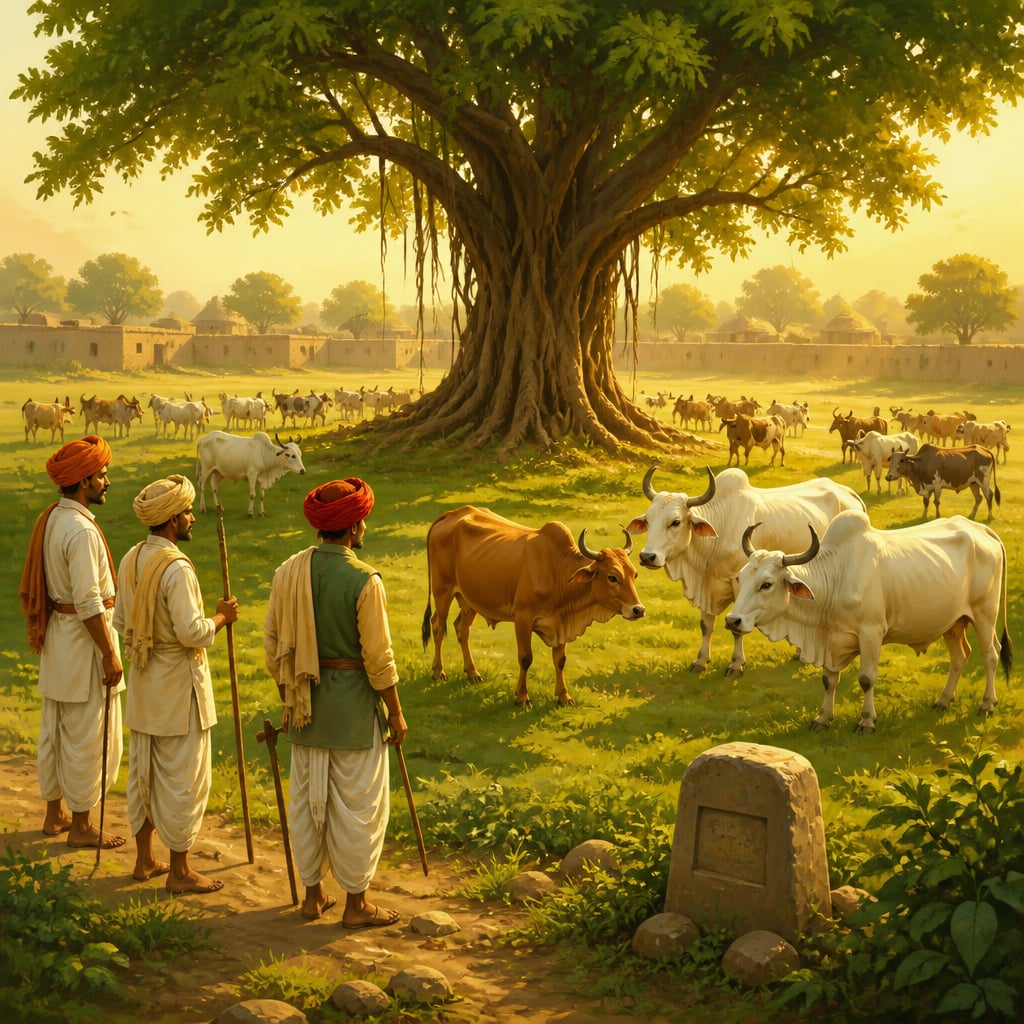
A Rajasthan village gauchar pasture at dawn with herds from many households grazing together

Yet here was a pasture, gauchar in the local tongue, that had fed a thousand herds across four centuries without degradation. How?

The Architecture of Shared Prosperity

The answer lay in an ancient governance system that Kautilya had documented two millennia earlier. The Arthashastra distinguished between sita (crown land managed by the state) and samanya-bhumi (common land managed by the village). For the latter, Kautilya prescribed a system of collective rights and responsibilities:

Kautilya inscribing the rule on common village land onto palm leaves by torchlight

सामान्यं भूमिं ग्रामः समं भुञ्जीत, न च एकस्य अधिकारः "Samanyam bhumim gramah samam bhunjita, na cha ekasya adhikarah" "The village shall enjoy common land equally, and no single person shall have exclusive right."

This wasn't communism, families owned their private fields. But pastures, forests, ponds, and grazing lands belonged to no individual. They belonged to the village as a living entity, to be managed through the grama sabha (village assembly) with rules that balanced individual use with collective sustainability.

The system worked through three interlocking mechanisms:

1. Graduated Rights Based on Need: A family with ten cattle didn't get ten times the grazing rights of a family with one. Instead, rights were calibrated to sustain both herds and pasture. The Arthashastra term yathashakti (according to capacity) governed allocation.

2. Seasonal Restrictions: Certain areas were closed during regeneration periods, what modern ecologists call 'rotational grazing.' These restrictions weren't government mandates but community decisions, enforced through social accountability.

3. Collective Labor for Maintenance: Each household contributed shramdan (voluntary labor) for commons upkeep, clearing water channels, maintaining boundaries, removing invasive species. Those who used the commons were obligated to care for the commons.

Global Perspectives: The Tragedy That Never Was

Garrett Hardin (1915-2003) published 'The Tragedy of the Commons' in Science in 1968, arguing that shared resources were doomed to overexploitation. His solution: either privatize everything or impose government control. For decades, this became the dominant paradigm in Western economics and policy.

Elinor Ostrom (1933-2012) spent forty years gathering evidence that proved Hardin wrong. Her fieldwork in Nepal, Switzerland, Japan, Spain, and crucially India revealed communities that had sustainably managed commons for centuries. In 2009, she became the first woman to win the Nobel Prize in Economics for demonstrating that communities can govern commons effectively without privatization or state control.

What Ostrom discovered in Rajasthan, the Arthashastra had prescribed 2,300 years earlier.

Thinker Claim Indian Reality
Hardin (1968) Commons inevitably collapse without private ownership or state control Indian villages managed commons sustainably for millennia
Ostrom (2009) Communities CAN govern commons through local institutions Grama sabha provided exactly this institutional framework
Kautilya (300 BCE) 'The village shall enjoy common land equally' Prescribed the system Ostrom 'discovered'

The difference is profound. Hardin assumed individuals were purely self-interested, the homo economicus of Western theory. Indian thought assumed individuals were embedded in community, bound by dharma, and accountable to neighbors they'd see every day. When your reputation, your children's marriage prospects, and your standing in the village assembly depend on how you treat common resources, you think differently.

A Living System in 2025

This isn't just history. In December 2024, the National Mission for Clean Ganga announced partnerships with 1,200 villages along the Ganga basin to revive traditional johad (community pond) and gauchar (common pasture) management systems. The policy explicitly referenced 'traditional commons governance' as more effective than centralized management.

Rajendra Singh leading villagers reviving a johad catchment in Alwar

In Rajasthan, the Tarun Bharat Sangh movement, led by 'Waterman of India' Rajendra Singh, has revived over 11,000 johads in 1,200 villages using exactly the governance principles Kautilya described. Singh won the Stockholm Water Prize (2015) not for new technology but for reviving ancient institutions.

Meanwhile, Farmer Producer Organizations (FPOs), numbering over 10,000 across India in 2025, function as modern commons, collectively owning processing facilities, marketing channels, and input supplies. The FPO model works precisely because it applies commons governance principles: collective ownership, graduated rights, shared labor, and grama sabha-style decision-making.

Your Turn: Commons in Your Life

The tragedy of the commons is not inevitable, it's a design failure. Wherever commons collapse, you'll find governance failures: missing rules, absent enforcement, or excluded voices. Wherever commons thrive, you'll find dharmic governance: clear boundaries, graduated rights, collective decision-making, and social accountability.

Consider the commons in your own life: shared workspaces, community resources, family assets, even digital commons like open-source software. What governance systems protect them? Where do you see 'tragedy' emerging, and what's missing?

In our next lesson, we'll explore sthala, the specific land concepts and boundary rules that made village commons work, from the sacred devabhumi (deity's land) to the practical gauchar (pasture).

Principal-agent alignment in common-pool resource management

Garrett Hardin assumed self-interest would destroy commons. Elinor Ostrom showed that community accountability, social monitoring, graduated sanctions, reputation effects, aligns individual interest with collective welfare.

Indian thought added the dharmic dimension: protecting commons wasn't just rational but righteous. This moral loading made violations costly in ways beyond fines, in reputation, marriage prospects, and spiritual standing.

Studies of Indian village forests show that community-managed forests have 15-20% better tree cover than government-managed reserves, despite fewer external resources (World Bank, 2018).

F.A. Hayek argued that local actors have knowledge that central planners cannot access. James Scott's 'Seeing Like a State' shows how distant governance destroys local solutions. Both echo ancient Indian practice.

Indian villages institutionalized local knowledge through the grama sabha, grama vriddhah (village elders), and occupational panchayats. Decisions incorporated generations of accumulated wisdom about local conditions.

Key terms

Samanya-Sampada
Common wealth or shared resources, property held collectively by a community rather than by individuals or the state.
Gauchar
Common pasture land, grazing ground collectively owned and managed by the village for all livestock.
Johad
Traditional earthen water-harvesting structure, a community pond or check dam that collects rainwater for irrigation, drinking, and groundwater recharge.
Shramdan
Gift of labor, voluntary contribution of physical work for community benefit, particularly for maintaining commons infrastructure.

Verses

सामान्यं भूमिं ग्रामः समं भुञ्जीत, न च एकस्य अधिकारः

Samanyam bhumim gramah samam bhunjita, na cha ekasya adhikarah

Common land belongs to all the village equally; no single person may claim it as their own.

This principle creates 'common property' as a third category between private and public ownership, what Elinor Ostrom's Nobel-winning research validated 2,300 years later.

Arthashastra, Book 2, Chapter 24 (R.P. Kangle)

सीमां रक्षेत् सर्वो ग्रामः, सीमालङ्घनं महापापम्

Simam rakshet sarvo gramah, simalanghanam mahapapam

The entire village must guard its boundaries; to violate them is a grave transgression.

By framing boundary violation as *papam* (sin), the system enlisted dharmic consciousness for enforcement, social shame and religious sanction supplemented legal penalties.

Arthashastra, Book 3, Chapter 10 (L.N. Rangarajan)

क्षेत्रस्य सीमां विवदन्तौ ग्रामवृद्धाः विनिर्णयेत्

Kshetrasya simam vivadantau grama-vriddhah vinirnayet

When land boundaries are disputed, the village elders shall determine the truth.

Local arbitration reduced transaction costs and preserved community cohesion, exactly what modern 'alternative dispute resolution' tries to achieve.

Manusmriti, Chapter 8, Verse 237 (Patrick Olivelle)

Key figures

Kautilya (Chanakya)

Political economist and author of the Arthashastra · 4th century BCE

Codified the principles of collective resource management that Indian villages practiced for millennia: equitable access, boundary protection, collective labor, and local dispute resolution. His framework predates Western 'discovery' of commons governance by 2,300 years.

Rajendra Singh

Water conservationist, founder of Tarun Bharat Sangh, 'Waterman of India' · Present (born 1959)

Since 1985, his Tarun Bharat Sangh has built or revived over 11,000 johads in 1,200+ villages, bringing five rivers back to life. His approach, community ownership, shramdan-based construction, grama sabha governance, directly applies the Arthashastra model. Won the Stockholm Water Prize (2015), the Magsaysay Award (2001), and the Jamnalal Bajaj Award.

Elinor Ostrom

American political economist, Nobel laureate (2009) · 1933-2012

In her landmark book 'Governing the Commons' (1990), Ostrom identified eight design principles for successful commons management, principles that, remarkably, align with what Indian texts like the Arthashastra had prescribed millennia earlier. She became the first woman to win the Nobel Prize in Economics, with the committee specifically citing her work on common-pool resources.

Case studies

Tarun Bharat Sangh: Reviving the Johads of Rajasthan

In 1985, when Rajendra Singh arrived in Gopalpura village in Rajasthan's Alwar district, he found a dying landscape. Five rivers had stopped flowing. Groundwater had dropped below 100 feet. Wells were dry. The annual migration to cities had hollowed out villages. The government's solution was to sink deeper borewells, a technological fix that accelerated groundwater depletion. Singh tried a different approach: he asked village elders about the old johads (earthen water-harvesting ponds) that their grandparents had maintained. The structures were still there, silted, breached, forgotten, but the knowledge of building them remained in living memory. The first johad took 40 days of shramdan (voluntary community labor). No government funds. No NGO contractors. The village decided where to build, contributed the labor, and maintained the structure. Within one monsoon, the groundwater began rising.

Conventional development economics prescribes external intervention: government schemes, technological solutions, expert consultants. The dharmic approach, embedded in the johad tradition, starts with community ownership. The grama sabha decides, the village builds through shramdan, and everyone shares the water according to agreed rules. The Arthashastra's principle that 'the village shall enjoy common land equally' became operational: water was a samanya-sampada (common wealth), not a commodity to be purchased or a government benefit to be distributed. When villagers built the johad with their own hands, they protected it with their own vigilance.

Over 40 years, Tarun Bharat Sangh has facilitated the construction or revival of over 11,000 johads in 1,200+ villages. Five rivers, Arvari, Ruparel, Sarsa, Bhagani, and Jahajwali, have returned to perennial flow. Groundwater levels rose from 100+ feet depth to 10-15 feet in many areas. Migration reversed: people returned to farming. The Arvari river even developed a fish population that hadn't existed in living memory. In 1998, the Arvari communities formed the 'Arvari Sansad' (Arvari Parliament), a river parliament where 72 villages collectively govern the river basin through traditional commons principles. This is grama sabha scaled to the watershed level.

Technology cannot substitute for governance. Borewells without community management accelerate crisis; johads with community ownership create sustainable abundance. The ancient commons governance model, collective ownership, local decision-making, shramdan-based maintenance, works in the 21st century exactly as it did for millennia.

The johad model directly influenced the MGNREGA watershed guidelines that now govern India's largest rural employment program. Globally, the Nature Conservancy and other organizations promote 'nature-based solutions' that are functionally identical to traditional water harvesting. The insight that community governance outperforms technological fixes applies equally to modern challenges like urban flooding, where green infrastructure consistently outperforms concrete drainage.

The Arvari basin's groundwater rose from 100+ feet depth to 10-15 feet within 15 years of johad revival, without any external pumping or recharge technology, purely through traditional water harvesting and community governance.

Chipko Movement: From Forest Protection to Joint Forest Management

In 1973, the women of Reni village in Uttarakhand's Chamoli district did something unprecedented: they hugged trees to prevent government-approved contractors from felling them. The forest, communal land their ancestors had protected, was being auctioned to a sports goods company without village consent. The movement, led by Gaura Devi and supported by activists like Sunderlal Bahuguna and Chandi Prasad Bhatt, wasn't just environmental protest. It was a demand for the restoration of traditional commons governance. Villages had managed these forests for centuries through 'van panchayats' (forest councils) with clear rules: which trees could be cut, when, and by whom. Colonial and post-colonial forest departments had nationalized these commons, cutting villages out of management while selling logging rights to contractors. The Chipko slogan, 'What do the forests bear? Soil, water, and pure air', captured the dharmic understanding that forests were samanya-sampada serving multiple functions, not commodities for extraction.

The British colonial system (continued post-independence) treated forests as state property to be commercially exploited. The dharmic view, embedded in traditional van panchayats, saw forests as community commons providing timber, fuel, fodder, water, and spiritual value. Chipko wasn't anti-development; it was pro-community governance. The women weren't asking for forests to be locked away, they were asking for the traditional system where villages managed forests, taking what they needed while ensuring regeneration. The contrast was between extractive state control and sustainable community management.

Chipko led directly to the National Forest Policy of 1988, which introduced 'Joint Forest Management' (JFM), a formal partnership between forest departments and village communities. Today, over 100,000 JFM committees across India manage nearly 23 million hectares of forest land. Van panchayats in Uttarakhand (over 12,000 of them) now have legal recognition for community forest management. Studies show that community-managed forests under JFM have better biodiversity and regeneration rates than pure state-managed reserves. The dharmic principle won: local governance outperforms distant control.

When communities lose governance rights over their commons, degradation follows, not because villagers are irresponsible, but because they're excluded from management. Restoring community governance (not just 'participation') is the key to sustainable commons management.

Joint Forest Management has become the template for community-based natural resource management worldwide. The REDD+ climate program, which pays communities to protect forests, operates on the same logic Chipko demanded: give communities governance rights and economic stakes in forest health, and deforestation drops. Countries from Nepal to Brazil now apply this principle.

Over 100,000 Joint Forest Management committees now manage 23 million hectares across India, a direct legacy of Chipko's demand for community governance of forest commons.

Historical context

Vedic Period through Mauryan Period (2000 BCE - 200 BCE) and beyond

Indian villages developed sophisticated commons governance over millennia, with the grama sabha as the decision-making body and dharmic principles providing moral enforcement. This system enabled sustainable management of pastures, forests, and water bodies across diverse ecological zones from Himalayan foothills to Thar Desert edges.

While European commons suffered the 'enclosures' (16th-18th centuries) that privatized communal lands, Indian commons largely survived until colonial intervention. The English 'tragedy of the commons' that Hardin referenced was a result of governance collapse during enclosures, not proof of inevitable failure.

Pre-colonial India had an estimated 10 million village ponds and tanks, most managed as commons through local governance. By independence (1947), over 60% were degraded or abandoned due to the collapse of traditional management systems under colonial administration.

Understanding that commons management is a governance problem (not an ownership problem) changes everything. The lesson isn't to privatize commons but to restore the community institutions that made commons work for millennia.

Living traditions

The Community Forest Rights provisions of the Forest Rights Act (2006), PESA Act's gram sabha powers, and the growing FPO movement all draw on traditional commons governance principles. India's 2024 National Water Mission explicitly references 'traditional water governance' as a policy model.

Reflection

More in Commons Management & Resource Governance

All lessons in Commons Management & Resource Governance · Grama Swarajya: Village Economics course