Devakula-Tadaga: Temple Tanks as Community Assets

Sacred Water, Sacred Forests

India once had millions of community tanks and thousands of sacred groves, infrastructure that harvested water, preserved biodiversity, and served communities for centuries. From Tamil Nadu's 39,000 eris to Rajasthan's stepwells to the sacred kavus of Kerala, different regions developed different solutions to the same challenge: governing shared ecological resources.

The Lake That Remembered Itself

In 2019, Chennai faced a water crisis that made global headlines. Reservoirs dried. Taps ran empty. Water was shipped in by train. Yet within the city limits, there existed something remarkable: Porur Lake, a 1,000-year-old temple tank that, unlike the modern reservoirs, had never run completely dry.

What was different? Porur wasn't a 'reservoir' in the modern sense, it was an eri, a temple tank designed as an integrated ecological system. While modern engineering treats water as a resource to be stored and extracted, the eri system treated water as a relationship to be maintained.

Across India, from Tamil Nadu's 39,000 eris to Rajasthan's stepwells to Karnataka's kalyanis, communities built water infrastructure that lasted centuries. Parallel to these, sacred groves (devara kaadu in Karnataka, kavu in Kerala, law kyntang in Meghalaya) preserved forests when all around them land was cultivated.

How did they work? What did we lose when we abandoned them? And can they be revived?

The Pan-Indian Mosaic of Water Wisdom

Tamil Nadu's Eri System: Engineering and Ecology
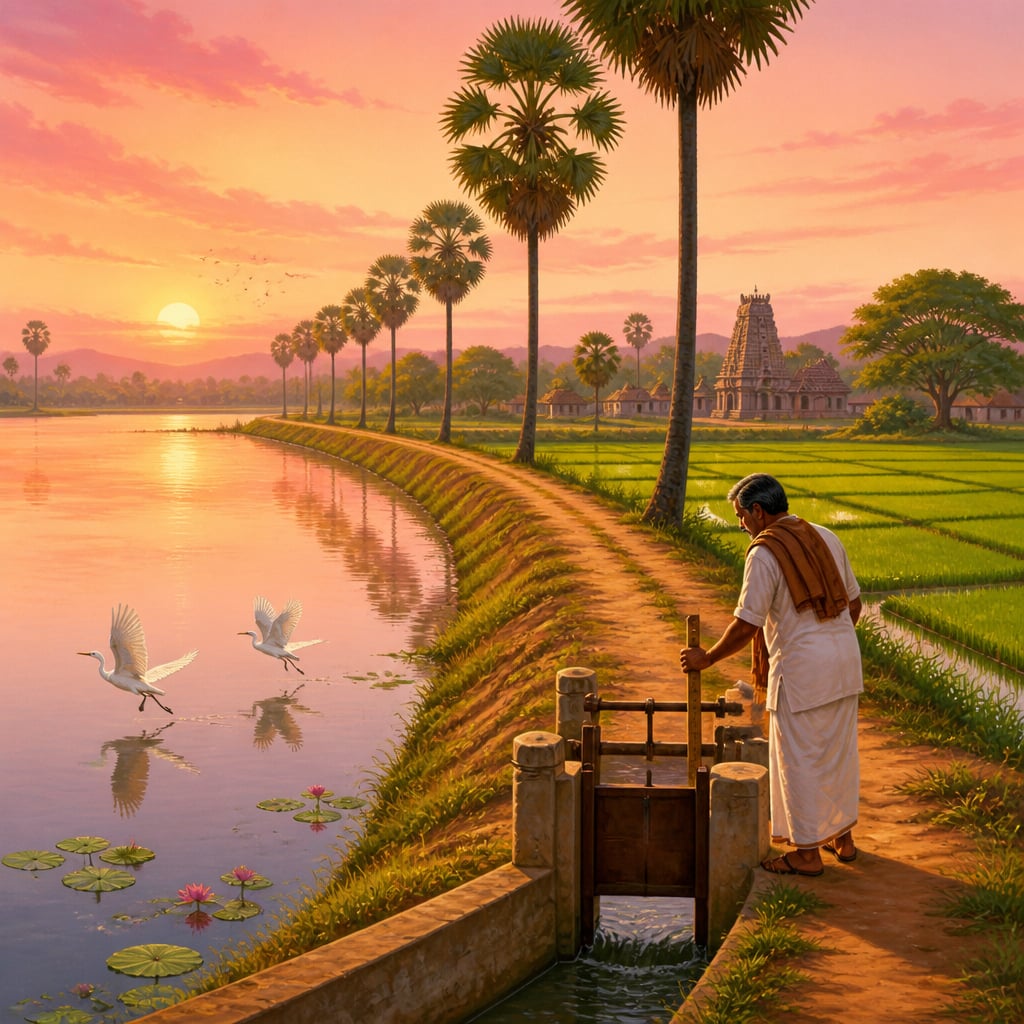
A Tamil Nadu eri tank at sunrise with the neerkatti walking the bund

The eri (tank) system of Tamil Nadu is the world's most sophisticated traditional water management network. At its peak, the region had over 39,000 tanks linked in cascade systems, where overflow from one tank fed the next.

But an eri wasn't just a pond. It was a complete system:

The Chola inscriptions record detailed rules: when water is released, in what sequence, to which fields. These weren't bureaucratic regulations, they were community decisions enforced through the eri kuttam (tank assembly).

Karnataka's Kalyanis: Architecture as Worship

In Karnataka, temple tanks took a different form: the kalyani or stepped tank. Unlike the vast agricultural eris, kalyanis were smaller, architecturally elaborate, and often attached to temples.

Hampi's tanks, built during the Vijayanagara Empire (1336-1646 CE), combined hydraulic engineering with sacred architecture. The pushkarini (lotus tank) at Vitthala Temple collected rainwater through invisible channels carved into the surrounding rock. Water wasn't just stored; it was choreographed.

Rajasthan's Stepwells: Mining Water from Desert

A Rajasthan baori stepwell with women descending its sandstone steps to the water

In arid Rajasthan, communities developed the baori or vav (stepwell), an architectural marvel that combined water access with social space. The famous Chand Baori at Abhaneri descends 13 stories (100 feet) to reach the water table, with 3,500 perfectly geometric steps.

Stepwells served multiple functions:

Sacred Groves: Two Models of Forest Commons

While tanks managed water, sacred groves managed forests, but through a very different mechanism: religious prohibition rather than active governance.

Western Ghats: Dev-Van and Kavu

A Kerala kavu sacred grove with a small stone shrine under untouched canopy

In Maharashtra, sacred groves are called devara kaadu or dev-van; in Kerala, kavu. These are patches of forest, sometimes just an acre, sometimes hundreds, dedicated to local deities.

The rules are simple: no extraction whatsoever. No felling trees, no collecting wood, no hunting animals, no removing anything. The forest belongs to the deity, and the deity does not share.

This absolute prohibition preserved biodiversity remarkably. Studies of kavus in Kerala found they contain species extinct everywhere else in the region. A 2020 survey documented over 1,200 kavus in Kerala alone, some containing trees 500+ years old.

Khasi Sacred Forests: Collective Governance

In Meghalaya, the Khasi people protect law kyntang (sacred forests) through a different model, not absolute prohibition but collective governance.

The law kyntang is owned by the village community (the syiemship) and managed through the dorbar (traditional council). Unlike the total prohibition of Kerala kavus, Khasi sacred forests allow regulated use:

The outcome is similar, preserved forests in a landscape of cultivation, but the governance model differs: divine ownership vs. collective trusteeship.

Aspect Western Ghats Model Khasi Model
Ownership Deity Village community
Extraction Zero tolerance Regulated by dorbar
Enforcement Religious sanction Community decision
Flexibility Low (absolute rule) Higher (case-by-case)
Outcome High biodiversity preserved High biodiversity preserved

Both models work. What they share is local governance with strong social enforcement, whether through fear of divine punishment or community sanction.

Global Perspectives: Why Conventional Conservation Fails

Garrett Hardin (1915-2003), in his famous 1968 essay, assumed commons would be destroyed by rational self-interest. His solution: privatize or nationalize.

India tried nationalization. The Indian Forest Act of 1927 (based on British colonial law) transferred forest governance from communities to the state. The result? India's forest cover declined from ~40% to ~21% over the 20th century. State control didn't protect forests, it removed local stewardship.

Elinor Ostrom (1933-2012) studied India's sacred groves as examples of successful commons governance without privatization or state control. Her insight: communities develop rules that work because they're adapted to local conditions and enforced by people who bear the consequences.

The Khasi law kyntang and Kerala kavu represent two valid solutions to the same problem: the divine ownership model (total prohibition) and the community governance model (regulated use). Both outperform state management.

Revival: The DHAN Foundation Story

For decades, traditional water infrastructure was abandoned, ignored by governments focused on dams and borewells, encroached by development, silted through neglect. But in 1997, an organization called Development of Humane Action (DHAN) Foundation began reviving what was lost.

DHAN's approach was simple: restore both infrastructure and governance.

In Madurai district, DHAN worked with village communities to revive tanks that had been abandoned for decades:

  1. Desiltation using community labor (modern shramdan)
  2. Bund repair following traditional engineering
  3. Sluice restoration for proper water control
  4. Eri Kuttam revival, reconstituting the traditional tank assembly

The key insight: physical restoration without governance restoration doesn't work. Tanks restored by government programs often fail again because no one maintains them. Tanks restored WITH community governance function for decades.

By 2024, DHAN has facilitated the revival of over 10,000 tanks across South India, affecting 2 million+ farmers. The organization doesn't build tanks, it rebuilds the institutions that maintain them.

Your Turn: What Governance Makes Possible

The lesson of temple tanks and sacred groves isn't about water or forests, it's about governance making conservation possible.

Consider: What resources in your community are degrading because no one governs them? What would it take to create (or revive) the local institutions that could maintain them?

In our next lesson, we'll examine what happens when commons governance fails, the actual 'tragedy of the commons' and how dharmic economics provides tools to prevent it.

Institutional capital and infrastructure sustainability

Development economics has long focused on 'hardware' (roads, dams, buildings) while undervaluing 'software' (institutions, governance, rules). This explains why so many World Bank-funded projects fail after the funding ends.

Traditional Indian infrastructure was designed with governance built in. Tanks came with assemblies, forests came with divine ownership, wells came with usage rules. The 'soft' institutional layer made the 'hard' physical layer sustainable.

Government-restored tanks without governance revival have a 60% failure rate within 10 years. DHAN-restored tanks with governance revival have a 90%+ success rate over 20+ years.

Equifinality in commons governance, multiple paths to same outcome

Western policy debates often assume there's one 'right' solution (privatize vs. nationalize). Elinor Ostrom showed that successful commons governance takes many forms, what matters is local fit and strong social enforcement.

Key terms

Eri
A tank or reservoir in Tamil Nadu's traditional water management system, not just a pond but a complete irrigation infrastructure with defined catchment, command area, and governance.
Kavu
Sacred grove in Kerala, a patch of forest dedicated to a deity where no extraction of any kind is permitted, preserving biodiversity through religious prohibition.
Baori / Vav
Stepwell, an architectural structure combining water access, storage, and community space, descending in steps to reach the water table.
Neerkatti
Traditional water manager responsible for operating tank sluices, allocating water according to established rules, and maintaining infrastructure.

Verses

ஏரிக்குக் கட்டளை ஐவர் நிர்வாகஞ் செய்வர்

Erikku kattalai aivar nirvaakam seyyvar

A committee of five shall govern the tank, elected, accountable, and bound by assembly decision.

Specialized governance committees for common-pool resources reduce management costs while increasing accountability. The 'committee of five' model balanced representation with efficiency.

Tamil inscription (Chola period), Uttaramallur inscription, c. 920 CE (Archaeological Survey of India)

देवारण्ये न छेदयेत् वृक्षं कदाचन

Devaranya na chhedayet vriksham kadachana

In the forest of the gods, no tree may ever be cut, for the trees themselves are the deity's body.

Divine ownership creates perfect inalienability at near-zero enforcement cost. Fear of supernatural sanction substitutes for policing, an elegant solution to the monitoring problem that plagues conservation.

Dharmashastra compilation, Various smritis on vriksha protection (P.V. Kane)

जलं विना न सस्यं, सस्यं विना न जीवनम्

Jalam vina na sasyam, sasyam vina na jivanam

Without water, no harvest; without harvest, no life. Water is the foundation of all prosperity.

Water infrastructure has the highest return on investment of any public good, it enables all other production. This is why ancient kings competed to build tanks.

Krishi Parashara, Ancient agricultural text, c. 400-500 CE (Y.L. Nene)

Key figures

The Uttaramallur Assembly (Institutional)

Chola-era village assembly with the world's most detailed ancient democratic procedures · c. 920 CE

The inscriptions describe: election by lot from qualified candidates, term limits, removal procedures for misconduct, specialized committees for tanks/gardens/audit, and anti-corruption rules. This represents perhaps the world's first documented democratic constitution for local governance.

M.S. Swaminathan

Agricultural scientist, 'Father of the Green Revolution in India' · 1925-2023

In his later career, Swaminathan became a vocal advocate for 'evergreen revolution', sustainable agriculture that combines modern science with traditional wisdom, including tank irrigation. His M.S. Swaminathan Research Foundation works on reviving traditional water systems alongside modern techniques.

DHAN Foundation (Institutional)

Development organization pioneering community-based tank revival · 1997-Present

DHAN's key insight: physical tank restoration fails without governance revival. Their approach combines desilting and engineering with reconstituting eri kuttams (tank assemblies), training neerkattis (water managers), and establishing community maintenance funds. The result: tanks that function sustainably for decades, not just until the next government program.

Case studies

DHAN Foundation: Restoring 10,000 Tanks Across South India

By the 1990s, Tamil Nadu's legendary tank system was in crisis. Of the 39,000 registered tanks, over 30% were completely defunct, silted, breached, encroached. Government restoration programs had spent crores, but restored tanks often failed again within years. The problem wasn't engineering, it was governance. In 1997, a group of development professionals founded DHAN (Development of Humane Action) Foundation with a different approach. Instead of treating tank restoration as an engineering problem, they treated it as an institutional problem. Their process: 1. **Identify tanks with historical governance** - Focus on tanks that had functioning eri kuttams (tank assemblies) in living memory 2. **Reconstitute the assembly** - Before any physical work, work with the community to re-establish the governing body with traditional roles (neerkatti, water distribution rules, maintenance duties) 3. **Community-led desiltation** - Physical restoration through shramdan (collective labor), not contractors. This builds ownership and capacity. 4. **Establish maintenance funds** - Create community funds for ongoing upkeep, so restoration doesn't depend on future government programs 5. **Document and codify rules** - Write down traditional practices so they can be enforced and taught to next generation

The government approach treats tanks as physical assets requiring technical maintenance. The dharmic approach treats tanks as community institutions requiring governance. DHAN's insight echoes the Uttaramallur inscriptions: a tank without a committee is just a pond. The physical structure enables irrigation, but the institutional structure, the eri kuttam, the neerkatti, the usage rules, enables sustainability. Critically, DHAN doesn't impose governance from outside. They research each tank's historical institutions, interview elders, review old records, and help communities reconstitute what they once had. This isn't development, it's recovery. Not building new institutions but reviving ancestral ones. The contrast with conventional development is stark: - Conventional: Engineers design, contractors build, government maintains (and eventually abandons) - DHAN: Community designs, community builds (with technical support), community maintains

By 2024, DHAN has facilitated the revival of over **10,000 tanks** across Tamil Nadu, Andhra Pradesh, and Karnataka. Key metrics: - **2 million+ farmers** now have access to reliable irrigation - **90%+ tanks remain functional** after 15-20 years (vs. 40% for government-restored tanks) - **1,500+ eri kuttams** (tank assemblies) reconstituted and functioning - **Water table rise** of 2-5 meters in catchment areas - **Cropping intensity** increased from 100% to 170% in many areas The DHAN model has been adopted by several state governments and is being studied by development organizations worldwide as a template for community-based infrastructure revival.

Physical restoration without institutional restoration is temporary construction. Sustainable infrastructure requires sustainable governance. The ancient insight, that tanks come with assemblies, not just embankments, remains true. DHAN's success proves that traditional institutional models can be revived and made to work at scale in the 21st century.

DHAN's tank restoration model has influenced India's Atal Bhujal Yojana (national groundwater management program) and is being studied by water management authorities in Sri Lanka and Southeast Asia. The 50-percentage-point performance gap between governance-restored and engineering-only-restored infrastructure applies broadly. Modern development projects that build physical assets without community institutions consistently underperform.

DHAN-restored tanks show 90%+ functionality after 15-20 years vs. 40% for government-restored tanks without governance revival, a 50+ percentage point difference attributable to institutional design.

Historical context

Ancient period through Colonial disruption (3000 BCE - 1947 CE)

India's traditional water infrastructure represented perhaps the largest human investment in pre-modern public goods: an estimated 1 million tanks, 500,000+ stepwells, and countless smaller structures. Each came with governance institutions that made them sustainable.

No other civilization built comparable community water infrastructure. Roman aqueducts were state projects; European water systems were mostly rivers. India's millions of community tanks represent a unique achievement in decentralized public goods provision.

Pre-colonial India had an estimated 1 million+ tanks and ponds, mostly community-managed. By 2000, over 40% were defunct due to governance collapse, encroachment, and government neglect.

The collapse of traditional water infrastructure contributes directly to India's current water crisis. Understanding how these systems worked, and why they stopped working, is essential for any revival.

Living traditions

Tank revival movements (DHAN, TBS, Arghyam) are restoring traditional water infrastructure across India. The National Water Mission (2024) explicitly references 'traditional water harvesting' as a policy priority. Several states (TN, Karnataka, Rajasthan) have passed legislation protecting community water rights.

Reflection

More in Commons Management & Resource Governance

All lessons in Commons Management & Resource Governance · Grama Swarajya: Village Economics course