ODOP: One District One Product Strategy
Reviving India's Geography of Excellence
For centuries, India's districts were known for distinctive crafts: Chanderi for silk, Moradabad for brass, Firozabad for glass. Colonial disruption broke these traditions. Now, the One District One Product (ODOP) initiative aims to revive 700+ local specializations, applying the ancient shreni principle that villages prosper through excellence in one craft, not mediocrity in many.
The Map of Excellence
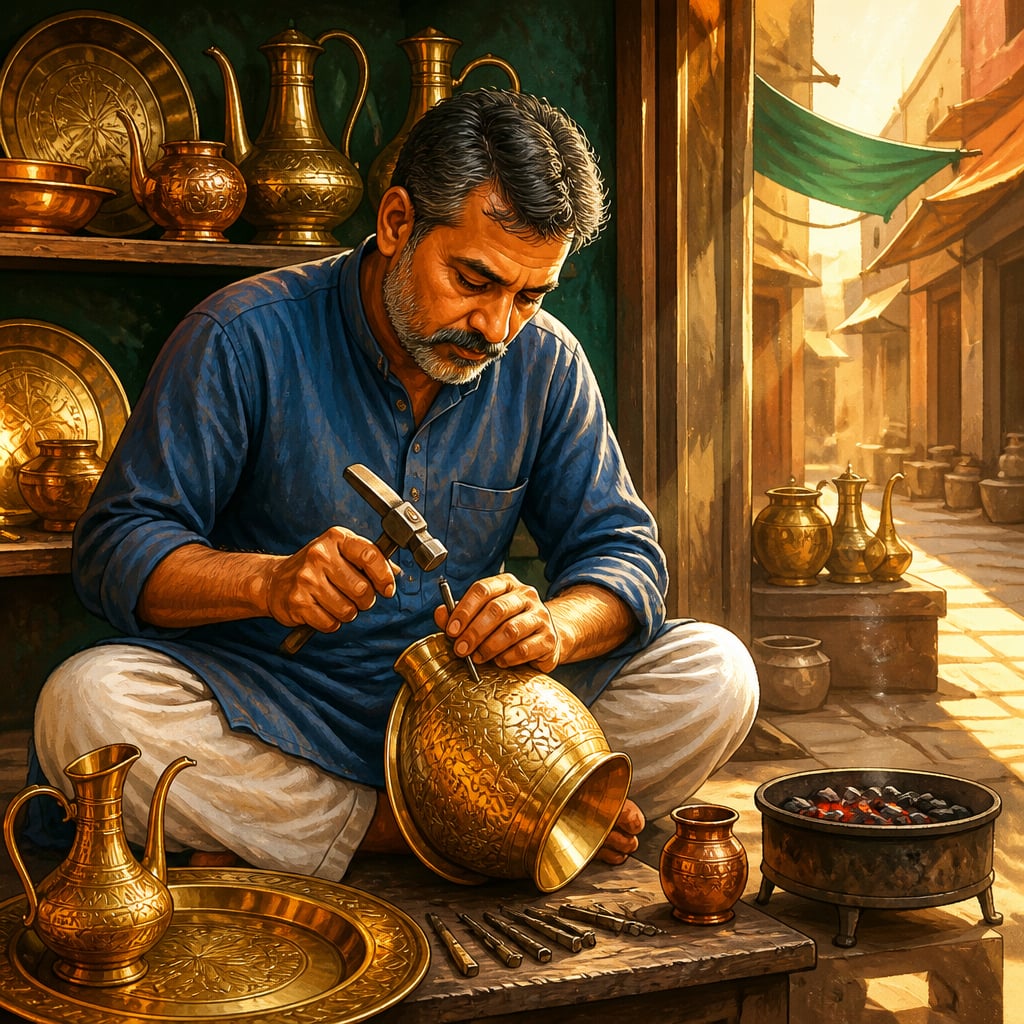
Moradabad, a city in western Uttar Pradesh, has been called the "Brass City of India" for over 400 years. Walk through its narrow lanes today, and you'll hear the same sounds that merchants from Persia and Arabia heard in the 17th century: the rhythmic hammering of brass, the hiss of molten metal, the scraping of intricate designs.
This single district exports over Rs 9,000 crore of brassware annually, to the Middle East, Europe, and America. Nearly 2 lakh artisans work in brass. The craft is passed from father to son, from master to apprentice, in an unbroken chain stretching back centuries.
Moradabad isn't unique. India's geography was once a map of specialized excellence: Chanderi for silk, Lucknow for chikankari, Bhadohi for carpets, Firozabad for glass bangles, Kannauj for perfumes, Kolhapur for chappals. Each district, one distinctive product. Each product, world-class.
The question is: how did India lose this geography of excellence, and can ODOP bring it back?
The Ancient Logic of Specialization
The principle behind ODOP isn't modern. It's embedded in India's economic DNA.
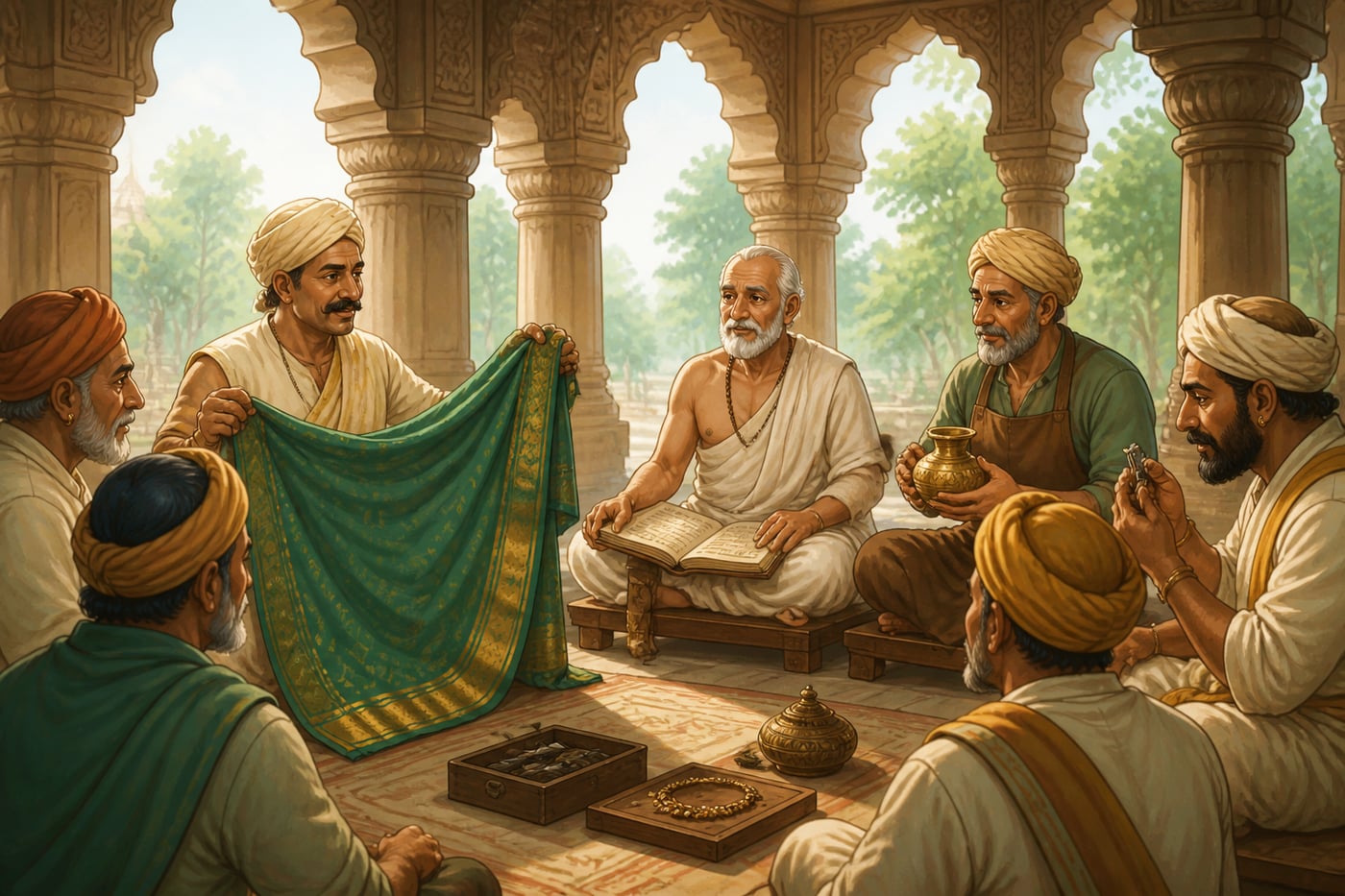
The shreni (guild) system, documented from at least 600 BCE, organized craftsmen by specialization. Each shreni controlled quality standards, trained apprentices, and protected trade secrets. Villages and districts became known for their shreni's craft.
But why specialize? Why not produce everything locally?
The ancient texts understood what economists later called comparative advantage. The Arthashastra observes:
"स्वकर्मणि अभिरतः सिद्धिं लभते नरः" Svakarmani abhiratah siddhim labhate narah "A person devoted to his own craft attains perfection."
Specialization produces mastery. When a village's weavers focus only on silk, generation after generation, they develop techniques no generalist can match. When brass workers concentrate all their creativity on one metal, they achieve excellence impossible for diversified artisans.
This isn't just skill. It's accumulated knowledge, tacit expertise passed through apprenticeships, improved incrementally over centuries, embedded in the community's collective memory. Chanderi weavers don't just know how to weave silk; they know how their grandmothers wove it, and how to improve on that technique.
The Colonial Disruption
So what happened to India's geography of excellence?
Colonial policy systematically destroyed it.
British economic strategy had one goal: make India a consumer of British manufactures and a supplier of raw materials. This required breaking India's productive capacity.
- Textiles: The famous Dhaka muslin, so fine it was called "woven air," was destroyed by import of Lancashire cloth and brutal taxes on Indian weavers. British records from the 1800s describe weavers' thumbs being cut off to prevent them from practicing their craft.
- Steel: India's wootz steel, which had made Damascus blades legendary, lost its markets to Sheffield. The knowledge died with its last practitioners.
- Shipbuilding: Indian shipyards that had built vessels for the East India Company itself were closed to eliminate competition with British yards.
By 1947, India's share of world manufacturing had fallen from 24.5% (in 1750) to 2.4%. The geography of excellence was shattered.
Independent India's industrial policy didn't help. The focus on heavy industry and large factories drew labor from villages to cities. Traditional crafts were seen as "backward." Mass production replaced artisanal quality.
The shreni tradition survived, barely, in pockets. Moradabad kept making brass. Chanderi kept weaving silk. But these were remnants, not a system.
Global Perspectives on Local Specialization
The value of local specialization isn't lost on Western economists. Three key insights:
Alfred Marshall (1842-1924), the British economist, observed that industries cluster geographically. His study of Sheffield steel and Birmingham metalwork showed that proximity creates advantages: shared suppliers, specialized labor pools, and "knowledge spillovers" as workers move between firms. He called these "industrial districts."
Michael Porter (1947-present), the Harvard strategist, developed cluster theory in "The Competitive Advantage of Nations" (1990). Porter argued that geographic concentration creates virtuous cycles: specialized suppliers, sophisticated customers, and fierce local rivalry all push firms toward excellence. Think Silicon Valley for tech, or Switzerland for watches.
Paul Krugman (1953-present), Nobel laureate in economics, formalized these ideas in "new economic geography." Krugman showed mathematically that increasing returns to scale create natural concentrations, and that these concentrations, once established, are self-reinforcing.
| Thinker | Key Insight | Indian Parallel |
|---|---|---|
| Alfred Marshall | Industrial districts create knowledge spillovers | Shreni apprenticeship and tacit knowledge |
| Michael Porter | Clusters compete globally through local rivalry | Moradabad's 400 competing brass workshops |
| Paul Krugman | Geographic concentration is self-reinforcing | Why Chanderi silk survived 700 years |
The dharmic tradition adds a dimension these economists miss: the moral value of craft excellence. In Western economics, specialization is efficient. In dharmic economics, it's also dharma, the sacred duty to perfect one's assigned work. A Chanderi weaver doesn't just produce silk; she practices svadharma (her own duty) in a lineage stretching back centuries.
ODOP: Reviving the Geography of Excellence
In 2018, Uttar Pradesh launched the One District One Product (ODOP) initiative. The concept was simple: identify each district's traditional strength, and invest in reviving it.
The national government scaled this in 2020, integrating ODOP with the Atmanirbhar Bharat vision. By 2024, over 700 products across 35 states and UTs have been identified, from Kinnaur apples to Thanjavur dolls.
What ODOP provides:
- GI (Geographical Indication) protection: Legal recognition that only products from specific regions can carry certain names (like Champagne or Parmesan). Chanderi silk, Moradabad brass, Lucknow chikan all have GI tags.
- Common Facility Centers: Shared infrastructure, testing labs, design studios, finishing units, that individual artisans couldn't afford alone.
- Market access: Integration with e-commerce platforms, government procurement (GeM), and export promotion. Amazon's "Karigar" program specifically sources from ODOP clusters.
- Skill development: Training programs that combine traditional techniques with modern design sensibilities.
The results are emerging:
Moradabad brass: Exports grew from Rs 5,500 crore (2018) to Rs 9,000+ crore (2024). New designs for European and American markets created fresh demand.

Chanderi silk: After GI protection and cluster development, Chanderi weavers' incomes increased 40-60%. The fabric now appears in international fashion weeks.
Varanasi toys: Traditional wooden toys, threatened by Chinese plastic imports, found new markets through Amazon Karigar and GI protection.
The Cluster Advantage in Action
Why does ODOP work? Because of what economists call agglomeration effects, the benefits of geographic concentration.
Consider Moradabad. Within a 20-kilometer radius, you find:
- Specialized suppliers: Metal dealers who understand exactly what brass workers need
- Skilled labor pool: Workers who can move between workshops, carrying knowledge
- Design evolution: Innovations spread rapidly through observation and imitation
- Buyer efficiency: Exporters can source diverse products from a single location
- Collective reputation: The "Moradabad" name carries weight in global markets
No individual artisan could build this ecosystem. But the ecosystem, once established, benefits every artisan within it.
This is the shreni principle in modern form. The guild didn't just organize workers, it created a self-reinforcing system of excellence.
Your Turn: Find Your District's Advantage
You might not be a brass worker or silk weaver. But the ODOP principle applies to every economy, including your personal economy.
Ask yourself:
- What is your distinctive skill, the equivalent of Moradabad's brass or Chanderi's silk?
- Are you developing deep expertise in one area, or spreading yourself thin across many?
- Where can you find your "cluster", the community of practice that creates knowledge spillovers?
The ancient wisdom is clear: prosperity comes from excellence, not diversification. The Gita's teaching on svadharma, do your own duty supremely well rather than another's duty poorly, applies to careers as much as crafts.
In the next lesson, we'll explore how young entrepreneurs are bringing this ancient wisdom to rural India, building startups that combine traditional knowledge with modern technology.
Comparative advantage and economies of specialization
David Ricardo's comparative advantage theory (1817) shows that regions benefit by specializing in what they produce relatively best. Adam Smith's pin factory example demonstrates how division of labor multiplies productivity.
The dharmic framework adds purpose beyond efficiency: specialization is svadharma, not just strategy. This creates commitment that survives market downturns, Chanderi weavers didn't abandon silk during hard decades because it was their identity, not just their job.
Moradabad's specialized brass cluster generates Rs 9,000+ crore annually, more than many diversified industrial cities. Concentration creates value.
The Heckscher-Ohlin theorem in trade theory argues that countries export goods that intensively use their abundant factors. Paul Krugman's economic geography shows how initial advantages become self-reinforcing through agglomeration.
The dharmic perspective sees geographic advantage as sacred gift, not mere accident. Chanderi's location at the intersection of cotton and silk routes was prarabdha (destined), a responsibility to honor, not just exploit.
Key terms
- Svadharma
- One's own duty; the work or role most suited to one's nature, skills, and circumstances
- Bhaugolik Sanket (GI)
- Geographical Indication; legal protection that links a product's quality and reputation to its geographic origin
- Samuha (Cluster)
- Cluster; a geographic concentration of interconnected businesses, suppliers, and associated institutions in a particular field
- Parampara
- Tradition; the unbroken chain of knowledge and practice passed from master to disciple, generation to generation
Key figures
The Shreni Masters of Moradabad
Hereditary brass guild leaders
Piyush Goyal
Union Minister of Commerce and Industry
Michael Porter
Harvard Business School professor and cluster theorist
Case studies
Chanderi Silk: 700 Years of Excellence Revived
Chanderi, a small town in Madhya Pradesh, has been weaving silk since the 13th century. The Chanderi fabric, a unique blend of silk and cotton with distinctive sheer texture and gold/silver brocade, was worn by Mughal emperors and Maratha queens. By the 1990s, Chanderi weaving was dying. Cheaper power-loom imitations flooded markets. Young weavers migrated to cities. The 3,500 remaining handloom weavers earned less than Rs 5,000 per month. The 700-year tradition seemed destined for extinction. Then, three interventions converged: 1. **GI Protection (2005)**: Chanderi fabric received Geographical Indication status, legally protecting it from imitations 2. **Design intervention**: Government and NGO programs connected Chanderi weavers with fashion designers, updating traditional motifs for modern tastes 3. **ODOP integration (2018)**: Chanderi became Ashoknagar district's designated ODOP product, receiving cluster development support, common facility centers, and marketing assistance
Chanderi's revival demonstrates the Gita's teaching: 'Sve sve karmany abhiratah samsiddhim labhate narah', those devoted to their own work attain perfection. The weavers didn't abandon silk to chase faster profits in other trades. They persisted through decades of decline because weaving was their svadharma, their identity, not just their income. This persistence created the foundation for revival. The GI protection embodies Arthashastra's principle of protecting shreni autonomy. Just as Kautilya said the king should protect guild self-governance, modern GI law protects community identity from exploitation by outsiders. Most importantly, Chanderi shows that parampara (tradition) is not static. The weavers adapted, new designs, new colors, new markets, while maintaining continuity with ancestral techniques. Living tradition evolves; dead tradition merely preserves.
By 2024, Chanderi weaving had transformed: - Weaver incomes increased from Rs 5,000 to Rs 12,000-15,000 per month (40-60% increase after ODOP integration) - Youth migration reversed as weaving became viable - Chanderi sarees appeared in international fashion weeks (Milan, Paris) - E-commerce access through Amazon Karigar and government portals - Common Facility Center provides warp preparation, dyeing, and finishing support The number of active weavers stabilized at around 4,000, not growth, but survival of a tradition that was near extinction.
Excellence built over centuries can be protected and revived, but only if the community maintains the tradition through hard times. Chanderi survived because weavers remained devoted to their svadharma even when it seemed economically irrational. That persistence, combined with appropriate policy support, enabled revival.
Chanderi's GI-driven revival is part of a global pattern where geographic authenticity commands growing premiums. Scotch whisky, Champagne, and Kobe beef all demonstrate that place-based identity creates durable competitive advantages that mass production cannot replicate. India's 500+ GIs represent untapped export potential estimated at Rs 50,000+ crore if marketing and quality systems match the inherent product value.
Chanderi sarees with GI certification command Rs 3,000-15,000, compared to Rs 500-1,500 for power-loom imitations. Geographic authenticity creates 3-10x price premium.
Moradabad Brass: The Rs 9,000 Crore Cluster
Moradabad's brass industry is India's largest artisan cluster, and one of the world's largest handmade metalware manufacturing centers. The city produces 40% of India's brassware exports, with products reaching every continent. Unlike Chanderi, Moradabad's challenge wasn't survival, the industry was already large. The challenge was upgrading: moving from commodity brassware to higher-value designer products, meeting international quality and environmental standards, and competing against Chinese machine-made alternatives. The transformation came through cluster development: - **Export Promotion Council**: Brass exporters organized collectively to access trade fairs, negotiate shipping rates, and meet buyer requirements - **Design upgrades**: Partnerships with NID (National Institute of Design) introduced contemporary aesthetics while maintaining handmade authenticity - **Environmental compliance**: Cluster-level effluent treatment plants helped workshops meet pollution norms that individual units couldn't afford - **ODOP branding**: 'Moradabad Brass' became a marketing identity, promoted nationally and internationally
Moradabad exemplifies the Arthashastra's principle: 'Deshakalapraptam karma kuryat', do the work appropriate to your place and time. The city's location on ancient trade routes, access to metal supplies, and accumulated expertise made brasswork its natural advantage. ODOP policy honored this advantage rather than imposing something new. The cluster demonstrates sangha-shakti (collective strength). Individual workshops compete fiercely, but cooperate on shared infrastructure, export promotion, and quality standards. This is exactly how ancient shrenis functioned: internal competition within collective frameworks. Moradabad also shows parampara in action. The brass techniques are centuries old, but the products evolve constantly. A Moradabad ustad today makes products his grandfather couldn't imagine, but using techniques his grandfather taught. This is living tradition: roots deep, branches growing.
Moradabad's brass cluster by 2024: - Annual exports exceed Rs 9,000 crore (up from Rs 5,500 crore in 2018) - Over 2 lakh artisans and 5,000+ manufacturing units - Products exported to 80+ countries - Major buyers include Ikea, Pottery Barn, and Middle Eastern hospitality chains - Common Facility Center provides electroplating, lacquering, and testing The cluster generates employment and prosperity that has kept Moradabad economically vibrant while comparable cities declined.
Scale doesn't require abandoning craft. Moradabad produces at industrial volumes while remaining handmade. The cluster model, shared infrastructure, collective marketing, competitive production, enables this combination. ODOP policy amplifies natural advantages; it doesn't create them artificially.
Moradabad's cluster model anticipates the 'industrial district' concept that powers economies from Shenzhen's electronics clusters to Italy's leather districts. The ODOP (One District One Product) policy draws directly from this tradition. The insight that geographic concentration of specialized skills creates productivity advantages now drives economic development strategy worldwide.
Moradabad brass workers earn Rs 15,000-25,000 monthly, 2-3x the agricultural wage in surrounding areas. Specialized clusters create wage premiums through productivity.
Historical context
Mughal Period to Present (1600 - 2025)
India's districts were historically defined by their crafts, a geographical knowledge system matching regions to products. Colonial rule broke this system; post-independence industrial policy ignored it. ODOP represents the first systematic attempt to rebuild India's geography of specialized excellence.
Successful economies often feature specialized regions: Germany's Mittelstand (specialized SME clusters), Italy's industrial districts (leather in Florence, ceramics in Sassuolo), Switzerland's watch valleys. India's ODOP follows this proven model of geographic specialization.
India has 700+ GI-registered products as of 2024, more than any country except China. But GI registration is only the beginning; building clusters around these products is the ODOP challenge.
Understanding ODOP helps evaluate local economic development. The policy works because it aligns with economic principles (comparative advantage, cluster effects) and dharmic principles (svadharma, parampara). Districts that embrace their traditional strengths, rather than chasing generic industrialization, have the best prospects for sustainable prosperity.
Reflection
- The Gita teaches: 'Better is one's own dharma, though imperfect, than another's dharma well-performed.' How might this apply to economic development, should every district develop its unique strength, even if another path seems more profitable? What are the limits of this principle?
- What is your personal 'ODOP', the one skill, knowledge area, or capability where you could achieve excellence through sustained focus? Are you currently developing it deeply, or spreading attention across many areas? What would change if you committed fully to your core specialization?