Jalvayu-Sahishnuta: Climate-Resilient Local Economies
Why Decentralization Is the Future
Climate change isn't just an environmental crisis, it's an economic argument for decentralization. When cyclones strike, when supply chains break, when extreme weather disrupts distant production, local economies prove more resilient. From Odisha's transformation in cyclone preparedness to ancient water harvesting traditions, discover why distributed village economies may be the future, not just the past.
Two Cyclones, Two Outcomes
On October 29, 1999, a super cyclone struck Odisha's coast. Wind speeds exceeded 260 km/h. The storm surge reached 8 meters. When it passed, 10,000 people were dead, some estimates say 15,000. Bodies floated in rice paddies. Entire villages had vanished.
Exactly 20 years later, on May 3, 2019, Cyclone Fani, equally powerful, with winds of 250 km/h, struck almost the same coast. This time, the death toll was 64 people.
Same geography. Same intensity. A 99% reduction in deaths.
What changed wasn't the weather. It was the system.
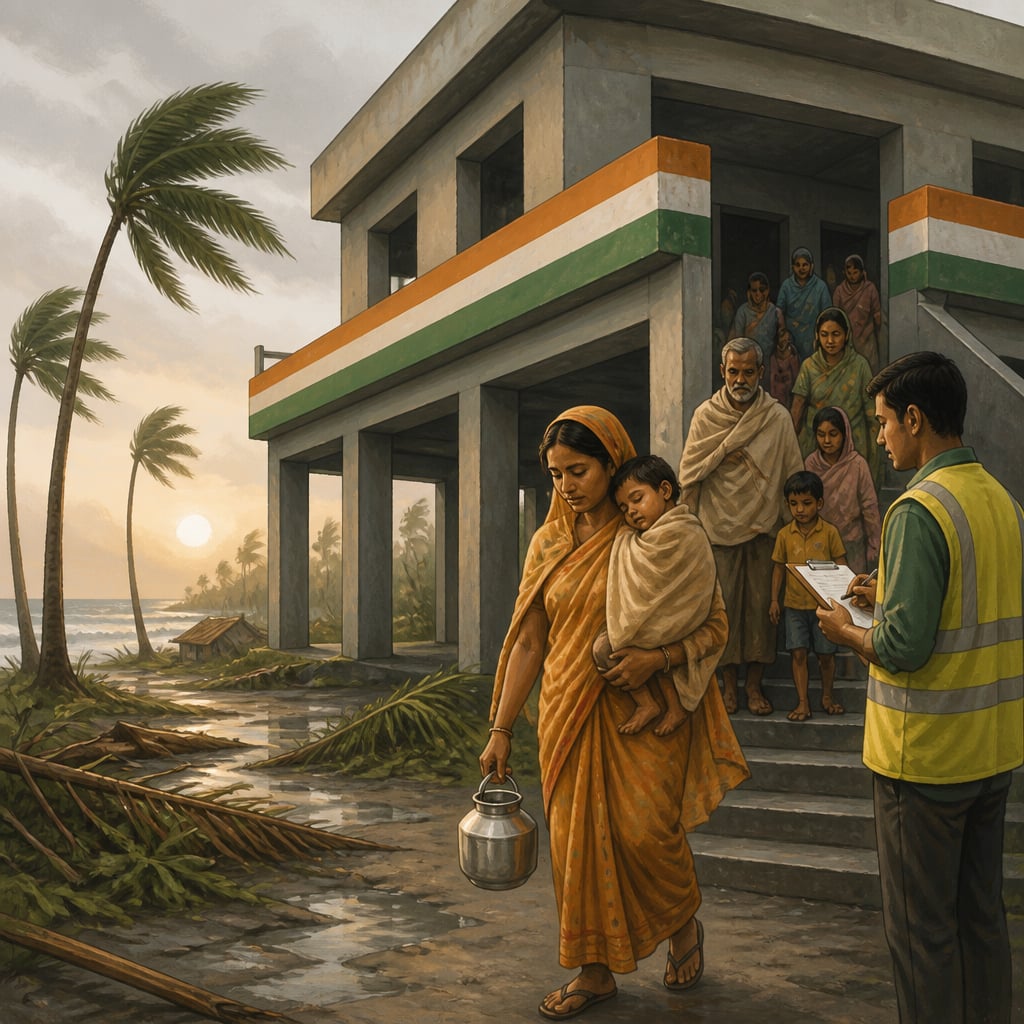
Odisha built a decentralized disaster response network: village-level cyclone shelters, trained local responders, community-based early warning systems, and distributed food and medicine stockpiles. When Fani struck, 1.2 million people had already evacuated, not because the central government commanded it, but because local systems activated automatically.
This is the lesson climate change is teaching us: decentralized systems survive what centralized systems cannot.
The Ancient Wisdom of Distributed Resilience
Indian civilization learned this lesson millennia ago. The subcontinent's climate has always been extreme, monsoons that bring 90% of annual rainfall in four months, droughts that last years, floods that reshape rivers.
Traditional village economies were designed for this reality.
Surapala, writing the Vrikshayurveda ("Science of Plant Life") around 1000 CE, documented sophisticated climate-adaptive agriculture:
"देशकालानुसारेण वृक्षाणां परिचर्यते" Deshakaalanusaarena vrikshanam paricharyate "Trees and plants should be cared for according to the conditions of place and time."
This principle, that agriculture must adapt to local conditions, not fight them, produced remarkable innovations:

- Johads (earthen check dams) in Rajasthan captured monsoon rain for year-round use
- Ahar-pyne systems in Bihar channeled floodwater into cascading irrigation networks
- Temple tanks in Tamil Nadu stored water while recharging groundwater
- Kuttanad farming in Kerala turned backwater regions into rice bowls through adapted techniques
These weren't primitive systems awaiting modern replacement. They were sophisticated technologies optimized for local climate variability, and they sustained populations through centuries of climate fluctuation.
Why Centralized Systems Fail Under Climate Stress
The 20th century replaced distributed village systems with centralized infrastructure: large dams, long-distance power grids, global supply chains, centralized food distribution.
These systems work efficiently, until they don't.
The vulnerabilities of centralization:
- Single points of failure: One dam breach floods millions; one port closure stops all imports
- Long supply chains: Each link adds fragility; disruption anywhere affects everywhere
- Delayed response: Central authorities must gather information, make decisions, and push commands outward
- Uniform solutions: Centralized policies ignore local variation; what works in Punjab fails in Rajasthan
Climate change amplifies every vulnerability. Extreme weather events are becoming more frequent and intense. Supply chains that worked for decades suddenly break. Infrastructure designed for historical climate conditions fails under new extremes.
Recent examples:
- Texas freeze (2021): Centralized grid collapsed; 4.5 million without power for days
- COVID supply chain disruptions (2020): Global just-in-time systems failed simultaneously
- European heatwaves (2022-2023): Nuclear plants shut down as rivers couldn't cool reactors
- Joshimath subsidence (2023): Concentrated development created concentrated risk
The pattern is clear: concentration creates fragility; distribution creates resilience.
The Economics of Decentralization
Western economists are now discovering what Indian villages practiced:
Herman Daly (1938-2022), the ecological economist, argued that economic growth must operate within ecological limits. His concept of "steady-state economics" recognized that infinite growth on a finite planet is impossible, and that local, self-sufficient economies are more sustainable than globalized extraction.
E.F. Schumacher (1911-1977) wrote "Small Is Beautiful" (1973), arguing that large-scale technology often creates more problems than it solves. His concept of "appropriate technology", technology suited to local conditions and capabilities, directly parallels the Vrikshayurveda's teaching.
Kate Raworth (1970-present) developed "Doughnut Economics", a framework balancing human needs (the inner ring) with ecological limits (the outer ring). Her model requires localized, regenerative economies rather than globalized, extractive ones.
| Thinker | Key Insight | Indian Parallel |
|---|---|---|
| Herman Daly | Economy must fit within ecology | Rta (cosmic order) as economic limit |
| E.F. Schumacher | Small, appropriate technology | Vrikshayurveda's local adaptation |
| Kate Raworth | Balance human needs with planetary limits | Santulana (balance) in village economics |
The dharmic tradition anticipated these insights. The concept of Rta (cosmic order), which underlies Dharma, recognized that human activity must harmonize with natural rhythms. The village economy wasn't just socially organized; it was ecologically embedded.
Odisha's Transformation: A Case Study in Decentralized Resilience
After the 1999 super cyclone, Odisha rebuilt differently.
What changed:
830+ cyclone shelters: Multipurpose buildings that serve as schools or community centers normally, but can shelter 500-1,000 people during cyclones. Located within 2 km of every coastal settlement.
Village-level response teams: Trained local volunteers who know their neighbors, understand local geography, and can act without waiting for central commands. 45,000+ trained responders by 2019.
Decentralized communication: Last-mile warning systems using loudspeakers, sirens, and mobile networks, not dependent on single communication channels.
Distributed stockpiles: Food, medicine, and supplies pre-positioned at local level, not waiting for central distribution.
Community ownership: Villages maintain shelters and stockpiles themselves. They're assets, not just emergency infrastructure.
The result for Cyclone Fani (2019):
- 1.2 million people evacuated in 48 hours, the largest evacuation in Indian history
- 64 deaths (down from 10,000+ in 1999)
- Recovery began within weeks, not years
Odisha's success attracted global attention. The United Nations praised it as a model for climate adaptation. But the underlying principle was ancient: distributed responsibility, local capability, community ownership.
The Climate Economics of Village Self-Reliance
Climate change is making the economic case for decentralization:
1. Supply chain resilience: Villages that produce their own food, generate their own energy, and manage their own water are insulated from global supply disruptions.
2. Adaptation flexibility: Local systems can adapt to local conditions. A village in Rajasthan needs different water strategies than one in Kerala, centralized solutions cannot optimize for both.
3. Reduced transport emissions: Local production and consumption eliminates the carbon footprint of long-distance transport. A tomato grown in Bengaluru and eaten there has 1/100th the carbon footprint of one imported from Spain.
4. Ecosystem services: Village economies that protect forests, wetlands, and watersheds maintain the natural systems that buffer against climate extremes, flood absorption, temperature regulation, water purification.
5. Social cohesion: Communities that cooperate on local challenges, water management, disaster response, resource sharing, build the social capital needed for collective climate adaptation.

Data points:
- Villages with restored johads in Rajasthan: Water tables rose 6 meters; crop diversity increased from 12 to 35 species
- Solar microgrids in Uttar Pradesh: 15,000+ villages with 24/7 power independent of central grid
- Organic farming villages in Sikkim: 30% higher farmer incomes through premium pricing and reduced input costs
Your Turn: Build Local Resilience
You might think climate resilience is a government responsibility. It isn't, or not entirely.
Every choice you make about where to source goods, how to build systems, and where to invest time creates either centralization or distribution.
Questions to consider:
- Food: How much of your food comes from within 100 km? Could you increase local sourcing?
- Energy: Could your home or community generate even part of its own power?
- Water: Do you know where your water comes from? Is that source vulnerable to climate stress?
- Community: Do you know your neighbors well enough to cooperate in an emergency?
- Skills: If supply chains broke, what could you produce or repair yourself?
The ancient village economy wasn't romantic, it was rational. It was designed for a world where supply chains didn't exist, where local resources were all you had, where community cooperation was survival.
Climate change is recreating those conditions. The villages that survived millennia of climate variation offer lessons more relevant now than at any time since industrialization.
In the next lesson, we'll explore what modern sustainability movements are learning from traditional village wisdom, and why the village may be the most sophisticated sustainability laboratory ever created.
Systems resilience through redundancy and distribution
Nassim Taleb's concept of 'antifragility' argues that systems improve under stress when they're decentralized and contain redundancy. Central points of failure create fragility; distributed systems survive shocks.
Traditional Indian systems were designed for variability, monsoons that fail, rivers that flood, droughts that persist. This produced distributed infrastructure (tanks vs. dams, johads vs. canals) that survived what centralized systems couldn't.
Odisha's 99% reduction in cyclone deaths (10,000+ in 1999 to 64 in 2019) demonstrates decentralization's resilience value. The same cyclone intensity, radically different outcomes through distributed response capacity.
Johan Rockstrom's 'planetary boundaries' framework identifies nine ecological limits humanity must not cross. We've already exceeded four. This is Rta in scientific language: limits exist, and violating them has consequences.
The Vedic understanding of Rta embeds limits in cosmology, not just science. Violating Rta isn't just impractical, it's adharmic, a moral failure. This produces deeper commitment to limits than purely utilitarian calculation.
Key terms
- Rta
- Cosmic order; the natural rhythms and laws that govern the universe; the harmony within which human activity must operate
- Jalvayu-Sahishnuta
- Climate resilience; the capacity to absorb climate shocks and adapt to changing conditions while maintaining essential functions
- Vikendrikaran
- Decentralization; the distribution of functions, powers, and resources from central authorities to local units
- Santulana
- Balance; equilibrium; the state of harmony between opposing forces or between human activity and natural limits
Key figures
Surapala (Author of Vrikshayurveda)
Ancient plant scientist and agricultural writer
Sunita Narain
Environmentalist and Director General of Centre for Science and Environment (CSE)
Herman Daly
Ecological economist and World Bank senior economist
Case studies
Odisha's Cyclone Resilience: From 10,000 Deaths to 64
On October 29, 1999, a super cyclone struck Odisha with winds exceeding 260 km/h and a storm surge of 8 meters. Over 10,000 people died, some estimates say 15,000. Bodies floated in rice paddies. Fifteen million people were affected. The state had no cyclone shelters, no trained responders, no early warning system that reached villages. The disaster shocked Odisha into transformation. Over the following two decades, the state built a completely new approach to cyclone preparedness, one based on decentralization: - **830+ cyclone shelters**: Multipurpose buildings serving as schools or community centers normally, but designed to shelter 500-1,000 people during cyclones. Located within 2 km of every coastal settlement. - **45,000+ trained volunteers**: Village-level responders who know their neighbors, understand local geography, and can act without waiting for central commands. They conduct mock drills, maintain first-response equipment, and lead evacuations. - **Last-mile early warning**: Sirens, loudspeakers, and mobile alerts that reach every household, not dependent on single communication channels. - **Distributed stockpiles**: Food, medicine, and supplies pre-positioned at district and block level, not waiting for central distribution. - **Community ownership**: Villages maintain their shelters and know them as community assets, not just emergency infrastructure.
Odisha's transformation embodies the Vrikshayurveda principle: solutions must be adapted to local conditions. A centralized response system, commands flowing from state capital to districts to villages, is too slow for cyclones that arrive in hours. Decentralized systems activate instantly because capability exists at every level. The transformation also reflects Rta, alignment with natural reality. Cyclones will come; the coast is vulnerable; concentrated populations near the sea face concentrated risk. Rather than deny this reality or build ever-higher sea walls, Odisha accepted it and built adaptive capacity. Most importantly, Odisha demonstrates sangha-shakti (collective strength). The 45,000 volunteers, the community-maintained shelters, the neighborhood-level response, these work because communities own them. Central government funded infrastructure, but communities made it work. This is the ancient village principle in modern form: distributed responsibility, local capability, collective action. It saved tens of thousands of lives.
When Cyclone Fani struck on May 3, 2019, equally powerful as the 1999 super cyclone, the system performed: - **1.2 million people evacuated** in 48 hours, the largest evacuation in Indian history - **64 deaths** (down from 10,000+ in 1999), a 99% reduction - **Zero** deaths in the 800+ cyclone shelters - Recovery began within weeks; schools reopened within a month The United Nations praised Odisha's model as a global standard for climate adaptation. Other cyclone-prone states and countries are now studying and replicating it. Odisha proved that with proper decentralized systems, even the most destructive natural events can be survived with minimal loss of life.
Decentralized systems survive what centralized systems cannot. When crisis strikes, local capability, shelters you can walk to, neighbors you know, responders who understand local geography, matters more than distant resources. Climate adaptation requires building this distributed resilience.
Odisha's transformation from disaster victim to disaster management leader has become a case study for climate adaptation globally. As extreme weather events intensify, the distributed preparedness model (local shelters, trained community responders, indigenous early warning systems) is being adopted from Bangladesh to the Philippines. FEMA studied Odisha's system after Hurricane Katrina exposed centralized response failures.
Cost comparison: Odisha's cyclone preparedness system cost approximately Rs 1,800 crore to build over 20 years. The 1999 super cyclone caused damages exceeding Rs 10,000 crore. Prevention through decentralization is far cheaper than centralized disaster response.
Historical context
Pre-Industrial to Climate Crisis (Traditional - 2025)
India's traditional village economy was designed for climate variability. The subcontinent's extreme monsoon pattern, 90% of rain in 4 months, required sophisticated water storage and drought adaptation. Colonial and post-colonial centralization weakened these distributed systems. Climate change is now forcing their rediscovery.
Developed nations are learning the same lesson. The Texas grid collapse (2021), European heatwave infrastructure failures (2022-2023), and supply chain breakdowns during COVID all demonstrated centralization's fragility. India's traditional distributed systems, and Odisha's modern adaptation, offer models for global climate resilience.
India had an estimated 1-2 million tanks and water harvesting structures before British colonization. By 1947, most were abandoned or destroyed. Today, organizations like CSE are reviving these systems as climate-appropriate infrastructure.
Climate change is the defining challenge of the 21st century. Understanding why decentralized systems survive climate stress, and centralized ones fail, is essential for personal, organizational, and national strategy. The ancient village economy's distributed resilience offers lessons more relevant now than at any time since industrialization.
Reflection
- The Rig Veda teaches 'Rtasya patha preta', proceed along the path of cosmic order. Climate change suggests humanity has violated this cosmic order for decades. What would it mean for you personally to realign with Rta, to operate within natural limits rather than against them? What would you need to change?
- Odisha's resilience came from decentralized capability, every village could respond without waiting for central commands. What aspects of your life (food supply, energy, water, community support) are dangerously centralized? What could you do in the next 30 days to build more distributed resilience?