Gramina-Udyamita: Rural Entrepreneurship
When IIT Graduates Return to Villages
A new generation of entrepreneurs is choosing villages over Bangalore. Armed with IIT degrees, Silicon Valley experience, and smartphone platforms, they're building agritech, rural fintech, and farm-to-fork startups that solve problems their grandparents faced. This is reverse migration, and it's transforming India's village economy through technology-enabled entrepreneurship rooted in dharmic values.
The IITian Who Went Home
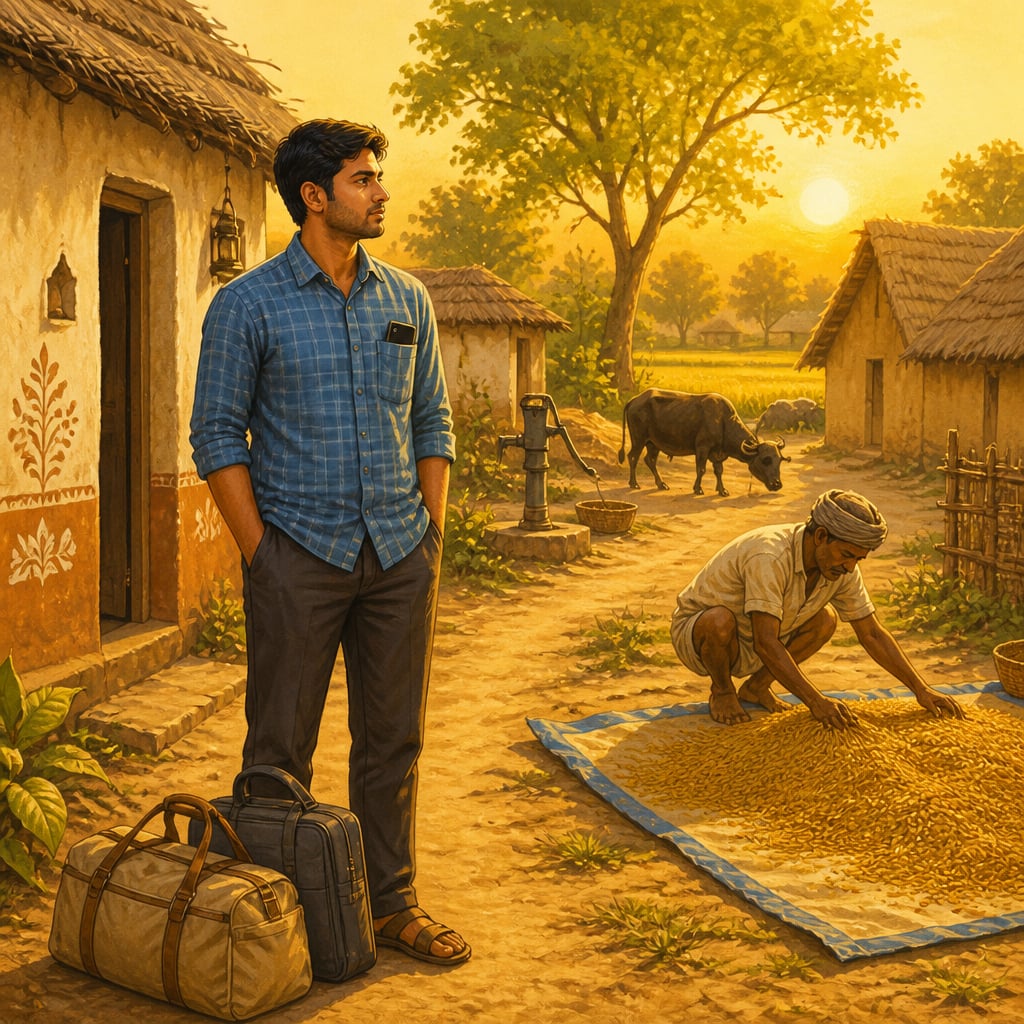
Shashank Kumar had everything a middle-class Indian family dreams of: an IIT Kharagpur degree, a job at a multinational, a path to the United States. His parents had struggled to educate him precisely so he could escape their village in Bihar.
In 2012, Shashank went home for a visit. He watched his father, a farmer with 5 acres, sell tomatoes for Rs 2 per kg. The same tomatoes sold in Patna for Rs 30. His father had no cold storage, no transport, no market information, no bargaining power.
"Why does this still happen?" Shashank asked. "I have all this education, and my father's problems are exactly what his father faced."
In 2012, Shashank quit his job. He returned to Bihar permanently. He started DeHaat, a full-stack agricultural platform that now serves over 2 million farmers across 10 states, with revenues exceeding Rs 1,400 crore.
Shashank isn't alone. Across India, a reverse migration is underway: IIT graduates, Silicon Valley returnees, and corporate professionals choosing villages over cities, not as retreat, but as opportunity.
The Ancient Precedent: Vanijya as Seva
The idea that business can serve society, that entrepreneurship is a form of seva (service), runs deep in Indian tradition.
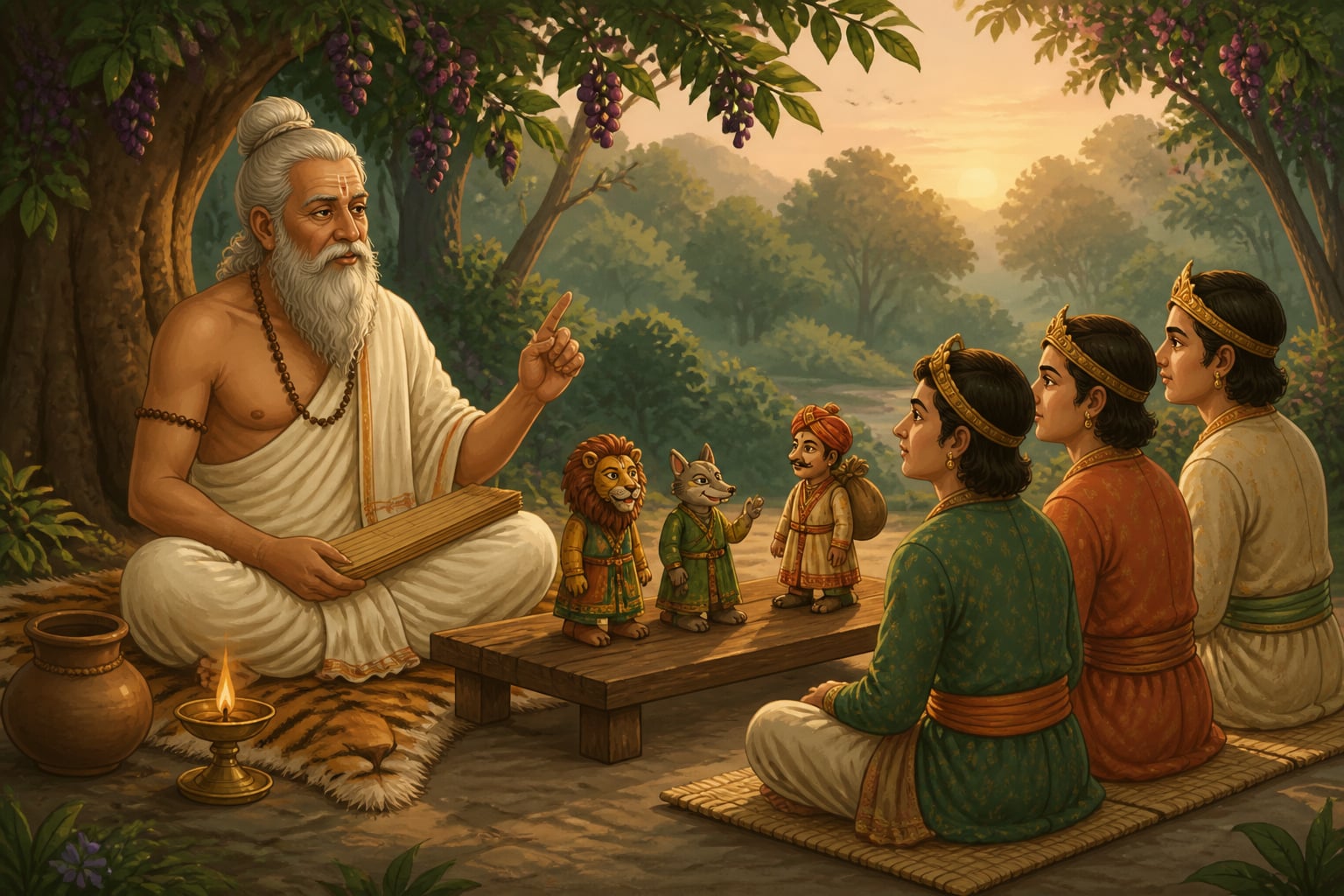
The Panchatantra, composed around 300 BCE, is often read as children's fables. But it's actually a treatise on practical wisdom, including business and entrepreneurship. The text teaches:
"उद्यमेन हि सिध्यन्ति कार्याणि न मनोरथैः" Udyamena hi sidhyanti karyani na manorathaihi "Enterprises succeed through effort, not through wishful thinking."
But the Panchatantra's deeper teaching is about why to undertake business. The merchant (vanij) prospers not by extracting value but by creating it, solving problems others cannot solve, connecting what is separate, adding value at every stage.
The Narada Smriti (circa 100-400 CE) elaborates business ethics in detail:
"धर्मेण लभ्यते ह्यर्थः" Dharmena labhyate hyarthah "Wealth is truly obtained through dharma (righteous means)."
This isn't just moral advice, it's practical wisdom. The merchant who cheats gains short-term profit but loses long-term trust. The merchant who serves the community's needs builds relationships that last generations.
Shashank Kumar's DeHaat embodies this principle: profit comes from solving farmers' problems, not from exploiting their weakness.
The Reverse Migration Revolution
For decades, the narrative was simple: talent leaves villages for cities. The brightest students escape agriculture for engineering, escape districts for metros, escape India for America.
This narrative is reversing.
The data shows the shift:
- Rural internet users: 350+ million (2024), growing faster than urban
- Agritech startup funding: $1.6 billion+ raised by Indian agritech startups (2020-2024)
- Reverse migration: Post-COVID, estimated 10+ million migrants returned to villages, many stayed to build local businesses
The entrepreneurs driving this shift:
- DeHaat (Bihar): Full-stack agri platform connecting farmers to inputs, markets, credit, and advisory
- Jai Kisan (pan-India): Digital lending platform providing credit to farmers without traditional collateral
- Stellapps (Karnataka): IoT devices for dairy farms, connecting village-level production to Amul-style processing
- Ninjacart (Bangalore): Farm-to-retail supply chain eliminating multiple middlemen
- CropIn (Bangalore): AI-based farm intelligence helping 7+ million farmers optimize production
These aren't charity projects. They're venture-backed startups competing for market share. The difference: they solve village problems rather than urban conveniences.
Global Perspectives on Bottom-of-Pyramid Innovation
The academic world has taken notice of this phenomenon. Three frameworks help understand it:
Clayton Christensen (1952-2020), the Harvard professor who coined "disruptive innovation," showed that new markets often emerge not by serving existing customers better, but by serving non-customers, people excluded from current markets. India's farmers were non-customers for banking, insurance, and modern retail. Startups that serve them aren't just doing good; they're accessing a massive untapped market.
C.K. Prahalad (1941-2010), the Indian-American management guru, articulated this as "The Fortune at the Bottom of the Pyramid" (2004). He argued that the world's 4 billion poor represented a $13+ trillion market opportunity, but only for businesses designed around their needs, constraints, and contexts.
Muhammad Yunus (1940-present), the Bangladeshi economist and Nobel laureate, demonstrated through Grameen Bank that the poor are not charity cases but viable customers. His microfinance model proved that lending to the unbanked, especially women, could be both profitable and transformative.
| Thinker | Key Insight | Indian Application |
|---|---|---|
| Clayton Christensen | Disrupt by serving non-customers | Farmers excluded from formal markets |
| C.K. Prahalad | Fortune at the Bottom of the Pyramid | 120M farm households as market |
| Muhammad Yunus | Poor are viable customers | Jai Kisan's farmer lending model |
The dharmic dimension adds something these frameworks miss: purpose beyond profit. Shashank Kumar didn't start DeHaat primarily to capture market share. He started it because his father's problem was solvable, and solving it was seva. This moral motivation produces resilience that pure commercial motivation cannot match.
How DeHaat Works: A Case Study in Tech-Enabled Village Commerce
DeHaat's model illustrates how technology transforms traditional village economics without destroying it.
The traditional problem:
- A farmer in Bihar needs quality seeds, but the local dealer sells adulterated products
- At harvest, the farmer sells to a local middleman at 30-40% of market price
- The farmer needs credit for next season but has no collateral for bank loans
- When crops face pest attack, there's no agronomist within 50 km

DeHaat's solution: DeHaat operates through a network of 15,000+ DeHaat Centers, micro-entrepreneurs in villages who serve 100-200 farmers each. Through a smartphone app, the center operator:
- Sources quality inputs (seeds, fertilizers) from verified suppliers at bulk prices
- Aggregates farmer produce and connects to buyers offering better prices
- Facilitates credit through partner NBFCs using crop and payment data as collateral
- Provides agricultural advisory through AI-powered crop diagnostics
The economics:
- Farmers report 20-30% higher incomes through better prices and lower input costs
- DeHaat earns margins on inputs, transactions, and credit facilitation
- Center operators earn Rs 15,000-25,000 monthly, creating rural employment
- The model is profitable and scalable without relying on subsidies
This is the Panchatantra's teaching in action: the vanij (merchant) who solves problems creates value for everyone, including themselves.
The Enabling Infrastructure
Reverse migration entrepreneurs succeed because India built enabling infrastructure:
UPI and digital payments: Rural UPI transactions grew from near-zero (2016) to billions monthly. Farmers who once dealt only in cash now receive and send digital payments.
Aadhaar and identity: Biometric identity enables farmers to access formal credit, insurance, and government benefits, previously impossible without documentation.
Cheap data and smartphones: India has the world's cheapest mobile data. Smartphones that cost Rs 5,000 give farmers access to market prices, weather forecasts, and crop advisory.
Jan Dhan accounts: 520+ million bank accounts opened since 2014 mean farmers can receive digital payments and access formal finance.
This is the India Stack, digital public infrastructure that enables private innovation. DeHaat didn't build the payment rails or identity system; it built services on top of them.
Your Turn: The Village as Frontier
You might think this applies only to agritech founders. It doesn't.
The reverse migration movement reveals a broader truth: the most valuable opportunities often lie in solving problems for underserved populations, not in serving already-saturated urban markets.
Ask yourself:
- What problems do people in your community face that you're uniquely positioned to solve?
- What expertise have you gained that could be reapplied in contexts where it's scarce?
- Are you chasing crowded opportunities in saturated markets, or finding untapped needs?
The Panchatantra teaches that the wise merchant finds opportunity where others see only difficulty. The difficult market, the village, the unbanked farmer, the underserved sector, is precisely where sustainable advantage is built.
Shashank Kumar could have competed with thousands of engineers for product manager roles in Bangalore. Instead, he found a problem no one was solving and built a Rs 1,400 crore company solving it.
In the next lesson, we'll explore how climate change is making decentralized, local economies not just desirable but necessary, and why villages may be more resilient than cities in the decades ahead.
Peter Drucker argued that entrepreneurship is 'the act of innovation', creating new markets rather than waiting for them to emerge. Saras Sarasvathy's 'effectuation' theory shows that entrepreneurs create opportunities through action, not just recognize pre-existing ones.
The dharmic framework embeds effort in moral purpose: udyama is not just action but righteous action. This produces perseverance through difficulties that pure profit-seeking cannot sustain.
Indian agritech startups raised $1.6+ billion (2020-2024), but the successful ones weren't those with most funding but those with founders who understood farmer problems firsthand through sustained fieldwork.
Francis Fukuyama's 'Trust' (1995) argues that high-trust societies outperform low-trust ones economically. Robert Putnam's research on social capital shows that community trust enables economic cooperation impossible through contracts alone.
The dharmic framework goes further: trust isn't just instrumental (useful for business) but intrinsic (part of righteous conduct). This produces genuine ethical behavior, not just calculated ethical appearance.
DeHaat's 2+ million farmers stay on the platform because they trust it, trust built through consistently honest dealings. Customer acquisition cost is nearly zero because farmers refer other farmers.
Key terms
- Udyama
- Enterprise; effort; initiative; the active pursuit of a goal through sustained work
- Vanij
- Merchant; trader; one who creates value by connecting supply and demand
- Seva
- Service; selfless action for the benefit of others; work offered without attachment to personal gain
- Gramina-Udyamita
- Rural entrepreneurship; enterprise rooted in and serving village communities
Key figures
Vishnusharman (Author of Panchatantra)
Scholar and author of foundational business wisdom
Shashank Kumar
Founder & CEO of DeHaat
Clayton Christensen
Harvard Business School professor and innovation theorist
Case studies
DeHaat: From Bihar Village to Rs 1,400 Crore Agritech Platform
In 2012, Shashank Kumar, an IIT Kharagpur graduate working at a multinational, returned to his village in Bihar. He watched his father, a farmer with 5 acres, sell tomatoes for Rs 2/kg while the same tomatoes retailed for Rs 30 in Patna, just 50 km away. The problem was systemic: - **No market information**: Farmers didn't know prevailing prices or buyer locations - **No storage**: Perishable produce had to be sold immediately at any price - **No transport**: Individual farmers couldn't reach distant markets - **No quality inputs**: Local dealers sold adulterated seeds and fertilizers - **No credit**: Banks wouldn't lend without land collateral most small farmers lacked Shashank started DeHaat (meaning 'village' in Hindi) in 2012 with a simple model: become the trusted intermediary between farmers and markets. But instead of building warehouses and logistics himself, he recruited village-level micro-entrepreneurs, 'DeHaat Kendras', who aggregated produce, distributed inputs, and facilitated services for 100-200 farmers each.
DeHaat embodies the Panchatantra's teaching: 'Udyamena hi sidhyanti karyani', enterprises succeed through effort. Shashank could have analyzed the problem endlessly; instead, he acted, learned through doing, and iterated. The model exemplifies the vanij (merchant) ideal from dharmic economics. DeHaat doesn't exploit farmer weakness; it solves farmer problems. By providing genuine value, better prices, quality inputs, accessible credit, DeHaat earns legitimate margins while farmers prosper. Most importantly, DeHaat follows the Narada Smriti's principle: 'Dharmena labhyate hyarthah', wealth through righteous means. The company built trust through transparent pricing, verified inputs, and honest dealings. This trust enabled scaling to 2+ million farmers, farmers who stay because they're served well, not because they're trapped. The DeHaat Kendra model is particularly dharmic: instead of extracting all value to a central platform, DeHaat created 15,000+ rural micro-entrepreneurs who earn Rs 15,000-25,000 monthly. Prosperity is distributed, not concentrated.
By 2024, DeHaat had grown to: - **2+ million farmers** served across 10 states - **15,000+ DeHaat Kendras** (village-level micro-entrepreneurs) - **Rs 1,400+ crore** annual revenue (growing 100%+ annually) - **$150+ million** raised from investors including Sofina, Prosus, and Temasek - **20-30% income increase** for farmers through better prices and lower input costs DeHaat has become India's largest full-stack agritech platform. But more importantly, it demonstrated that village problems are not charity cases, they're billion-dollar opportunities for those with the insight and commitment to solve them.
The most valuable opportunities lie in solving problems for underserved markets. While thousands of startups competed for urban consumers, DeHaat found a larger, more loyal market in India's 120 million farming households. Reverse migration isn't retreat, it's strategic positioning.
DeHaat's model represents a broader trend of 'reverse brain drain' entrepreneurs building rural-focused platforms. Across India, IIT and IIM graduates are founding agritech, edtech, and healthtech companies serving Tier 3+ markets. The insight that underserved markets offer larger opportunities than saturated urban ones is reshaping venture capital allocation, with rural-focused startups attracting over $2 billion in funding between 2020-2024.
DeHaat farmers report 20-30% higher net incomes through the platform, primarily from better output prices and lower input costs. The company earns margins on facilitating this value creation, not on extracting from farmer weakness.
Historical context
Pre-liberalization to Digital India (1991-2025)
For decades, India's development strategy implicitly assumed rural-to-urban migration: the 'solution' to rural poverty was leaving for cities. The reverse migration movement challenges this, arguing that technology can bring urban opportunities to rural areas, enabling people to prosper where they are.
China's development also involved massive rural-to-urban migration (250+ million). But India's path may differ: digital infrastructure enabling distributed economic activity, combined with cultural attachment to ancestral villages, may enable a different model, rural prosperity rather than rural emptying.
Indian agritech startups raised $1.6+ billion (2020-2024), up from almost nothing a decade earlier. This investment reflects market recognition that India's 120 million farm households represent a massive, previously inaccessible market now reachable through smartphones.
Understanding the reverse migration movement helps evaluate career and investment decisions. The conventional wisdom, leave villages for cities, may be inverting. The next generation of India's largest companies may be those solving rural problems, not urban conveniences.
Reflection
- The Panchatantra teaches that 'enterprises succeed through effort, not wishful thinking.' Many people see problems in their communities or industries but wait for someone else to solve them. What problem have you identified that you could address through your own effort, even imperfectly, rather than waiting for the perfect solution or someone else's initiative?
- Shashank Kumar's education gave him skills, but his village roots gave him problems worth solving. What unique combination of education, experience, and personal context do you have that positions you to solve problems others cannot see or reach? How might you leverage this combination?