FPO: Farmer Producer Organizations

Collective Self-Reliance for India's Farmers

A single farmer with 2 acres is powerless against markets, middlemen, and monsoons. But 1,000 farmers together? They become a force. Discover how Farmer Producer Organizations are reviving the ancient shreni (guild) model to give India's 120 million farming households collective bargaining power, and why this dharmic principle of sangha (collective action) is revolutionizing agricultural economics.

The Farmer Who Stopped Being Alone
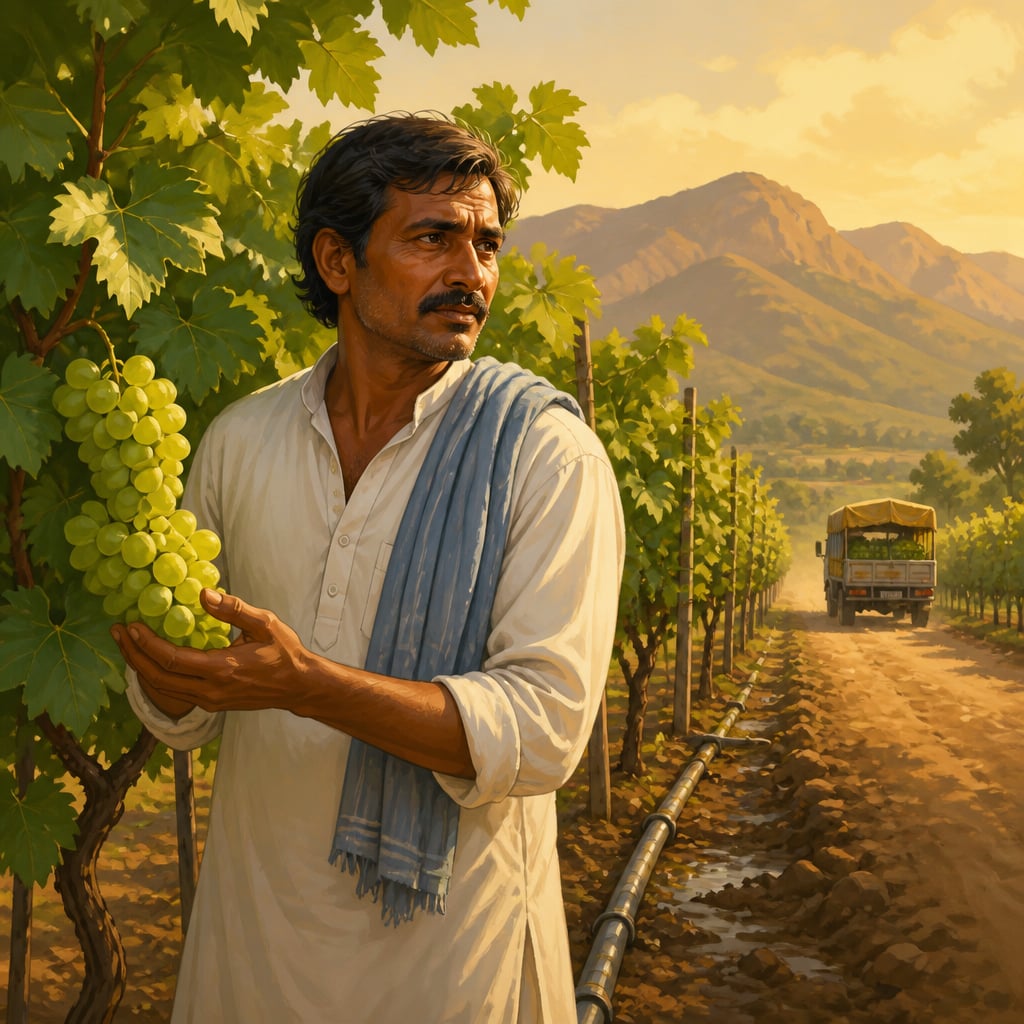
Vilas Shinde alone in his Nashik grape orchard

Vilas Shinde stood in his grape orchard in Nashik, Maharashtra, watching the 2012 harvest ripen. His grapes were perfect, Thompson Seedless, the variety European supermarkets demanded. But Vilas knew what would happen next.

The middleman would arrive. He would name a price, take it or leave it. Vilas couldn't store grapes, couldn't transport them himself, couldn't negotiate. Every year, it was the same: the buyer's price, or watch the grapes rot.

Then Vilas heard about something new. Farmers in his district were forming an FPO, a Farmer Producer Organization. Not a cooperative exactly, but a company owned by farmers. Within two years, Vilas and 2,000 other grape farmers had created Sahyadri Farms. Today, it exports 45,000 tonnes of grapes annually, employs over 15,000 farmers, and generates revenues exceeding Rs 500 crore.

What changed? Not the grapes. Not the weather. Not even the market. What changed was that farmers stopped competing against each other, and started bargaining together.

The Ancient Wisdom of Collective Action

The idea of farmers working collectively isn't new. India's villages practiced it for millennia.
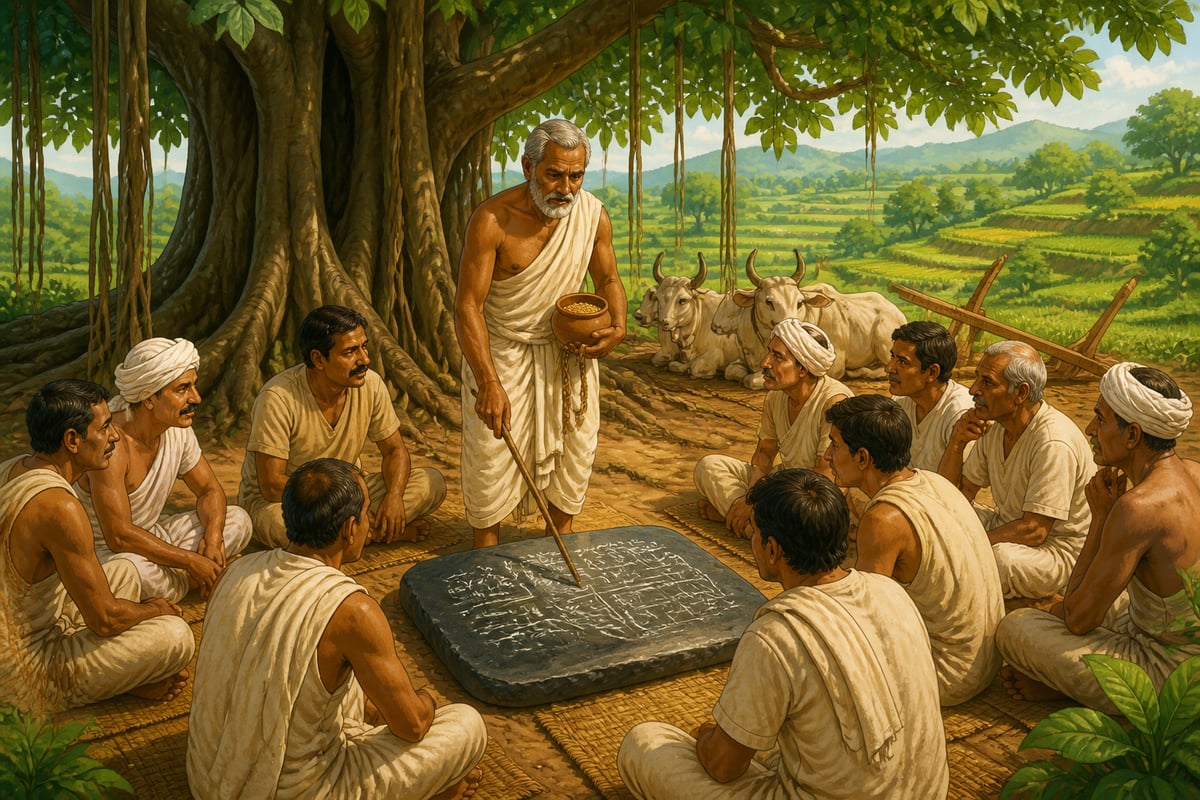
Ancient krishika-sangha farmer assembly beneath a banyan

Krishi Parashara, the ancient agricultural text (circa 400 BCE), describes the krishika-sangha, farmer assemblies that coordinated planting, irrigation, and harvest. The sage Parashara writes:

"एकाकी न समर्थो हि कृषिकर्मणि कर्हिचित्" Ekaki na samartho hi krishikarmani karhichit "A farmer alone is never capable in the work of agriculture."

This wasn't poetry, it was practical economics. Irrigation channels needed collective digging. Pest control required coordinated action. Harvest labor had to be shared. The individual farmer was always part of a larger sangha (assembly).

The shreni (guild) system extended this principle beyond farming. Weavers, potters, metalworkers, each craft had its shreni that set quality standards, trained apprentices, negotiated collectively with buyers, and provided social security to members. These weren't government institutions; they were self-governing collectives.

The Arthashastra describes shrenis as essential to economic order:

"श्रेणीनां स्वधर्मं राजा रक्षेत्" Shreninam svadharmam raja rakshet "The king should protect the self-governance of guilds."

Notice: the king doesn't control guilds, he protects their autonomy. This is the dharmic principle underlying FPOs: collective self-governance, not government control.

The Problem FPOs Solve

India has approximately 120 million farm holdings, of which 86% are smaller than 2 hectares. These marginal farmers face a fundamental problem: they have no market power.

Consider the mathematics:

Who has bargaining power? Always the trader.

This isn't corruption, it's structural asymmetry. The farmer's need to sell now always exceeds the trader's need to buy now. Result: farmers receive 25-40% of the final retail price; middlemen capture the rest.

FPOs invert this equation. When 2,000 farmers aggregate their produce:

The individual farmer becomes part of a shreni, and suddenly, market power flows both ways.

Global Perspectives on Farmer Collectives

India's FPO movement isn't unique. Agricultural cooperatives transformed farming worldwide, but with different philosophies:

Friedrich Wilhelm Raiffeisen (1818-1888), a German mayor, created the first agricultural credit cooperatives in the 1860s. His principle: small farmers pooling resources to access credit denied to them individually. The Raiffeisen model spread across Europe, enabling peasant farmers to mechanize and compete.

Elinor Ostrom (1933-2012), the only woman to win the Nobel Prize in Economics, studied how communities manage common resources, irrigation, fisheries, forests, without privatization or government control. Her research proved that self-governing collectives, operating on shared norms and trust, often outperform both markets and states. She called this "polycentric governance."

Mondragon Corporation in Spain's Basque region demonstrates cooperative principles at industrial scale, 85,000 worker-owners, $12 billion in revenue. It proves that collective ownership isn't just for farms.

Thinker/Model Key Insight Indian Parallel
Raiffeisen Credit pooling enables modernization Amul's collection-payment cycle
Elinor Ostrom Self-governance beats external control Shreni autonomy in Arthashastra
Mondragon Cooperatives can scale industrially Sahyadri Farms' $50M+ operations

What distinguishes the Indian approach is the dharmic dimension. FPOs aren't just economic instruments, they're expressions of sangha-dharma, the duty of collective welfare. When farmers share equipment, knowledge, and market access, they practice paraspara-sahayya (mutual assistance), a principle older than any cooperative law.

The FPO Revolution: 2020-2025

In February 2020, the Government of India announced a transformative target: 10,000 new FPOs by 2027-28, with Rs 6,865 crore in support. This wasn't charity, it was strategic investment in collective self-reliance.

The results by 2024:

Specific examples of FPO impact:

Modern Sahyadri Farms grape export packing facility

Sahyadri Farms (Maharashtra): Started with 2,000 grape farmers in 2011. Now 15,000+ farmer-members, Rs 500+ crore revenue, exports to 27 countries. Farmers receive 70% of export price (vs 30-40% through traditional channels).

Solapur Pomegranate FPO: 3,000+ farmers collectively brand and market "Ruby" pomegranates. Direct sales to BigBasket and Amazon eliminate three layers of middlemen.

Organic FPOs in Sikkim: After Sikkim became India's first fully organic state, FPOs enabled farmers to collectively certify, brand, and premium-price organic produce.

The pattern is consistent: collective organization delivers 30-60% higher farmer incomes, not through subsidies, but through restored market power.

Your Turn: The Sangha Principle

You might not be a farmer. But the sangha principle applies everywhere.

Consider: In your professional life, are you negotiating alone or as part of a collective? Freelancers who join professional associations access group insurance, shared knowledge, and collective bargaining. Startup founders who join accelerator cohorts access mentorship, investor networks, and peer support.

The same structural asymmetry that disadvantages individual farmers disadvantages individual professionals against large employers, individual consumers against corporations, individual citizens against bureaucracies.

The dharmic response isn't to wait for government intervention. It's to form sanghas, collective bodies that aggregate individual weakness into collective strength.

Ask yourself: Where in your life could collective action, shared resources, joint bargaining, mutual support, transform your position from weakness to strength?

In the next lesson, we'll see how the government is supporting this collective principle through ODOP, One District One Product, helping local communities specialize and compete globally.

Galbraith argued that market power concentrations (big buyers) could only be countered by organized power on the other side (big sellers). Labor unions, consumer groups, and producer cooperatives all create 'countervailing power.'

The Indian tradition adds a moral dimension: the sangha isn't just tactical, it's dharmic. Mutual support is a duty, not just a strategy. This produces stronger commitment than purely economic incentives.

Sahyadri Farms' 15,000 farmers collectively earn 70% of export prices vs 30-40% through traditional middleman channels, a direct demonstration of countervailing power.

Elinor Ostrom's Nobel-winning work demonstrated that local self-governance often outperforms centralized control. Her 'design principles' for successful commons management, clearly defined boundaries, collective-choice arrangements, monitoring by members, describe exactly what successful FPOs practice.

The Indian framework embeds self-governance in dharmic duty: the shreni's 'svadharma' (own law) isn't just permission, it's responsibility. Members are morally bound to participate in governance, not just benefit from it.

FPOs with active farmer participation in governance show 40% higher survival rates than those managed primarily by external agencies, evidence that self-governance produces resilience.

Key terms

Sangha
Assembly; collective; a group united for common purpose with shared governance
Shreni
Guild; an association of craftsmen or traders practicing the same profession, with self-governance powers
Krishaka
Farmer; cultivator; one who practices krishi (agriculture)
Paraspara-sahayata
Mutual assistance; reciprocal help; the principle that community members support each other

Key figures

Verghese Kurien

Father of the White Revolution and founder of Amul

R.S. Sodhi

Managing Director of GCMMF (Amul)

Elinor Ostrom

Political economist and Nobel laureate (2009)

Case studies

Sahyadri Farms: From Grape Farmers to Global Exporters

In 2010, grape farmers in Nashik district faced a recurring crisis. Their Thompson Seedless grapes met European quality standards, but they received barely Rs 15-20 per kg while the same grapes sold for Rs 150+ in London supermarkets. Middlemen captured the difference. Vilas Shinde, a second-generation farmer, had a different vision. Instead of accepting middlemen, why not become the middleman, collectively? In 2011, he gathered 2,000 farmers to form Sahyadri Farmer Producer Company Limited. The challenges were immense. European buyers demanded GLOBAL G.A.P. certification, cold chain logistics, consistent supply, and food safety compliance. No individual farmer could provide these. But 2,000 farmers together could: - They pooled resources to build pack-houses with cold storage - They hired agronomists to standardize grape quality across farms - They obtained collective certifications that no individual could afford - They negotiated shipping contracts with volume discounts - They established direct relationships with Tesco, Marks & Spencer, and other European retailers

Sahyadri exemplifies the sangha principle from Mahabharata: 'Sanghe shaktih', strength through unity. Individual farmers were powerless; the collective became powerful. But Sahyadri went beyond aggregation. It practiced Kautilya's shreni principle: self-governance. Farmers elect the board, set quality standards, and decide profit distribution. Government facilitated (through FPO policy) but doesn't control. The dharmic dimension appears in how Sahyadri distributes value. Conventional agribusiness extracts value from farmers; Sahyadri returns it. The 70% farmer share of export price isn't charity, it's structural. Farmer-owners don't exploit themselves. Most importantly, Sahyadri demonstrates paraspara-sahayata (mutual assistance). Farmers share knowledge, help each other meet quality standards, and collectively respond to pest outbreaks. This isn't contractual, it's relational. The trust accumulated over years enables coordination that no contract could mandate.

By 2024, Sahyadri Farms had grown to: - 15,000+ farmer-members (from 2,000 in 2011) - Rs 500+ crore annual revenue - Exports to 27 countries including UK, Netherlands, Germany - 45,000 tonnes of grapes, pomegranates, and vegetables processed annually - Farmer incomes increased 2-3x compared to non-FPO farmers in same region Sahyadri now operates its own logistics fleet, pack-houses, and quality testing labs. It provides members with input supplies at bulk discount, crop advisory services, and forward contracts that guarantee minimum prices. The model has spawned imitators. Mahagrapes, Solapur Pomegranate FPO, and dozens of other producer companies now follow the Sahyadri template, proving the model is replicable.

Market power flows to those who organize. Individual farmers will always lose to aggregated buyers. But organized farmers, practicing sangha-dharma, can negotiate as equals. Sahyadri didn't change the market; it changed who has power in the market.

Sahyadri's farmer-to-consumer model is being replicated by agritech platforms across India and globally. Companies like Ninjacart, WayCool, and Kenya's Twiga Foods all compress agricultural supply chains to return more value to producers. The cooperative structure that enables this, where farmers own the platform rather than being 'users' of it, consistently delivers better farmer incomes than investor-owned alternatives.

Sahyadri farmers receive approximately Rs 70 of every Rs 100 the export consumer pays. Traditional middleman chains returned only Rs 30-40 to farmers. Collective organization captured the difference, not through subsidy, but through eliminated intermediaries.

Historical context

Ancient India to Modern (400 BCE - 2025)

India's villages practiced collective agriculture for millennia, gram sabhas coordinated irrigation, labor-sharing during harvest was universal, and shrenis governed craft production. Colonial disruption weakened these institutions, but the cooperative movement (starting with Amul) revived collective principles. The 2020 FPO policy represents the most ambitious attempt to scale these principles nationwide.

Agricultural cooperatives transformed farming globally: Danish bacon cooperatives, Dutch dairy cooperatives, and New Zealand's Fonterra show that farmer-owned organizations can compete at world scale. India's FPO movement is late but ambitious, attempting in a decade what other countries built over a century.

India has 120 million farm holdings, of which 86% are below 2 hectares. Even with 10,000 FPOs covering 1,000 farmers each, only 10 million farmers (8%) would be organized. The potential for collective organization remains enormous.

Understanding the FPO model, and its roots in shreni traditions, helps evaluate agricultural policy. FPOs aren't government schemes; they're farmer-owned businesses. Success depends on farmer participation, professional management, and self-governance, not on government subsidies alone.

Reflection

More in Atmanirbhar Bharat: Reviving Decentralized Economics

All lessons in Atmanirbhar Bharat: Reviving Decentralized Economics · Grama Swarajya: Village Economics course