Atmanirbhar: Self-Reliance as Dharmic Principle
Self-Reliance, Not Isolation
Atmanirbhar Bharat isn't about closing borders, it's the ancient dharmic principle of building capability before engaging the world. From Kautilya's state self-sufficiency to ISRO's global success, discover why true self-reliance makes you a better partner, not an isolationist.
The Morning That Changed Everything
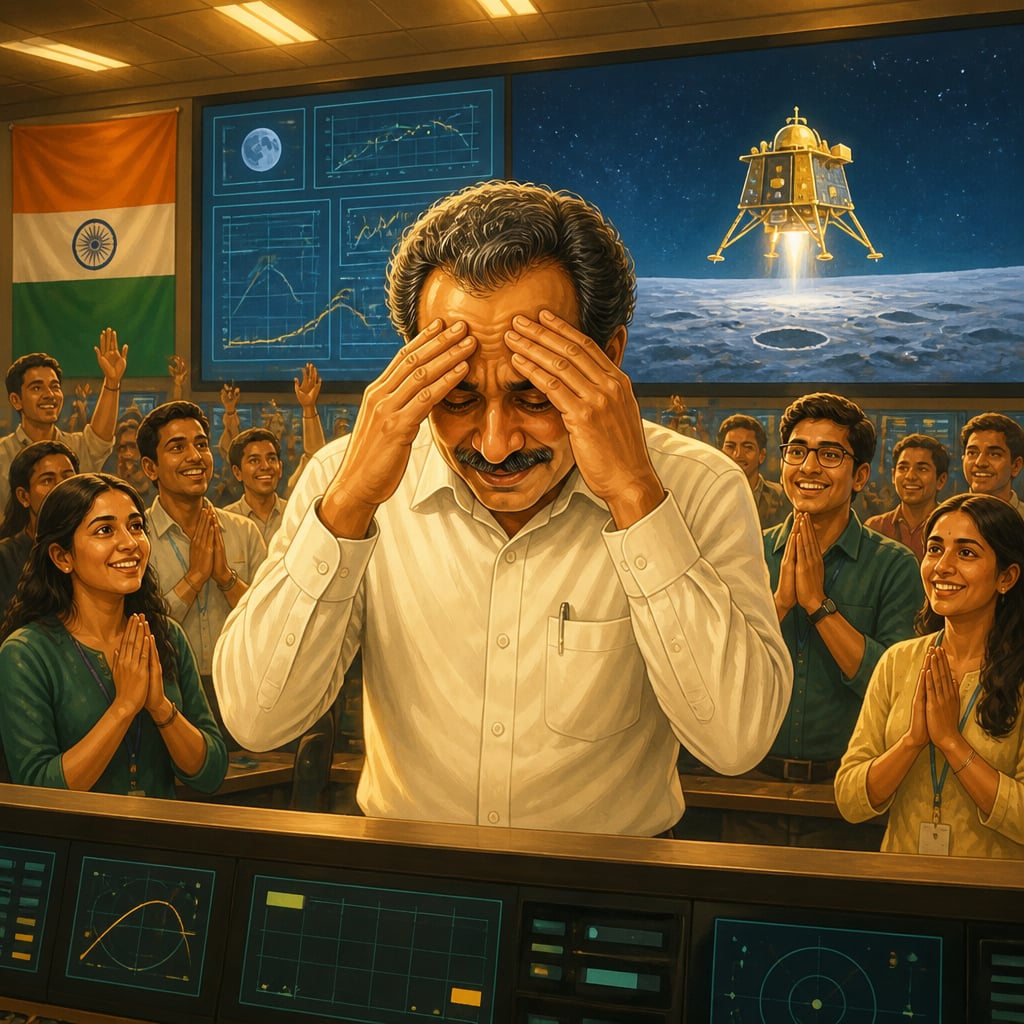
On August 23, 2023, S. Somanath, Chairman of ISRO, stood in the control room at Bengaluru as Chandrayaan-3's Vikram lander touched down on the lunar south pole. India had just become the fourth nation, and the first in the Global South, to soft-land on the Moon. But the real story wasn't the landing. It was what happened before.
When Russia's Luna-25 mission crashed into the Moon just three days earlier, Western commentators asked: "Will India rely on Russian or American technology next?" The answer was already settled decades ago. ISRO had built this capability themselves, from scratch, through failures, through budget constraints that would have killed any Western space program.
This is the essence of Atmanirbhar, not isolation, but capability-building that makes you strong enough to engage the world on your own terms.
The Ancient Roots of Self-Reliance
The concept of self-reliance isn't a 2020 slogan. It runs through Indian economic thought for millennia.

Kautilya, writing in the 4th century BCE, devoted entire chapters of the Arthashastra to what he called svadeshi-vyavastha, the self-sufficiency system. His principle was clear:
"स्वदेशे निर्मितं वस्त्रं परदेशे न वर्धते" Svadeshe nirmitam vastram paradeshe na vardhate "What is produced in one's own land does not increase [dependency on] foreign lands."
But Kautilya was no isolationist. The same Arthashastra contains detailed regulations for foreign trade, merchant protection, and diplomatic commerce. His vision was simple: build capability first, then trade from strength.
The Mauryan Empire under Chandragupta didn't refuse Greek envoys, it received Megasthenes and traded extensively with the Hellenistic world. But it did so from a position of industrial self-sufficiency. The famous Mauryan iron and steel didn't need Greek technology; Greek merchants needed Mauryan steel.
The Principle Revealed: Tyaga and Capability
The Isha Upanishad opens with one of the most misunderstood verses in Indian philosophy:
"तेन त्यक्तेन भुञ्जीथा" Tena tyaktena bhunjitha "Enjoy through renunciation."
This isn't about rejecting wealth. It's about non-attachment to outcomes while building real capability. You don't build ISRO by obsessing over whether you'll beat NASA. You build it by mastering propulsion, navigation, and materials science, step by step, failure by failure.
The dharmic insight is this: true self-reliance comes from capability, not closure. A village that can produce its own grain doesn't refuse to trade with the next village, it trades surplus, not necessities. It engages from strength, not desperation.
This is precisely what Atmanirbhar Bharat means in 2025. When PM Modi launched the initiative in May 2020, critics abroad (and some at home) called it protectionism. They missed the point entirely.
Global Perspectives on Self-Reliance Economics
The tension between self-reliance and global trade isn't uniquely Indian. Three Western thinkers offer illuminating comparisons:
Friedrich List (1789-1846), the German economist, argued that free trade only benefits nations that have already industrialized. His "infant industry" theory held that developing nations must protect and nurture domestic capability before opening to global competition. List wasn't anti-trade, he was anti-premature trade. Germany followed his advice, building industrial strength before engaging Britain as equals.
Alexander Hamilton (1755-1804), America's first Treasury Secretary, implemented similar policies. His "Report on Manufactures" (1791) advocated tariffs and state support for American industry, the opposite of the free trade America would later preach to others.
Ha-Joon Chang, the contemporary Cambridge economist, calls this "kicking away the ladder." Rich nations that industrialized through protection now demand developing nations embrace immediate free trade.
| Thinker | Key Insight | Indian Parallel |
|---|---|---|
| Friedrich List | Protect infant industries until competitive | Kautilya's svadeshi before foreign trade |
| Alexander Hamilton | State investment builds industrial base | Arthashastra's state-supported crafts |
| Ha-Joon Chang | Development requires strategic protection | Atmanirbhar as capability-first approach |
The Indian approach, however, adds something these Western thinkers lacked: a dharmic dimension. Self-reliance isn't just economic strategy, it's moral imperative. Svadhyaya (self-study), svadharma (one's own duty), swadeshi (self-reliant economy), these are interconnected principles of living authentically while engaging interdependently.
Modern Resonance: Why 2025 Proves the Point
Consider what happened after COVID-19. When global supply chains collapsed, India discovered it imported 70% of its Active Pharmaceutical Ingredients (APIs) from China. Medical equipment, semiconductors, solar panels, all critically dependent on foreign supply chains.
The response wasn't to close borders. It was to build capability:
![]()
- PLI Schemes (Production Linked Incentives) now cover 14 sectors from mobile phones to pharmaceuticals
- India Semiconductor Mission attracted $15 billion in investment for chip manufacturing
- Defence indigenization crossed 75% local content in 2024
- UPI now processes 12 billion transactions monthly, built entirely in India, now exported globally
This is Kautilya's vision in action: build the capability at home, then engage the world from strength. ISRO doesn't compete with SpaceX by buying Falcon rockets, it builds PSLV and offers commercial launches at one-tenth the cost.
Your Turn: Self-Reliance Starts Local
You might be wondering: "What does national policy have to do with me?"
Everything. The same principle applies at every scale.
A student who builds deep skills in one field becomes atmanirbhar, able to collaborate from expertise, not desperation. A family that saves before spending, that builds assets before taking loans, practices the same svadeshi economics.
Ask yourself: In your work, your finances, your skills, are you building capability or just consuming? Are you trading from strength or from need?
The ancient sages knew what ISRO proved on August 23, 2023: the path to global excellence runs through local mastery. Chandrayaan-3 didn't succeed because India isolated itself. It succeeded because India built the capability that made international collaboration a choice, not a necessity.
In the next lesson, we'll see how this principle transforms agriculture, where Farmer Producer Organizations are helping millions of small farmers achieve collective self-reliance.
John Maynard Keynes argued for 'liquidity preference', the value of holding reserves rather than committing all resources. Modern central banks maintain forex reserves for exactly this reason.
The Indian approach adds a moral dimension: reserves aren't just for bargaining power but for serving your people without depending on foreign goodwill during crises (as COVID-19 demonstrated).
India's forex reserves crossed $650 billion in 2024, providing 11 months of import cover, up from just 2 weeks during the 1991 crisis.
Harvard's negotiation research shows that the party with better alternatives (BATNA) always negotiates better. This is the Isha principle in Western terms, detachment from this deal because you have alternatives.
The Indian insight goes deeper: detachment isn't just tactical but spiritual. You build capability because it's your dharma, not because you're obsessed with outcomes. This produces sustainable excellence rather than burnout.
ISRO's budget for Chandrayaan-3 was $75 million, less than the catering budget for the Hollywood movie 'Gravity.' Detachment from Western standards enabled Indian innovation.
Key terms
- Atmanirbhar
- Self-reliant; having the capability to depend on oneself while engaging interdependently with others
- Swadeshi
- Of one's own country; economic self-reliance through local production and consumption
- Svadhyaya
- Self-study; the practice of independent learning and capability-building
- Kosha
- Treasury; stored wealth; the reserves that enable self-reliance
Key figures
Vinoba Bhave
Spiritual leader and social reformer
Narendra Modi
Prime Minister of India
Friedrich List
German economist and theorist of national development
Case studies
ISRO's Chandrayaan-3: Self-Reliance That Conquered the Moon
On August 23, 2023, ISRO's Chandrayaan-3 lander touched down on the lunar south pole, a region no nation had successfully reached. Just three days earlier, Russia's Luna-25 mission had crashed attempting the same feat. The contrast was stark: Russia, with decades of Soviet space heritage and far larger budgets, failed where India succeeded. But ISRO's journey to this moment began in the 1960s, when Western nations refused to share rocket technology with India. Dr. Vikram Sarabhai, ISRO's founder, made a pivotal decision: instead of buying foreign rockets, India would build its own. The early years were humbling, scientists transported rocket parts on bicycles and bullock carts. The first rocket was assembled in a church in Thiruvananthapuram. Decade by decade, ISRO built capability: SLV, ASLV, PSLV, GSLV, each generation solving problems the previous couldn't. When Chandrayaan-2's lander crashed in 2019, ISRO didn't blame foreign components or seek foreign help. They analyzed the failure, redesigned the system, and tried again with Chandrayaan-3.
ISRO embodies the Atmanirbhar principle: build capability through your own effort, learn from failures without blame, engage the world from strength. Conventional economics might suggest India should have bought rockets from established space powers, faster, perhaps cheaper initially. But the dharmic approach asks: what builds lasting capability? What enables future generations? The Arthashastra's principle of svadeshi-vyavastha (self-sufficiency system) doesn't forbid foreign trade, it prioritizes domestic capability. ISRO now offers commercial launches to foreign clients, earns foreign exchange, and collaborates with NASA as equals. This is trade from strength, not dependence. The Isha Upanishad's tena tyaktena bhunjitha manifests in ISRO's culture: scientists focused on mastering their craft, detached from Western comparisons or budgets. Chandrayaan-3 cost $75 million; NASA's comparable mission would cost billions. Detachment from Western standards enabled Indian innovation.
India became the fourth nation (after USSR, USA, and China) to soft-land on the Moon, and the first to reach the lunar south pole. ISRO's commercial arm now launches satellites for European, American, and Asian clients, earning over $300 million in foreign exchange. The technology developed for space now powers India's missile defence, weather prediction, and communication infrastructure. Most importantly, ISRO created a generation of Indian engineers who know they can solve world-class problems without foreign assistance. When India needs semiconductor fabs, the same mindset applies: build the capability, learn from failures, engage the world from strength.
Self-reliance isn't isolation, it's the foundation for genuine global engagement. ISRO didn't succeed by closing itself off; it succeeded by building capability that made international collaboration a choice rather than a necessity.
ISRO's cost-innovation model has spawned a commercial space industry in India, with startups like Skyroot and Agnikul building on the self-reliance ecosystem ISRO created. SpaceX's cost disruption followed a similar playbook: build capability in-house rather than depending on legacy contractors. The lesson scales beyond space. Countries and companies that invest in deep capability building consistently outperform those that rely on imported solutions.
ISRO's cost per kilogram to orbit is $1,500, compared to $54,500 for NASA's Space Shuttle. Self-reliance enabled cost innovation that now makes India the world's most affordable space launch provider.
Historical context
Post-Independence India to Present (1947-2025)
India's journey with self-reliance has been complex. The Swadeshi movement (1905-1947) was primarily political, rejecting British goods to assert independence. Post-independence, self-reliance became economic policy but often meant inefficient protection. The 2020 Atmanirbhar vision attempts to synthesize lessons from both eras: build capability strategically, but engage globally from strength.
Every major developed nation, Britain, Germany, USA, Japan, South Korea, China, built industrial capability through strategic protection before opening to free trade. India's Atmanirbhar approach follows this proven path, not the free-trade-from-day-one prescription that Western economists recommend but their own nations never followed.
India's share of world GDP fell from 24.4% in 1700 to 4.2% in 1950 under colonial de-industrialization. As of 2024, it has recovered to approximately 7.3%, the Atmanirbhar strategy aims to accelerate this recovery to developed-nation status by 2047.
Understanding the true history of self-reliance, both India's experiments and global precedents, is essential for evaluating current policies. Atmanirbhar Bharat isn't outdated protectionism; it's the same development strategy that built every major economy, now adapted for the 21st century.
Reflection
- The Isha Upanishad says 'enjoy through renunciation' (tena tyaktena bhunjitha). How does building capability with detachment from outcomes differ from working desperately to achieve specific goals? In your own experience, which approach has produced better results, and better peace of mind?
- Identify one area of your life (skill, financial situation, or relationship) where you currently depend on external factors you cannot control. What specific steps could you take in the next 30 days to build internal capability that reduces this dependence, without cutting off engagement with others?