Viksit Rashtra: What 'Developed' Means for India

Beyond GDP: Defining Success on India's Terms

What does 'developed nation' truly mean for India? Not just GDP numbers, but a civilizational vision rooted in Purushartha (four aims of life), Antyodaya (upliftment of the last person), and Saptanga (seven pillars of national strength). This lesson explores why India's definition of development must differ from Western models, and what that means for our 2047 vision.

The Question That Haunts Every Budget Speech
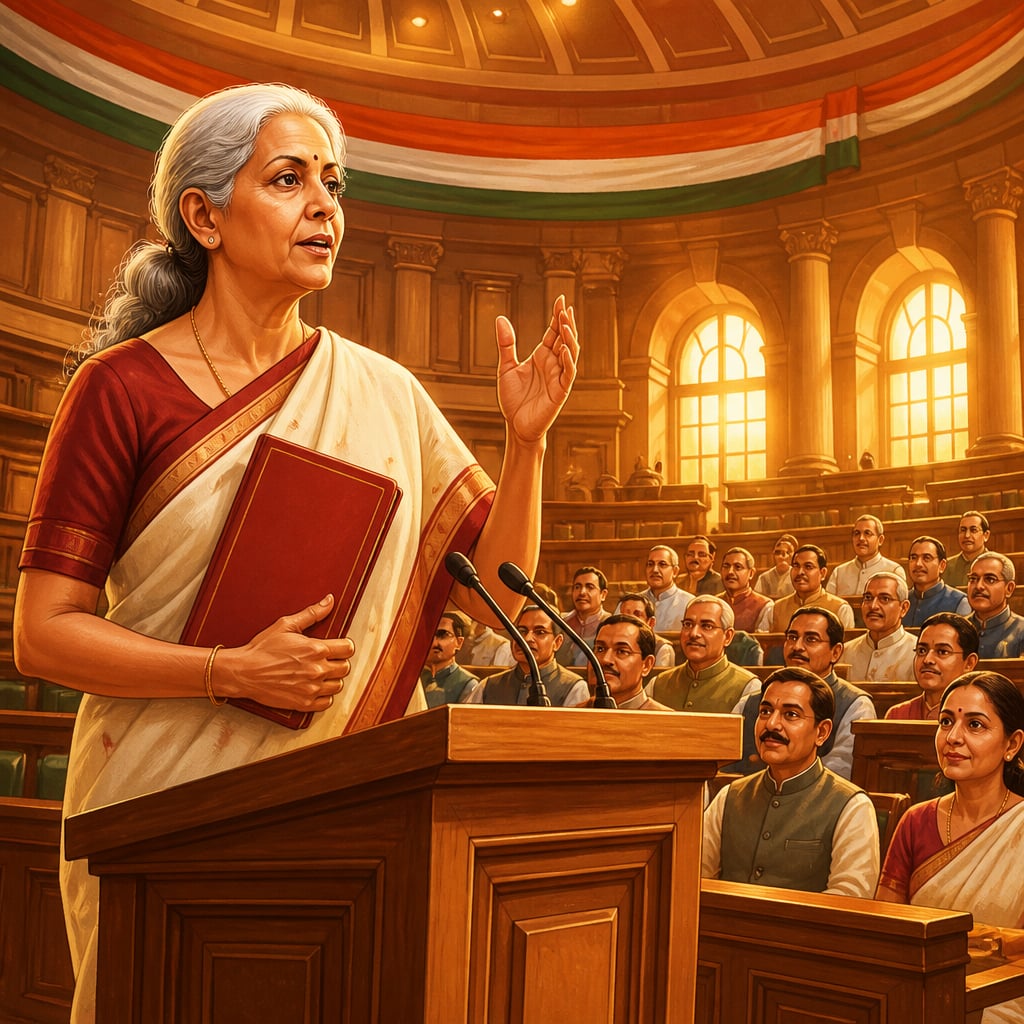
Finance Minister Nirmala Sitharaman delivering the Union Budget in Parliament

On July 23, 2024, Finance Minister Nirmala Sitharaman rose in Parliament to present India's Union Budget. But before the numbers came a question that has haunted Indian policymakers for seven decades: When will India become a developed nation?

The World Bank has a simple answer: when per capita income crosses $14,000 (in 2022 dollars). By that measure, India, at approximately $2,500 per capita, has decades to go. China crossed that threshold only recently, after 40 years of breakneck growth.

But is that the right question? Is a nation 'developed' merely because its people earn more dollars? Or is there something deeper, something the ancient texts understood that GDP calculators miss?

What the Rishis Knew About Prosperity
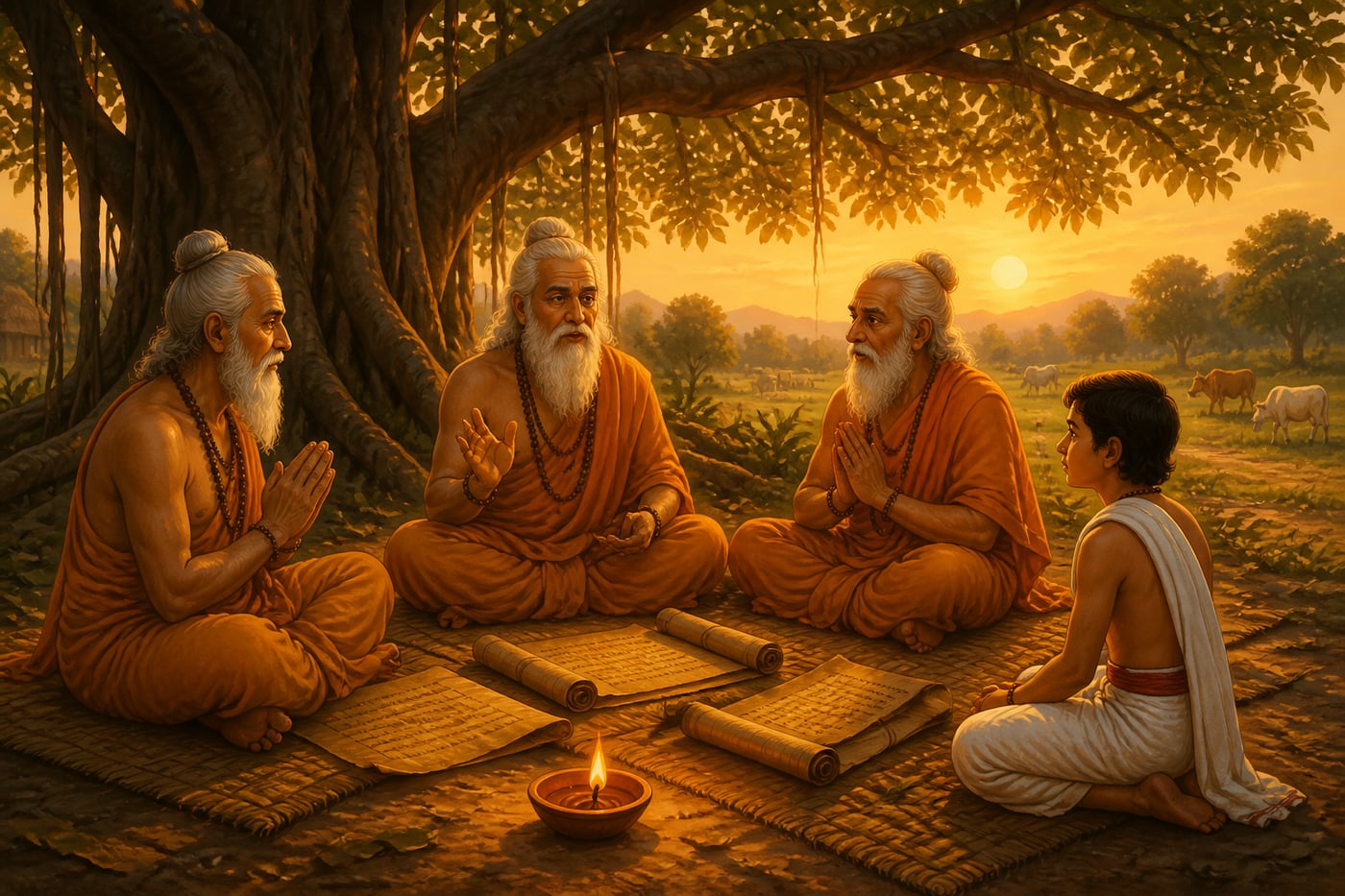
Forest rishis under a banyan tree debating the four aims of life

Three thousand years before economists invented GDP, Indian thinkers wrestled with the same question: What makes a nation truly prosperous?

Their answer wasn't a single number. It was a framework.

The Purushartha doctrine identified four aims of human life: Dharma (righteousness and duty), Artha (wealth and security), Kama (fulfillment and wellbeing), and Moksha (ultimate liberation). A prosperous society enabled pursuit of all four, not just wealth accumulation.

Kautilya, writing in the 4th century BCE, translated this into statecraft. His Saptanga theory identified seven pillars of national strength: Swami (leadership), Amatya (administration), Janapada (territory and people), Durga (fortifications/infrastructure), Kosha (treasury), Danda (military), and Mitra (allies). Notice: wealth (Kosha) was just one of seven.
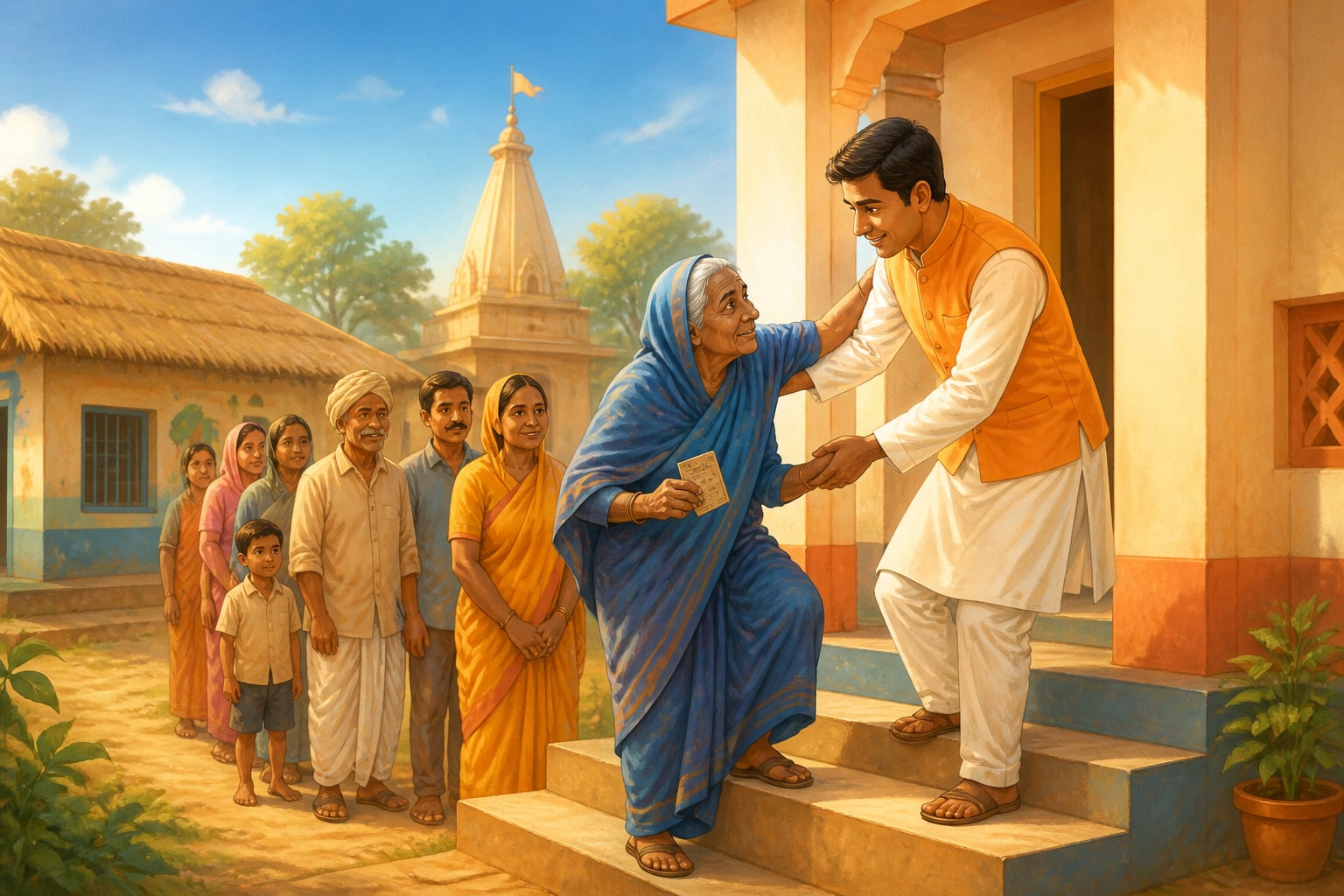
An elderly villager being uplifted at the panchayat in the spirit of Antyodaya

Centuries later, Deendayal Upadhyaya articulated the Antyodaya principle: true development must be measured by the condition of the antya, the last person, the poorest of the poor. If they haven't risen, the nation hasn't developed.

"यतो धर्मस्ततो जयः" Yato dharmas tato jayah "Where there is dharma, there is victory."

This Mahabharata verse captures the core insight: prosperity divorced from dharma is hollow. A nation wealthy but unjust, rich but polluted, growing but unequal, has it truly developed?

Global Perspectives on Development

Indian philosophers weren't alone in questioning pure GDP metrics. Three Western thinkers offer illuminating parallels:

Amartya Sen (1933-present), the Nobel laureate economist, developed the Human Development Index precisely because GDP was insufficient. His "capabilities approach" asks: Can people actually live lives they value? Health, education, freedom, these matter beyond income.

Robert Kennedy (1925-1968) famously said in 1968: "GDP measures everything except that which makes life worthwhile." It counts pollution cleanup as growth, but not clean air. It values security guards but not safe neighborhoods.

Kate Raworth (1970-present), the Oxford economist, proposed "Doughnut Economics", development must meet human needs (the inner ring) without overshooting planetary boundaries (the outer ring). Growth that destroys the environment isn't development; it's a Ponzi scheme borrowing from the future.

Thinker Key Insight Indian Parallel
Amartya Sen Human capabilities matter beyond income Purushartha: four aims, not just Artha
Robert Kennedy GDP misses what makes life worthwhile Dharma precedes and guides Artha
Kate Raworth Development must respect planetary limits Dharmic sustainability principle

The Indian contribution adds something these Western thinkers approached but didn't fully articulate: development has a spiritual dimension. The Moksha component of Purushartha suggests that ultimate human flourishing isn't material at all, and a developed nation must create conditions for that pursuit too.

India vs. China: A Tale of Two Developments

In 1980, India and China had roughly equal per capita incomes, around $200. Today, China's is nearly five times India's. By GDP metrics, China "won."

But let's apply the Indian framework:

By Saptanga (Seven Pillars):

By Purushartha:

By Antyodaya: China lifted 800 million from poverty, extraordinary. But India's approach through Jan Dhan (500 million bank accounts), Ayushman Bharat (500 million health coverage), and direct benefit transfers reaches the last person with choice, not coercion.

The point isn't that India is "better", clearly, we lag on many metrics. The point is that development is multidimensional, and India's definition of success must be India's own.

Modern Resonance: The 2047 Framework

PM Modi's Viksit Bharat 2047 vision explicitly embraces this multidimensional approach. The five pillars announced aren't just economic:

  1. Economic Growth (Artha) - $30 trillion economy
  2. Social Progress (Dharma) - Zero poverty, universal education and health
  3. Environmental Sustainability - Net zero by 2070, Dharmic responsibility to nature
  4. Good Governance - Corruption-free, efficient, responsive (Amatya of Saptanga)
  5. Strong Security - Defence capability, food and energy security (Danda and Durga)

This is Purushartha + Saptanga + Antyodaya operationalized for the 21st century.

NITI Aayog's Multidimensional Poverty Index represents exactly this thinking. Instead of just counting income, it measures 12 indicators across health, education, and living standards. By this measure, India reduced multidimensional poverty from 55% (2005-06) to 11.3% (2022-23), far faster than income growth alone would suggest.

Your Turn: Defining Your Own Development

You might be thinking: "This is national policy. What does it mean for me?"

Everything. The same framework applies at personal scale.

Are you measuring your own development only by salary? Or by the full Purushartha: Are you living dharmically? Is your work meaningful (Kama)? Are you growing spiritually (Moksha)?

The Antyodaya test applies personally too: In your family, community, or workplace, how is the "last person" doing? Development that leaves others behind isn't development, it's just advantage.

As we explore the $10 trillion pathway in the next lesson, keep this framework in mind. The numbers matter, but they're not the whole story. Viksit Bharat isn't just about catching up to Western GDP. It's about demonstrating a different model of development, one where Dharma leads, Artha follows, and the last person rises with the first.

The world is watching. And increasingly, as China's model falters and the West questions its own path, they're asking: Does India have an alternative?

Daron Acemoglu's research ('Why Nations Fail') shows that inclusive institutions, rule of law, property rights, accountability, are the true drivers of long-term prosperity. This is the 'Dharma' component in economic terms.

India's dharmic framework goes beyond institutions to encompass environmental stewardship, intergenerational responsibility, and spiritual wellbeing, dimensions Western institutional economics is only beginning to incorporate.

China's GDP grew 40x from 1980-2020, but its social trust index (Edelman) fell to among the lowest globally. Wealth without dharma corrodes the social fabric that enables prosperity.

John Rawls' 'veil of ignorance' thought experiment leads to the 'maximin' principle, design society as if you might be the worst-off person. This parallels Antyodaya but lacks its policy operationalization.

Antyodaya has been translated into concrete policy architecture: Jan Dhan reached the unbanked, Ayushman Bharat the uninsured, PM-KISAN the marginal farmer. These programs are designed specifically for the 'antya.'

India's Multidimensional Poverty declined from 55% (2005-06) to 11.3% (2022-23), 415 million people lifted. This Antyodaya-focused metric shows progress that per capita GDP alone would understate.

Key terms

Viksit
Developed, evolved, flourished, a state of having reached full potential across multiple dimensions, not just economic.
Purushartha
The four aims of human life, Dharma (righteousness), Artha (wealth), Kama (fulfillment), Moksha (liberation), representing a complete framework for human and societal flourishing.
Saptanga
The seven limbs/pillars of the state in Kautilyan theory: Swami (sovereign), Amatya (ministers), Janapada (territory/people), Durga (fortifications), Kosha (treasury), Danda (army), Mitra (allies).
Antyodaya
Rise/upliftment of the last person, the principle that development must be measured by how the poorest and most marginalized have benefited, not by averages.

Key figures

Prasanta Chandra Mahalanobis

Statistician, architect of India's development measurement framework

Narendra Modi

Prime Minister of India

Amartya Sen

Nobel laureate economist, creator of Human Development Index framework

Case studies

India vs. China: Two Paths to Development

In 1980, India and China were economic twins, both had per capita incomes around $200, populations over 900 million, and agrarian economies emerging from decades of socialist planning. Forty-four years later, China's per capita income is nearly five times India's ($12,700 vs $2,500). China built 40,000 km of high-speed rail; India has 1,500 km. China became the world's factory; India the world's back office. By conventional GDP metrics, China won decisively. But that's only one dimension. China faces a demographic cliff: working-age population shrinking by 35 million per decade. India's will grow until 2050. China's social trust has collapsed under surveillance state tactics. India, for all its messiness, maintains democratic legitimacy. China has few genuine allies; India has QUAD, I2U2, and growing global partnerships. China's environment is devastated; 16 of the world's 20 most polluted cities are Chinese. Most crucially, China's model is showing cracks in 2025: property crisis, youth unemployment over 20%, and capital flight reaching record levels. The authoritarian efficiency that built bullet trains also enabled catastrophic policy errors with no correction mechanism.

**Applying Saptanga Analysis:** *Kosha (Treasury)*: China leads significantly, but treasury built on debt (300% of GDP) and property bubbles is not the same as sustainable kosha. *Janapada (People)*: India's demographic dividend vs China's demographic disaster. By 2047, India's working-age population advantage will be 400+ million. *Mitra (Allies)*: India has genuine partnerships; China has transactional dependencies. The QUAD, I2U2, and IMEC represent alliance-building China cannot replicate. *Danda (Military strength)*: Both are nuclear powers with large armies. But India's military has combat experience; China's last major engagement was 1979. *Swami (Governance)*: India's democratic accountability creates course-correction mechanisms China lacks. Xi Jinping's errors cannot be challenged; Modi faces elections. **Applying Purushartha:** China prioritized Artha (wealth) while suppressing Dharma (through authoritarianism), restricting Kama (quality of life, freedom), and eliminating Moksha (spiritual pursuit). This imbalance produces brittle prosperity. **Applying Antyodaya:** China lifted 800 million from poverty, genuinely extraordinary. But it was done through coercion, not choice. India's approach, Jan Dhan accounts, direct benefit transfers, Ayushman Bharat, reaches the poor while preserving their agency and dignity.

By 2025, the narrative is shifting. Western investors are divesting from China and looking to India. Apple now manufactures more iPhones in India than anywhere except China, and the gap is closing. India attracted record FDI in 2024 while China faced unprecedented capital outflows. More importantly, India's development is proving more resilient. Democracy is messy but self-correcting. Demographic advantage compounds over decades. Alliance networks provide security and market access. The lesson isn't that India is 'better', by many metrics, we still lag. The lesson is that **development pathways matter**. China's authoritarian sprint may peak early and decline fast. India's democratic marathon may take longer but sustain better. By 2047, the gap may look very different than today's GDP numbers suggest.

Development is not a sprint to a GDP number, it's a marathon across multiple dimensions. The Saptanga framework reveals that China's impressive Kosha (treasury) is undermined by weak Mitra (allies), demographic Janapada crisis, and governance fragility. India's slower but more balanced development may prove more durable.

As Western investors diversify away from China due to geopolitical risk and demographic decline, India is emerging as the primary alternative. The Saptanga framework's multi-dimensional assessment explains why: India's advantages in demographics, democracy, and institutional stability matter more over decades than China's current GDP lead.

China's working-age population peaked in 2012 and will shrink by 200 million by 2050. India's will grow by 180 million over the same period, a 380 million person swing in demographic advantage.

Historical context

Post-Independence Development Planning (1947-2025)

India's post-independence development debate oscillated between socialist planning (Nehru-Mahalanobis), market liberalization (1991 reforms), and the current synthesis attempting to combine market dynamism with welfare delivery through digital public infrastructure.

India's development path differs from both the Western (market-led) and Chinese (state authoritarian) models. The emerging Indian model uses digital public infrastructure to deliver welfare at scale while maintaining democratic accountability, potentially a template for other developing democracies.

India moved from world's 10th largest economy in 2014 to 5th in 2024, overtaking UK and France. Per capita income, however, remains below $3,000, illustrating why size and per-person development are both important metrics.

Understanding what 'development' means shapes what we measure and therefore what we pursue. If India accepts GDP-only metrics, it will copy paths that may not suit its civilizational genius. Defining development on India's own terms, Purushartha, Saptanga, Antyodaya, enables an authentic development model.

Reflection

More in Viksit Bharat 2047: The Road to $10 Trillion

All lessons in Viksit Bharat 2047: The Road to $10 Trillion · Viksit Bharat: India's Development Journey course