Janasankhya-Labha: Demographic Dividend
India's 400 Million Advantage
India has what China, Japan, and Europe have lost: a growing working-age population. By 2047, India will have 380+ million more working-age people than China. But demographic dividend doesn't convert automatically, it requires skills, jobs, and productive employment. This lesson explores how India turned its people into economic power through IT services, and what's needed to replicate that success in manufacturing and beyond.
The Chart That Terrifies China
In 2012, something unprecedented happened: China's working-age population peaked and began declining. For the first time since Mao's revolution, China had fewer workers than the year before. By 2050, China will have 200 million fewer working-age people than today, a loss roughly equal to the entire population of Brazil.
Meanwhile, India's working-age population will grow by 180 million over the same period.
This isn't projection. It's arithmetic. The children who will be 35 in 2050 are already born. China's demographic disaster, caused by the one-child policy, is locked in. India's demographic advantage is equally locked in.
The 380-million swing: By 2047, India will have 380 million more working-age people (15-64) than China. This is the largest demographic advantage in recorded history.
But here's the catch: demographic dividend isn't automatic. It's a window, not a guarantee.
Nara-Shakti: The Philosophy of Human Power
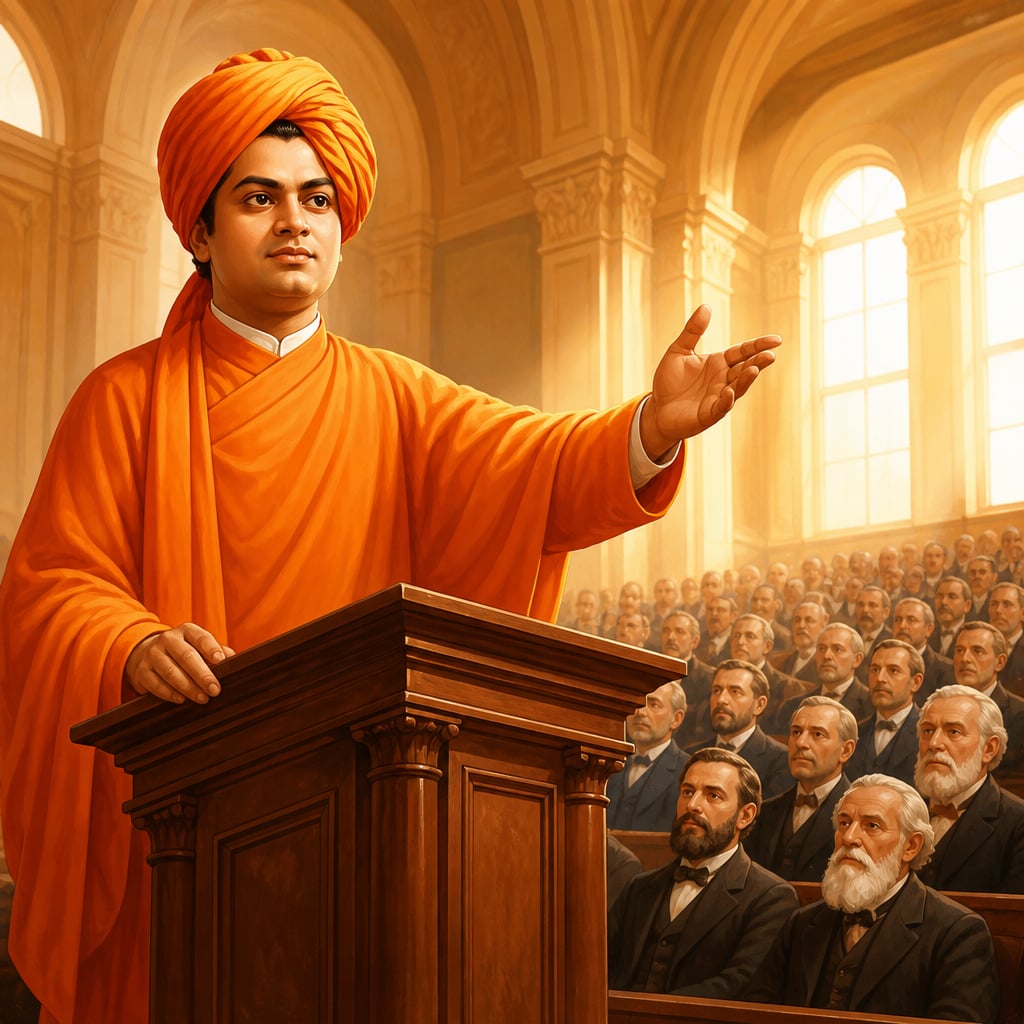
Swami Vivekananda, speaking at the Parliament of World Religions in 1893, articulated a vision that transformed how India thought about its people:
"We want that education by which character is formed, strength of mind is increased, the intellect is expanded, and by which one can stand on one's own feet."
This wasn't just educational philosophy, it was economic philosophy. Vivekananda saw India's millions not as a burden but as Nara-Shakti, human power waiting to be unleashed.
The ancient texts were explicit about this. The Subhashita tradition declared:
"विद्या धनं सर्वधनप्रधानम्" Vidya dhanam sarva-dhana-pradhanam "Knowledge-wealth is the chief of all wealth."
Unlike material wealth, vidya (knowledge) has a unique property: it increases when shared. A teacher who educates 100 students doesn't lose knowledge, the total knowledge in society multiplies. This is the economic insight that underlies human capital theory.
The Gurukul tradition, where students lived with teachers for years, understood something modern education often forgets: skills aren't just information transfer. They're transformation of the whole person. Character, discipline, practical wisdom, these come from immersion, not just instruction.
Global Perspectives on Human Capital
Western economics eventually arrived at similar insights, though without the spiritual dimension.
Gary Becker (1930-2014), Nobel laureate, formalized "human capital theory" in the 1960s. His radical insight: spending on education and skills isn't consumption, it's investment that yields returns like any capital. Countries that invest in people grow faster than those that invest only in machines.
Theodore Schultz (1902-1998), another Nobel laureate, studied post-war Germany and Japan. Both countries lost most of their physical capital in World War II, factories, infrastructure, cities. Yet within decades, they were richer than before. Why? Their human capital, skills, knowledge, work habits, survived the bombing. Physical capital is replaceable; human capital drives recovery.
Claudia Goldin (1946-present), the first woman to win the Economics Nobel solo, demonstrated that the "race between education and technology" determines inequality. When technology advances faster than skills, inequality rises; when education catches up, it falls.
| Thinker | Key Insight | Indian Parallel |
|---|---|---|
| Gary Becker | Education spending is investment, not consumption | Vidya as wealth that multiplies |
| Theodore Schultz | Human capital enables recovery and growth | Post-1991 India grew through people, not resources |
| Claudia Goldin | Education vs technology race determines outcomes | India's IT success vs manufacturing challenge |
Vivekananda anticipated all three: "Give me 100 energetic young men and I will transform India." He understood that human potential, properly developed, is the ultimate economic resource.
IT Services: The Dividend That Worked
India's IT services industry is proof that demographic dividend can be converted into economic power.
The numbers:
- 1991: IT exports near zero
- 2000: $8 billion
- 2010: $58 billion
- 2024: $250+ billion
What happened:
In the 1990s, India had millions of English-speaking graduates but limited manufacturing jobs. The License Raj had strangled industry. But it hadn't touched services.

Companies like Infosys, TCS, and Wipro realized something: India's "burden", millions of educated but underemployed young people, was actually a resource. They could be trained to write code, manage systems, handle customer service, and do it at a fraction of Western costs.
The Y2K crisis accelerated everything. Western companies needed thousands of programmers immediately; India had them. The relationships built during Y2K became permanent outsourcing arrangements.
What made it work:
- English education: Colonial legacy became competitive advantage
- IITs and engineering colleges: Created technical talent pipeline
- Telecom revolution: Made India accessible to global clients
- Entrepreneurial leadership: Narayana Murthy, Azim Premji, Shiv Nadar built world-class companies
- Government enabling: STPI tax benefits, software parks, light regulation
The lesson: India's demographic dividend converted into economic value when three conditions aligned: skills (English, technical), demand (global IT outsourcing), and enabling environment (infrastructure, policy).
The Manufacturing Gap: Dividend Unrealized
But IT employed perhaps 5 million directly and 15 million indirectly. India adds 12 million to its workforce every year.
The services success story couldn't absorb all the people. Manufacturing, which employs 25-30% of workforce in successful industrializers, remained stuck at 10-12%.
The skills mismatch:
India produces:
- 10 million graduates annually
- 1.5 million engineering graduates
- But only 45% are considered "employable" by industry surveys
Meanwhile, manufacturing companies report:
- 80% face skilled worker shortages
- Average time to fill technical positions: 60+ days
- Many positions remain permanently unfilled
The problem isn't too few graduates. It's the wrong skills. India's education system produces people for exams, not employment. Theory without practice. Degrees without capabilities.
Skill India: The Current Bet
Prime Minister Modi's Skill India Mission (2015) represents the largest skilling intervention in history:

Infrastructure:
- 15,000+ ITIs (Industrial Training Institutes)
- 40+ Sector Skill Councils
- 700+ PM Kaushal Kendras (skill centers)
- National Skill Development Corporation coordinating private participation
Targets and achievements:
- Target: 400 million skilled by 2022 (later extended)
- Achieved: 140 million+ trained through various schemes
- PMKVY (Pradhan Mantri Kaushal Vikas Yojana): 14 million+ trained
Challenges:
Placement rates: Official training doesn't always lead to jobs. Placement rates vary from 30% to 70% depending on program.
Quality vs quantity: Speed of scaling compromised depth. Many ITI graduates still need company-specific training.
Industry disconnect: Curriculum often lags industry needs. By the time courses are designed, technology has moved on.
Aspirational mismatch: Young Indians want white-collar jobs; manufacturing jobs carry stigma despite higher pay.
What's working:
- Apprenticeship expansion: 10 lakh+ apprentices in 2024 (up from 3 lakh in 2014). Learning while earning works better than classroom-only.
- Industry partnerships: Companies like Maruti, L&T, Tata running their own training programs, producing immediately employable graduates.
- New-age skills: Digital skills training (coding, data entry, digital marketing) showing high placement rates.
The Window Is Closing
India's demographic advantage peaks around 2040. After that, aging begins.
The math:
- 2025-2040: Approximately 250 million people enter working age
- If 60% find productive employment: demographic dividend
- If 40% remain unemployed or underemployed: demographic disaster
The difference between dividend and disaster isn't the number of people. It's whether they have:
- Skills that employers need
- Jobs that exist in sufficient quantity
- Infrastructure that connects people to opportunities
China's experience is cautionary. The one-child policy created decades of dividend (fewer dependents, more workers). But when the dividend ended, there was no plan. China now faces a demographic collapse that no policy can reverse.
India's advantage is real, but time-limited. The 25-year window (2025-2050) is India's chance to convert people into prosperity.
Your Turn: You Are the Dividend
If you're reading this and under 35, you ARE the demographic dividend. Your skills, your productivity, your contribution determines whether India's population becomes prosperity or burden.
Vivekananda's vision applies directly: "We want that education by which character is formed, strength of mind is increased, the intellect is expanded, and by which one can stand on one's own feet."
Ask yourself:
- Are you building skills that create value? Or collecting degrees that signal nothing?
- Are you prepared for a job that may not exist yet? Or training for yesterday's economy?
- Are you developing vidya (wisdom, capability) or just pariksha-gyaan (exam knowledge)?
The difference between India's demographic dividend and disaster depends on millions of individual choices. The national statistics emerge from personal decisions.
In the next lesson, we examine Atmanirbhar Bharat, how self-reliance in strategic sectors ensures that the value created by India's workforce stays in India rather than enriching foreign economies.
Paul Romer's endogenous growth theory shows that ideas and knowledge have 'non-rivalry', using an idea doesn't prevent others from using it. This property creates increasing returns: more knowledge leads to faster knowledge creation.
The vidya-dhana concept goes further than Romer: it establishes a moral imperative to share knowledge. Unlike Western intellectual property frameworks that restrict knowledge sharing, the vidya tradition sees sharing as dharma.
India's open-source software contributions rank third globally. The vidya-dhana philosophy, knowledge should be shared, manifests in Indian engineers' high participation in collaborative development.
Modern labor economics emphasizes 'matching', workers perform best in jobs suited to their skills and preferences. Germany's dual-track education system (academic vs vocational) acknowledges different aptitudes; India's one-track system pretends everyone should be an engineer.
If India reclaims the original varna concept, aptitude-based placement rather than birth-based hierarchy, it could develop a sophisticated skill development system matching diverse talents to diverse needs.
Germany: 50%+ of students enter vocational training; youth unemployment 5.8%. India: vocational training stigmatized; graduate unemployment 12%+. Respecting diverse aptitudes (svabhava) produces better outcomes.
Key terms
- Janasankhya-Labha
- Demographic dividend, the economic growth potential created when a large proportion of the population is of working age, creating more producers than dependents.
- Nara-Shakti
- Human power or human energy, the productive potential of a population viewed as the ultimate economic resource.
- Vidya-Dhana
- Knowledge-wealth, education and skills understood as the highest form of wealth because they increase when shared and cannot be stolen.
- Kaushal
- Skill, proficiency, expertise, practical ability to perform tasks effectively. Distinguished from theoretical knowledge (jnana) by emphasis on application.
Key figures
Swami Vivekananda
Spiritual leader, philosopher, advocate of 'man-making education'
Narayana Murthy
Co-founder of Infosys, architect of India's IT services model
Gary Becker
Nobel laureate economist, founder of human capital theory
Case studies
India's IT Services: How Demographic Dividend Actually Works
In 1991, India liberalized its economy but faced a paradox: millions of educated but unemployed young people, a manufacturing sector strangled by decades of License Raj, and no obvious path to employment. The IT services industry emerged from this crisis. Companies like Infosys (founded 1981), TCS, and Wipro realized that India's 'problem', masses of English-speaking graduates, was actually a solution. They could be trained to write code, manage systems, and serve global clients at a fraction of Western costs. The Y2K crisis (1999-2000) accelerated everything. Western companies needed thousands of programmers immediately to fix date-related bugs. India had them. The emergency relationships became permanent outsourcing contracts. **The scale of transformation:** - 1991: IT exports ~$100 million - 2000: $8 billion - 2010: $58 billion - 2024: $250+ billion - Employment: 5 million direct, 15 million indirect **What made it work:** 1. **English education**: The colonial legacy became competitive advantage, India had millions who could communicate with Western clients. 2. **Technical education infrastructure**: IITs, RECs (now NITs), and engineering colleges produced technically capable graduates. 3. **Entrepreneurial leadership**: Narayana Murthy, Azim Premji, Shiv Nadar built world-class companies with innovative models (campus hiring, intensive training, global delivery). 4. **Government enabling**: Software Technology Parks (STPI) offered tax benefits and infrastructure. Importantly, government stayed out of the way, no licenses required. 5. **Telecom revolution**: As internet connectivity improved, India could serve global clients in real-time.
**Applying Vidya-Dhana:** The IT industry's core business is vidya, knowledge and skill. Indian IT companies created massive 'knowledge transfer' systems: hiring smart graduates, training them intensively, then deploying them globally. The vidya-dhana principle of knowledge multiplying through sharing enabled rapid scaling. **Applying Nara-Shakti:** Vivekananda's vision of human potential realized: millions of young Indians, previously seen as unemployable burden, became engines of economic value. The IT industry proved that India's population was strength, not weakness, if properly developed. **Applying Aptitude Matching:** The IT industry succeeded partly because it matched work to Indian strengths: analytical thinking, English communication, mathematical aptitude, willingness to work hard. Rather than forcing fit with unsuitable work (heavy manufacturing at the time), it found work suited to available human capital. **Gurukul Elements:** Infosys's Global Education Centre at Mysore (which can train 15,000 people simultaneously) resembles a modern gurukul: immersive residential training that transforms raw graduates into professionals. The intensive, holistic approach reflects traditional shiksha.
**By 2024:** - IT services export: $250+ billion annually - Contribution to GDP: 7.4% - Employment: 5+ million direct jobs (highest paying private sector jobs in India) - Wealth creation: Infosys, TCS, Wipro, HCL among India's most valuable companies - Global presence: Indian IT companies serve 80%+ of Fortune 500 **What this proves:** Demographic dividend converts to economic value when: 1. **Skills match demand**: English + technical skills matched global outsourcing need 2. **Enabling environment exists**: Infrastructure, light regulation, tax incentives 3. **Entrepreneurial leadership builds institutions**: World-class companies created the ecosystem 4. **People are viewed as assets**: The mindset shift from 'burden of unemployed youth' to 'opportunity of trained workforce' **The challenge:** IT employed 5 million directly. India adds 12 million to workforce annually. The services model worked but couldn't absorb all the demographic dividend. Manufacturing, which can employ at scale, remains the unfulfilled promise.
Demographic dividend works when skills, demand, and enabling environment align. India's IT success proves the concept; the challenge is replicating it in manufacturing and other sectors that can employ at greater scale.
India faces the challenge of replicating IT's success in manufacturing, where AI threatens to automate the low-skill jobs that traditionally absorb large workforces. The next phase of demographic dividend depends on whether India can create a manufacturing equivalent of the IT training-to-deployment pipeline at 10x the scale.
Infosys's training model: Fresh graduates undergo 6+ months of intensive training before deployment. This investment (estimated Rs 5 lakh per employee) converts raw graduates into productive professionals, modern gurukul at industrial scale.
Historical context
Post-Independence Human Capital Development (1947-2025)
India's demographic transition is later than China's (which peaked in 2012) but will be more gradual. This gives India time, but also creates urgency. The window for dividend (favorable ratio of workers to dependents) lasts until approximately 2050. After that, aging begins.
China's one-child policy created intense dividend (1980-2010) followed by collapse (2010+). Japan and Europe converted dividend to development but are now aging. India's advantage is timing: demographic dividend is peaking just as manufacturing is relocating from China.
Working-age population (15-64) change 2020-2050: China: -200 million; Europe: -50 million; India: +180 million. India will have 380 million more working-age people than China by 2050.
Demographic dividend is a one-time window. Countries either convert it to development (Korea, Taiwan) or waste it (Philippines, Latin America). India's next 25 years determine which path it follows. There are no second chances with demography.
Reflection
- Vivekananda emphasized 'man-making education' that builds character and self-reliance, not just imparts information. How does this differ from the education you experienced? What elements of 'man-making', character formation, practical skills, ability to stand on your own feet, were present or absent? How might education be reformed to better serve the goal of building complete human beings rather than just exam-passers?
- You ARE the demographic dividend, your productivity and skills determine whether India's population becomes prosperity or burden. Honestly assess: Are the skills you're building in genuine demand? Are you preparing for jobs that will exist in 2035, or jobs that existed in 2015? Identify one specific skill you should develop in the next 6 months to increase your value in the economy of the future.