PM Modi's 2047 Vision: The Centenary Goal

The Roadmap to Developed India

At India's 100th independence anniversary in 2047, what will Viksit Bharat look like? This lesson synthesizes the entire chapter: the development definition, growth pathway, manufacturing transformation, demographic dividend, and strategic autonomy into PM Modi's comprehensive 2047 vision, the five pillars, the milestone roadmap, and the green energy transition that proves ambitious targets are achievable.

The Speech That Defined a Generation's Mission
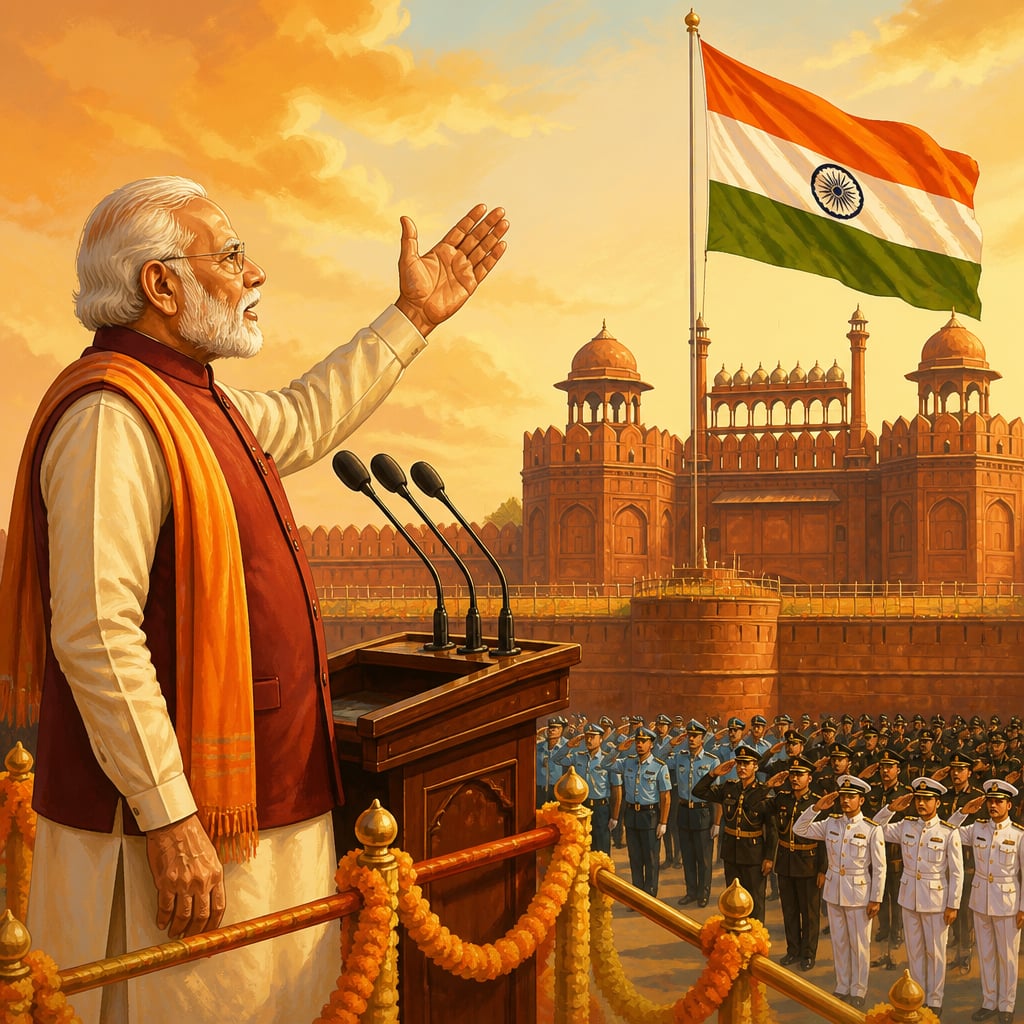
PM Modi addressing the nation from the Red Fort and declaring the Amrit Kaal

On August 15, 2022, India's 75th Independence Day, Prime Minister Narendra Modi stood at the Red Fort and issued a challenge:

"In the next 25 years, the period of Amrit Kaal, we must turn India into a developed nation. When we celebrate 100 years of independence in 2047, we should be Viksit Bharat."

This wasn't a vague aspiration. It was a specific, measurable, time-bound national goal: developed nation status by 2047.

What does "developed" mean? As we explored in Lesson 1, India's definition goes beyond GDP per capita. It encompasses:

The 2047 vision operationalizes these principles into a concrete roadmap.

The Five Pillars Framework

PM Modi's Viksit Bharat 2047 rests on five interconnected pillars:

Pillar 1: Economic Development

Target: $30+ trillion economy, top-3 globally

Pillar 2: Social Progress

Target: Zero poverty, universal capability

Pillar 3: Environmental Sustainability

Target: Growth within planetary boundaries

Pillar 4: Good Governance

Target: Transparent, efficient, accountable

Pillar 5: Security & Global Stature

Target: Secure and respected

These five pillars are the modern operationalization of Saptanga, the seven limbs of national strength from Kautilya. Economic development is Kosha (treasury); social progress is Janapada (people's welfare); governance is Amatya (administration); security is Danda and Durga (military and fortifications).

The Milestone Roadmap

Viksit Bharat 2047 isn't one big leap, it's a series of measured steps:

By 2030 (Immediate Term)

Metric Current 2030 Target
GDP $3.5T $7T
Manufacturing GDP 13% 20%
Renewable capacity 180 GW 500 GW
API self-sufficiency 30% 50%
Defense exports Rs 21K cr Rs 50K cr

By 2035 (Medium Term)

Metric 2030 2035 Target
GDP $7T $12T
Per capita income $4,800 $7,500
Semiconductor fab 1 3+ operational
Electric vehicles 10% sales 50% sales
Multidimensional poverty 5% 1%

By 2047 (Centenary Goal)

Metric 2035 2047 Target
GDP $12T $30T+
Per capita income $7,500 $15,000+
Global GDP rank 4th 2nd-3rd
Manufacturing 22% 25%
Carbon emissions Peak Net zero path

The math requires sustained 8% growth for 22 years, exactly what China achieved from 1990-2012, what Korea achieved from 1965-1997. Ambitious but precedented.

Pancha-Shakti: The Five Powers

The dharmic framework for 2047 vision draws on Pancha-Shakti, five dimensions of national power:

1. Artha-Shakti (Economic Power): The $30 trillion economy isn't just about wealth, it's about capability. Economic strength enables all other strengths.

2. Sastra-Shakti (Technological Power): Indigenous capability in critical technologies, semiconductors, AI, space, nuclear, biotech. Not just users but creators.

3. Sainya-Shakti (Military Power): Defense self-reliance, regional security leadership, credible deterrence. The Tejas, Vikrant, and BrahMos represent this.

4. Sanskriti-Shakti (Cultural Power): Soft power through yoga, Ayurveda, cinema, cuisine, spiritual traditions. India's civilizational contribution to global culture.

5. Adhyatma-Shakti (Spiritual Power): The dimension Western frameworks miss. India's ultimate contribution isn't GDP, it's the wisdom traditions that can heal a world suffering from material success without spiritual grounding.

Viksit Bharat 2047 must develop all five powers simultaneously. A nation strong only in GDP but weak in culture is incomplete. A nation rich in heritage but poor in economics cannot project influence.

Green Energy Transition: Proof the Vision Works

India's renewable energy transformation demonstrates that ambitious Viksit Bharat targets are achievable:

The 2015 Starting Point:

The Commitment: At Paris COP21 (2015), PM Modi announced India would reach 175 GW renewable capacity by 2022 and 500 GW by 2030. Skeptics called it impossible.

Aerial view of the Bhadla Solar Park stretching across the Rajasthan desert

The Execution:

The Results (2024):

What this proves: When India commits to ambitious targets with proper policy support, execution follows. The green transition model, bold targets, enabling policy, private investment, competitive procurement, is the template for all Viksit Bharat goals.

Kartavya Path: The Duty-Based Vision

An honour guard at sunset on Kartavya Path, the renamed ceremonial axis

The renaming of Rajpath (King's Road) to Kartavya Path (Path of Duty) symbolizes the philosophical foundation of Viksit Bharat 2047.

Viksit Bharat isn't something the government will deliver to citizens. It's a collective endeavor requiring everyone to fulfill their duty:

Rashtra-Dharma (National Duty): India's 2047 vision isn't just about India's prosperity. It's about India's civilizational contribution to the world. As PM Modi said: "When India is strong, the world is stable. When India rises, it lifts others."

India reaching developed status while maintaining democracy, respecting pluralism, and prioritizing sustainability would offer an alternative development model to the world, neither Western individualism nor Chinese authoritarianism.

Individual Kartavya: Every citizen has a role:

Viksit Bharat 2047 isn't a government program. It's a generational mission that requires 1.4 billion Indians fulfilling their kartavya.

Global Perspectives on Development Visions

Lee Kuan Yew (1923-2015), Singapore's founding father, transformed a mosquito-swamp with no resources into a first-world nation in one generation. His insight: "A nation is nothing without a vision that inspires people to sacrifice short-term comfort for long-term greatness."

Deng Xiaoping (1904-1997) set China on its development path with the vision of "xiaokang" (moderate prosperity) by 2020 and "great rejuvenation" by 2049. China largely achieved xiaokang; India's 2047 is our equivalent.

Mahathir Mohamad (1925-present), Malaysia's longtime Prime Minister, launched Vision 2020 in 1991, a 30-year plan for developed nation status. Though Malaysia hasn't fully achieved it, the vision organized national effort for three decades.

Leader Vision Key Insight
Lee Kuan Yew Singapore transformation Long-term vision justifies short-term sacrifice
Deng Xiaoping China's rejuvenation Generational timeframes enable transformation
Mahathir Vision 2020 National goals organize diverse efforts

PM Modi's Viksit Bharat 2047 joins this tradition of transformational national visions. The 25-year timeframe is deliberate: long enough for transformation, short enough for accountability.

Synthesis: How the Chapter Connects

This chapter has built the complete framework:

Lesson 1 (Definition): Viksit Bharat means multidimensional development, Purushartha, Antyodaya, Saptanga, not just GDP.

Lesson 2 (Pathway): The math requires 8%+ growth sustained for 22 years. Achievable with right policies, as Korea proved.

Lesson 3 (Manufacturing): Manufacturing must double from 13% to 25% of GDP. PLI schemes and defence transformation show it's possible.

Lesson 4 (Demographics): India's 380-million-person demographic advantage vs. China is the ultimate asset, if we skill them properly.

Lesson 5 (Autonomy): Strategic sectors require atmanirbhar capability; the pharma API crisis showed the cost of neglecting this.

This Lesson (Vision): PM Modi's 2047 vision synthesizes all these into a coherent roadmap with five pillars, milestone targets, and the green energy proof that execution is possible.

Your Turn: Your 2047 Contribution

You are reading this during the Amrit Kaal, the 25-year nectar period between India's 75th and 100th independence anniversaries.

By 2047:

Your kartavya question: What will your contribution to Viksit Bharat 2047 be?

The vision requires:

Somewhere in those numbers is your role. The national vision becomes real through individual action. Kartavya Path runs through your life.

In the final lesson, we'll bring everything to the present moment: what does all this mean for 2026 and beyond? How do you apply these lessons starting today?

Walter Mischel's 'marshmallow test' showed that children who could delay gratification achieved more. Lee Kuan Yew said national development requires the same: convincing people to sacrifice present comfort for future greatness.

India's dharmic culture has built-in frameworks for sacrifice: fasting, tapasya, yajna. The Amrit Kaal framing taps this cultural resource, framing 2047 effort as sacred duty, not just economic calculation.

South Korea's savings rate during development (1960-1990): 35-45% of GDP. Indians saved for future through traditional means; channeling this tendency toward national investment is Amrit Kaal's opportunity.

Balanced development vs. single-metric optimization

China optimized for GDP and fell behind on soft power, demographics, and governance legitimacy. The US optimized for military and financials while manufacturing hollowed out. Single-metric focus creates vulnerabilities.

The five-pillar framework explicitly prevents single-metric optimization. Economic growth must come with social progress, environmental sustainability, good governance, and security. Viksit Bharat is holistic by design.

Key terms

Pancha-Shakti
The five dimensions of national power: economic (artha), technological (sastra), military (sainya), cultural (sanskriti), and spiritual (adhyatma). Comprehensive national strength requires all five.
Amrit Kaal
The 'Nectar Era', PM Modi's term for the 25-year period from India's 75th independence anniversary (2022) to its centenary (2047). A uniquely precious window for transformation.
Kartavya Path
Path of Duty, the new name for the ceremonial avenue in New Delhi (formerly Rajpath). Symbolizes the shift from subjects serving a king to citizens fulfilling duties.
Rashtra-Dharma
National duty, the collective responsibility of a nation to fulfill its civilizational purpose. For India, this includes contributing to global welfare through its unique cultural and spiritual heritage.

Key figures

Narendra Modi

Prime Minister of India, architect of Viksit Bharat 2047 vision

Lee Kuan Yew

Founding Prime Minister of Singapore, architect of 'First World from Third World'

King Janaka

Philosopher-king of Videha, exemplar of karma yoga

Case studies

India's Green Energy Revolution: Proof That Vision Becomes Reality

In 2015, India's renewable energy capacity was 35 GW, mostly older hydropower. Solar was just 3.7 GW, barely visible in the energy mix. Coal supplied 75% of electricity. The country was seen as a laggard on climate, unable to afford clean energy transition. At the Paris Climate Conference (COP21) in December 2015, PM Modi announced India would reach: - **175 GW renewable capacity by 2022** - **500 GW renewable capacity by 2030** - **50% electricity from non-fossil sources by 2030** - **Net zero emissions by 2070** Sceptics dismissed these as impossible. India was too poor, too coal-dependent, too infrastructure-starved. **What happened:** 1. **Policy architecture:** - Reverse auctions brought private investment at competitive rates - Solar parks (Bhadla at 2,245 MW is world's largest) enabled scale - Renewable purchase obligations forced utilities to buy green - International Solar Alliance positioned India as global leader 2. **Technology revolution:** - Solar costs fell from Rs 18/unit (2010) to Rs 2/unit (2024), 90% reduction - Grid integration improved to handle intermittent renewable - Battery storage and green hydrogen became next frontiers 3. **Investment mobilization:** - Annual green investment: $15 billion+ (from $5 billion in 2015) - Foreign investment in renewable surged - Domestic manufacturing through PLI for solar

**Applying Rashtra-Dharma:** Climate action isn't just about India, it's about planetary responsibility. India's green transition demonstrates that development and sustainability can coexist. This is rashtra-dharma: national action for global welfare. **Applying Pancha-Shakti:** The green transition builds multiple strengths: - Artha-shakti: $250 billion market opportunity - Sastra-shakti: Solar manufacturing capability, green hydrogen leadership - Sanskriti-shakti: International Solar Alliance projects Indian leadership **Applying Kartavya Path:** The transition required collective kartavya: government policy, private investment, consumer adoption, international partnerships. No single actor could achieve it alone. **Applying Amrit Kaal Urgency:** The 2030 targets create accountability. 500 GW isn't a vague aspiration, it's a specific goal with annual milestones (180 GW achieved by 2024). The green transition proves that Amrit Kaal-style targeted development works.

**By 2024:** - Renewable capacity: 180+ GW (from 35 GW in 2015, 5x growth) - Solar capacity: 75+ GW (from 3.7 GW, 20x growth in 9 years) - Fifth largest renewable capacity globally - On track for 500 GW by 2030 **What this proves for Viksit Bharat 2047:** 1. **Ambitious targets work:** The sceptics said 175 GW by 2022 was impossible. India achieved 180+ GW by 2024. 2. **Policy + private investment:** Government didn't build solar plants, it created conditions for private investment. This model scales. 3. **Global leadership:** India leads International Solar Alliance (120+ countries). Capability creates influence. 4. **Economic opportunity:** Green transition isn't cost but opportunity. India's solar manufacturing is now export-competitive. **The template:** Bold targets + enabling policy + private investment + milestone accountability = transformation. Apply this to manufacturing, semiconductors, pharma APIs, and all Viksit Bharat 2047 goals.

The green energy transition proves that Viksit Bharat 2047 is achievable. When India commits to ambitious targets with proper policy architecture and milestone accountability, transformation happens. The sceptics who said 175 GW by 2022 was impossible were wrong. Apply the same model across all five pillars.

India's solar tariffs are now among the world's lowest, making renewable energy cheaper than new coal plants. This cost crossover point, reached in 2020, means India's green transition is driven by economics rather than ideology. The same pattern is emerging in battery storage, where costs are falling on a similar trajectory.

Solar tariff trajectory: Rs 18/unit (2010) → Rs 7/unit (2015) → Rs 2/unit (2024). A 90% cost reduction in 14 years. This wasn't prediction, it was policy-enabled execution. The same trajectory is possible for semiconductors, EVs, green hydrogen.

Historical context

Post-Independence Development Visions (1947-2047)

India has had development visions before, Nehru's 'temples of modern India,' Indira Gandhi's 'Garibi Hatao,' Vajpayee's 'Shining India.' Viksit Bharat 2047 differs in specificity (five pillars, milestones), accountability (annual tracking), and timeframe (25 years with generational ownership).

Successful development stories had similar long-term visions: Singapore's Lee Kuan Yew (first-to-third world in one generation), China's Deng Xiaoping (xiaokang by 2020, rejuvenation by 2049), Malaysia's Mahathir (Vision 2020). India joins this tradition with Viksit Bharat 2047.

Singapore in 1965 had lower per capita income than India. By 1995, it was 20x India's. The difference: 30 years of disciplined execution toward clear vision. India's Amrit Kaal is the same opportunity.

Without vision, nations drift. Without specificity, visions remain slogans. Without milestones, accountability fails. Without timeframe, urgency dissipates. Viksit Bharat 2047 has all four: vision, specificity, milestones, timeframe. The question is execution.

Reflection

More in Viksit Bharat 2047: The Road to $10 Trillion

All lessons in Viksit Bharat 2047: The Road to $10 Trillion · Viksit Bharat: India's Development Journey course