Nirmana-Vikasa: Manufacturing Transformation

From Assembly to Creation

India's manufacturing share (13% of GDP) must double for Viksit Bharat. This lesson explores the dharmic philosophy of making, from Vishwakarma's divine craftsmanship to Kautilya's quality oversight, and how India's defence manufacturing transformation demonstrates that world-class production is achievable when strategic focus meets artisan dharma.

The Fighter Jet That Changed the Narrative
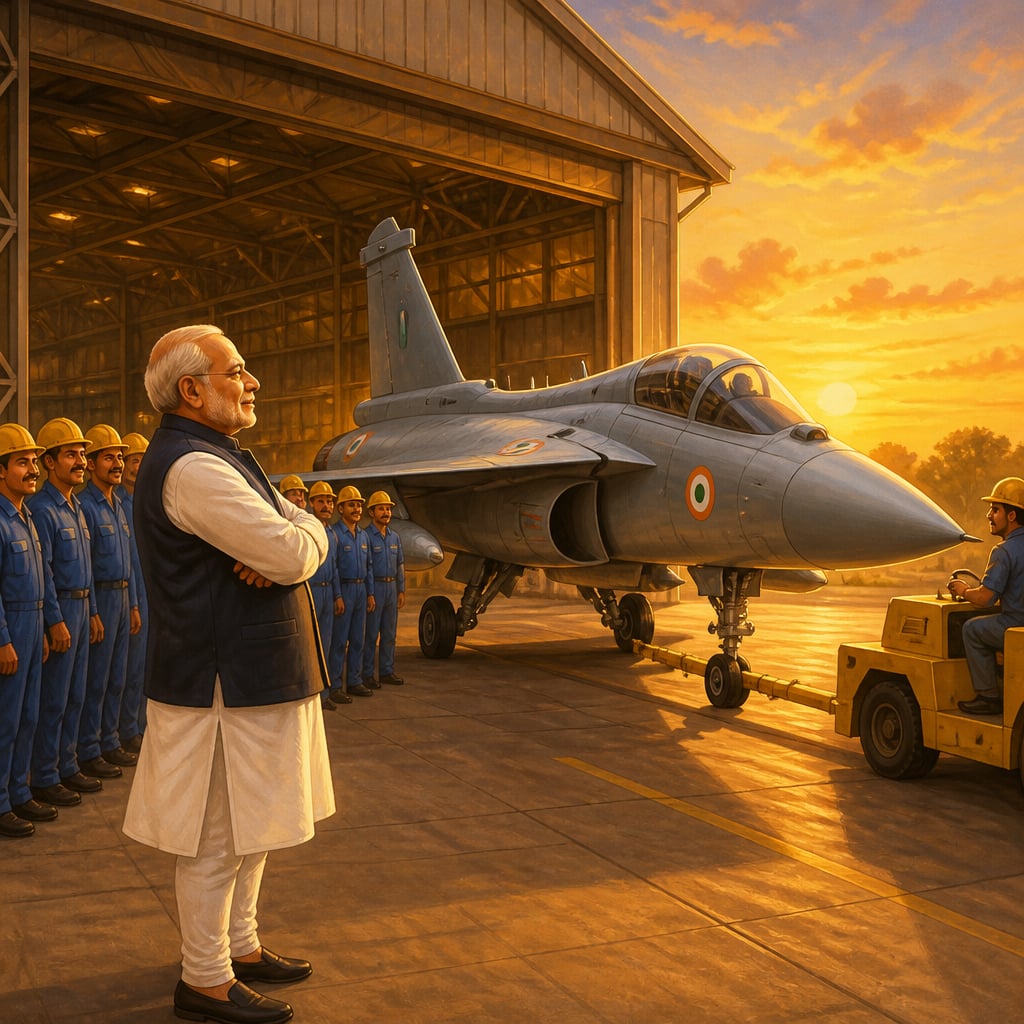
Rajnath Singh watching the first HAL Tejas Mk1A roll out of the Bangalore hangar

On February 20, 2024, Rajnath Singh, India's Defence Minister, watched as the first indigenously manufactured HAL Tejas Mk1A rolled off the production line at Bengaluru. This wasn't just another aircraft. It was proof that India could build fourth-generation fighter jets, something only a handful of nations can claim.

But the real transformation was in what came next: orders from Argentina, Egypt, and Malaysia. India wasn't just buying weapons anymore. India was selling them.

Defence exports crossed $2.6 billion in FY2024, up 30x from a decade ago. BrahMos missiles went to Philippines. ALH Dhruv helicopters to Mauritius. Dornier aircraft to Sri Lanka. The world's largest arms importer was becoming an arms exporter.

How did a country that couldn't manufacture a decent scooter in the 1970s reach here?

The Dharma of Making

Indian civilization has always honored the maker. Vishwakarma, the divine architect and craftsman, is worshipped not as a minor deity but as the creator of the gods' own weapons and palaces. The Rig Veda describes him as Vishvakarma Vachaspati, the lord of speech who gives form to everything.
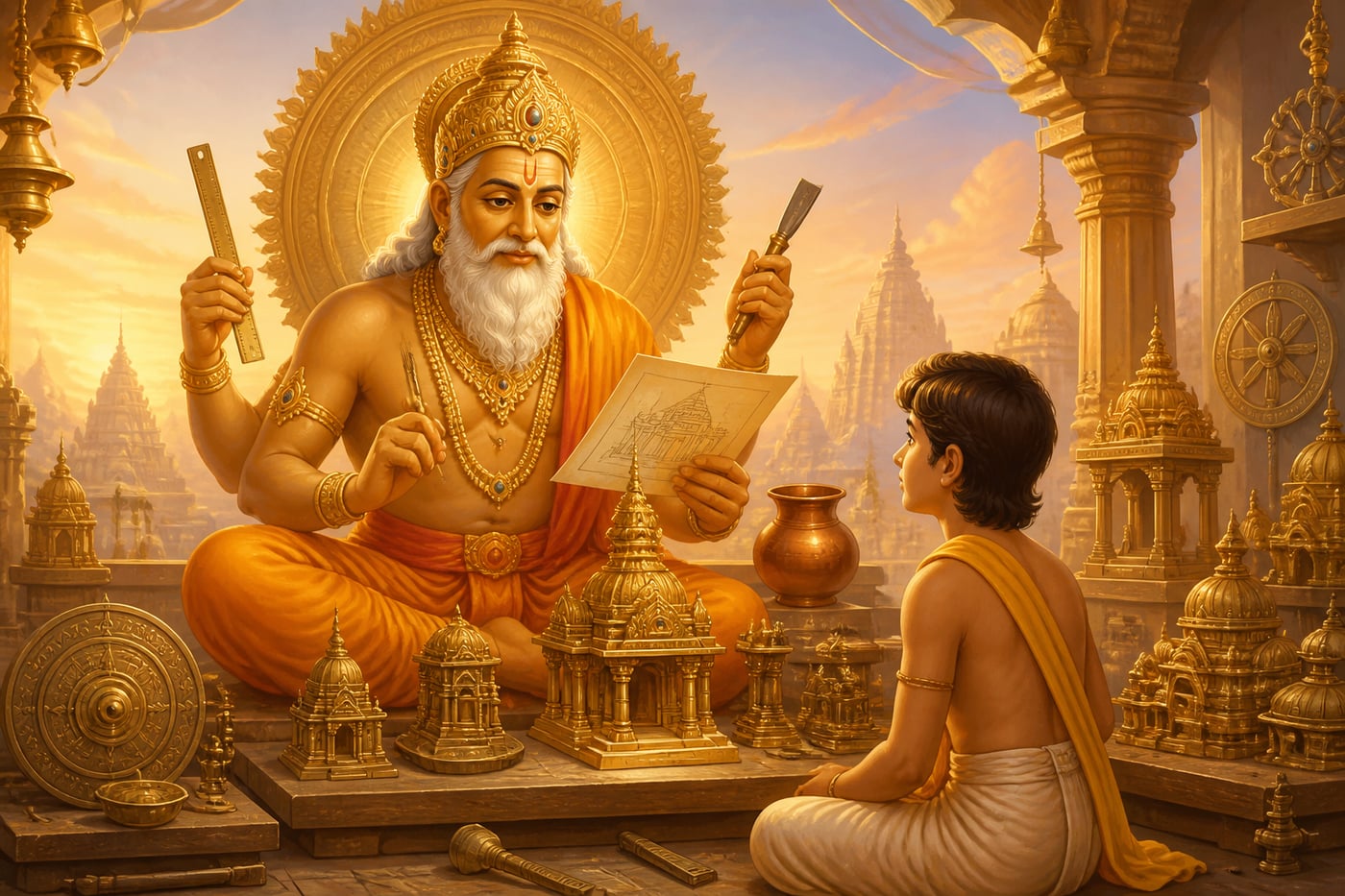
Vishwakarma the divine craftsman teaching a young human apprentice in his workshop

This reverence translated into Shilpa-Dharma, the ethical code of artisans. The Shilpa Shastras weren't just technical manuals; they were dharmic guides. A craftsman who produced substandard work violated dharma. Quality wasn't a market differentiator; it was a moral imperative.

"शिल्पं धर्मस्य साधनम्" Shilpam dharmasya sadhanam "Craft is the instrument of dharma."

Kautilya operationalized this philosophy through the Karmanta-Adhyaksha, the Superintendent of Factories. The Arthashastra dedicates chapters to manufacturing oversight: quality standards, fair wages for artisans, punishment for adulteration, and state investment in strategic industries.

The message was clear: making things well is dharma. Making things poorly is adharma, regardless of profit.

Global Perspectives on Industrial Transformation

How do nations transform from agricultural to industrial powerhouses? Three global thinkers offer frameworks:

Alexander Hamilton (1755-1804), America's first Treasury Secretary, wrote the "Report on Manufactures" (1791) arguing that the US could never be truly independent while importing manufactured goods. His solution: tariffs to protect infant industries, state investment in infrastructure, and prizes for innovation. America followed this playbook for 150 years.

Friedrich List (1789-1846), the German economist, argued that free trade benefits already-industrialized nations while trapping developing countries in commodity exports. His "infant industry protection" theory directly influenced Germany's rise as an industrial power, and later, Japan, Korea, and China.

Mariana Mazzucato (1968-present), contemporary economist, demonstrates in "The Entrepreneurial State" that every major industrial innovation, from the internet to iPhones, originated in state-funded research. The private sector commercialized; the public sector created.

Thinker Key Insight Indian Parallel
Alexander Hamilton Infant industry protection enables industrialization PLI schemes protect emerging sectors
Friedrich List Late industrializers need different policies than leaders India's strategic manufacturing push
Mariana Mazzucato State investment creates the innovations private sector commercializes DRDO-to-private sector tech transfer

Kautilya anticipated all three. The Arthashastra prescribes state workshops for strategic goods (Hamilton), protection for domestic craftsmen (List), and state investment in yantra-shastra (technology development, Mazzucato).

The 13% Problem

India's manufacturing share of GDP has stagnated at 13-15% for decades, while every successful development story shows manufacturing at 25-30% during the high-growth phase.

Why does this matter?

  1. Employment: Manufacturing creates more jobs per unit of output than services. India adds 12 million working-age people annually; services cannot absorb them all.

  2. Exports: No country has achieved export surplus through services alone. Physical goods are tradeable at scale in ways services aren't.

  3. Technology diffusion: Manufacturing clusters develop ecosystems, suppliers, skills, innovation, that services hubs don't replicate.

  4. Strategic autonomy: You cannot be atmanirbhar if you import your weapons, chips, and medicines.

The target: Manufacturing at 25% of GDP by 2030, up from 13% today.

The tools:

Dhirubhai Ambani: The Man Who Proved It Possible

Dhirubhai Ambani surveying the half-built Patalganga petrochemical complex

Dhirubhai Ambani started as a gas station attendant in Yemen. He returned to India in 1958 with Rs 50,000 and a conviction: India could manufacture world-class goods if bureaucrats got out of the way.

The License Raj said otherwise. Every expansion required government permission. Import licenses were rationed. Capacity was controlled. The system assumed Indian entrepreneurs couldn't compete globally, so it protected them from having to try.

Dhirubhai broke every rule. He built the world's largest grassroots refinery at Jamnagar when skeptics said India couldn't manage such complexity. He created a polyester revolution that made Vimal a household name. When denied licenses, he found workarounds. When regulations blocked imports, he pioneered backward integration.

His philosophy was simple: "If you don't build your dream, someone will hire you to help build theirs."

By the time Dhirubhai died in 2002, Reliance had revenues exceeding the GDP of many countries. He had proved that Indian manufacturing could compete globally, if freed from bureaucratic chains.

Defence Manufacturing: The Transformation Story

Defence manufacturing represents the sharpest test of manufacturing capability. Fighter jets, missiles, submarines, these are the most complex products humans make. If you can build them, you can build anything.

India's defence manufacturing journey:

2014: Defence production Rs 44,000 crore; exports negligible 2024: Defence production Rs 1.27 lakh crore (3x); exports Rs 21,000 crore (30x)

Key milestones:

  1. HAL Tejas: From 30-year development hell to serial production. 83 Mk1A jets on order; export enquiries from 6+ countries.

  2. BrahMos: World's fastest cruise missile, jointly developed with Russia. Now exported to Philippines, with interest from Vietnam, Indonesia, UAE.

  3. INS Vikrant: India's first indigenously built aircraft carrier, 40,000 tons of floating proof that complex manufacturing is possible.

  4. 75% indigenization target: From importing 70% of equipment to targeting 70% domestic by 2030.

What worked:

This is Kautilya's vision realized: state strategic direction (rajaniti), private sector execution (vaishya-karma), with quality standards enforced (karmanta-adhyaksha).

Modern Resonance: The PLI Revolution

Prime Minister Modi's PLI schemes represent the largest industrial policy intervention since independence. Rs 1.97 lakh crore ($26 billion) committed to transform 14 sectors:

Sector PLI Outlay Target Outcome
Electronics Rs 41,000 cr $300B production by 2026
Automobiles Rs 26,000 cr EVs, hydrogen vehicles
Pharmaceuticals Rs 15,000 cr API self-sufficiency
Textiles Rs 10,683 cr Man-made fiber leadership
Semiconductors Rs 76,000 cr Chip fabs by 2026

Early results (2024):

The philosophy is explicitly Kautilyan: state investment to enable private productivity, with outcome-linked accountability. Unlike the License Raj's input controls, PLI rewards outputs. Miss targets, lose incentives.

Your Turn: The Maker's Dharma

Manufacturing transformation isn't abstract policy, it touches every Indian.

Every time you choose Indian-made over imported, you participate in swadeshi, the economic dimension of dharma. Every entrepreneur who decides to make rather than trade honors Vishwakarma. Every engineer who improves a process continues the shilpa-dharma tradition.

The question isn't whether India can manufacture. Defence production has answered that. The question is whether we will honor the maker's dharma at scale, the discipline to pursue quality as moral imperative, not market tactic.

Dhirubhai Ambani proved that Indians could build world-class facilities when freed from constraints. HAL proves it's possible in the most demanding sectors. The PLI schemes are removing constraints across industries.

The rest is execution. And execution is karma, the daily discipline of doing, making, improving.

In the next lesson, we explore India's greatest manufacturing asset: its people. The demographic dividend gives India 25 years of workforce growth that China, Europe, and Japan have already exhausted. The question is whether we can skill them fast enough.

W. Edwards Deming brought statistical quality control to Japan, creating the Japanese manufacturing miracle. But Deming's systems require cultural adoption, Japan's 'monozukuri' (craft spirit) provided that. Without cultural foundation, quality systems become bureaucratic checkboxes.

India's shilpa-dharma tradition provides the cultural substrate for quality manufacturing. When workers see quality as dharma rather than compliance, they catch defects no inspection system would find, because they internalize the standard.

Toyota's defect rate: 1 per 10,000 vehicles. Indian auto industry average: 50 per 10,000. The gap isn't technology, it's culture. Shilpa-dharma, properly revived, can close it.

Infant industry protection and capability development

Friedrich List's infant industry argument: developing nations must protect emerging industries until they can compete globally. Every successful industrializer, UK, US, Germany, Japan, Korea, did this despite later preaching free trade.

India's PLI schemes represent strategic patience: 5-6 year windows for capability development, with tapering incentives as competitiveness builds. Unlike the License Raj's permanent protection, PLI has accountability and sunset clauses.

Key terms

Shilpa-Dharma
The ethical code and moral duty of craftsmen and artisans, quality as dharmic obligation rather than mere market requirement.
Karmanta-Adhyaksha
The Superintendent of Factories/Manufacturing in Kautilya's administrative system, responsible for quality standards, fair practices, and strategic production.
Vishwakarma
The divine architect and craftsman in Hindu tradition, the maker of the gods' weapons and the architect of their cities. Represents the sanctity of creative work.
Swadeshi Nirmana
Indigenous manufacturing, production within one's own country using local resources and capabilities as a matter of economic and strategic principle.

Key figures

Dhirubhai Ambani

Industrialist, founder of Reliance Industries

Ajay Bhatt

Secretary, Department for Promotion of Industry and Internal Trade (DPIIT)

Alexander Hamilton

First US Treasury Secretary, architect of American industrial policy

Case studies

India's Defence Manufacturing Transformation: From Importer to Exporter

In 2014, India was the world's largest arms importer, buying $18 billion worth of weapons annually while domestic production stagnated at Rs 44,000 crore. The HAL Tejas programme was 30 years old and still not in serial production. INS Vikrant was a rusting hull. BrahMos existed but wasn't exported. The phrase 'indigenous defence production' was practically an oxymoron.

**Applying Shilpa-Dharma:** The transformation required internalizing quality as dharma. HAL's quality issues weren't just technical, they were cultural. The shift from 'good enough for Indian standards' to 'good enough for export' required shilpa-dharma revival: quality as identity, not compliance. **Applying Karmanta-Adhyaksha (Strategic Oversight):** The negative import list represented Kautilyan strategic direction, the state deciding that certain capabilities must be developed domestically, then creating conditions for that development. **Applying Vishwakarma Principle:** The cultural shift included Vishwakarma Puja becoming more prominent in defence factories, reconnecting modern manufacturing to the maker's sacred tradition. Workers building fighter jets aren't just employees; they're participating in national dharma. **Applying Strategic Patience:** Tejas took 33 years. Critics called it failure. But patient capability development produced something only 5-6 nations can build. Premature cancellation would have lost not just the aircraft but the ecosystem of suppliers, skills, and tacit knowledge.

**By 2024:** - Defence production: Rs 1.27 lakh crore (up from Rs 44,000 crore in 2014, 3x increase) - Defence exports: Rs 21,000 crore (up from Rs 700 crore, 30x increase) - Indigenization: 60% domestic content (up from 30%) - Private sector share: 20% of defence production (from negligible) **What this proves:** India can build world-class complex manufacturing when strategic focus meets sustained investment. Defence is the hardest test, if you can build fighter jets, you can build anything. The capability now exists; the question is extending it to other sectors. **The model:** 1. Policy clarity (negative import list, higher FDI) 2. Patient investment (DRDO, HAL continued funding despite criticism) 3. Private sector enablement (L&T, Tata, Mahindra entry) 4. Export orientation (BrahMos to Philippines proved global competitiveness) 5. Ecosystem development (16,000+ MSME suppliers)

Complex manufacturing capability requires strategic patience, sustained investment, and the cultural foundation of shilpa-dharma. India's defence transformation proves these capabilities can be built, the question is whether the same focus will be applied to electronics, semiconductors, and other strategic sectors.

India's BrahMos export to the Philippines opened a new strategic market. By 2025, India has defence export agreements with over 85 countries and has moved from buyer to seller in a sector where geopolitical leverage follows the supply chain. This shift changes India's diplomatic weight in every bilateral relationship.

BrahMos missile export to Philippines: First major weapons system export in India's history. This single deal (approximately $375 million) represented more than India's total defence exports in most previous years. It proved India could compete in global arms markets, not just buy from them.

Historical context

Post-Independence Manufacturing (1947-2025)

India's manufacturing story is one of unfulfilled potential. From cottage industries destroyed by colonialism to License Raj's stunted industrialization to post-1991's service-sector success without manufacturing takeoff, India has consistently underperformed in making things. The current PLI push represents perhaps the final opportunity to industrialize before demographic dividend expires.

Every successful development story features manufacturing at 25-30% of GDP during the high-growth phase: UK, US, Germany, Japan, Korea, China. India is the only major economy attempting developed-nation status with manufacturing stuck at 13%. The PLI bet is that strategic intervention can change this trajectory.

Manufacturing share of GDP: Germany 19%, South Korea 25%, China 27%, Japan 20%, India 13%. Employment implications: manufacturing employs 10-12% of India's workforce vs 25-30% in successful industrializers.

Manufacturing matters beyond GDP contribution. It creates jobs (especially for those without higher education), builds technological capability, generates exportable products, and ensures strategic autonomy. India cannot be Viksit Bharat without manufacturing transformation.

Reflection

More in Viksit Bharat 2047: The Road to $10 Trillion

All lessons in Viksit Bharat 2047: The Road to $10 Trillion · Viksit Bharat: India's Development Journey course