Vanijya-Dharma: Commerce as Service to Society

Trade as Service

How honest commerce serves society - connecting producers with consumers, creating value.

Seven Women, Eighty Rupees, One Question
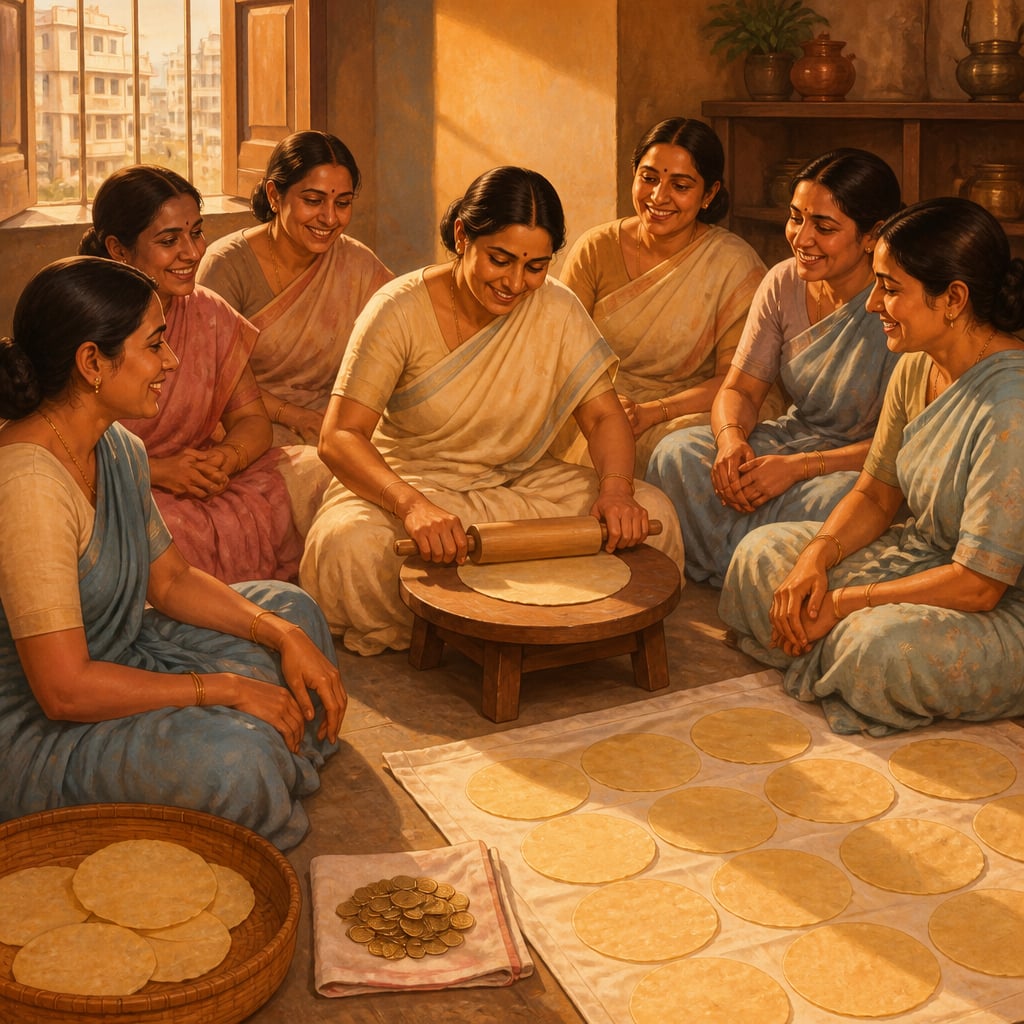
Seven Lijjat founders rolling papads in 1959

In 1959, seven women sat on the floor of a small room in Girgaon, Mumbai. Between them lay exactly ₹80, borrowed from a social worker named Chhaganlal Karamshi Parekh. They had one question: Could they feed their families without depending on their husbands' uncertain incomes?

Jaswantiben Jamnadas Popat, one of the seven, had an idea. She knew how to make papad. Every Gujarati household needed it. What if they made papads together and sold them?

That ₹80 became Shri Mahila Griha Udyog Lijjat Papad, today a ₹1,800 crore enterprise employing 45,000 women across India. No external investors. No bank loans in the early decades. No male management. Just seva, commerce as service.

What Makes Commerce "Service"?
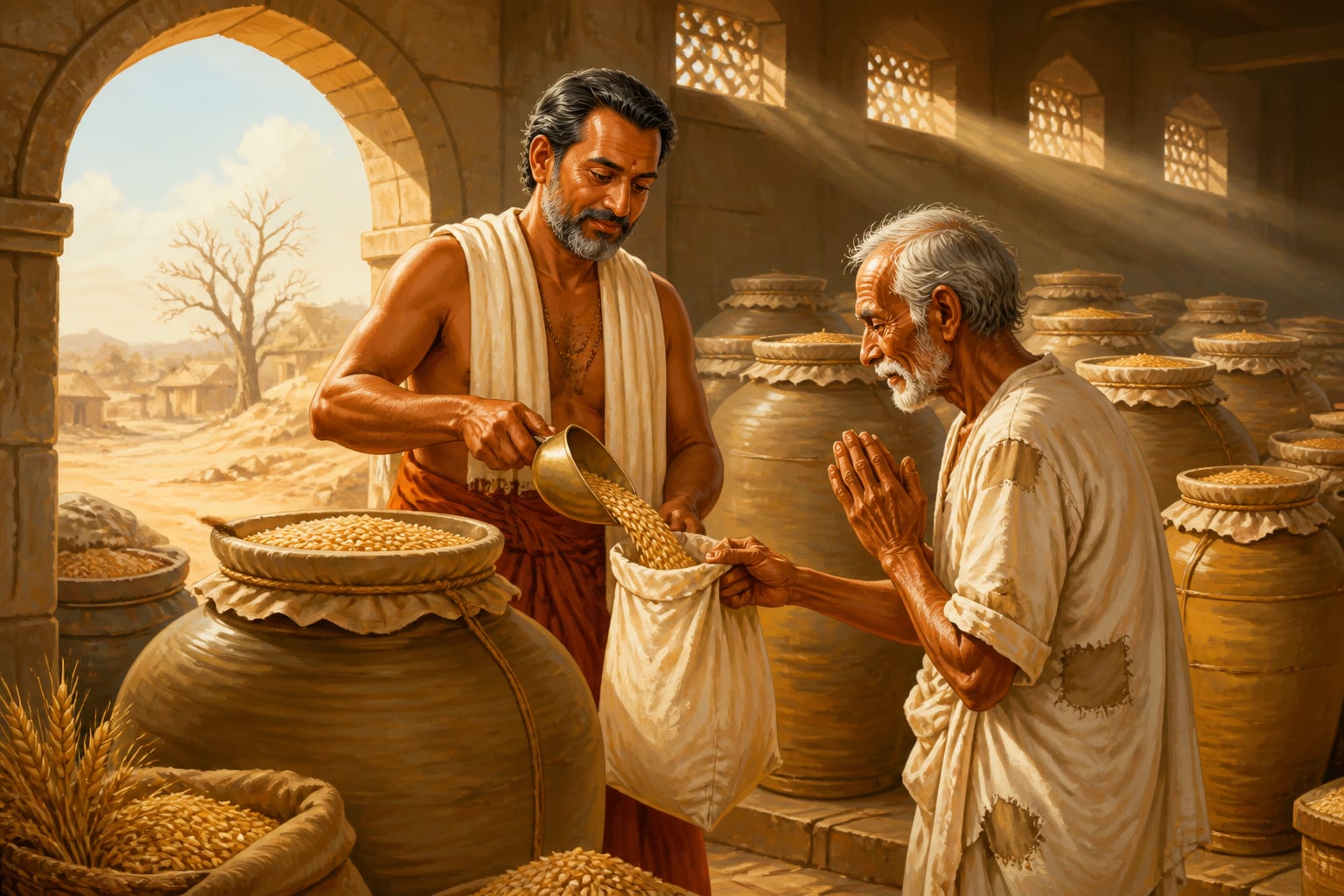
A grain merchant providing during drought

The Panchatantra tells of a grain merchant who stored wheat during harvest (when prices were low) and sold during drought (when prices were high). Colonial-era thinking would call this exploitation. Dharmic analysis says otherwise.

Consider what that merchant actually did:

Kautilya recognized this in the Arthashastra:

"Vāṇijyam ekaṁ paṇyādhiṣṭhānam"

"Trade is the foundation of commodity movement."

Without merchants, coastal salt wouldn't reach inland villages. Mountain timber wouldn't build coastal ships. Kerala pepper would never have flavored Roman feasts. The merchant's role is infrastructure, as essential as roads or rivers.

The Three Utilities

Utility Type What It Means Example
Form Utility Transforming raw materials Cotton → cloth
Place Utility Moving goods to where needed Kerala spices → Rome
Time Utility Storing for future availability Grain stored for drought

The Lijjat women created all three: they transformed ingredients (form), distributed across India (place), and ensured year-round availability (time). Their profit was earned, not extracted.

Global Perspectives on Commerce as Service

The idea that business exists to serve, not merely to profit, has emerged across cultures, though India articulated it earliest.

Peter Drucker (1909-2005), the Austrian-American management thinker, famously declared: "The purpose of a business is to create a customer." Not to maximize shareholder value, not to generate profit, but to serve someone so well they become a customer. Profit, Drucker insisted, is a result, not a purpose.

Muhammad Yunus (1940-), the Bangladeshi economist and Nobel laureate, built Grameen Bank on the principle that banking should serve the poor, not exclude them. His microfinance model proved that serving the "unbankable" could be sustainable business, seva and viability together.

E.F. Schumacher (1911-1977), the German-British economist, argued in Small Is Beautiful that economics should serve human needs, not the reverse. His "Buddhist economics" framework, emphasizing right livelihood, parallels dharmic thought remarkably.

Thinker Core Insight Dharmic Parallel
Drucker Business exists to create customers Commerce as lokayatra (world-sustenance)
Yunus Serve the excluded, viability follows Seva-commerce includes all
Schumacher Economics should serve humans Artha serves dharma, not vice versa

What distinguishes the Indian framework? Integration. The Shukra Niti states: "Lokayātrārthaṁ vāṇijyaṁ praśastam", commerce is praiseworthy because it enables the world's sustenance. Service isn't an add-on; it's the definition of legitimate commerce.

Commerce Embedded in Community

R. Vaidyanathan, Professor Emeritus at IIM Bangalore, documents how traditional Indian commerce differed from Western transactional models:

"The Chettiar, Marwari, and Gujarati networks weren't just business networks, they were trust networks. They enabled commerce across vast distances where no legal enforcement existed. This social capital was as valuable as financial capital."

Traditional Indian commerce was embedded in:

Lijjat Papad recreated this model. Every woman is a ben (sister), not an employee. Decisions are collective. Profits are shared. The organization is the community.

Modern Seva-Commerce in Action

In 2024, India's startup ecosystem increasingly embraces seva-commerce:

A modern fintech founder serving small investors

Finance Minister Nirmala Sitharaman captured this at Startup India 2024: "When you build a company that employs 100 people, you're not just creating jobs, you're creating 100 families' livelihoods, 100 children's education opportunities. This is seva."

Your Turn: The Seva Test

Before any commercial venture, ask four questions:

  1. Does my business exist because I solve someone's genuine problem?
  2. Would my customers be worse off if I didn't exist?
  3. Do I add genuine utility, form, place, or time?
  4. Is my profit proportional to my value-addition?

If yes to all four, your commerce is seva. If no, you may be extracting rather than serving.

Jaswantiben and her six companions asked these questions in 1959. Sixty-five years and ₹1,800 crore later, the answer remains yes. That's the difference between building a business and practicing vanijya-dharma.

Modern economists distinguish between productive activities (creating new value) and rent-seeking (capturing existing value through manipulation). Stiglitz and others critique finance that extracts rather than creates.

The dharmic framework goes further by providing a moral compass: commerce must create genuine utility (form, place, or time) to be legitimate. Profit from manipulation, hoarding, or information asymmetry is adharmic regardless of legality.

In 2023, India's ONDC (Open Network for Digital Commerce) aims to democratize e-commerce by reducing platform extraction and increasing value for small merchants - a policy aligned with Kautilyan principles.

Game theory shows that repeated interactions foster cooperation while one-time transactions incentivize defection. Robert Axelrod's work on cooperation validates relationship-based commerce.

Indian tradition didn't need game theory to discover this - it was encoded in business culture. The kul (family) and jati (community) networks created automatic repeat-game environments where reputation mattered intensely.

Research shows Indian family businesses outperform non-family businesses by 7-8% on average, partly because long-term family reputation incentivizes ethical behavior that builds trust with customers and partners.

Key terms

Seva
Selfless service; in dharmic commerce, the understanding that business activity should serve society's needs, not merely extract profit
Upayogita
Utility or usefulness; the value created by transforming, moving, or storing goods to better serve human needs
Vishwas
Trust; the social capital that enables commerce across distances and communities without formal legal enforcement
Lokayātrā
The world's journey or sustenance; the ongoing functioning of society and civilization that commerce enables and supports

Verses

वाणिज्यमेकं पण्याधिष्ठानम्

vāṇijyam ekaṁ paṇyādhiṣṭhānam

Commerce alone is the foundation upon which all commodities rest and move.

This sutra establishes the merchant as essential infrastructure, not a parasitic middleman. Without trade networks, regional specialization and comparative advantage cannot develop. Kautilya anticipates Adam Smith's insight about markets enabling specialization - but frames it as duty rather than self-interest.

Arthashastra, 2.16.6 (L.N. Rangarajan translation)

लोकयात्रार्थं वाणिज्यं प्रशस्तम्

lokayātrārthaṁ vāṇijyaṁ praśastam

Commerce is praised because it enables the world's journey - the sustenance of all people.

This sutra frames commerce as social service. The Sanskrit 'lokayatra' (world-journey) suggests commerce enables civilization's ongoing progress. Profit is justified not by self-interest but by contribution to collective welfare.

Shukra Niti, 4.2.76 (Various)

उद्यमेन हि सिध्यन्ति कार्याणि न मनोरथैः

udyamena hi sidhyanti kāryāṇi na manorathaiḥ

By enterprise alone are tasks accomplished, never by mere wishing.

This sutra validates entrepreneurial effort as the path to prosperity. Unlike fatalistic worldviews that attribute wealth to karma or fortune, Panchatantra's merchant stories show wealth as earned through intelligence, risk-taking, and persistent effort - a meritocratic economic philosophy.

Panchatantra, Mitra Bheda (Book 1) (Arthur Ryder translation)

Key figures

Chanakya (Kautilya)

c. 375-283 BCE

R. Vaidyanathan

1946-present

Peter Drucker

1909-2005

Case studies

Lijjat Papad: From ₹80 to ₹1,800 Crore Through Pure Seva

In 1959, seven women in Girgaon, Mumbai, borrowed ₹80 from social worker Chhaganlal Karamshi Parekh to start making papads. Led by Jaswantiben Jamnadas Popat, they had no business plan, no investors, no factory, just a skill and a need. Their husbands' incomes were uncertain; they wanted financial independence. They called their venture Shri Mahila Griha Udyog Lijjat Papad. Today, 65 years later, Lijjat is a ₹1,800 crore enterprise with 45,000 women members across 82 branches in 17 Indian states. They've never taken a bank loan for working capital. They've never had external investors. Every woman is a co-owner, not an employee, called 'ben' (sister), never 'worker.'

Lijjat embodies seva-commerce in its purest form. **No extraction**: profits are distributed entirely to members based on work done, not capital invested. **Community-embedded**: the organization functions like an extended family, with collective decision-making and mutual support during hardships. **Genuine utility**: they create form utility (raw ingredients to papads), place utility (distribution across India), and time utility (shelf-stable product). **Service-first**: their guiding principle is 'sarvodaya' (upliftment of all), the organization exists to serve members and customers, with viability as a consequence. Western business would ask: 'How do we maximize shareholder returns?' Lijjat asks: 'How do we serve our sisters and our customers?'

The results validate seva-commerce: ₹1,800 crore annual revenue, 45,000 women economically empowered, zero debt, consistent quality that made 'Lijjat' synonymous with papad in India. More remarkably: the organization has survived leadership transitions, economic crises, and competition from corporate players, all without the governance structures that MBAs consider essential. Their secret? When everyone is an owner serving other owners, alignment is automatic. When profit follows service rather than driving it, sustainability follows naturally. The seven women of 1959 proved that dharmic commerce isn't idealism, it's a business model.

Lijjat Papad demonstrates that seva-commerce scales. The assumption that 'nice' businesses stay small while 'serious' businesses prioritize profit is false. By making service the purpose and profit the consequence, Lijjat achieved both, while creating a model of women's economic empowerment that corporate CSR programs can only dream of.

The cooperative model Lijjat pioneered is now being studied by Silicon Valley as 'platform cooperativism,' where gig workers own the platform they work on. Companies like Stocksy and Up & Go follow this logic. Lijjat proved decades ago that ownership by workers, not investors, creates resilience that venture-funded startups often lack.

Lijjat Papad grew from ₹80 initial capital to ₹1,800 crore revenue over 65 years with ZERO external investment and ZERO bank loans for working capital, entirely self-financed through reinvested earnings and member contributions.

Historical context

Mauryan to Gupta Period (c. 300 BCE - 500 CE)

The Mauryan Empire under Chandragupta and Kautilya created one of history's most sophisticated economic administrations. The state actively promoted commerce through road-building, market regulation, and merchant protection. This was not laissez-faire capitalism but managed economy with dharmic constraints.

While Greek philosophers like Plato despised commerce and Roman aristocrats considered trade beneath their dignity, Indian tradition placed merchants (Vaishyas) as essential to cosmic order. This cultural difference enabled India's commercial dominance for millennia.

The Periplus of the Erythraean Sea (c. 60 CE), a Roman merchant's guide, describes Indian ports handling goods from across the known world - evidence of the commercial sophistication that dharmic commerce enabled.

Understanding that commerce was culturally honored helps correct the colonial narrative that India was 'stagnant' and needed Western 'modernization.' India's commercial decline under colonialism was destruction, not natural evolution.

Living traditions

The Marwari model continues through conglomerates like Aditya Birla Group, Bajaj Group, and newer ventures. In 2024, Zerodha (founded by Marwari entrepreneurs Nithin and Nikhil Kamath) became India's largest stockbroker while charging near-zero fees - modern seva-commerce.

Reflection

More in The Dharma of Commerce

All lessons in The Dharma of Commerce · Vaishya Dharma: The Art of Ethical Commerce course