Dharmasutras: Merchant Ethics in Ancient Texts
Ancient Business Ethics
Gautama, Baudhayana, and Apastamba on merchant conduct - timeless ethical principles.
The Dispute That Shaped a Dynasty

In 1874, a young Parsi entrepreneur named Jamsetji Tata faced a dilemma. His cotton trading business had received a shipment of inferior cotton from an upcountry supplier, mislabeled as premium grade. The supplier offered a simple solution: sell it anyway. "The buyer won't know until the bales are opened in Manchester. By then, you'll have your money."
Jamsetji refused. He returned the entire shipment at a loss, then wrote to the supplier: "My name is worth more than any single transaction."
That decision cost him dearly in the short term. But it established a reputation for honesty that would help build the Tata empire. What principle guided Jamsetji? The same one articulated 2,500 years earlier in the Dharmasutras: "Na vikrītaṁ parivartayet", do not misrepresent what has been traded.
The Dharmasutra Framework
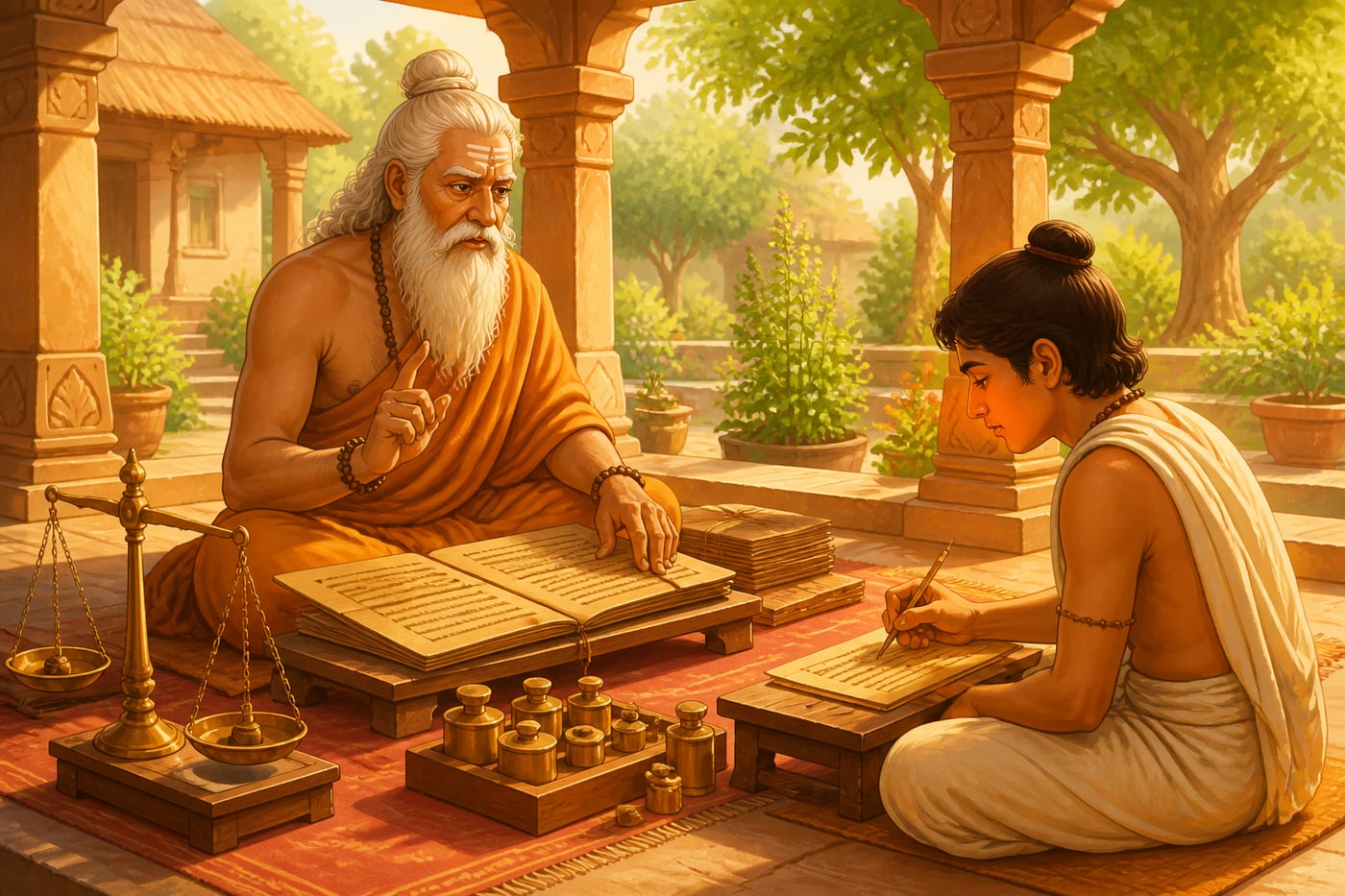
The Dharmasutras, Gautama, Baudhayana, Apastamba, and Vashishtha, are among India's oldest legal texts, predating Manusmriti by centuries. Written in terse sutra style, they weren't theoretical philosophy. They were practical law, used by guild councils and village panchayats to resolve commercial disputes.
Gautama (c. 600-400 BCE) addresses commercial deception directly:
"Na vikrītaṁ parivartayet"
"Do not resell goods while misrepresenting their origin or quality."
His prohibitions are specific:
- Adulterating goods, mixing inferior with superior
- False measurement, using incorrect weights
- Misrepresenting origin, passing off one region's product as another's
- Concealing defects, selling damaged goods as new
Baudhayana adds institutional safeguards:
"Tulā-mānāni samyak dhārayet"
"Weights and measures must be kept accurately."
He prescribes regular calibration, public verification of merchant scales, severe penalties for fraud, and compensation to cheated customers. Measurement fraud is particularly insidious because customers cannot detect it, hence institutional verification.
Apastamba codifies contract sanctity:
"Samayaṁ kṛtvā na laṅghayet"
"Having made an agreement, do not violate it."
Verbal agreements with witnesses are binding. Changed circumstances don't void contracts. A deal is a deal, except in genuine force majeure.
Global Perspectives on Commercial Honesty
The insight that commerce requires ethical foundations emerged across civilizations, though the Dharmasutras articulated it earliest and most systematically.
Cicero (106-43 BCE), the Roman statesman, addressed commercial ethics extensively in De Officiis (On Duties). He posed a famous dilemma: A grain merchant sailing to famine-struck Rhodes knows other ships follow with supplies. Must he disclose this, knowing it will lower prices? Cicero's answer: yes. "Concealment is always wrong; the wise merchant's profit comes from service, not from information asymmetry."
Hammurabi (c. 1754 BCE), the Babylonian king, codified commercial penalties in his famous code, false weights meant severe punishment. But Hammurabi's approach was purely punitive; the Dharmasutras integrate ethics with religious duty, making honesty a matter of karma, not just law.
Adam Smith (1723-1790), often misread as advocating pure self-interest, actually grounded his economics in moral philosophy. In The Theory of Moral Sentiments, he argued that commerce depends on trust, and trust requires virtue. "The man who barely abstains from violating his neighbour's property is surely not a good citizen."
| Thinker | Core Teaching | Dharmasutra Parallel |
|---|---|---|
| Cicero | Concealment is always wrong | Na vikrītaṁ parivartayet |
| Hammurabi | Punish false weights severely | Tulā-mānāni samyak dhārayet |
| Smith | Commerce requires virtue | Nyaya-labha vs anyaya-labha |
The Indian advantage? Integration. While Western traditions separated law, ethics, and religion, the Dharmasutras unified them. A merchant who deceives doesn't just break a rule, he violates dharma, accumulates negative karma, and damages his soul across lifetimes.
The Four Types of Profit
| Sanskrit | Meaning | Example |
|---|---|---|
| Nyaya-labha | Righteous profit | Fair margin for genuine service |
| Anyaya-labha | Unrighteous profit | Profit from deception |
| Ati-labha | Excessive profit | Exploiting scarcity or desperation |
| Alpa-labha | Insufficient profit | Unsustainable for business |
The dharmic position is not anti-profit but pro-nyaya-labha, profit that is proportionate, honestly earned, and sustainable. Even alpa-labha is problematic: a business that cannot sustain itself cannot serve.
The Shreni System: Ancient Self-Regulation
The Dharmasutras envisioned decentralized commercial governance through shrenis (guilds):
- Setting quality standards for each trade
- Training apprentices in both skills and ethics
- Arbitrating disputes among members
- Expelling violators from the profession
- Representing trade interests to the king
Why did shreni self-regulation often exceed state enforcement? Guilds had technical expertise bureaucrats lacked. Reputation mattered intensely within tight-knit communities. Expulsion meant livelihood death. Peer pressure maintained standards automatically.

Modern Applications
In 2024, SEBI's framework for market intermediaries echoes Dharmasutra principles: disclosure requirements (Gautama's transparency), standardized measurements (Baudhayana's accuracy), contract enforcement (Apastamba's sanctity). India's Consumer Protection Act 2019 and Legal Metrology Act 2009 implement these ancient categories in modern legal language.
Indra Nooyi, former PepsiCo CEO and one of the world's most powerful businesswomen, credits her ethics to her Chennai upbringing: "My mother taught me that your word is your bond. If you say you'll do something, you do it, even if circumstances change. That's not American business school wisdom. That's Dharmasutra wisdom."
Your Turn: The Five-Fold Test
Before any significant business decision, apply the Dharmasutra framework:
- Gautama Test: Am I transparent about quality and origin?
- Baudhayana Test: Are my measurements and representations accurate?
- Apastamba Test: Will I honor this agreement even if it becomes inconvenient?
- Nyaya-labha Test: Is my profit proportionate to my value addition?
- Shreni Test: Would my industry peers consider this conduct ethical?
Jamsetji Tata asked these questions in 1874. His answer built an empire that outlasted British rule and continues to shape Indian industry 150 years later. These 2,500-year-old principles remain the foundation of commercial ethics, because human nature hasn't changed, and neither has the temptation to cut corners.
Modern commercial law separates consumer protection, contract law, and fair trade practice into different statutes. The Indian approach integrated these as aspects of one dharmic framework.
The dharmic integration means ethics is not external compliance but internal identity. A merchant who deceives has not just broken a rule but violated their dharma - a profound identity violation that affects future births.
India's Consumer Protection Act 2019 and Competition Act 2002 echo Dharmasutra principles: no misrepresentation, honest measurement, contract enforcement, and fair pricing. The legal categories are remarkably similar.
Modern SROs like FINRA (finance), medical boards, and bar associations echo guild functions. Nobel laureate Elinor Ostrom's research validated that community self-governance often outperforms state regulation.
India had sophisticated SROs millennia before Western theories justified them. The shreni model combined technical expertise (peers know quality better than bureaucrats), reputation incentives (expulsion is livelihood-ending), and ethical training (apprenticeship included values).
NASSCOM's industry codes, AMFI's mutual fund guidelines, and various commodity exchange self-regulatory frameworks are modern shreni successors - though without the deep community embeddedness that made ancient shrenis effective.
Key terms
- Nyaya-labha
- Righteous profit; fair earnings proportionate to the genuine value and service provided, as opposed to profit from deception or exploitation
- Shreni
- Trade guild; self-regulating professional associations that set standards, trained apprentices, and arbitrated disputes within a trade
- Dharmasutra
- Ancient Sanskrit texts on law and ethical conduct, providing detailed guidance on commercial practices and social obligations
- Samaya
- Agreement, contract, or covenant; a binding commitment between parties that must be honored regardless of changed circumstances
Verses
न विक्रीतं परिवर्तयेत्
na vikrītaṁ parivartayet
Let no merchant misrepresent what has been sold or exchanged.
This sutra establishes truth-in-advertising as ancient Indian commercial law. It recognizes that information asymmetry enables exploitation. The merchant's margin must come from genuine service (transport, storage, availability) not from deceiving customers about product nature.
Gautama Dharmasutra, 10.15 (Patrick Olivelle translation)
तुलामानानि सम्यक् धारयेत्
tulā-mānāni samyak dhārayet
Let weights and measures be maintained with perfect accuracy.
This sutra addresses information asymmetry in measurement. The customer cannot verify the merchant's scale instantly. Baudhayana's solution anticipates modern consumer protection: public verification, regular calibration, and penalties. Trust in measurement is infrastructure for commerce.
Baudhayana Dharmasutra, 1.5.10.21 (Patrick Olivelle translation)
समयं कृत्वा न लङ्घयेत्
samayaṁ kṛtvā na laṅghayet
Having given your word, never break it.
This sutra creates the predictable commercial environment essential for trade. If agreements could be voided when convenient, no merchant could plan ahead. Apastamba recognizes that contract enforcement is infrastructure for commerce - more valuable than individual contract flexibility.
Apastamba Dharmasutra, 2.6.14.1 (Patrick Olivelle translation)
Key figures
Gautama
c. 600-400 BCE
Bibek Debroy
1955-present
Marcus Tullius Cicero
106-43 BCE
Case studies
Tata Steel: Building an Empire on Dharmasutra Principles
In 1907, Jamsetji Tata's dream of an Indian steel plant was finally being realized in the jungles of Jharkhand. But Jamsetji had died in 1904, leaving his son Dorabji to execute the vision. The conventional approach would have been to maximize profit by minimizing labor costs, as British industrialists did in their mills. Instead, Dorabji implemented his father's radical vision: Tata Steel would practice what the Dharmasutras taught. **Gautama's transparency**: Workers were told exactly what the company could afford. Wages were published. There were no hidden deductions. **Baudhayana's accuracy**: Time was measured fairly. The 8-hour workday was introduced in 1912, decades before it became law in India or Britain. **Apastamba's contract sanctity**: When the Great Depression hit in 1929, Tata Steel honored all employment commitments. Not a single worker was laid off, even as global steel companies collapsed. **Nyaya-labha**: Profits were shared. Provident fund, gratuity, and medical benefits, unheard of in colonial industry, were standard at Tata Steel.
The conventional colonial business model treated Indian labor as expendable, maximize extraction, minimize cost. Dharmasutra principles demanded the opposite: transparency in dealings (Gautama), accuracy in measurement of work and wages (Baudhayana), honoring commitments regardless of circumstances (Apastamba), and proportionate profit that left room for worker welfare (nyaya-labha). Western critics called the Tatas 'naive socialists.' The Tatas were practicing something older and more sophisticated: commercial dharma. They understood that a steel plant was not just an economic unit but a *shreni*, a community with mutual obligations. The company was responsible for workers' welfare; workers were responsible for quality and productivity.
The results vindicate Dharmasutra economics. Tata Steel has operated continuously for 117 years, surviving two World Wars, Independence, the License Raj, liberalization, and global competition. Jamshedpur, the company town, became a model of industrial welfare that impressed even Jawaharlal Nehru. Labor relations remained peaceful while other steel cities saw strikes and violence. The 8-hour workday and worker benefits that Tata introduced voluntarily in 1912 became Indian law only in 1948. In 2007, Tata Steel acquired Corus (formerly British Steel) for $12 billion, the Indian company founded on dharmic principles buying its former colonial master's industrial crown jewel. The acquisition was funded without laying off a single Jamshedpur worker.
Tata Steel proves that Dharmasutra principles scale to industrial capitalism. Transparency, accurate measurement, contract sanctity, and proportionate profit are not obstacles to business success, they are foundations for it. The company that treated workers as expendable (British Steel) was eventually sold. The company that treated workers as *shreni* members (Tata Steel) became the buyer.
Today's ESG (Environmental, Social, Governance) frameworks and B-Corp certifications attempt to formalize what Tata Steel practiced from day one. The difference is that modern ESG is often a compliance checkbox, while Tata's approach was structural. Companies struggling with 'purpose-washing' could learn that ethical operations must be embedded in culture, not bolted on through reporting.
Tata Steel introduced the 8-hour workday in 1912, 36 years before the Indian Factories Act mandated it in 1948, and 26 years before the US Fair Labor Standards Act of 1938. Dharmasutra principles anticipated modern labor law by decades.
Historical context
Later Vedic to Early Classical Period (c. 800 BCE - 200 CE)
The Dharmasutras emerged during a period of commercial expansion when India was transitioning from predominantly agricultural village economies to more complex urban trade networks. The need for codified commercial ethics reflected this economic sophistication.
While Hammurabi's Code (c. 1754 BCE) contained some commercial provisions, the Dharmasutras offer more sophisticated treatment of commercial ethics. Roman commercial law developed later (c. 450 BCE onward). The Dharmasutra approach - embedding ethics in religious duty - differs from Western legalistic approaches.
Archaeological and inscriptional evidence shows hundreds of shrenis operating across ancient India, with some guild seals and records surviving to document their commercial governance.
Understanding that India had sophisticated commercial law helps counter the colonial narrative that India needed 'civilizing' through Western legal systems. Indian commercial ethics were systematic, sophisticated, and effective.
Living traditions
The 2021 mandatory hallmarking of gold jewellery implements Baudhayana's principle that measurement must be publicly verified. Industry resistance initially echoed ancient tensions between state regulation and guild self-governance. The compromise - BIS standards implemented through licensed private assaying centers - combines state authority with industry expertise.
- BIS Hallmarking: Mandatory certification of gold purity, with testing centers and standardized marks - a modern tula-mana (weighing/measuring) system
- Jewellers' Associations: Bodies like the Gems and Jewellery Export Promotion Council set ethical standards and arbitrate disputes - modern shreni functions
- Jaipur Gem Testing Laboratory: See modern measurement verification in action - the descendant of Baudhayana's emphasis on accurate weights and measures
- Zaveri Bazaar, Mumbai: India's largest jewellery market, where reputation and community trust still govern commerce alongside formal regulation
- Mumba Devi Temple: The patron deity of Mumbai, located in the heart of the gold trading district. Jewelers and traders have worshipped here for centuries, seeking blessings before major transactions.
- Shreni Temples of Patan: Ancient temples built by medieval merchant guilds (shrenis) that demonstrate the historical integration of trade associations with temple construction and maintenance.
Reflection
- Baudhayana emphasized accurate weights and measures. In the digital economy, what are the modern equivalents of 'false weights' that businesses use to deceive customers?
- Why might self-regulation by industry guilds (shrenis) sometimes be more effective than government regulation? When might it fail?