Entrepreneurship as Nation-Building

Commerce as Patriotic Duty

How wealth creation through honest commerce strengthens society and nation - the patriotic dimension of Vaishya Dharma.

The Speech That Created 58 Lakh Shareholders
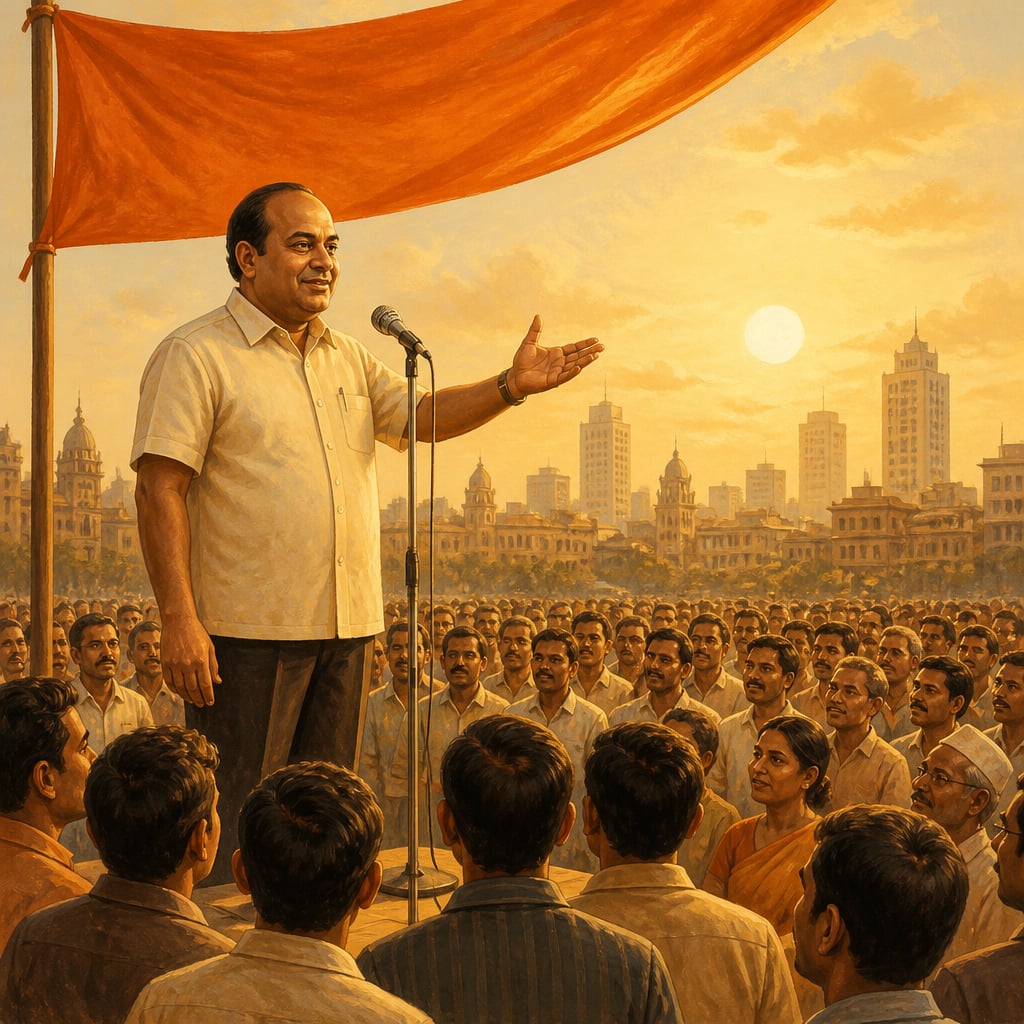
Dhirubhai Ambani addressing small investors at Cross Maidan

On June 12, 1977, Dhirubhai Ambani stood before a crowd at the Cross Maidan in Mumbai. Behind him, the Reliance Textile Industries IPO was about to close, India's largest public offering at the time. But Dhirubhai wasn't talking about share prices or dividends. He was talking about nation-building.

"I do not want Reliance to be a company of the Ambanis," he declared. "I want Reliance to be a company of India. Every shareholder is a partner in building this nation. When you buy our shares, you are not just investing money, you are investing in India's industrial future."

By the time Reliance completed its various offerings, it had created 58 lakh (5.8 million) shareholders, more than any company in Indian history. Dhirubhai had democratized ownership itself. A textile mill worker could own a piece of the same company as a Mumbai industrialist.

This wasn't just business strategy. This was Kautilya's principle in action: "Arthasya mūlaṁ rājyam", wealth is the foundation of the state. But Dhirubhai added a democratic twist: when citizens own the wealth-creating enterprises, their prosperity and the nation's prosperity become one.

The Kautilyan Insight
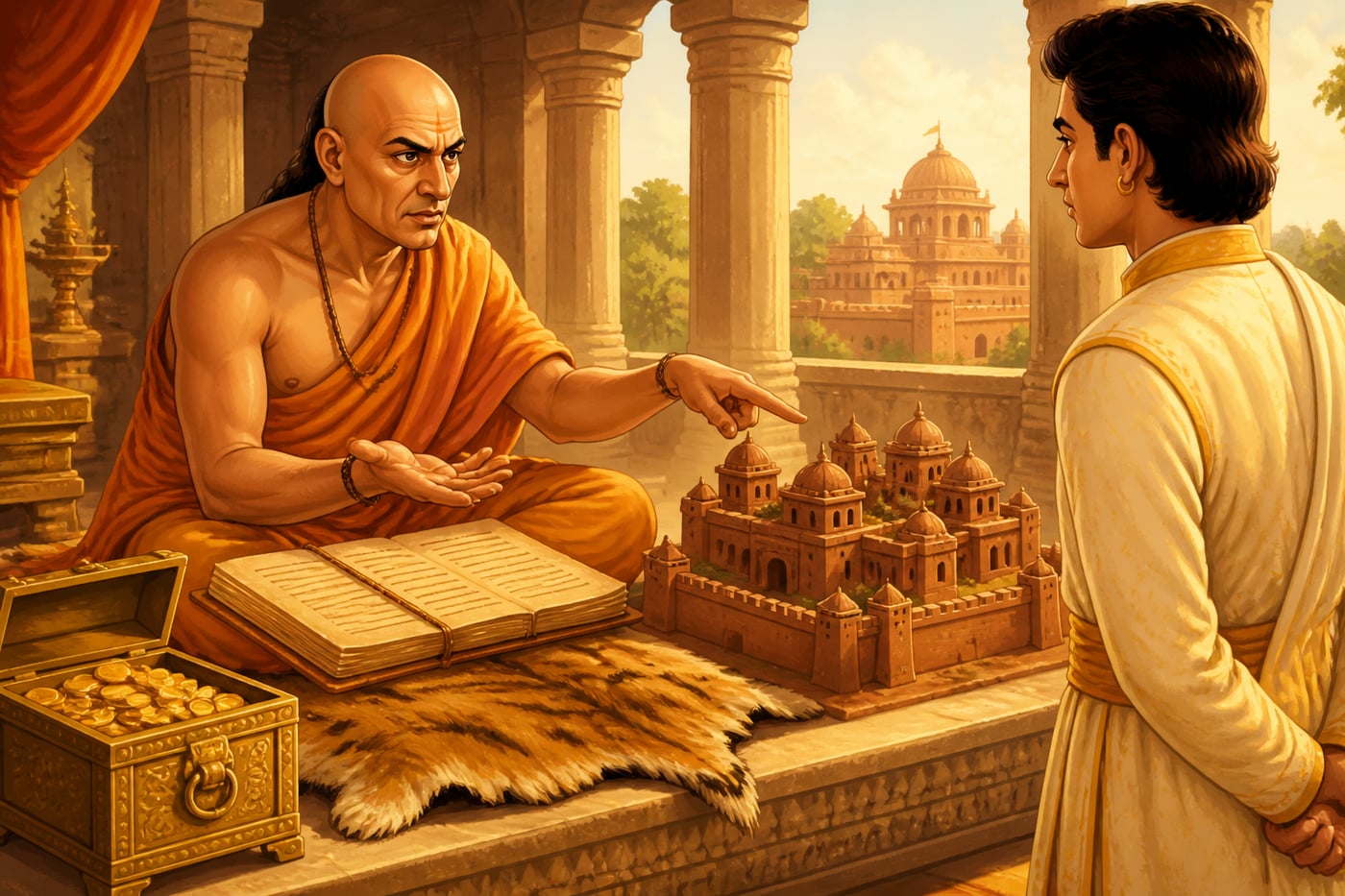
Kautilya teaching wealth as foundation of state

Arthashastra begins with a profound statement:

"Arthasya mūlaṁ rājyam"

"Wealth is the foundation of the state."

Kautilya understood what many intellectuals forget: a poor nation cannot maintain sovereignty. Without economic strength:

Wealth creation is thus a patriotic duty, not a selfish pursuit.

The Colonial Wealth Drain

Historian Angus Maddison documented India's share of world GDP:

Year India's Share What Happened
1 CE ~33% Prosperous ancient civilization
1700 ~24% Still major global economy
1820 ~16% East India Company extraction begins
1947 ~4% After 200 years of colonial drain
2024 ~8% Recovery underway

The British didn't just rule India, they systematically drained its wealth. Economists estimate £45 trillion extracted over the colonial period.

Global Perspectives on Economic Nationalism

The insight that entrepreneurship is patriotic duty has emerged across nations that successfully industrialized.

Alexander Hamilton (1755-1804), America's first Treasury Secretary, argued in his Report on Manufactures (1791) that a new nation must build industrial capability to achieve true independence. "Not merely political liberty, but economic independence determines sovereignty." He advocated protective tariffs, government investment in infrastructure, and support for domestic industry, policies India would echo two centuries later.

Friedrich List (1789-1846), the German economist, developed the "National System of Political Economy" arguing that free trade benefits established powers while keeping developing nations subordinate. Germany's industrial rise followed his prescriptions: protect infant industries, develop national infrastructure, build manufacturing capability before opening markets.

Lee Kuan Yew (1923-2015), Singapore's founding father, transformed a tiny city-state with no natural resources into a first-world economy in one generation. His insight: "A nation's wealth is its people." He combined business-friendly policies with relentless investment in education and infrastructure, creating a model of development that proved economic transformation was possible within a single lifetime.

Thinker Core Principle Indian Parallel
Hamilton Industry creates sovereignty Atmanirbhar Bharat
List Protect infant industries PLI schemes for manufacturing
Lee Kuan Yew Human capital is national wealth Skill India, education investment

The Indian advantage? Civilizational depth. Hamilton, List, and Lee were building new nations. India is rebuilding a civilization that once commanded 25% of world GDP. The commercial DNA exists, it needs reactivation, not creation.

Business Communities as National Resilience

Despite colonial extraction, Indian business communities preserved economic capability:

Marwaris: Maintained commercial networks across India Chettiars: Preserved banking and finance knowledge Gujaratis: Continued international trade Parsis: Built industrial enterprises

S. Gurumurthy notes:

"These communities were economic nationalists before political nationalism existed. They preserved the commercial DNA of the civilization when the state had been captured by foreigners."

Post-independence industrial rebuilding was possible because these communities retained entrepreneurial capabilities through two centuries of colonialism.

Bharat Forge's stamping floor at sunrise

The Modern Mandate: Viksit Bharat 2047

Prime Minister Modi's vision of Viksit Bharat (Developed India) by 2047 requires massive wealth creation:

Who will achieve this? Entrepreneurs. Businesspeople. Modern Vaishyas.

Kiran Mazumdar-Shaw, founder of Biocon and India's richest self-made woman, frames it clearly: "When I started Biocon in a garage with ₹10,000, people asked why a woman would do this. I wasn't just building a company, I was proving that India could compete globally in biotechnology. Every entrepreneur fighting to build something world-class is fighting for India."

Nirmala Sitharaman on Entrepreneurship

Finance Minister Sitharaman has consistently framed business as national service:

"Every MSME that survives and grows, every startup that scales, every manufacturer that exports, these are acts of nation-building. The entrepreneur who creates employment and generates taxes is as much a patriot as anyone in public service."

Her policies reflect this philosophy:

The Jobs Creation Imperative

India adds 10 million people to workforce annually. Only private enterprise can create jobs at this scale:

Sector Job Creation Capacity
Government Limited (fiscal constraints)
Large corporates Moderate (automation trends)
MSMEs High (labor-intensive)
Startups Highest (growth-oriented)

Every small business that succeeds creates livelihoods. This is seva at scale.

From Individual Dharma to National Destiny

The connection flows clearly:

  1. Individual Vaishya practices dharmic commerce
  2. Business community creates ecosystem of trust
  3. Industry sector becomes globally competitive
  4. National economy strengthens
  5. Civilization can invest in culture, defense, research
  6. Dharmic order is sustained for future generations

Your business success is not separate from India's success, it is India's success.

Your Turn: The Nation-Builder's Test

Reflect on your economic potential:

  1. As employee: Am I contributing skills that strengthen Indian capability?
  2. As entrepreneur: Am I creating jobs, building Indian brands, developing Indian technology?
  3. As investor: Am I funding enterprises that build national capacity?
  4. As consumer: Do I consider Indian alternatives before importing solutions?
  5. As taxpayer: Am I enabling the national investments that fund development?

Dhirubhai Ambani asked himself these questions in 1977. His answer created 58 lakh shareholders and India's largest private-sector company. The Viksit Bharat vision requires millions more to ask the same questions, and answer with action.

Every economic role is a dharmic opportunity. Dharmic commerce is patriotic commerce.

Alexander Hamilton's 'Report on Manufactures' similarly argued that manufacturing strength was essential for American independence. Friedrich List's 'National System of Political Economy' made comparable arguments for Germany.

The Indian framework adds dharmic dimension: wealth creation is not just economically necessary but spiritually meaningful. The entrepreneur fulfilling their Vaishya dharma is simultaneously achieving spiritual progress and national service.

India's GDP recovery from 4% of world economy (1947) to 8% (2024) has been driven primarily by private enterprise. The target of $30+ trillion economy by 2047 requires continued entrepreneurial expansion.

Development economics emphasizes employment as the primary channel for poverty reduction. Nobel laureate Amartya Sen's capability approach similarly focuses on enabling human flourishing.

The Indian framework provides moral clarity: creating employment is seva (service). The employer who provides dignified livelihoods is performing dharmic action. This elevates business from mere profit-seeking to genuine service.

India needs to create 10-12 million jobs annually to absorb workforce growth. Only private sector can achieve this scale. Every job created is a family sustained, dignity preserved, potential unlocked.

Key terms

Viksit Bharat
Developed India; the national vision of India becoming a fully developed nation by 2047, requiring massive economic growth and wealth creation
Swavalamban
Self-reliance; economic independence at individual and national levels, a key component of Atmanirbhar Bharat
Rashtra Nirman
Nation-building; the understanding that individual economic activity aggregates into national strength and sovereignty
Svadeshi
Of one's own country; indigenous production and consumption; the economic dimension of national self-reliance

Verses

अर्थस्य मूलं राज्यम्

arthasya mūlaṁ rājyam

Wealth is the root from which the state draws its sustenance and strength.

This sutra establishes the primacy of economics in statecraft. Kautilya was no naive idealist - he understood that moral aspirations require material foundations. A poor state cannot educate citizens, defend borders, or invest in the future. Economic policy is thus not separate from national purpose but its foundation.

Arthashastra, 1.1.1 (L.N. Rangarajan translation)

प्रजासुखे सुखं राज्ञः प्रजानां च हिते हितम्

prajāsukhe sukhaṁ rājñaḥ prajānāṁ ca hite hitam

The king's happiness lies in the happiness of his people; the king's welfare lies in the welfare of his subjects.

This sutra establishes that national wealth creation is for national welfare, not elite accumulation. The businessman who creates employment and generates prosperity is serving the same purpose as the state - enabling citizen flourishing. This provides the ethical framework for viewing entrepreneurship as national service.

Arthashastra, 1.7.1 (R. Shamasastry translation)

यद्यदाचरति श्रेष्ठस्तत्तदेवेतरो जनः

yad yad ācarati śreṣṭhas tat tad evetaro janaḥ

Whatever the leaders do, the common people follow; whatever standard they set, the world pursues.

This sutra establishes the responsibility of successful entrepreneurs to model dharmic commerce. When Tata practices integrity, it influences thousands of businesses. When a visible entrepreneur cuts ethical corners, it normalizes such behavior. Success brings responsibility to demonstrate that dharmic commerce works.

Bhagavad Gita, 3.21 (Bibek Debroy translation)

Key figures

Chanakya (Kautilya)

c. 375-283 BCE

Nirmala Sitharaman

1959-present

Lee Kuan Yew

1923-2015

Case studies

Reliance Industries: From Yarn Trader to India's Largest Company

In 1966, Dhirubhai Ambani started Reliance Commercial Corporation as a yarn trading business with Rs 15,000 in Mumbai. By 2024, Reliance Industries is India's largest private-sector company with $100+ billion revenue, spanning petrochemicals, refining, retail, and telecommunications. More remarkably: at its peak, Reliance had 58 lakh shareholders, more than any company in Indian history. Dhirubhai didn't just build a company; he democratized Indian capitalism. As he said: "I do not want Reliance to be a company of the Ambanis. I want Reliance to be a company of India. Every shareholder is a partner in building this nation."

Reliance embodies Kautilya's principle Arthasya mulam rajyam (wealth is the foundation of the state). Dhirubhai applied this with a democratic twist. By creating millions of shareholders from ordinary Indians, he aligned citizen prosperity with company prosperity. His backward integration strategy, from textiles to petrochemicals to refining, built indigenous capability that reduced India's dependence on imports. Every refinery, every petrochemical plant was an act of rashtra nirman (nation-building).

Middle-class Indians who invested in Reliance IPOs saw wealth multiply across generations. Jio's pricing revolution made mobile data affordable for hundreds of millions of Indians. Reliance reduced import dependence in petrochemicals and built world-scale manufacturing capability in India. Jamnagar refinery became the world's largest single-location refinery complex, and the company now employs 350,000+ people directly.

Democratizing ownership aligns company success with national prosperity. Backward integration builds national capability and reduces import dependence. Thinking at national scale creates opportunities invisible to smaller ambitions. Enterprise and nation-building can be the same pursuit.

Reliance Jio's disruption of Indian telecom mirrors the current race to democratize AI access. Just as Jio made data nearly free and unlocked participation for 400 million Indians, the question today is whether AI tools will follow the same pattern. The principle holds: whoever makes transformative technology accessible to the masses first captures both market share and national purpose.

Started with Rs 15,000 in 1966; now $100+ billion revenue. Created 58 lakh (5.8 million) shareholders (India's largest shareholder base). Jio brought 4G to 400+ million Indians, and the Jamnagar refinery is the world's largest single-location refinery complex.

Bharat Forge: Making India's Manufacturing Globally Competitive

When Baba Kalyani took over his family's small forging business in Pune in 1972, India was seen as capable of cheap labor, not world-class manufacturing. Kalyani had a different vision: Bharat Forge would become a global leader in precision forging, competing with German, Japanese, and American manufacturers on quality, not just price. Today, Bharat Forge supplies critical components to Boeing, Airbus, Mercedes, and defense forces worldwide, proving that 'Made in India' can mean 'Best in World.' As Kalyani says: "When I started, people said India can't do precision manufacturing. They said we'll always be a low-cost, low-quality producer. I said: watch us. Today, the same German and Japanese companies who doubted us are our customers."

Bharat Forge exemplifies the Gita's principle Yad yad acarati sresthas tat tad evetaro janah (leaders set standards others follow). Kalyani demonstrated that Indian manufacturing could achieve global quality standards. By investing in R&D, automation, and skill development when others cut costs, he proved that Indian companies could compete on capability, not just price. Bharat Forge became a benchmark that raised standards across Indian manufacturing, fulfilling the Vaishya Dharma ideal of prosperity through excellence.

Bharat Forge raised the bar for Indian manufacturing quality and created an ecosystem of precision suppliers. It developed a skilled workforce that competes globally, creating high-wage manufacturing jobs in India. The company proved that India can achieve manufacturing excellence and reduced technology dependence. Now expanding into defense manufacturing, EVs, and aerospace.

Competing on quality, not just cost, builds sustainable advantage. Investing in R&D and skills creates capability that others cannot replicate. Global ambition forces domestic excellence. One company's success raises standards for an entire industry.

As global supply chains decouple from China, countries compete to become alternative manufacturing hubs. Bharat Forge's journey from low-cost supplier to precision engineering leader is the exact playbook India needs across sectors like semiconductors, EVs, and defense. The lesson is timely: competing on capability, not just cost arbitrage, is the only sustainable path for manufacturing nations.

World's second-largest forging company and largest in Asia. Supplies to 6 of the top 10 global truck manufacturers and is a critical supplier to Boeing, Airbus, and multiple defense forces. Invested in automation when Indian labor was cheap, betting on quality over cost.

Historical context

Colonial Period through Present Day

India's economic decline under colonialism and recovery post-independence demonstrates the Kautilyan principle that national strength requires economic foundation. The current push for Viksit Bharat 2047 explicitly frames entrepreneurship as patriotic duty.

Post-war Japan and South Korea achieved development through combination of state support and entrepreneurial drive. India's path similarly requires millions of entrepreneurs treating business as national service. China's state capitalism offers a contrasting model that prioritizes control over individual enterprise.

India's recovery from 4% of world GDP (1947) to 8% (2024) has been driven primarily by private enterprise. Achieving the Viksit Bharat target of becoming the world's third-largest economy requires continued entrepreneurial expansion.

Understanding entrepreneurship as national service provides motivation beyond personal gain. When you know your business success contributes to India's resurgence, work acquires meaning beyond profit. This is ancient wisdom meeting modern context.

Living traditions

The 'Har Ghar Tiranga' campaign and similar initiatives reflect the continued connection between economic and national identity. Indian entrepreneurs increasingly frame their work in terms of national contribution - building semiconductor plants, creating global companies, achieving export milestones. This is Vaishya Dharma in contemporary form.

Reflection

More in The Dharma of Commerce

All lessons in The Dharma of Commerce · Vaishya Dharma: The Art of Ethical Commerce course