Labha-Dharma: Righteous Profit-Making
Wealth and Wisdom Together
Why successful business requires both prosperity (Lakshmi) and knowledge (Saraswati).
The Billionaire Who Moved to a Village
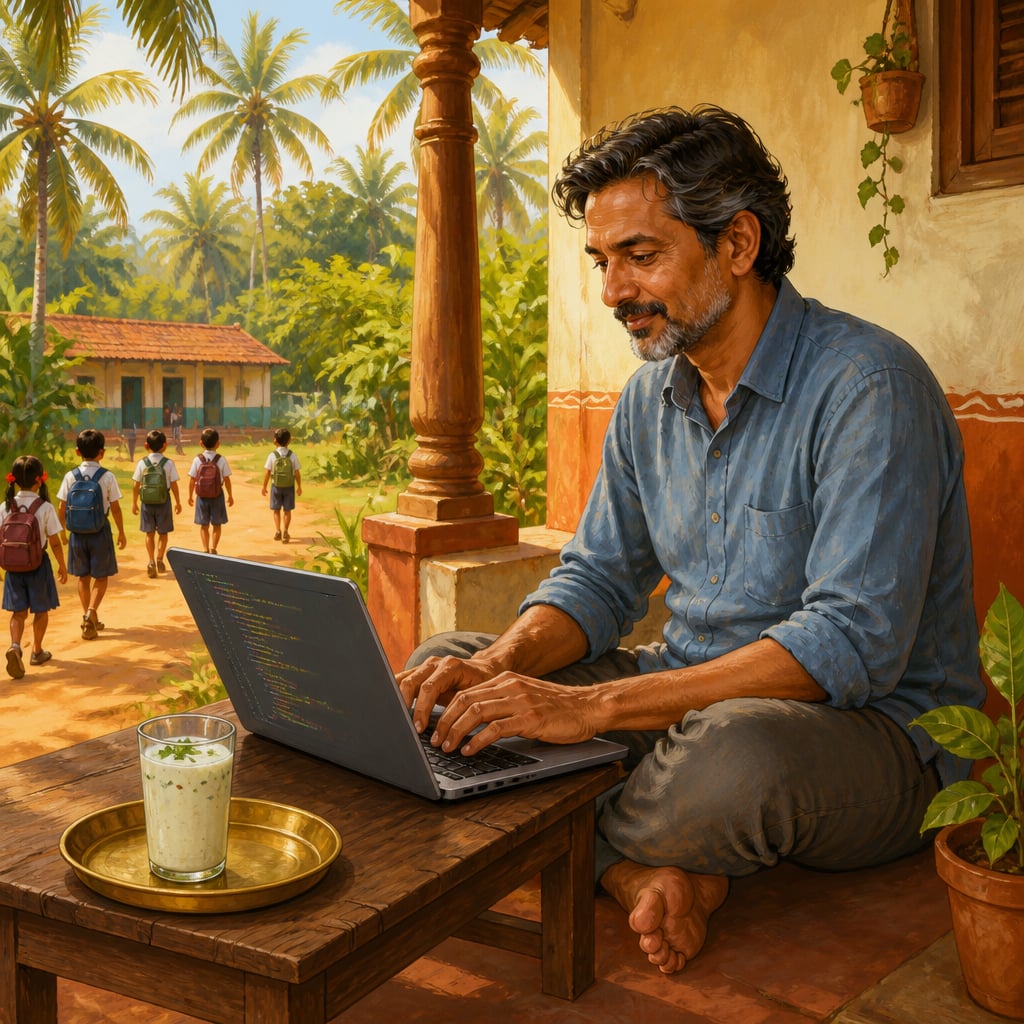
In 2020, at the height of the pandemic, Sridhar Vembu made an announcement that stunned India's tech industry. The founder of Zoho, a $1 billion software company with 12,000 employees, was moving from Chennai to Tenkasi, a small town in rural Tamil Nadu.
Why would a billionaire leave the city for a village? Vembu's answer revealed a philosophy rooted in ancient wisdom: "Knowledge should flow to where it's needed, not concentrate where it's already abundant. I want to prove that world-class software can be built from a village."
Vembu wasn't just relocating. He was demonstrating something the Arthashastra taught 2,300 years ago: "Vidyā viniyogāt āyāḥ", income flows from the proper application of knowledge. Zoho had no venture capital, no IPO, no debt, just knowledge converted into value. Saraswati became Lakshmi.
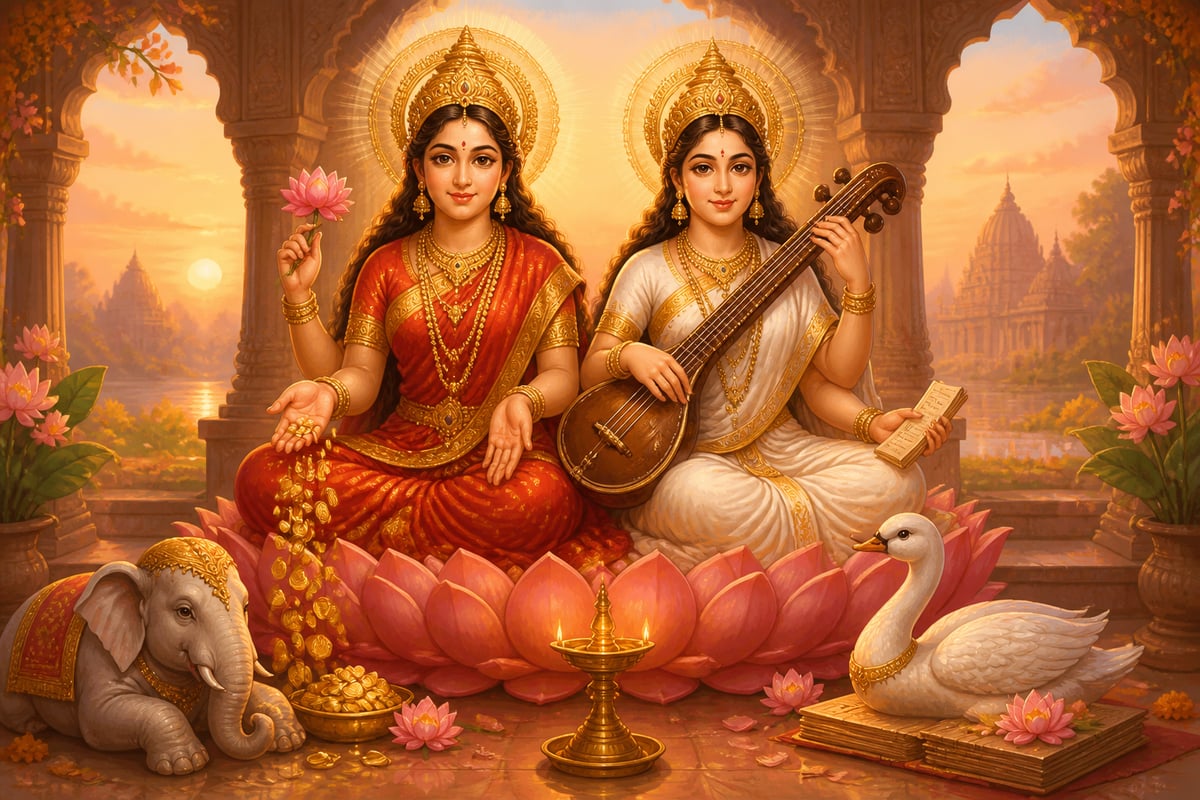
The False Opposition
A popular folk saying claims:
"Lakshmi aur Saraswati dono ek jagah nahin rehti"
"Lakshmi and Saraswati don't stay in the same place."
This is often interpreted as: choose knowledge OR wealth. Scholars stay poor; the rich stay ignorant.
This interpretation is fundamentally wrong, a colonial-era distortion that served British interests by discouraging educated Indians from commerce.
The truth is the opposite: sustainable wealth requires knowledge. Wealth without knowledge dissipates. Knowledge without application remains sterile.
| Lakshmi (Wealth) | Saraswati (Knowledge) |
|---|---|
| What you have | What you know |
| Stock (accumulated) | Flow (regenerating) |
| Outcome | Process |
| Material capital | Intellectual capital |
The insight: Lakshmi without Saraswati is inherited wealth that dissipates. Saraswati without Lakshmi is academic knowledge that never serves.
Bhartrihari's Three Hundred Verses
Bhartrihari (c. 450-510 CE), the poet-king who renounced his throne to become a philosopher, understood this integration deeply. In his Niti Shataka (Hundred Verses on Conduct), he wrote:
"Vidyā dadāti vinayaṁ vinayād yāti pātratām"
"Knowledge grants humility, humility grants worthiness."
The verse continues: worthiness attracts wealth, wealth enables dharma, dharma brings happiness. Knowledge is the first cause in this chain. But notice: Bhartrihari doesn't stop at knowledge. The sequence must complete, knowledge → character → capability → prosperity → purpose.
Kautilya made it explicit:
"Vidyā viniyogāt āyāḥ"
"Income flows from the proper application of knowledge."
The key word is viniyoga, proper application. Mere accumulation of knowledge (like collecting degrees) doesn't generate wealth. Knowledge must be applied to create value.
Global Perspectives on Knowledge and Wealth
The relationship between knowledge and prosperity has fascinated thinkers across civilizations.
Theodore Schultz (1902-1998), the American economist, won the Nobel Prize for "Human Capital Theory", the insight that investment in education yields economic returns. His research showed that a nation's wealth correlates more with educational investment than with natural resources. South Korea has few resources but massive education investment; resource-rich nations often remain poor.
Peter Thiel (1967-), the PayPal co-founder and venture capitalist, argues in Zero to One that true wealth comes from creating "secrets", knowledge that others don't have. "The best entrepreneurs know something the rest don't." His insight: knowledge that merely matches others creates competition; unique knowledge creates monopoly profits.
Kiran Mazumdar-Shaw (1953-), India's richest self-made woman, turned a Master's degree in brewing science into Biocon, a $7 billion biotech company. She started in a garage with ₹10,000. Her journey embodies vidyā viniyoga, deep scientific knowledge properly applied.
| Thinker | Core Insight | Dharmic Parallel |
|---|---|---|
| Schultz | Education investment yields returns | Saraswati precedes Lakshmi |
| Thiel | Unique knowledge creates wealth | Viniyoga (proper application) matters |
| Mazumdar-Shaw | Science → enterprise | Vidyā → āyāḥ in action |
The Indian framework adds something Western theories miss: the sequence matters. Bhartrihari's chain, knowledge → humility → worthiness → wealth → dharma, ensures that prosperity serves purpose. Wealth without this foundation becomes destructive.

The Marwari-IIT Convergence
Two traditions exemplify Lakshmi-Saraswati integration in modern India:
Traditional Marwari model:
- Apprenticeship from childhood (practical knowledge)
- Mental arithmetic mastery (mathematical knowledge)
- Network intelligence (market knowledge)
- Ethical training embedded in commerce
Modern IIT ecosystem:
- Deep technical education (engineering knowledge)
- Problem-solving orientation (applied knowledge)
- Founder networks (entrepreneurial knowledge)
- 200+ startups worth $30B+ from IIT-Delhi alone
Both models integrate learning with earning. Neither separates "intellectual" from "commercial" paths. The Marwari trader calculating compound interest mentally and the IIT founder building algorithms are practicing the same principle: vidyā viniyoga.
Modern India's Knowledge-Wealth Pipeline
In 2024, Finance Minister Nirmala Sitharaman declared in her Budget speech:
"India's competitive advantage is no longer cheap labor, it's skilled labor. Our human capital, our Saraswati, is what attracts Lakshmi in the form of global investment."
This is ancient wisdom in policy form:
- National Education Policy 2020, Saraswati investment
- Skill India, Digital India, Practical knowledge
- Startup India, Knowledge-to-wealth conversion
- PLI schemes, Attracting manufacturing knowledge
India's IT services ($250B annually), pharma exports ($25B), and startup ecosystem ($450B valuation) all demonstrate that Saraswati attracts Lakshmi when properly applied.
Your Turn: The Integration Test
Ask yourself:
- Am I accumulating knowledge or applying it? (Degrees without application is incomplete Saraswati)
- Is my wealth generating more knowledge? (Lakshmi should fund Saraswati investments)
- Do I learn while I earn? (Integration, not separation)
- Am I building knowledge that others lack? (Thiel's "secrets" create sustainable advantage)
Sridhar Vembu answered these questions by building Zoho without external capital, pure knowledge converted to value. Then he asked a deeper question: Can this knowledge serve rural India?
He moved to Tenkasi not despite his billions but because of them. Lakshmi followed Saraswati to where knowledge was needed most. That's the ultimate integration: wealth serving wisdom, serving society.
Theodore Schultz and Gary Becker developed human capital theory in the 1960s, showing that education investment yields economic returns. This is now mainstream economics.
The Indian framework adds a crucial element: viniyoga (proper application). Not all knowledge generates wealth - only knowledge properly applied to value creation. This prevents the trap of education for credentialism rather than capability.
India's IT services industry generates $250+ billion annually, built on human capital. IITs and IIMs (Saraswati investments) generate Lakshmi through knowledge workers. The correlation is direct.
Adam Smith emphasized 'moral sentiments' as foundation for markets. Warren Buffett looks for 'integrity' in managers before capability. Modern behavioral economics studies how character affects economic outcomes.
The Indian model makes the mechanism explicit: true knowledge creates the character (vinaya) that makes wealth sustainable. Quick wealth without this foundation is unstable. This explains why lottery winners often go broke while self-made entrepreneurs preserve wealth.
Studies show 70% of wealthy families lose their wealth by the second generation, 90% by the third. The Lakshmi-Saraswati framework explains this: inherited wealth (Lakshmi) without inherited knowledge (Saraswati) doesn't last.
Key terms
- Lakshmi
- Goddess of wealth, prosperity, and material abundance; represents the outcome of successful economic activity
- Saraswati
- Goddess of knowledge, wisdom, and learning; represents the intellectual and ethical foundation for sustainable prosperity
- Vidya Viniyoga
- Proper application of knowledge; the conversion of learning into practical value and economic prosperity
- Pātratā
- Worthiness; the quality of being a fit vessel to receive and hold wealth; the character capacity developed through knowledge that attracts and sustains prosperity
Verses
विद्या विनियोगात् आयाः
vidyā viniyogāt āyāḥ
From the wise application of knowledge, wealth naturally flows.
This sutra anticipates the knowledge economy by two millennia. Kautilya understood that wealth comes not from resources alone but from the knowledge to use them. This is why Arthashastra begins with education - Saraswati precedes Lakshmi in the logical order of prosperity.
Arthashastra, 1.2.11 (L.N. Rangarajan translation)
सरस्वती स्थिता वक्त्रे लक्ष्मीः स्थिता करे
sarasvatī sthitā vaktre lakṣmīḥ sthitā kare
Wisdom dwells upon the tongue, while fortune rests in working hands.
This sutra encodes the knowledge-to-action-to-wealth pipeline. Knowledge alone (Saraswati in vaktre) doesn't create wealth - it must be converted to action (kare). The entrepreneur who can both articulate ideas and execute them bridges the two goddesses.
Subhashita (Traditional Wisdom), Various compilations (Traditional)
विद्या ददाति विनयं विनयाद् याति पात्रताम्
vidyā dadāti vinayaṁ vinayād yāti pātratām
Knowledge grants humility, and humility grants worthiness.
This sutra explains why knowledge leads to wealth through an intermediate step: character formation. The discipline (vinaya) that comes from true learning makes one a worthy vessel (patra) for handling wealth responsibly. Quick wealth without this foundation is unstable.
Hitopadesha, 1.3 (Various)
Key figures
Bhartrihari
c. 450-510 CE
R. Vaidyanathan
1946-present
Peter Thiel
1967-present
Case studies
Zoho Corporation: Knowledge Without Capital
Zoho Corporation, founded by Sridhar Vembu in 1996 in Chennai, represents perhaps the purest modern example of vidya viniyoga. The company grew from a small software firm to a $1 billion enterprise with 12,000 employees, without any venture capital, private equity, or debt. Pure knowledge converted to value. As Vembu put it: "We don't need venture capital because we have something better. We have knowledge. Our people understand our customers deeply. That understanding is our competitive advantage, and no one can take it away."
Zoho embodies the principle of Vidya viniyogat ayah (income from the deployment of knowledge). Vembu bet everything on knowledge: he built products by deeply understanding customer problems, trained rural students as engineers through Zoho Schools (no degrees required), and proved that intellectual capital alone, without financial capital, can build a global enterprise. His 2020 relocation of company HQ from Chennai to Tenkasi village further demonstrated that knowledge, not geography, creates value.
Engineers trained through Zoho Schools now lead product teams, many coming from villages with no prior tech exposure. Small businesses worldwide access enterprise-grade software at a fraction of Big Tech prices. Tenkasi village has transformed into a tech hub, creating local employment and showing rural India that tech careers are possible. Zoho now offers 45+ software products serving 80+ million users globally, competing successfully against Microsoft, Google, and Salesforce.
Knowledge properly applied (viniyoga) can substitute for financial capital. Rural talent is untapped intellectual capital waiting for investment. Self-reliance in funding creates freedom to make long-term, dharmic decisions. Saraswati investments in education eventually generate Lakshmi returns.
Zoho's bootstrapped model directly challenges the 'raise venture capital or die' narrative dominating the tech startup world. As more founders face down-rounds and forced liquidations in the 2023-2025 funding winter, Zoho's proof that self-funded companies can compete with billion-dollar competitors has become the most relevant counter-example in global SaaS.
Zero external funding across 28+ years. Zoho Schools train rural students with no college degrees to become world-class engineers, and the company competes against Microsoft, Google, and Salesforce with 45+ products serving 80+ million users.
Narayana Hrudayalaya: Heart Surgery at a Fraction
Dr. Devi Shetty, a cardiac surgeon who once operated on Mother Teresa, founded Narayana Hrudayalaya in Bangalore in 2001 to democratize heart surgery. By applying deep medical knowledge to process innovation, he reduced cardiac surgery costs to $2,000, a fraction of Western prices ($50,000-$100,000), while maintaining world-class outcomes. As Dr. Shetty said: "The solution to India's healthcare crisis is not charity. It's innovation. When you truly understand a problem, you find ways to solve it at scale. Knowledge is the ultimate democratizer."
Narayana Hrudayalaya illustrates the principle Vidya dadati vinayam vinayad yati patratam (knowledge gives humility, humility gives worthiness). Dr. Shetty's medical knowledge (vidya) created humility about healthcare inequity (vinaya), which made him worthy (patrata) to receive the resources and trust needed to transform Indian healthcare. His expertise attracted capital from patients, investors, and government. This is Lakshmi following Saraswati in the healthcare domain.
Poor farmers and workers now access life-saving surgery previously available only to the wealthy. Narayana Hrudayalaya created India's largest cardiac surgery training program, where junior doctors gain experience faster than anywhere else. The Yeshasvini micro-insurance scheme covers 4+ million farmers for just Rs 5 per month. The model proved that world-class healthcare for the poor is economically viable, inspiring global replication. Today the network operates 30+ hospitals with 6,000+ beds across India and the Cayman Islands.
Deep expertise (Saraswati) enables process innovations that create new markets. Knowledge applied with dharmic purpose (seva) attracts both patients and prosperity. Volume combined with efficiency and purpose creates sustainable low-cost models. Medical knowledge converts to wealth when applied to underserved markets.
Healthcare systems worldwide are grappling with cost inflation that outpaces GDP growth. Narayana Hrudayalaya's process innovation model is being studied by the NHS in Britain and hospital networks in Africa as proof that quality and affordability can coexist when deep expertise is applied to system design rather than just clinical intervention.
Narayana Hrudayalaya performs over 30 cardiac surgeries daily (more than most US hospitals do in a month) at approximately $2,000 per surgery versus $50,000-$100,000 in the USA, with mortality rates matching or exceeding Western hospitals.
Historical context
Vedic Period through Modern Era
The Lakshmi-Saraswati framework reflects India's sophisticated understanding that wealth and knowledge are complementary, not opposing. Colonial education disrupted traditional apprenticeship systems that integrated learning with practice, creating the artificial separation that modern India is now working to repair.
The German dual education system and Silicon Valley's 'learn by building' culture independently rediscovered principles embedded in traditional Indian apprenticeship. India's challenge is to reconnect with its own integrated learning traditions while absorbing useful modern innovations.
India's knowledge exports (IT services, pharmaceuticals, professional services) now exceed $200 billion annually - evidence that Saraswati investments generate Lakshmi returns when properly applied (viniyoga).
Understanding the Lakshmi-Saraswati integration helps individuals plan careers that build both knowledge and earning capacity, and helps policymakers design education systems that connect to economic outcomes.
Living traditions
India's tech industry embodies Lakshmi-Saraswati integration: IITs and IIMs (Saraswati temples) produce founders and executives who create companies (Lakshmi generators). Startup incubators in IIT campuses physically unite education and entrepreneurship. The knowledge economy is ancient wisdom in modern form.
- Chopda Pujan: Worship of account books on Diwali - Saraswati (accurate record-keeping) serving Lakshmi (financial clarity)
- Children's Education Blessing: On Dhanteras/Diwali, children are blessed for educational success alongside prosperity - connecting Saraswati to Lakshmi for the next generation
- Muhurat Trading: Auspicious stock market sessions that combine ritual (Saraswati/wisdom of timing) with commerce (Lakshmi/wealth creation)
- Any Marwari Business House during Diwali: Witness the elaborate integration of religious ritual and commercial practice that embodies Lakshmi-Saraswati unity
- National Stock Exchange, Mumbai (Diwali Night): The Muhurat Trading session demonstrates modern India's continued integration of auspicious timing with commercial activity
- Ashtalakshmi Temple: Dedicated to the eight forms of Lakshmi including Dhana Lakshmi (wealth), Vidya Lakshmi (knowledge), and Vijaya Lakshmi (victory) - physically embodying the Lakshmi-Saraswati integration principle.
- Gnana Saraswati Temple: One of two temples in India dedicated to Goddess Saraswati. Business families visit to bless children's education, understanding that knowledge is the foundation of sustainable wealth.
Reflection
- In your own life, do you tend more toward 'pure Saraswati' (knowledge without economic application) or 'pure Lakshmi' (wealth pursuit without knowledge depth)? How could you better integrate both?
- The Marwari apprenticeship model combined practical skills with ethical training from young age. How might modern education systems incorporate similar integrated learning?