Vaishya-Varna: The Sacred Duty of Wealth Creation

Sacred Duty of Commerce

What ancient texts say about the merchant's role - trade as dharmic occupation, not just livelihood.

The Ledger That Built a Dynasty
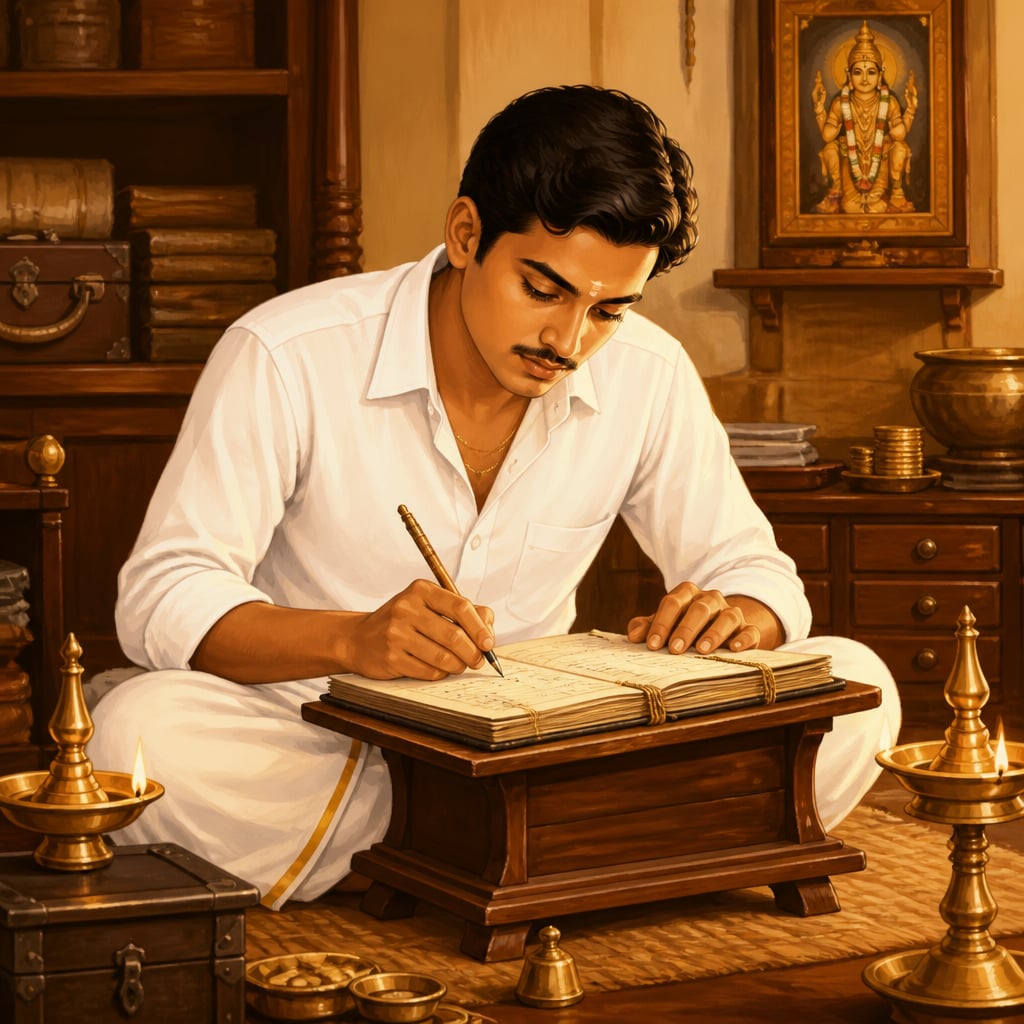
Young A.M. Murugappa at his Rangoon counting house

In 1900, a young Nattukotai Chettiar named A.M. Murugappa sat in his counting house in Rangoon, Burma, carefully recording transactions in his traditional peredu ledger. Each entry carried more than numbers, it carried a philosophy. His father had taught him: "We do not merely make money; we create shraddha (trust)." That trust would build the Murugappa Group into a ₹45,000 crore empire spanning five generations.

But Murugappa wasn't following some MBA textbook. He was practicing what his ancestors had called Vaishya Dharma, the sacred duty of wealth creation. What did this ancient framework actually teach? And why did communities who preserved it, Chettiars, Marwaris, Gujaratis, dominate Indian business for centuries?

The Cosmic Origin of Commerce

The Purusha Sukta (Rig Veda 10.90) describes something remarkable: the Vaishya emerging from the thighs (ūru) of the cosmic being. This wasn't arbitrary symbolism. The thighs are the body's center of locomotion and strength, without them, the body cannot move, cannot carry burdens, cannot travel.

The message was clear: merchants are civilization's locomotive power. While Brahmins think and Kshatriyas protect, Vaishyas move, goods, capital, ideas, prosperity. A society without thriving commerce is a body without functioning legs.

Manusmriti (1.90) codified this understanding:

"Pashunaam rakshanam daanam ijyaadhyayanam eva cha Vanikpatham kuseedam cha vaishyasya krishim eva cha"

The prescription was comprehensive: cattle-rearing (pashunaam rakshanam), charity (daanam), religious practice (ijya), continuous study (adhyayanam), trade (vanikpatham), lending (kuseedam), and agriculture (krishim). Notice what Manu integrated, wealth creation AND wealth distribution, profit AND charity, commerce AND spirituality.

The Gita's Revolutionary Claim

Lord Krishna made an extraordinary statement in Bhagavad Gita 18.44:
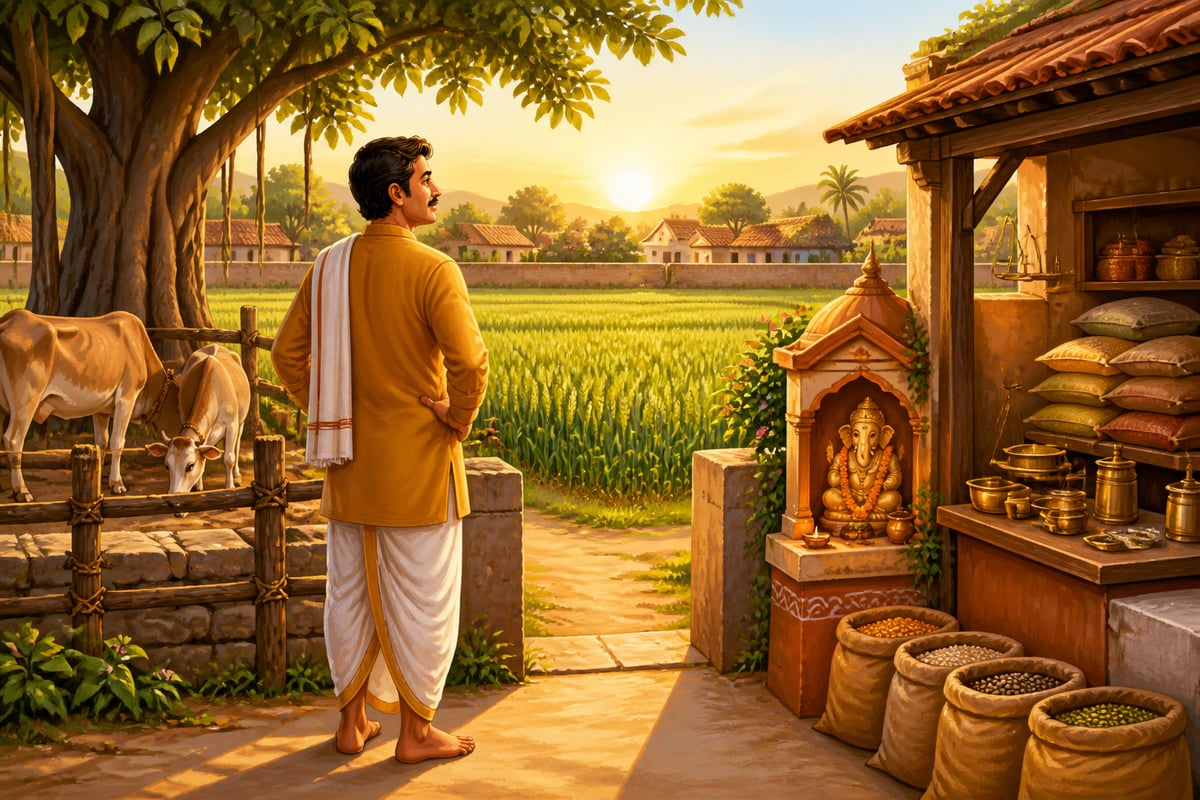
A Vaishya household with cattle, fields, and shop

"Krishi-go-rakshya-vanijyam vaishya-karma svabhava-jam"

"Agriculture, cattle-protection, and trade are the natural work of the Vaishya, born of their inherent nature."

The word svabhava-jam (born of one's nature) is revolutionary. Krishna is saying: some people are naturally inclined toward commerce. This isn't a lesser calling, it's their authentic path to dharmic fulfillment. Suppressing this nature to pursue "higher" spiritual paths would be adharma.

Global Perspectives on Commerce and Calling

Indian thinkers weren't alone in recognizing commerce as a sacred calling, though they arrived at this insight earliest.

Max Weber (1864-1920), the German sociologist, famously described the "Protestant work ethic" in which Calvinist Christians viewed worldly success as evidence of divine favor. But Weber himself noted that India's merchant communities had developed similar frameworks centuries earlier, what he called "traditionalist capitalism."

Adam Smith (1723-1790) argued in The Wealth of Nations that the "natural propensity to truck, barter, and exchange" was fundamental to human nature. His insight parallels Krishna's svabhava-jam, that some are born for trade. However, Smith's framework lacked the integrated charity (daanam) that Indian thought demanded.

Ibn Khaldun (1332-1406), the Arab historian, identified merchants as essential to civilization's asabiyyah (social cohesion). Like Indian texts, he saw commerce not as mere accumulation but as social binding, creating interdependence between communities.

Thinker Key Insight Indian Parallel
Weber Work as divine calling Svabhava-jam (nature-born duty)
Smith Natural propensity to trade Vanikpatham as inherent dharma
Ibn Khaldun Commerce creates social cohesion Trade as seva (service)

The Indian advantage? Integration. Western thinkers separated profit from charity, commerce from spirituality. Manu's prescription kept them united: you cannot fulfill Vaishya Dharma through trade alone, daanam (giving) is equally mandatory.

Modern India's Commercial Renaissance

In 2024, Finance Minister Nirmala Sitharaman declared MSMEs "the backbone of Viksit Bharat," allocating ₹22,138 crore for their development. She was echoing, perhaps unknowingly, the Purusha Sukta's thigh imagery, recognizing that without vibrant commerce, the national body cannot walk.

Ela Bhatt, founder of SEWA (Self Employed Women's Association), demonstrated Vaishya Dharma's modern relevance by organizing 2.1 million informal sector women into a cooperative movement. Street vendors, home-based workers, agricultural laborers, Bhatt proved that dharmic commerce wasn't just for wealthy families. Every bidi roller practicing honest trade, every vegetable seller giving fair weight, embodies vanikpatham.

The communities that preserved Vaishya Dharma through colonialism, Chettiars financing Southeast Asian trade, Marwaris rebuilding industry post-independence, Gujaratis creating cooperative models, now lead India's economic renaissance. The correlation between dharmic commerce and lasting prosperity is not coincidental.

Your Turn: The Four Questions

If you feel drawn to entrepreneurship, trade, or business, recognize this as svabhava, your authentic nature. The Vedic tradition doesn't rank this below spiritual pursuits; it sanctifies economic activity conducted dharmically.

But Vaishya Dharma demands self-examination. Ask yourself:

  1. Is my wealth creation ethical (dharmic)?
  2. Does my business serve society (seva)?
  3. Am I fulfilling the charity mandate (daanam)?
  4. Am I continuously learning (adhyayanam)?

Three generations in the Murugappa boardroom

The Murugappa family has asked these questions for 124 years. Each generation added to the ledger, not just profits, but trust, not just wealth, but shraddha. That's the difference between making money and practicing Vaishya Dharma.

Comparative Advantage and Vocational Specialization

Adam Smith's division of labor and Ricardo's comparative advantage suggest people should specialize in what they do best. Weber's 'Protestant work ethic' similarly sanctified commercial activity as divine calling.

The Indian framework goes further: it integrates charity (dāna) and spiritual practice (ijyā) into commercial duty, preventing the separation of profit from purpose that plagues modern capitalism.

Traditional Indian business communities (Marwaris, Gujaratis) who maintained dharmic commercial practices control an estimated 60% of India's private sector assets today.

Modern 'Triple Bottom Line' (People, Planet, Profit) and ESG frameworks attempt to integrate social responsibility into business. CSR regulations mandate charitable giving.

The Manu model is older and more integrated - charity is not an add-on but a core duty. Continuous learning (adhyayana) is embedded, anticipating the modern 'learning organization' concept by millennia.

Key terms

Vaishya Dharma
The sacred duties and ethical responsibilities prescribed for those engaged in commerce, agriculture, and wealth creation
Svabhava-jam
Born of one's nature; referring to natural inclinations that guide one's appropriate role in society
Vanikpatham
The path of trade and commerce; the mercantile profession as a legitimate dharmic occupation
Dānam
The act of giving, charity, or donation; a mandatory component of Vaishya Dharma that requires wealth distribution alongside wealth creation

Verses

कृषिगौरक्ष्यवाणिज्यं वैश्यकर्म स्वभावजम्

krishi-go-rakshya-vānijyaṁ vaiśya-karma svabhāva-jam

The work born of a merchant's nature is tending fields, protecting herds, and conducting trade.

This verse establishes that economic activity is not merely material pursuit but a spiritual calling. The term 'svabhava-jam' (born of nature) suggests vocational fit - some people are naturally suited to commerce, and honoring this nature leads to both prosperity and dharmic fulfillment.

Bhagavad Gita, 18.44 (Bibek Debroy translation)

पशूनां रक्षणं दानमिज्याध्ययनमेव च। वणिक्पथं कुसीदं च वैश्यस्य कृषिमेव च॥

paśūnāṁ rakṣaṇaṁ dānam ijyādhyayanam eva ca | vaṇikpathaṁ kusīdaṁ ca vaiśyasya kṛṣim eva ca ||

For the Vaishya: guard the herds, give freely, make offerings and study; walk the trader's path, lend wisely, and till the earth.

This sutra reveals that traditional Indian economic thinking never separated profit from social responsibility. The Vaishya must create wealth (trade, agriculture), preserve it (lending wisely), distribute it (charity), and maintain spiritual grounding (sacrifice, study). This is a remarkably complete model for what we now call 'stakeholder capitalism.'

Manusmriti, 1.90 (Patrick Olivelle translation)

ब्राह्मणोऽस्य मुखमासीद्बाहू राजन्यः कृतः। ऊरू तदस्य यद्वैश्यः पद्भ्यां शूद्रो अजायत॥

brāhmaṇo'sya mukham āsīd bāhū rājanyaḥ kṛtaḥ | ūrū tad asya yad vaiśyaḥ padbhyāṁ śūdro ajāyata ||

From Cosmic Being's face came forth the priest, from mighty arms the warrior sprang; the merchant arose from steadfast thighs, from feet the servant came along.

The thighs represent mobility, strength, and the power to carry weight. This symbolism positions the Vaishya as the economy's locomotive power - moving goods, circulating wealth, bearing the burden of production. Without strong thighs, the cosmic body cannot move; without prosperous Vaishyas, civilization cannot function.

Rig Veda (Purusha Sukta), 10.90.12 (Ralph T.H. Griffith translation)

Key figures

Vidura

Mahabharata period (traditional dating ~3000 BCE; scholarly dating 1500-500 BCE)

S. Gurumurthy

1948-present

Ela Bhatt

1933-2022

Case studies

Murugappa Group: 124 Years of Vaishya Dharma in Practice

In 1900, Dewan Bahadur A.M. Murugappa Chettiar started a small money-lending and trading business in Rangoon, Burma. By 2024, the Murugappa Group has grown into a ₹45,000+ crore conglomerate spanning 28 businesses across 10 verticals, from Tube Investments and Cholamandalam Finance to Coromandel fertilizers and Parry's sugar. What's remarkable isn't just the growth, but how: five generations, zero family feuds, no major scandals, and a reputation for ethical dealing that has survived colonialism, independence, nationalization waves, and liberalization. The family created a written constitution in the 1950s, decades before Harvard Business School began teaching family governance. Their *peredu* (traditional accounting ledger) evolved into modern compliance systems, but the underlying principle remained: wealth must be created dharmically and shared generously.

The Murugappa model embodies all components of Vaishya Dharma from Manusmriti 1.90. **Vanikpatham** (trade): diversification across industries. **Kuseedam** (lending): Cholamandalam Finance serves underbanked populations. **Daanam** (charity): AMM Foundation runs schools, hospitals, and supports temples across Tamil Nadu. **Adhyayanam** (study): the family mandates education and professional qualifications before joining the business. **Ijya** (worship): Murugappa Chettiar temples and daily puja remain central. Conventional Western business advice would say: 'Focus on core competency, maximize shareholder value, separate business from family.' The Murugappa approach says: 'Integrate family values into governance, diversify to serve multiple stakeholders, see charity as duty not option.'

The results speak: 124 years of continuous operation, 50,000+ employees, presence in 100+ countries, and consistent ranking among India's most respected business houses. When Cholamandalam Finance won the 'Best Ethical Company' award in 2023, it wasn't PR, it was the culmination of practices the Nattukotai Chettiars brought from their trading houses in Southeast Asia a century earlier. The family wealth grew *because* of dharmic constraints, not despite them. Their family constitution, now studied by business schools, mandates that no single branch can dominate, disputes go to elders before courts, and community service is non-negotiable.

The Murugappa Group proves that Vaishya Dharma isn't ancient idealism, it's a competitive advantage. Integrating daanam with vanikpatham, adhyayanam with kuseedam, creates the trust (*shraddha*) that compounds across generations. The choice isn't between dharma and profit; it's between short-term extraction and long-term prosperity.

Family businesses today spend millions on governance consultants to solve succession crises. The Murugappa model shows that integrating charity, education, and worship into the business charter itself creates alignment that no external advisor can manufacture. Modern family offices are rediscovering this: values-first governance outlasts rules-first governance.

The Murugappa Group has operated for 124 years across 5 generations with no major family litigation, a rarity among Indian business families where 70%+ face succession disputes within three generations.

Historical context

Vedic Period to Classical Period (c. 1500 BCE - 500 CE)

India was the world's largest economy for most of recorded history, with sophisticated commercial networks spanning from Rome to Southeast Asia. Indigenous banking, credit instruments (hundis), and trade guilds (shrenis) predated European equivalents by centuries.

While Rome was collapsing and Europe entering the 'Dark Ages,' India maintained vibrant commercial civilization. Medieval European traders learned from Indian Ocean commerce. The 'Corporation' concept in modern law traces to Indian guild structures.

According to economic historian Angus Maddison, India accounted for approximately 32% of world GDP in 1 CE and maintained 20-25% share until 1700 CE.

Understanding that commerce was dignified in traditional India corrects colonial distortions that taught Indians to be ashamed of business. Recovering Vaishya Dharma is essential to India's economic renaissance.

Living traditions

The tradition continues in modern form: India's National Stock Exchange and BSE conduct special Muhurat trading sessions each Diwali. Tata, Birla, Ambani, and other business houses perform elaborate Lakshmi Puja. The Confederation of Indian Industry (CII) and FICCI begin major initiatives on auspicious days. This is Vaishya Dharma alive in 2025.

Reflection

More in The Dharma of Commerce

All lessons in The Dharma of Commerce · Vaishya Dharma: The Art of Ethical Commerce course