Wootz: The Legendary Indian Steel

The Metal That Made Crusaders Tremble

The famous 'Damascus swords' that Crusaders feared were made from Indian steel called Wootz, a material so advanced that modern metallurgists only recently understood its secret: naturally occurring carbon nanotubes. This lesson explores how South Indian smiths achieved 2,000 years ago what Western science 'discovered' in 1991.

The Sword That Cut Through Armor
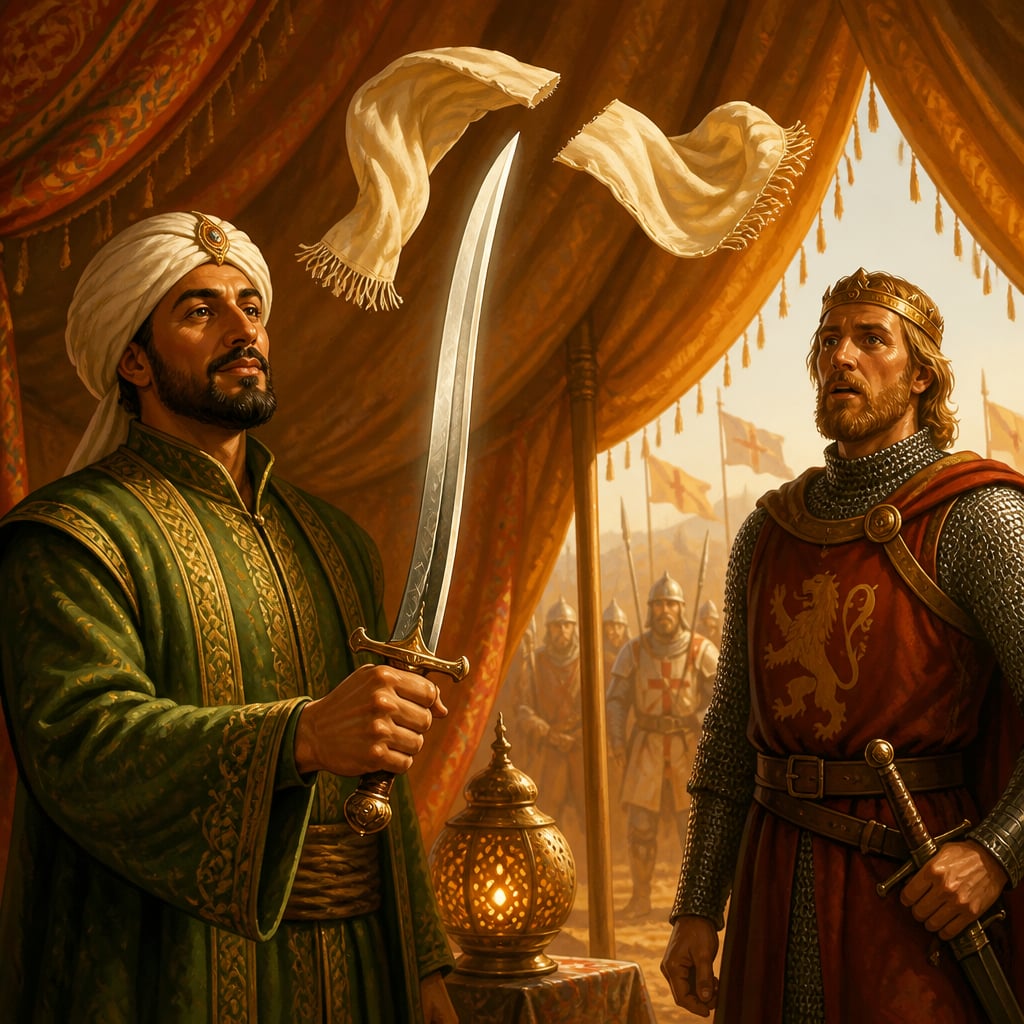
Saladin's wootz blade cleaving a falling silk scarf before Richard the Lionheart

In 1192 CE, Richard the Lionheart met Saladin during the Third Crusade. According to chronicler Baha ad-Din, the two leaders exchanged demonstrations of their swords. Richard swung his heavy European blade through an iron bar, brute strength breaking metal. Saladin responded differently. He threw a silk scarf into the air and passed his curved sword beneath it. The scarf fell to the ground in two pieces.

Richard's sword was made from European iron. Saladin's was made from Damascus steel, and Damascus steel was made from Wootz, forged in the furnaces of South India.

For over a thousand years, this Indian metal was the most prized material in the world. Swords made from it could cut through European armor. They held their edge through a hundred battles. And they displayed a distinctive wavy pattern, called "damask", that no European smith could replicate.

What was the secret? How did village smiths in Tamil Nadu and Karnataka create steel that the Industrial Revolution couldn't match? The answer involves science that wasn't formally "discovered" until 1991.

The Kodumanal Mystery

In 1990, archaeologists excavating Kodumanal in Tamil Nadu's Erode district found something remarkable: iron smelting furnaces dating to 300 BCE. Carbon dating revealed that South Indians had mastered high-carbon crucible steel, wootz, over 2,300 years ago.
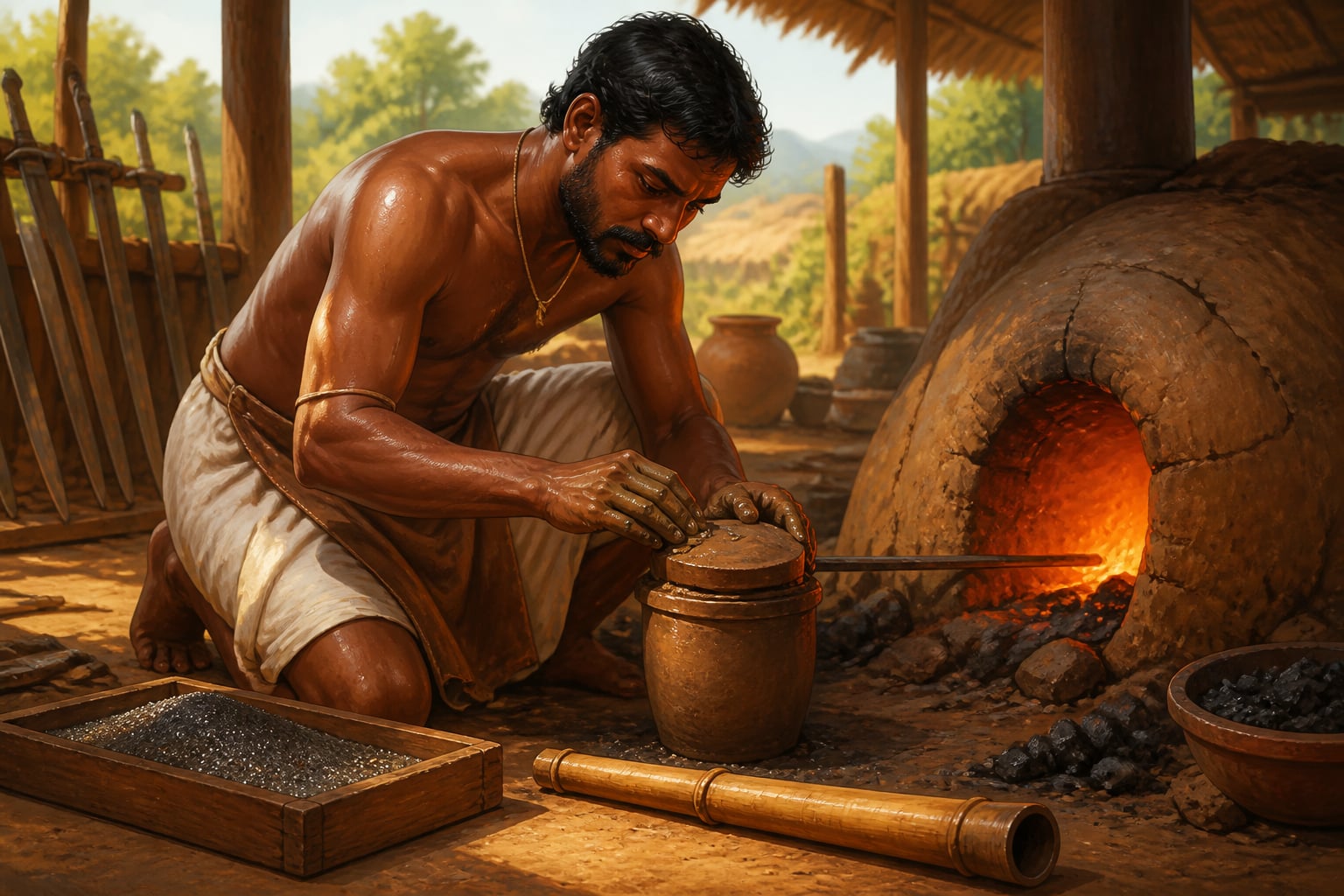
A Tamil smith sealing a wootz crucible at the Kodumanal forge

The process was deceptively simple yet precisely controlled:

  1. Iron ore was mixed with carbon-rich materials (wood, leaves, rice husks)
  2. The mixture was sealed in small clay crucibles (koduththu)
  3. Crucibles were heated in furnaces to 1,200-1,400°C for days
  4. The crucibles were cooled slowly, sometimes buried underground for weeks
  5. The resulting "cake" of steel was traded across the world

This process created steel with 1.5-2% carbon content, impossibly high for European methods. More remarkably, the carbon was distributed in a unique crystalline structure that created the legendary properties.

"Ayas param balam" "Iron is supreme strength." , Arthashastra

The Science Behind the Legend

For centuries, European scientists tried to understand wootz. They could analyze its composition but couldn't replicate its properties. In 2006, Peter Paufler of Dresden University finally solved the mystery: wootz contained carbon nanotubes.

Yes, the material that nanotechnologists "invented" in 1991 was naturally forming in South Indian furnaces 2,000 years earlier.

Here's what happened:

The Nanoscale Secret When wootz steel cooled slowly, its high carbon content formed iron carbide nanowires wrapped in carbon nanotubes. These structures, invisible to the naked eye, created the distinctive wavy pattern visible on the blade surface. More importantly, they created steel that was simultaneously:

No European steel achieved this combination. You could have hard steel (brittle) or flexible steel (soft), but not both. Wootz was both, and the secret lay in atomic-level engineering that Indian smiths achieved empirically, without microscopes or material science degrees.

The Numbers:

Global Perspectives: The Hunt for Indian Steel

Jean-Robert Bréant (1760-1830), a French metallurgist, spent decades trying to understand Damascus steel. In 1823, he published his findings: the steel originated in India, was traded through Persia, and was forged into blades in Damascus (hence the name). He identified the distinctive pattern as coming from a high-carbon crucible process, but couldn't replicate it.

"The true Damascus is of Indian origin," Bréant wrote. "The art of making it has been lost, and all modern attempts at imitation have failed."

Michael Faraday (1791-1867), the legendary British scientist, was so intrigued by wootz that he conducted extensive experiments on Indian steel samples. In 1819, he published "On the Alloys of Steel," attempting to identify what made wootz special. He correctly identified high carbon and minute impurities but couldn't unlock the full secret. The knowledge remained elusive.

Cyril Stanley Smith (1903-1992), the American metallurgist and historian, documented how wootz represented the highest achievement of pre-industrial metallurgy. "The production of wootz steel in India," he wrote, "was as complex and carefully controlled as any modern industrial process."

Scientist Era Contribution Limitation
Jean-Robert Bréant 1823 Identified Indian origin Couldn't replicate
Michael Faraday 1819 Analyzed composition Missed nanostructure
Peter Paufler 2006 Discovered carbon nanotubes Mystery finally solved

The pattern is clear: European scientists spent 200 years trying to understand what Indian smiths had perfected 2,000 years earlier.

The Trade That Shaped Empires

Wootz wasn't just a curiosity, it was strategic material. Control of wootz steel shaped medieval geopolitics.

The Trade Route:

Arab traders controlled the wootz trade for centuries, jealously guarding the supply routes. When Crusaders encountered Damascus swords, they assumed the steel was made in Damascus, the greatest marketing success in metallurgical history.

Tipu Sultan inspecting wootz swords in the Srirangapatna armoury

Tipu Sultan's Last Stand The final chapter of wootz connects to India's struggle against colonialism. Tipu Sultan of Mysore (1750-1799) equipped his armies with wootz weapons. His swords, rockets, and armor were forged from the legendary steel. When the British finally defeated him at Seringapatam in 1799, they captured thousands of wootz blades, now displayed in museums from London to Paris.

But they never captured the knowledge. By the mid-1800s, the wootz tradition had died. The smiths were gone. The techniques were lost. Like Dacca muslin, wootz steel became a legend of what India had been.

Modern Resonance: From Colonial Conquest to Global Acquisition

In January 2007, Tata Steel completed the acquisition of Corus, the company formed from British Steel. An Indian company had bought Britain's steel industry.

The $12 billion deal wasn't just business. It was history rhyming.

Consider the arc: In 1813, Britain banned Indian textile imports. By 1857, it controlled India's economy. For 150 years, Indian raw materials fed British industry. Then in 2007, an Indian company bought what remained of British steelmaking.

Ratan Tata at the acquisition ceremony: "This is a moment of great fulfillment for India. We are not here as conquerors but as partners."

Today, India is the world's #2 steel producer (140 million tonnes, 2023-24). JSW Steel, under Sajjan Jindal, has become one of the world's most efficient producers. Tata Steel operates plants across four continents. SAIL remains India's largest public sector steel company.

The smiths of Kodumanal couldn't have imagined it. But they would recognize the principle: excellence in metal, pursued with dedication, creates power.

Your Turn: Recognizing Invisible Excellence

The wootz story teaches something profound: true excellence often operates at levels invisible to casual observation.

The carbon nanotubes in wootz were invisible. The smiths couldn't see them. The scientists who studied their swords for 200 years couldn't detect them. Yet these invisible structures created visible, dramatic results, swords that cut silk, blades that never dulled.

Ask yourself:

Excellence has layers. What appears as "magic" is often systematic refinement over generations, knowledge encoded in practice before it's encoded in theory.

In the next lesson, we'll explore India's third manufacturing miracle: shipbuilding. The same civilization that created wootz also built ocean-going vessels that dominated the Indian Ocean for centuries. The Chola navy, the Gujarat shipyards, the vessels that carried trade to Rome and China, another story of excellence that the world has forgotten.

Michael Polanyi's concept of 'tacit knowledge', knowledge that can be demonstrated but not fully articulated, describes exactly what wootz smiths possessed. Japanese manufacturing philosophy calls this 'monozukuri' (the art of making things). German craftsmen call it 'Fingerspitzengefühl' (fingertip feeling). All describe the same phenomenon: expertise that exceeds explanation.

The guild system (shreni) was designed to transmit tacit knowledge. Apprentices learned by watching and doing, not by reading. Techniques were preserved in hands, not books. This made Indian manufacturing resilient across centuries, but also vulnerable when guilds were destroyed. Tacit knowledge dies with its practitioners.

It took Western science 2,000 years to understand what wootz smiths did: carbon nanotubes were 'discovered' in 1991; their presence in wootz was proven in 2006. The smiths achieved atomic-level engineering through empirical refinement, not theoretical understanding.

Modern industrial policy recognizes 'strategic industries', sectors critical for national security and economic sovereignty. The US CHIPS Act (2022), European Green Deal, and China's Made in China 2025 all aim to secure supply chains for critical materials. This is Kautilyan thinking with a 21st-century vocabulary.

India understood strategic industries 2,300 years ago. The Arthashastra prescribes state oversight of mines, metal production, and arms manufacturing, not because of ideology but because these capabilities determine national power. India's current semiconductor mission and PLI schemes continue this ancient wisdom.

In 2024, India announced investments of ₹1.26 lakh crore in semiconductor manufacturing. This echoes Kautilya's prescription: the state must ensure India controls the strategic materials of its era. Semiconductors are the 'wootz' of the 21st century.

Key terms

Ukku / Wootz
High-carbon crucible steel produced in South India; the raw material from which Damascus swords were forged; noted for its distinctive wavy pattern and exceptional properties
Loha-Shastra
The science of metals; metallurgical knowledge; the systematic understanding of metal properties, production, and working
Kudutthu / Crucible
The sealed clay vessel in which wootz steel was produced; the technology that enabled high-carbon steel by preventing oxidation during the smelting process
Damask
The distinctive wavy pattern visible on wootz steel surfaces; named after Damascus where Indian steel was forged into blades; now known to result from iron carbide nanowires

Verses

अयः परं बलम्

Ayaḥ param balam

Iron is the supreme strength.

This verse reveals ancient India's understanding that manufacturing capability, not just raw resources, determines power. The state invested in metallurgical knowledge because superior metal meant superior weapons, tools, and trade goods. Wootz was India's ultimate expression of this principle: metal so advanced it shaped global power for a millennium.

Arthashastra, Book 2, Chapter 12 (Superintendent of Metals) (Based on R.P. Kangle translation)

लोहगुणाः परीक्ष्याः

Loha-guṇāḥ parīkṣyāḥ

The qualities of metal must be carefully tested.

Ancient India had quality control systems. The emphasis on 'pariksha' (testing) meant that metalworkers developed systematic knowledge of what made good steel. This empirical approach, refining processes based on results, is the foundation of all manufacturing excellence. The wootz smiths didn't need to understand carbon nanotubes; they tested, observed, and refined over generations.

Brihat Samhita, Chapter 58 (Loha Pariksha - Testing of Metals) (Based on M. Ramakrishna Bhat translation)

कर्म-कुशलाः श्रेणि-विज्ञाः

Karma-kuśalāḥ śreṇi-vijñāḥ

Those skilled in craft are wise through their guild.

Wootz steel wasn't invented by a single genius, it was refined over centuries by guild systems that preserved what worked and discarded what didn't. This is institutional knowledge: the guild 'knew' things that no individual member could fully articulate. When colonialism destroyed the guilds, this knowledge evaporated. Modern manufacturing clusters (like Japan's keiretsu or Germany's Mittelstand) achieve similar knowledge accumulation.

Shukraniti, Chapter on Artisans (Shilpi Vidhi) (Traditional interpretation)

Key figures

The Smiths of Kodumanal

c. 300 BCE - 300 CE

Sajjan Jindal

1959-present

Jean-Robert Bréant

1760-1830

Case studies

Tata Steel's Corus Acquisition: Colonial History Reversed

In January 2007, Tata Steel completed the acquisition of Corus Group, the company formed from British Steel, for $12.1 billion. It was the largest international acquisition by an Indian company at the time. The deal made Tata Steel the world's fifth-largest steel producer and placed historic British steel facilities under Indian ownership. The acquisition came exactly 200 years after Britain had begun systematically dismantling Indian industry, and 159 years after the last wootz furnaces had gone cold.

The Corus acquisition represents dharmic commerce in action. Ratan Tata explicitly rejected the language of 'conquest.' 'We are not here as conquerors but as partners,' he said. This is Vishwa-Kalyana thinking: the goal isn't domination but mutual flourishing. The Tatas preserved Corus jobs, invested in upgrades, and worked with British communities, a stark contrast to the extractive colonialism that once flowed the other direction. The acquisition also demonstrated long-term thinking: Tata Steel accepted short-term financial stress to build long-term global capability.

The Corus acquisition transformed Tata Steel from an Indian producer into a global giant. Today, Tata Steel operates in 26 countries with 80,000+ employees. The European operations, though financially challenging post-2008, provided technology, brand recognition, and global market access. More importantly, the acquisition symbolized India's return to global manufacturing leadership. When Indian steel now competes globally, it carries the heritage of wootz, and the reversal of colonial economics.

Excellence in manufacturing creates strategic power, but that power can be exercised dharma-consciously. The Tatas could have gutted Corus for assets. Instead, they tried to preserve communities and build partnerships. The lesson: the goal of rebuilding India's manufacturing isn't revenge but restoration, returning India to its natural role as a maker of things that the world values.

Indian companies completed over $15 billion in cross-border acquisitions in 2023 alone. The Tata-Corus experience, with its mix of strategic success and financial challenges, remains the primary case study for Indian executives evaluating overseas deals. The lesson is consistently cited: cultural integration and community engagement matter as much as financial engineering.

Tata Steel is now India's largest private steel producer (19 MTPA capacity in India). The Corus acquisition, despite financial challenges, established the model for Indian global industrial expansion that Tata Motors (Jaguar Land Rover), Mahindra, and others would follow.

Historical context

Indian Steel Dominance (300 BCE - 1850 CE)

India's metallurgical excellence predates Rome. The iron pillar of Delhi (5th century CE) has resisted rust for 1,600 years, metallurgical achievement that still puzzles scientists. Wootz was produced from the Deccan to Sri Lanka, traded through Arabia, and forged into weapons across the medieval world. Indian steel was a strategic commodity for over a millennium.

When Indian smiths were producing 1.5% carbon steel, European metalworkers struggled with 0.5%. The crucible process that produced wootz wasn't developed in Europe until the 18th century, and even then, couldn't replicate wootz properties. The Industrial Revolution eventually outproduced Indian steel through volume, not quality. It took until 2006 for science to explain what Indian smiths achieved 2,000 years earlier.

Wootz steel cakes traded for the price of a horse in medieval Europe. At peak production, South India exported an estimated 10,000-15,000 steel cakes annually, a trade worth millions in modern terms and supplying weapons to warriors from Arabia to Scandinavia.

Understanding wootz reveals that India's industrial capabilities were not 'primitive' but often superior to European methods. The decline wasn't natural evolution but colonial policy. India didn't need the Industrial Revolution to make world-class products, it needed protection from colonial destruction.

Living traditions

India is now the world's #2 steel producer (140 million tonnes, 2023-24). Tata Steel, JSW Steel, SAIL, and private producers have made India a global metallurgical power. The government's PLI scheme for specialty steel aims to make India self-sufficient in advanced steel products. While the specific knowledge of wootz is lost, the spirit of metallurgical excellence continues.

Reflection

More in India's Industrial Heritage

All lessons in India's Industrial Heritage · Vaishya Dharma: The Art of Ethical Commerce course