Relevance in 2026 and Beyond
From World's Largest Economy to Viksit Bharat, The Ancient Playbook for Modern Dominance
How India's historical industrial supremacy, textiles, steel, shipbuilding, and trade mastery, provides the blueprint for reclaiming economic leadership in the 21st century.
The Question No One Is Asking
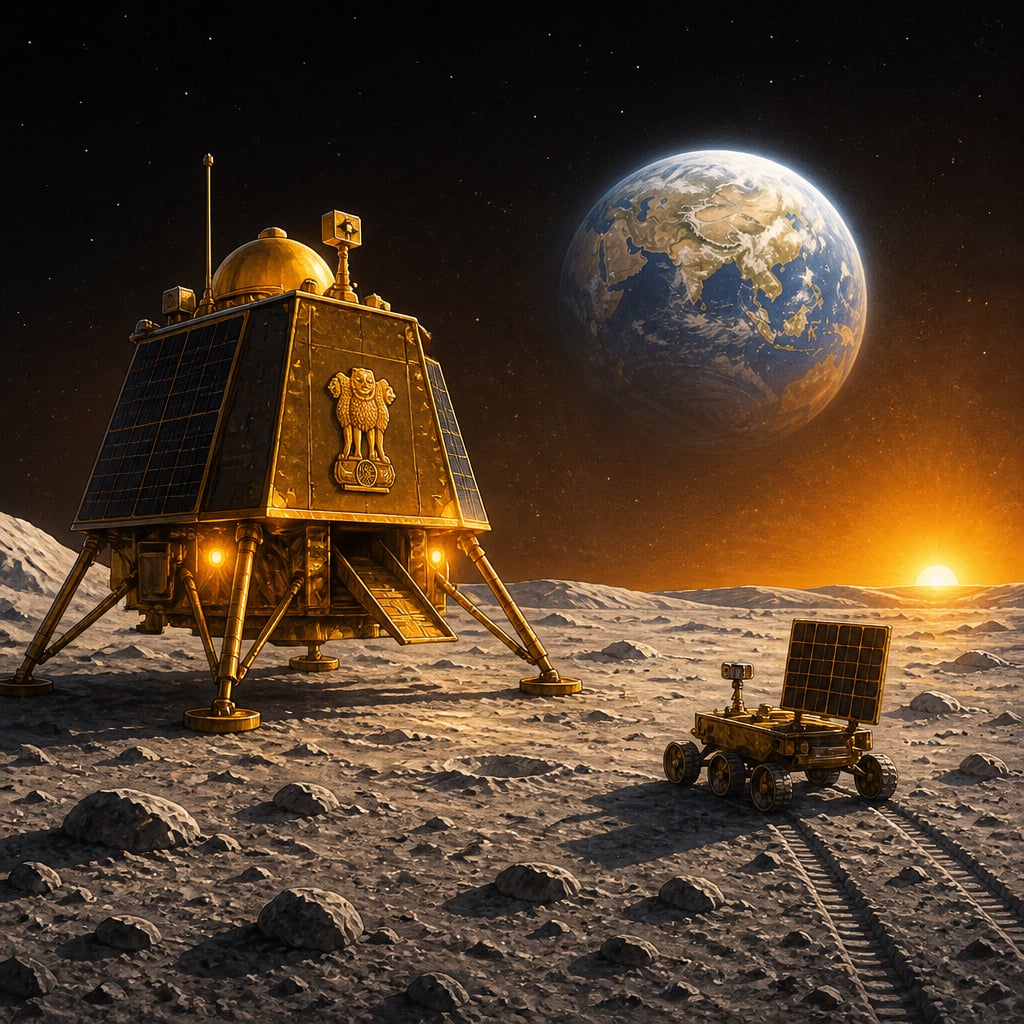
In September 2023, when ISRO's Chandrayaan-3 landed near the Moon's south pole, a feat NASA, ESA, and Roscosmos had failed to achieve, something unusual happened in the global media. Instead of celebration, there was confusion. How did India, a country the West still associates with poverty, achieve what the world's richest space agencies could not, on a budget smaller than a Hollywood blockbuster?
The answer lies not in some recent miracle, but in a 3,000-year-old pattern we've spent this entire chapter uncovering.
The Modern Challenge: Amnesia and Underestimation
India faces a peculiar modern challenge: collective amnesia about its own capabilities, and systematic underestimation by the world. When Bloomberg runs headlines about India's "surprising" manufacturing growth, or The Economist expresses "shock" at UPI processing more transactions than Visa and Mastercard combined, they reveal a blind spot built on centuries of colonial narrative.
This isn't just wounded pride, it has real economic consequences. Indian entrepreneurs still seek Western validation before domestic expansion. Policy makers import frameworks designed for industrial-era Europe rather than building on indigenous strengths. And most critically, young Indians grow up believing their ancestors were "simple agrarians" who contributed nothing to global industry.
The data tells a radically different story. As we've seen, India commanded 25-32% of world GDP for most of recorded history. Indian textiles clothed the world. Indian steel was the gold standard of metallurgy. Indian ships dominated the Indian Ocean for millennia. This wasn't luck, it was the systematic application of principles that remain startlingly relevant.
What the Chapter Actually Taught Us
Across six lessons, we've identified a consistent pattern underlying India's historical dominance:
Shilpa-Dharma (Sacred Craft): The Kodumanal smiths didn't just make steel, they performed a sacred act. The Dacca weavers didn't just produce cloth, they maintained a spiritual practice. This elevated craftsmanship beyond mere production to a form of yoga. The result? Quality that competitors couldn't replicate for centuries.
Karma-Kaushalya (Excellence as Duty): Excellence wasn't optional or motivated by profit, it was dharmic obligation. A weaver producing substandard muslin violated cosmic order, not just commercial standards. This built in quality control that no inspection regime could match.
Vishwa-Kalyana (Global Welfare through Trade): Indian commerce wasn't zero-sum extraction but value creation. The Cholas built infrastructure across Southeast Asia. Indian Ocean trade networks enriched every participant. This philosophy created sustainable commercial relationships lasting millennia.
Swadeshi (Self-Reliance with Openness): India absorbed Chinese silk technology, Arab navigation methods, and Persian administrative practices, then improved them. Self-reliance meant building capabilities, not isolation.
The Bridge: Ancient Principles in Modern Action
These principles aren't museum artifacts. They're actively driving India's most successful modern ventures.
Technology Leadership: When Satya Nadella transformed Microsoft from a dying giant into a $3 trillion company, he explicitly cited the Indian concept of "growth mindset", a direct translation of Karma-Kaushalya. When Sundar Pichai runs Google with collaborative rather than cutthroat culture, he's applying Vishwa-Kalyana to Silicon Valley.
![]()
Manufacturing Renaissance: The Production Linked Incentive (PLI) scheme that brought Apple manufacturing to India isn't just industrial policy, it's modern Shilpa-Dharma. The focus on building world-class production capabilities, not just attracting assembly plants, echoes the guilds that made India's textiles inimitable.
Digital Infrastructure: UPI's architecture, which processes 10 billion transactions monthly, was designed as public infrastructure, Vishwa-Kalyana in digital form. Unlike Western payment systems that extract fees at every step, UPI enables commerce for all. This philosophy is why India can run financial infrastructure that the world's richest nations can't replicate.
Space and Defence: ISRO's frugal engineering, landing on the Moon for $75 million when NASA spent $93 billion on Artemis, isn't just budget management. It's Karma-Kaushalya applied to engineering: excellence as obligation, waste as dharmic violation.
Addressing the Skeptic's Questions
Three objections deserve honest engagement:
"Isn't this just Hindu nationalism dressed as economics?" The data doesn't care about politics. Angus Maddison was a British economist. Paul Bairoch was Belgian. The historical GDP calculations come from Western scholars using Western methodologies. The civilizational confidence this chapter advocates isn't nationalism, it's numeracy.
"If India was so great, why did it fall behind?" We addressed this directly in Lesson 6. The colonial destruction was deliberate, documented, and devastating. The question isn't why India fell, it's why anyone expects a civilization systematically deindustrialized for 200 years to have fully recovered in 75. The trajectory matters more than the snapshot, and India's trajectory is unmistakable.
"Aren't modern principles incompatible with ancient approaches?" The false choice between "traditional" and "modern" is itself a colonial construct. Japan's Meiji Restoration proved Eastern civilizations could industrialize while maintaining cultural identity. India's semiconductor mission, digital payments revolution, and space program demonstrate the same synthesis is possible, indeed, it may be the only sustainable path.
Your Role in the Reclamation
Viksit Bharat 2047, the vision of a developed India by the centenary of independence, isn't a government program. It's a civilizational project requiring millions of individual contributions.
For entrepreneurs: Consider what Shilpa-Dharma means for your craft. Are you building something excellent because the world needs it, or just chasing the next funding round?
For professionals: Karma-Kaushalya asks: are you performing your role as sacred duty or mere employment? The answer shapes not just your career but your contribution to civilizational renewal.
For citizens: Vishwa-Kalyana invites examination of how your economic choices ripple outward. The products you buy, the businesses you support, the skills you develop, all participate in either continuation of colonial patterns or their reversal.
The data is clear: India was the world's workshop for most of human history. The principles that enabled that dominance remain valid. The only question is whether this generation will remember them, and act.