Nau-Nirmana: Shipbuilding Excellence
Masters of the Indian Ocean
For over two millennia, Indian shipwrights built vessels that dominated ocean trade from Africa to China. Their innovations, stitched hulls, superior teak construction, and advanced navigation, made the Indian Ocean an 'Indian lake.' This lesson explores how India's third great manufacturing miracle was written on water.
The Admiral Who Humiliated an Empire
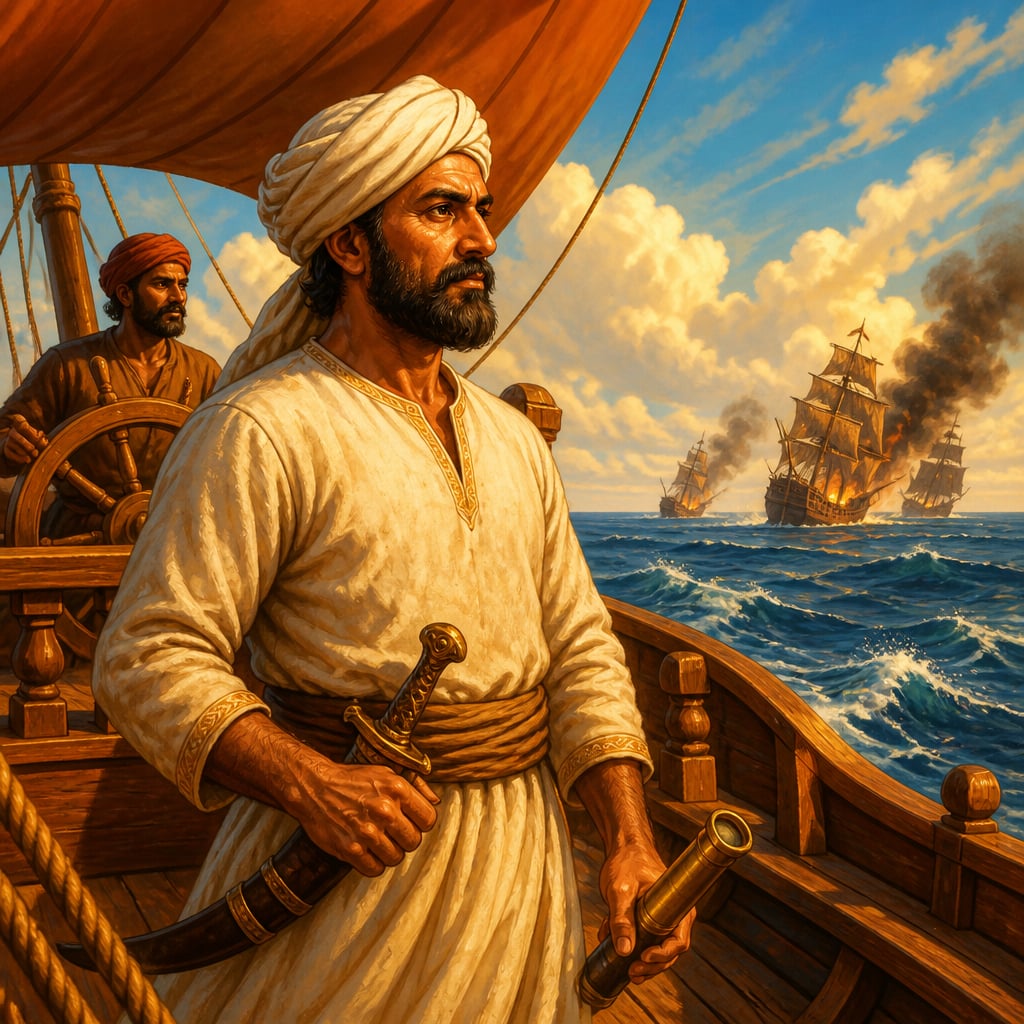
In 1571, Kunjali Marakkar IV stood on the deck of his flagship, watching Portuguese galleons retreat in flames. For eighty years, the Portuguese had tried to control the Malabar coast. For eighty years, the Marakkars, a dynasty of naval commanders serving the Zamorin of Calicut, had stopped them.
The Portuguese had superior cannons. They had European naval tactics. They had the backing of a global empire. What they didn't have were ships built for the Indian Ocean.
Kunjali's fleet consisted of paruv and odam, vessels designed by Indian shipwrights for Indian waters. Lighter than Portuguese carracks, faster in coastal waters, and crewed by sailors who'd navigated these seas for generations. The Marakkars used guerrilla tactics: attacking supply lines, burning anchored ships, disappearing into shallow waters where Portuguese vessels couldn't follow.
For a century, this dynasty of admirals, Kunjali I through IV, kept the Portuguese from monopolizing Indian Ocean trade. Their story reveals something larger: India wasn't just a source of goods to be traded. India built the ships that carried those goods.
The Technology That Ruled the Seas
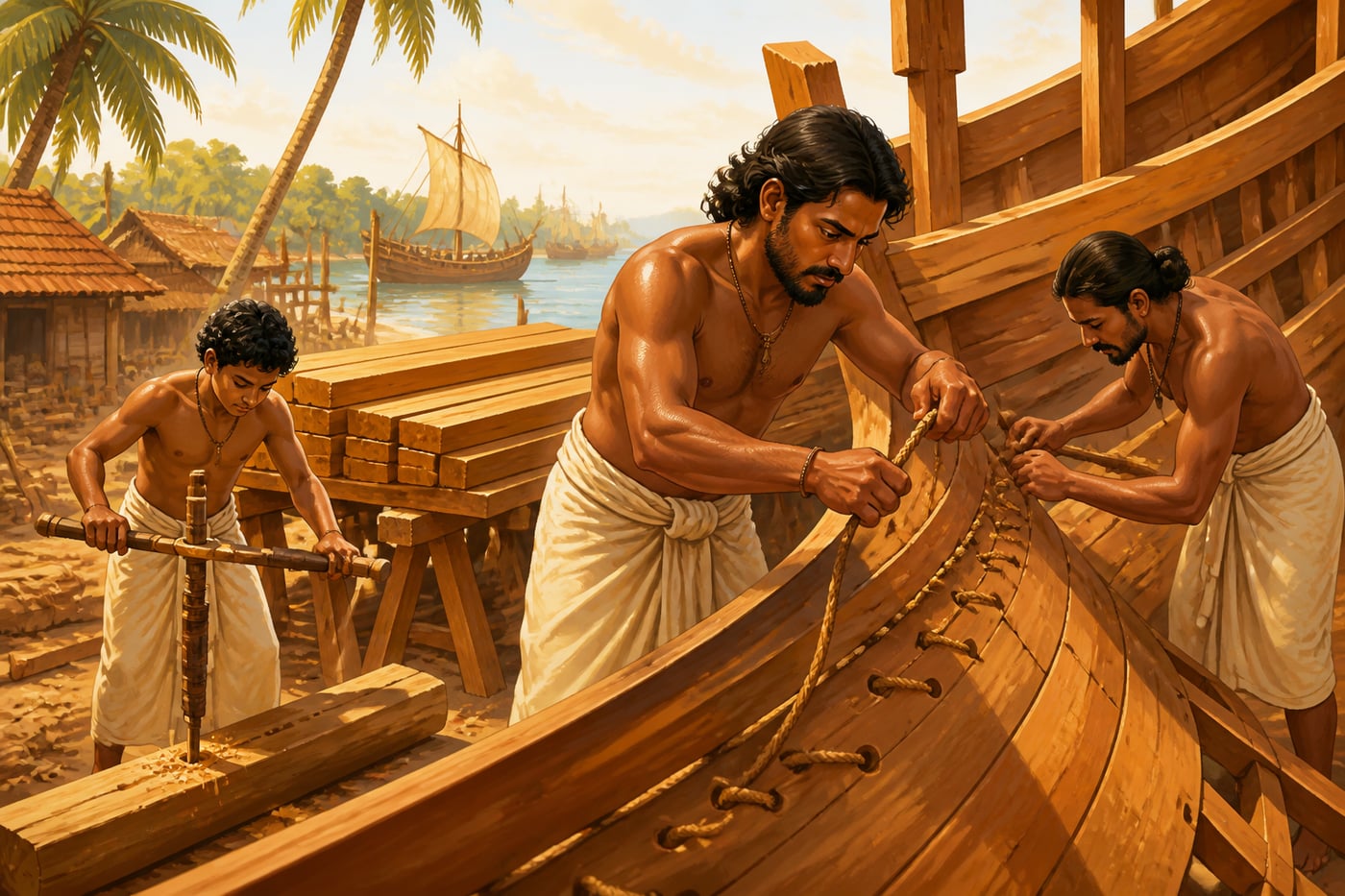
When Ibn Battuta arrived in Calicut in 1342, he recorded his amazement at Indian shipbuilding:
"The Indians build their ships without nails. The planks are sewn together with cord made from coconut fiber. These ships are extraordinarily strong and can withstand the roughest seas."
This stitched-hull technology baffled European observers. Surely nailed ships were superior? In fact, the opposite was true for ocean voyages:
Why Stitched Hulls Were Superior:
- Flexibility: Stitched planks could flex with waves; nailed planks cracked
- Repairability: Damaged sections could be re-stitched at sea; nailed ships needed dry docks
- Durability: Coconut coir resisted salt water; iron nails rusted
- Longevity: Indian ships lasted 80-100 years; European ships averaged 20-30
The technology was ancient. The Rig Veda mentions ocean-going vessels. The Ajanta caves (2nd century BCE) depict multi-masted ships. By the time Europeans arrived, Indian shipwrights had refined their craft over two millennia.
"Nau-vidya param kalam" "The science of ships is the supreme art." , Yuktikalpataru
The Teak Advantage
India possessed a strategic resource no other shipbuilding nation could match: Malabar teak.
Teak (Tectona grandis) from Kerala's Western Ghats was, and remains, the world's finest shipbuilding timber:
- Rot-resistant: Natural oils repel water and prevent decay
- Insect-proof: Teak is naturally resistant to marine borers that destroyed European oak ships
- Dimensionally stable: Doesn't warp, crack, or shrink like other woods
- Strength-to-weight ratio: Lighter than oak with comparable strength
The British Royal Navy recognized this. From 1800-1850, they ordered ships built in Indian yards specifically for teak construction. HMS Minden (built in Bombay, 1810) lasted until 1861. HMS Trincomalee (built in Bombay, 1817) still exists, the oldest British warship afloat, over 200 years later.

The Bombay Dockyard became one of the world's premier shipbuilding facilities. At its peak, it employed 10,000 workers and built 130+ ships for the Royal Navy. The British weren't using Indian labor because it was cheap, they were using Indian shipyards because they were better.
| Ship Type | Hull Material | Average Lifespan |
|---|---|---|
| European (oak, nailed) | Oak with iron nails | 20-30 years |
| Indian (teak, stitched) | Teak with coir stitching | 80-100 years |
| Bombay-built (teak, nailed) | Teak with copper fastening | 60-80 years |
The Indian Ocean Was an Indian Lake
For two thousand years, the Indian Ocean was effectively controlled by Indian and Indian-allied maritime powers.
The Trade Network:
- West: Indian ships carried goods to Arabia, Persia, East Africa, and (via intermediaries) to Rome
- East: Indian ships reached Southeast Asia, China, and the Indonesian archipelago
- South: Regular voyages to Sri Lanka and the Maldives
Arab and Persian merchants used Indian ships and Indian pilots. When Vasco da Gama finally reached India in 1498, he needed an Indian navigator, Ibn Majid (or a pilot trained in the Indian tradition), to guide his fleet across the final leg from Africa.
The Chola Navy (9th-13th century) represented the peak of this maritime power. Rajendra Chola I's 1025 expedition against Srivijaya deployed over 1,000 ships and established Tamil merchant colonies across Southeast Asia. Chola inscriptions in Thailand, Indonesia, and Myanmar testify to a trading empire that operated for centuries.
The Tamil Merchant Guilds (Ainnurruvar, Nanadesi) maintained trading posts from Oman to Cambodia. Their ships carried Indian textiles, steel, spices, and Indian shipbuilding techniques spread across the ocean.
Global Perspectives: What Europeans Found
Ibn Battuta (1304-1369), the Moroccan traveler, spent years in the Indian Ocean world. His accounts document Indian maritime supremacy:
"Ships in the Indian Ocean are built in the ports of Calicut, Cochin, and Quilon. The largest can carry a thousand men, sailors, merchants, and soldiers. They have four decks, with private cabins for wealthy travelers. The Chinese ships are even larger, but the Indian ships are stronger."
Ibn Battuta noted that Indian ships dominated the western Indian Ocean trade routes, while Chinese junks dominated the eastern routes. The two systems met in the Strait of Malacca, where Indian merchants and Indian-built ships were prominent.
Marco Polo (1254-1324) described Gujarat's shipbuilding:
"The ships of this country are the worst in the world... built of fir timber, fastened with wooden pegs and stitched with thread."
Polo was wrong. He judged Indian ships by European standards, missing why stitched construction was superior. His dismissal reveals European bias, the same bias that would later claim Indian manufacturing was "primitive."
William Dampier (1651-1715), the English explorer, was more honest:
"The Indian shipwrights build excellent vessels. Their teak ships outlast anything built in Europe. A Surat ship will serve sixty or seventy years, while an English ship is done in twenty."
The Marakkar Legacy
The Kunjali Marakkars represent India's naval resistance to European colonialism. Four generations of admirals, Kunjali I through IV, served the Zamorin of Calicut from 1502 to 1600.
Their achievements:
- Kunjali I: Established the naval force that challenged Portuguese monopoly
- Kunjali II: Expanded the fleet and developed guerrilla naval tactics
- Kunjali III: Won multiple engagements against Portuguese armadas
- Kunjali IV: Maintained resistance until internal politics undermined him
The Marakkars used asymmetric warfare before the term existed. Their smaller, faster ships attacked Portuguese supply lines, raided anchored fleets, and used intimate knowledge of coastal waters to outmaneuver heavier European vessels.
In 1600, the Portuguese finally defeated Kunjali IV, but only after allying with the Zamorin himself, who'd grown suspicious of his admiral's power. Even then, it took a combined Portuguese-Zamorin assault on the Marakkar fortress at Kottakkal to end the resistance.
Kunjali IV was executed. But his legacy endures. In 2020, Kerala Chief Minister Pinarayi Vijayan unveiled a memorial declaring the Marakkars "the first freedom fighters of the Indian Ocean."
Modern Resonance: From Wooden Dhows to Aircraft Carriers
Indian shipbuilding never died, it transformed.
Mandvi, Gujarat still builds traditional wooden ships. The shipwrights of Mandvi construct kotia and padao vessels using techniques passed down for generations. These ships, some over 200 tonnes, still carry cargo across the Arabian Sea to Dubai, Oman, and East Africa.
In 2024, Mandvi's yards produced 60+ vessels. The shipwrights use no blueprints, they build from experience and inherited knowledge. A master shipwright can look at a piece of timber and know exactly where it belongs in the hull. This is tacit knowledge in its purest form.
Cochin Shipyard Limited (CSL) represents the modern transformation. India's largest shipyard by capacity, CSL has evolved from ship-repair facility (1972) to global shipbuilder. In 2024:
- Order book: ₹21,000+ crore
- International clients: Norway, Germany, Netherlands
- Products: LNG carriers, aircraft carriers, defense vessels
CSL built INS Vikrant, India's first indigenous aircraft carrier. Commissioned in 2022, Vikrant represents India's return to blue-water naval capability. The 45,000-tonne carrier was 76% indigenous content, from steel to electronics.
Mazagon Dock Shipbuilders Limited (MDL) builds India's submarines and destroyers. The Kalvari-class submarines (Scorpène design, indigenous construction) and Visakhapatnam-class destroyers demonstrate that India can build the most complex vessels.
Your Turn: Building for Generations
The shipbuilding lesson extends beyond vessels.
Indian shipwrights built ships that lasted 100 years. They used materials (teak) that endured and techniques (stitching) that allowed repair. They thought in generations, not quarters.
Ask yourself:
- Are you building things that last? Or disposable solutions for immediate problems?
- Do you use the best materials available, even if more expensive upfront?
- Are you creating knowledge that can be passed to the next generation?
The Mandvi shipwrights still build without blueprints because knowledge lives in their hands. The Bombay Dockyard's teak ships still float after 200 years. Excellence, properly built, outlasts its builders.
In the next lesson, we'll examine the data behind India's dominance: the GDP estimates, trade figures, and economic evidence that prove India was the world's largest economy. Numbers that European scholars spent centuries denying, and Indian economists are now reclaiming.
Modern economics often optimizes for lowest initial cost, ignoring total cost of ownership. A European ship lasting 25 years cost less to build than an Indian ship lasting 100 years, but over a century, you'd need four European ships versus one Indian. Contemporary business is rediscovering this: Toyota's quality philosophy, Patagonia's lifetime guarantees, and infrastructure debates about deferred maintenance all grapple with the same principle.
Indian shipwrights thought in generations. They used teak because it lasted a century, not because it was cheapest. They stitched hulls because stitched ships could be repaired at sea and maintained indefinitely. This long-term thinking, building assets that outlast their builders, created compound advantages across decades. HMS Trincomalee, built in Bombay in 1817, still floats today.
HMS Trincomalee (teak, built Bombay 1817) is the oldest British warship still afloat, over 200 years old. The average lifespan of a European oak ship was 25 years. Indian shipbuilding achieved 4-8x the asset lifespan of European equivalents.
Business strategy recognizes that smaller competitors can defeat larger ones by changing the basis of competition. Clayton Christensen's 'disruptive innovation,' guerrilla marketing, and niche strategies all describe what the Marakkars practiced: don't fight the enemy's strength, compete where your strengths matter.
The Marakkars understood their asymmetric advantages: knowledge of coastal waters, monsoon patterns, and local resupply. Their ships were smaller but faster and shallower-drafted. They avoided pitched battles where Portuguese cannons would dominate, instead attacking supply lines and using terrain. This strategic intelligence, competing on your terms, not the enemy's, kept the Malabar coast partially free for a century.
The Marakkars resisted Portuguese colonialism for 98 years (1502-1600) with smaller forces and no European-style cannons. Their asymmetric approach, guerrilla naval warfare using local advantages, demonstrated that superior technology doesn't guarantee victory.
Key terms
- Nau-Nirmana
- Shipbuilding; the science and craft of constructing ocean-going vessels; naval architecture in the Indian tradition
- Sivana-Nirmana
- Stitched-hull construction; the technique of joining ship planks with fiber (typically coconut coir) rather than nails; the technology that made Indian ships superior for ocean voyages
- Sagara-Samrajya
- Ocean empire; maritime dominion; the concept of power projection and trade control across oceanic spaces
- Kunjali
- A title held by the hereditary naval commanders of the Zamorin of Calicut; specifically, the Marakkar dynasty that resisted Portuguese colonialism for a century
Verses
नौविद्या परमं कलाम्
Nau-vidyā paramam kalām
The science of ships is the supreme art.
Shipbuilding was the aerospace industry of the ancient world, the most complex manufacturing challenge, requiring the highest skills and producing strategic assets. Nations that mastered shipbuilding dominated trade and projected power. India's supremacy in nau-vidya enabled its economic dominance of the Indian Ocean.
Yuktikalpataru, Chapter on Nau-Nirmana (Shipbuilding) (Based on traditional interpretation)
नावाध्यक्षो नौकर्म नियुञ्ज्यात्
Nāvādhyakṣo naukarma niyuñjyāt
The Superintendent of Ships shall oversee all naval activities.
2,300 years ago, India had a Minister of Shipping. The Navadhyaksha oversaw construction standards, port facilities, customs duties, and naval defense. This institutional sophistication, treating maritime affairs as a core state function, enabled India's sustained ocean dominance. Modern India's Ministry of Ports, Shipping and Waterways continues this tradition.
Arthashastra, Book 2, Chapter 28 (Superintendent of Ships) (Based on R.P. Kangle translation)
समुद्रयानं वाणिज्यं कुर्वाणो लभते महत्
Samudra-yānam vāṇijyam kurvāṇo labhate mahat
One who engages in ocean commerce obtains great wealth.
This verse contradicts the colonial myth that Indians shunned sea travel. Ancient texts recognized that oceanic trade yielded the highest returns, risk justified by reward. India's maritime merchants took this seriously: Tamil guilds operated from Africa to Indonesia; Gujarat's merchants reached Southeast Asia and China. The dharmic sanction for maritime trade enabled India's ocean dominance.
Manusmriti, Chapter 8 (on Maritime Trade) (Based on Ganganath Jha translation)
Key figures
Kunjali Marakkar IV
c. 1560-1600 CE
Mazagon Dock Shipbuilders Limited
1934-present
Ibn Battuta
1304-1369 CE
Case studies
Mandvi: Where Ancient Shipbuilding Lives
In the shipyards of Mandvi, Gujarat, master craftsmen still build ocean-going wooden vessels using techniques unchanged for centuries. No blueprints. No computer designs. Just inherited knowledge passed from father to son across generations. A master shipwright (*mistri*) can look at a curved piece of teak and know exactly where it belongs in a hull. In 2024, Mandvi's yards produced 60+ vessels ranging from 100 to 400 tonnes, traditional dhows that still carry cargo across the Arabian Sea to Dubai, Oman, and East Africa. These ships compete with steel-hulled motor vessels on routes their ancestors sailed a millennium ago.
Mandvi represents *parampara*, the unbroken transmission of knowledge across generations. The shipwrights don't build from blueprints because their knowledge is tacit, embodied in hands trained since childhood. This is the same tradition that built the ships Ibn Battuta admired. The economic model is dharmic too: shipwrights work in family units, sharing knowledge and resources, maintaining quality standards through reputation rather than regulation. The ships they build are expensive (₹3-5 crore for a large dhow) but last 30-40 years, generational thinking in practice.
Mandvi's shipbuilding survives because it serves a real market: traditional wooden dhows are still preferred for certain cargo on Arabian Sea routes. The ships are quieter, more maneuverable in ports, and require less maintenance than steel vessels. Mandvi has adapted, diesel engines replaced sails, fiberglass coating extends hull life, but the core construction remains traditional. The shipwrights are now recognized by the Gujarat government as heritage craftsmen, and there's growing interest in documenting their techniques before the knowledge fades.
Traditional knowledge survives when it serves real needs. Mandvi's shipwrights aren't museum exhibits, they're commercial operators whose techniques remain competitive. The lesson: don't assume old methods are obsolete. Indian stitched-hull technology was superior for centuries; Mandvi's wooden construction still serves purposes that modern alternatives can't fully replace. Evaluate traditions on their merits, not their age.
The 'maker movement' and renewed interest in artisanal craftsmanship worldwide parallel Mandvi's survival. Luxury markets increasingly value handmade goods with provenance stories. Mandvi's traditional shipbuilders find new customers among yacht enthusiasts and heritage preservation projects, proving that craft knowledge retains commercial value when it serves genuine functional needs.
Mandvi produces 60+ vessels annually worth ₹150-200 crore. The shipbuilding community employs 1,500+ families directly. A master shipwright trains for 15-20 years before leading construction, the same apprenticeship duration as ancient guild systems.
Cochin Shipyard: From Repair Dock to Global Builder
Cochin Shipyard Limited (CSL) began in 1972 as primarily a ship-repair facility. Today, it's India's largest shipbuilder by capacity, with an order book exceeding ₹21,000 crore. CSL builds everything from oil tankers to aircraft carriers, serving clients from Norway to Germany. The transformation required strategic vision, technology absorption, and the same principle that made ancient Indian shipbuilding great: building better than others, not just cheaper. CSL's most prestigious achievement: INS Vikrant, India's first indigenous aircraft carrier, commissioned in 2022.
CSL's transformation embodies *karma-kaushalya*, excellence in action through systematic capability building. The shipyard didn't try to compete globally overnight. It built capabilities step by step: repair → construction → complex vessels → aircraft carriers. Each step built skills for the next. The INS Vikrant project (17 years, ₹20,000+ crore) required patience and long-term thinking, the same generational perspective that made Indian ships last a century. CSL also practices *vishwa-kalyana*: its international orders demonstrate that Indian manufacturing can serve global needs, not just domestic markets.
CSL is now profitable, publicly traded, and internationally competitive. Its order book includes vessels for European clients, a reversal of the colonial pattern where India only received orders. The shipyard employs 5,000+ workers with another 15,000+ in the supply ecosystem. INS Vikrant's commissioning in 2022 marked India's entry into the elite club of nations that can build aircraft carriers domestically. CSL's success proves that Indian shipbuilding can compete at the highest levels of complexity and quality.
Capability building takes time but creates lasting advantage. CSL didn't become an aircraft carrier builder overnight, it built skills over 50 years, each project slightly more complex than the last. This patient, systematic approach echoes how ancient Indian shipyards developed: generational accumulation of knowledge, not shortcuts. The lesson for Viksit Bharat: strategic industries require strategic patience.
India's push for naval self-reliance accelerated after 2020, with orders for indigenous aircraft carriers, submarines, and destroyers. Cochin Shipyard's progression from repair dock to aircraft carrier builder is the template for defense indigenization across sectors. The same patient capability-building approach now applies to fighter jets (Tejas), missiles (BrahMos), and space launch vehicles (ISRO).
CSL's revenue grew from ₹1,900 crore (2014) to ₹3,500+ crore (2024). Order book: ₹21,000+ crore. INS Vikrant: 45,000 tonnes, 76% indigenous content, 17 years construction, India's largest and most complex indigenous defense project completed.
Historical context
Indian Maritime Dominance (3000 BCE - 1750 CE)
The Indian Ocean was an 'Indian lake' for two millennia. Indian ships, Indian merchants, and Indian shipbuilding techniques dominated trade from Africa to China. Arab and Persian traders used Indian ships and pilots. Chinese junks dominated the eastern routes, but Indian vessels dominated the western Indian Ocean. This maritime heritage enabled India's role as the world's manufacturing and trading hub.
When Indian ships were lasting 80-100 years, European ships lasted 20-30. When Indian merchants were trading peacefully across the ocean, European arrival brought naval warfare and monopoly attempts. The Portuguese needed Indian pilots to navigate Indian waters; Indian shipwrights taught European dockworkers new techniques. The 'Age of Discovery' was largely discovering what India already knew.
The British Royal Navy commissioned 130+ ships from Bombay Dockyard (1800-1850) specifically for the superior quality of teak construction. HMS Trincomalee, built in Bombay in 1817, is still afloat, the oldest British warship in existence.
Understanding India's maritime heritage reveals both capability and vulnerability. India dominated ocean trade for millennia but lost control when European naval power combined with industrial technology. The lesson: maritime capability is strategic necessity. India's current naval expansion, including indigenous aircraft carriers and submarines, represents recovery of a capability that was always part of Indian civilization.
Living traditions
India's shipbuilding industry employs 500,000+ workers and generates ₹50,000+ crore annually. Mazagon Dock (Mumbai), Cochin Shipyard (Kochi), Garden Reach (Kolkata), and Larsen & Toubro build everything from fishing boats to aircraft carriers. The government's Maritime India Vision 2030 targets making India a top-5 global shipbuilding nation. From Mandvi's wooden dhows to Mumbai's steel submarines, the tradition of nau-nirmana continues.
- Mandvi Traditional Shipbuilding (Gujarat): Master shipwrights continue building wooden dhows using techniques passed down for generations. No blueprints, just inherited knowledge. Ships of 100-400 tonnes still carry cargo across the Arabian Sea.
- Beypore Uru Building (Kerala): The shipwrights of Beypore build 'urus', traditional wooden vessels up to 200 tonnes. Once trading vessels, they're now often luxury houseboats or heritage craft, but the skills remain.
- Fishing Boat Construction (Coastal India): Traditional boat-building continues in fishing communities from Gujarat to Tamil Nadu. Catamarans, vallams, and other traditional designs remain in use, adapted with modern motors but retaining traditional hull forms.
- Mandvi Shipyards, Gujarat: Watch traditional wooden ships under construction using techniques unchanged for centuries, one of the few places where pre-industrial shipbuilding remains commercially active
- INS Vikrant, Kochi: India's first indigenous aircraft carrier, now commissioned, symbol of India's return to naval manufacturing capability
- Maritime Heritage Museum, Lothal (planned): Lothal was an Indus Valley port city with the world's oldest known dry dock. A major maritime heritage center is planned to showcase India's 5,000-year maritime history
- Kunjali Marakkar Memorial, Kerala: Memorial to the dynasty of admirals who resisted Portuguese colonialism, unveiled in 2020 recognizing them as India's first naval freedom fighters
- Thalassery Theyyam Temples: Coastal temples where maritime communities have worshipped for centuries. The Theyyam tradition incorporates maritime deities protecting sailors and traders, connecting spiritual practice with seafaring life.
- Swami Narayan Temple: Important temple in the traditional shipbuilding town of Mandvi. The town's merchant and shipwright communities have deep religious traditions connecting their craft to dharmic values.
Reflection
- Indian ships built with stitched hulls lasted 80-100 years, while European nailed ships lasted 20-30 years. What 'obvious' assumptions in your own field might actually be wrong? Are there traditional or unconventional approaches that could outperform current 'best practices'?
- The Marakkars resisted Portuguese colonialism for 98 years using asymmetric advantages: local knowledge, appropriate technology, and strategic patience. What are your asymmetric advantages? What do you know or can do that larger/richer competitors can't easily replicate? How can you compete where you're strongest rather than where they're strongest?