Vishwa-Sampada: Quantifying World Dominance

The Data That Colonial Historians Hid

Stories of textiles, steel, and ships are compelling, but what do the numbers prove? This lesson examines the GDP data, trade statistics, and economic evidence showing India was the world's largest economy for 1,700 years. From Angus Maddison's databases to Utsa Patnaik's colonial drain calculations, see how modern scholars have quantified what colonial narratives spent centuries denying.

The Number That Changed Everything

Angus Maddison at his Groningen desk with global economic ledgers

32.9%

That's India's share of world GDP in 1 CE, according to economic historian Angus Maddison. When Rome was at its height, India produced nearly one-third of everything made on Earth. The Roman Empire, spanning from Britain to Egypt? About 21%.

For seventeen centuries, from the time of Christ until the Industrial Revolution, India was either the largest or second-largest economy on the planet. This isn't speculation. It isn't nationalist myth. It's what the data shows, compiled by Western economists using rigorous historical methodology.

And for two hundred years, colonial historians tried to make you forget it.

The Man Who Counted Everything

Angus Maddison (1926-2010) was a British economic historian who spent his career at the OECD and the University of Groningen, building the most comprehensive database of historical global economics ever assembled. His work, "The World Economy: A Millennial Perspective" (2001), reconstructed GDP estimates for every major region going back 2,000 years.

Maddison wasn't pro-India or anti-West. He was a data obsessive who wanted to understand how the world economy evolved. His findings demolished the colonial narrative:

India's Share of World GDP:

Read those numbers again. In 1700, before colonialism fully took hold, India produced nearly a quarter of world output. By 1950, after two centuries of British rule, India had collapsed to 4%.

"आर्थं प्रमाणं सर्वेषाम्" "Data is the proof of all things." , Adapted from Vaisheshika philosophy

The Great Reversal Explained

How did the world's largest economy become among its poorest? The data tells the story:
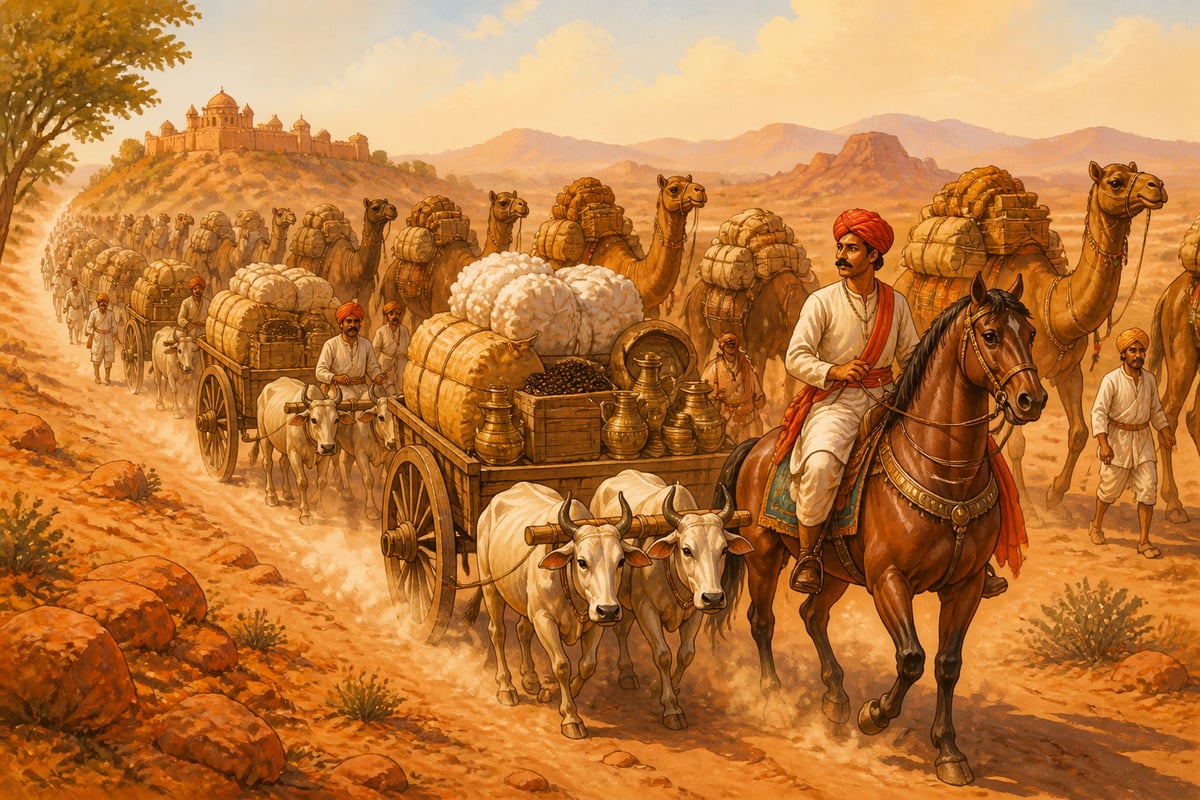
A 1700-era Mughal trading caravan of camels and bullock carts crossing Rajasthan

Pre-Colonial India (1700):

Post-Colonial India (1947):

The reversal wasn't natural economic evolution. It was engineered through policy:

Year Policy Effect
1813 Ban on Indian textile imports to Britain Protected nascent British industry from superior Indian competition
1830s Tariffs on Indian cloth sold IN India Forced Indians to buy British goods even in their own country
1858 Direct Crown rule Systematic extraction of resources with no investment in Indian development
1870s Railway network built Designed for resource extraction (raw materials out), not internal development

Paul Bairoch (1930-1999), the Swiss economic historian, calculated that in 1750, India's manufacturing output was larger than all of Europe combined. "The developed countries of today," he wrote, "were yesterday's underdeveloped countries."

Sanjeev Sanyal: The Indian Voice

Sanjeev Sanyal (1971-present), currently Principal Economic Adviser to the Government of India, has spent two decades reconstructing Indian economic history from primary sources.

His books, "The Indian Renaissance" (2008), "The Ocean of Churn" (2016), and "Revolutionaries" (2017), combine economic data with archaeological and textual evidence to build a comprehensive picture of pre-colonial India.

Sanyal's key contributions:

1. Debunking the "Caste Rigidity" Myth Colonial historians claimed Indian society was static and economically stagnant. Sanyal demonstrates from temple inscriptions and guild records that pre-colonial India had significant social mobility, with merchant and artisan families rising to prominence and even royalty.

2. Documenting Maritime Trade Using merchant guild inscriptions found across Southeast Asia, Sanyal traces Indian trading networks that operated for centuries before European arrival, disproving claims that Indians avoided sea travel.

3. Quantifying the Colonial Collapse Sanyal's analysis of British records shows that India's per capita income, which was comparable to Western Europe in 1700, had fallen to one-tenth of British levels by 1947.

"The narrative that India was always poor and Britain 'developed' it," Sanyal writes, "is not just wrong, it's the opposite of what happened. India was rich and Britain made it poor."

The $45 Trillion Question

Utsa Patnaik, Professor Emerita at JNU, spent years analyzing British colonial records to answer a simple question: How much did Britain actually take from India?

Her methodology: trace the "drain", the systematic extraction of Indian wealth through taxation, forced purchases, and rigged trade.

Her conclusion: $45 trillion in today's terms.

The calculation works like this:

  1. Britain taxed Indians, collecting revenue in rupees
  2. Those rupees purchased Indian goods (textiles, food, raw materials)
  3. The goods were exported to Britain or sold globally
  4. The profits stayed in London, never returning to India
  5. Compounded over 200 years at 5% interest: $45 trillion

To put this in perspective:

Critics argue the $45 trillion figure involves assumptions. Fair enough, economic history always does. But even conservative estimates put colonial extraction at several trillion dollars. The drain was real, massive, and catastrophic for Indian development.

What the Data Proves

Across multiple researchers, methodologies, and perspectives, the data converges on several undeniable facts:

Fact 1: India Was the World's Largest Economy for 1,700 Years From 1 CE to approximately 1700 CE, India consistently produced 25-33% of world output. This isn't contested by any serious economic historian.

Fact 2: India's Collapse Was Colonial, Not Natural India's share of world GDP fell from 24% (1700) to 4% (1950) during the exact period of British rule. No other major economy experienced such a collapse. The causation is clear.

Fact 3: India's Manufacturing Was Destroyed, Not "Undeveloped" India had the world's largest textile industry, the world's best steel, and significant shipbuilding. These weren't primitive, they were deliberately destroyed to eliminate competition with British industry.

Fact 4: The Drain Was Massive Whether $45 trillion (Patnaik) or several trillion (conservative estimates), Britain extracted wealth from India at a scale unprecedented in human history. India funded the Industrial Revolution.

Fact 5: Recovery Is Possible, and Happening In 2022, India's GDP overtook the UK's for the first time since 1870. India is now the world's 5th largest economy. The Maddison data that shows India at 32.9% of world GDP also shows that economic positions can change, and India is changing again.

The Lesson of Data

Why does quantification matter? Because narratives can be manipulated. Data is harder to fake.

For two centuries, colonial historians wrote India's history. They portrayed a backward, stagnant civilization that needed European enlightenment. They buried evidence of Indian achievement and manufactured myths of perpetual poverty.

The data revolution in economic history, Maddison, Bairoch, Patnaik, Sanyal, has made this narrative unsustainable. We now have the numbers. We can prove what happened.

But data isn't just for historians. The same empirical rigor that's recovering India's past should inform its future:

The dharmic tradition has always valued pramana (valid means of knowledge). In economics, that means data. The scholars in this lesson aren't storytellers, they're evidence-gatherers. And their evidence has changed how we understand the world.

Modern Resonance: India Reclaiming Its Position

In 2022, India's GDP officially surpassed the United Kingdom's. For the first time since the 1870s, the former colony was larger than the former colonizer.

The symbolism was powerful. But for those who know the data, it was long overdue, a partial correction of a two-century aberration.

Consider the trajectory:

The Maddison data shows India was #1 for 1,700 years. The colonial interlude, 200 years, was an interruption, not the natural order. The question isn't whether India can be a great economy. The question is: how fast can it recover what was taken?

Your Turn: Becoming Data-Literate

The lesson from economic history is simple: whoever controls the narrative controls perception. But data controls truth.

Ask yourself:

The scholars in this lesson changed how we understand history because they counted things. They didn't argue, they proved. That methodology applies far beyond economic history.

In the next lesson, we'll examine the tragedy and triumph in detail: how colonialism destroyed India's manufacturing industries and how Make in India is rebuilding them. The destruction was systematic. The recovery must be too.

Modern economics recognizes that information asymmetry creates power imbalances. Those with better data make better decisions; those without data are easily exploited. This applies to markets, politics, and historical narratives. Colonial powers controlled India's story by controlling the data, what was recorded, what was taught, what was remembered.

The economists in this lesson broke the colonial information monopoly. Maddison, Bairoch, Patnaik, and Sanyal recovered data that had been ignored or suppressed. Their work demonstrates that historical power can be contested through rigorous research. India's story is being rewritten, not with ideology but with evidence.

Maddison's GDP database covers 2,000 years and 160 countries. It's the most cited source for historical economics. The fact that a Western academic produced data proving Indian dominance shows that truth, rigorously pursued, transcends ideology.

Business schools teach that long-term thinking creates competitive advantage. Amazon famously prioritizes long-term customer value over short-term profits. But most analysis covers quarters, not centuries. The economists in this lesson demonstrate what becomes visible with a truly long view: colonialism appears as a recent aberration, not the natural order.

India's civilizational continuity enables a long view that younger nations can't access. When Indians understand that their ancestors led the world economy for 1,700 years, the current moment looks different, not as the beginning of ascent but as recovery from interruption. This perspective affects strategy: the goal isn't to become something new but to regain what was lost.

If India recovers to 25% of world GDP (its pre-colonial share), at current trajectories, this would occur around 2075-2100. The colonial interlude, 1757 to ~2075, would then appear as a 300-year disruption in 2,000+ years of economic leadership. The long view reveals what short-term analysis misses.

Key terms

Vishwa-Sampada
World wealth; global economic position; the concept of a nation's share of total global output and prosperity
Pramana
Valid means of knowledge; evidence; proof; the epistemological foundation for reliable conclusions
Arthik Nikasi
Economic drain; the systematic extraction of wealth from a colonized country to the colonizer; the process by which colonial powers impoverished their subjects
Sakala Gharelu Utpada
Gross Domestic Product (GDP); the total value of goods and services produced within a country; the standard measure of economic output

Verses

प्रत्यक्षानुमानोपमानशब्दाः प्रमाणानि

Pratyakṣa-anumāna-upamāna-śabdāḥ pramāṇāni

Perception, inference, comparison, and testimony, these are the valid means of knowing truth.

Economic history requires all four pramanas: direct evidence (pratyaksha) from records and artifacts; inference (anumana) from patterns; comparison (upamana) across regions and times; and testimony (shabda) from historical accounts. Maddison's methodology embodies these principles, his GDP estimates combine direct data, logical reconstruction, comparative analysis, and documented sources.

Nyaya Sutra, Chapter on Pramana (Valid Knowledge) (Based on Vatsyayana's commentary)

सङ्ख्याया विनिश्चयः

Saṅkhyāyā viniścayaḥ

Certainty comes through counting.

India had census and economic data 2,300 years ago. The Arthashastra prescribes record-keeping that would be recognizable to modern statisticians. When modern economists reconstruct India's economic history, they're recovering a tradition of quantification that colonialism interrupted, then used selectively to justify extraction.

Arthashastra, Book 2, Chapter 6 (on State Records) (Based on R.P. Kangle translation)

विमृश्यैतदशेषेण यथेच्छसि तथा कुरु

Vimṛśya etad aśeṣeṇa yathā icchasi tathā kuru

Reflect on this fully, then do as you choose.

The Gita's call for complete reflection (vimrshya aseshena) is the dharmic equivalent of thorough data analysis. Colonial narratives relied on Indians NOT examining the evidence. The economists in this lesson did what Krishna advised: they reflected fully on the data. Their conclusions are now unavoidable.

Bhagavad Gita, Chapter 18, Verse 63 (Standard translation)

Key figures

Angus Maddison

1926-2010

Sanjeev Sanyal

1971-present

Paul Bairoch

1930-1999

Case studies

The $45 Trillion Question: Utsa Patnaik's Colonial Drain Calculation

Professor Utsa Patnaik of Jawaharlal Nehru University spent years analyzing British colonial records to answer one question: How much did Britain actually extract from India? Her methodology traced the 'drain', the systematic transfer of Indian wealth to Britain through taxation, forced purchases, and rigged trade. Her conclusion, published in 'Agrarian and Other Histories' (2018): **$45 trillion** in today's terms. The calculation: British-controlled India taxed Indians in rupees, used those rupees to buy Indian goods, exported the goods globally, and kept the profits in London. Over 200 years, compounded at 5% interest (conservative for capital returns), this extraction totaled $45 trillion.

Patnaik's work embodies *satya* (truth) pursued through *pramana* (valid evidence). She didn't argue ideologically, she counted. Her methodology used British records against the colonial narrative: the colonizers documented their own extraction. This is dharmic scholarship: rigorous, evidence-based, and ultimately unanswerable. The $45 trillion figure has been debated on methodology but not on the fundamental finding, massive extraction occurred.

Patnaik's research has become central to discussions of colonial reparations. While the exact figure is debated, her work established several undeniable facts: (1) systematic drain occurred, (2) it was documented in British records, (3) it was enormous by any measure, and (4) it explains India's impoverishment under colonialism. Her research has been cited by Indian leaders, including in international forums, and has shifted academic discussion from 'whether' colonial drain occurred to 'how much.'

Rigorous quantification changes debates. Before Patnaik, colonial apologists could claim British investment 'benefited' India. Her calculation, using British data, made such claims absurd. When you can show $45 trillion extracted versus a few hundred million 'invested,' the narrative collapses. The lesson: don't just argue, count. Numbers are harder to dismiss than rhetoric.

Colonial reparations debates have intensified globally, with Caribbean nations demanding compensation from Britain and African nations raising similar claims. Patnaik's $45 trillion calculation provides the quantitative foundation for these discussions. The methodology of tracing capital flows across centuries is now being applied to other colonial relationships, from French West Africa to the Dutch East Indies.

$45 trillion equals approximately 15x Britain's current GDP or 13x India's current GDP. Even if the methodology yields a lower estimate (say, $10 trillion), the scale of extraction was catastrophic. India literally funded Britain's Industrial Revolution, with no return on investment.

Historical context

Recovery of Economic History (1970s - present)

For two centuries, India's economic history was written by colonizers. The narrative: India was always poor, Britain brought development, colonialism was a net benefit. This narrative served colonial interests and survived independence. The scholars in this lesson, working with data, not ideology, have dismantled it piece by piece. India's intellectual decolonization includes reclaiming its economic history.

Every colonial power wrote self-serving histories. What's remarkable about the Indian case is how thoroughly the colonial narrative was demolished by data, much of it from Western scholars like Maddison and Bairoch. Their intellectual honesty, combined with Indian scholars like Patnaik and Sanyal, has created a new consensus: colonialism was extractive, devastating, and documented.

Maddison's database is maintained by the University of Groningen as the 'Maddison Project.' It's the most cited source for historical GDP data globally. The fact that rigorous Western scholarship confirms Indian claims of historical greatness demonstrates that this isn't nationalist myth, it's documented reality.

Data matters because it changes what's possible. When Indians believed they were 'always poor,' limited ambition seemed rational. When they understand their ancestors led the world economy for 1,700 years, recovery becomes imaginable. The numbers don't just describe the past, they shape expectations for the future.

Living traditions

India's current economic data continues the story. In 2024, India is the world's 5th largest economy, growing at 6-7% annually. Projections show India becoming the 3rd largest economy by 2027 and potentially rivaling the US and China by mid-century. The Maddison data provides context: India was #1 for 1,700 years. Current growth is recovery, not unprecedented rise.

Reflection

More in India's Industrial Heritage

All lessons in India's Industrial Heritage · Vaishya Dharma: The Art of Ethical Commerce course