Vastra-Udyoga: Textile Manufacturing Supremacy

How Indian Weavers Clothed the World

For two millennia, Indian textiles were the world's most prized luxury goods. From Dacca muslin so fine it was called 'woven wind' to chintz patterns that drove European fashion, Indian weavers achieved technical feats that remain unmatched. This lesson explores the secrets of India's textile supremacy, and why the British had to destroy it to industrialize.

The Empress's Invisible Gown
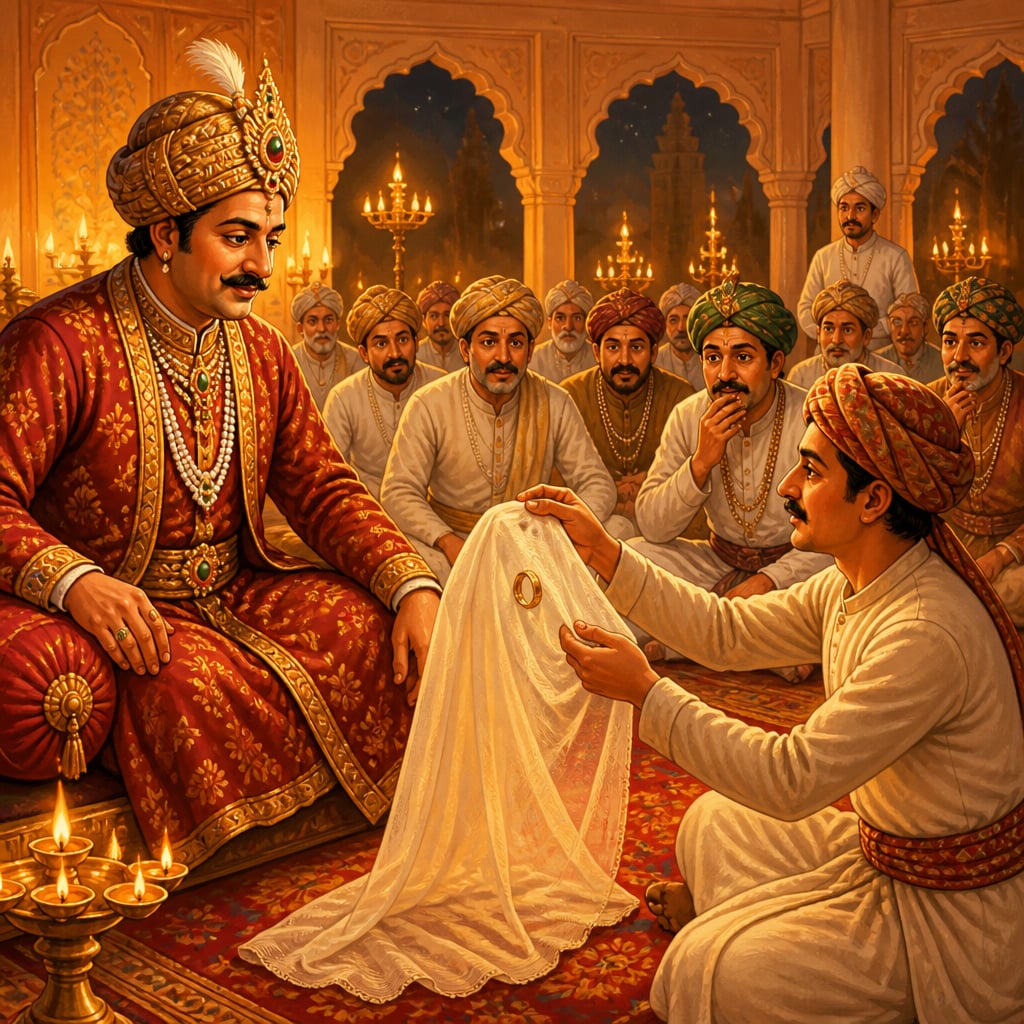
A fine ring drawn through an entire fold of Dacca muslin at the Nawab's durbar

In 1789, Nawab Asaf-ud-Daula of Awadh hosted a grand durbar. Among the European guests was a British diplomat who later recorded his astonishment: the Nawab's favorite dancer appeared to be wearing nothing at all. Only upon closer inspection did he realize she wore seven layers of muslin, each so fine that together they weighed less than a single European handkerchief.

This wasn't magic. It was Dacca muslin, cloth so gossamer that poets called it abrawan (running water), baft-hawa (woven wind), and shabnam (evening dew). A single sari could pass through a wedding ring. The entire 50-yard bolt could fit in a small matchbox.

How did Indian weavers achieve what modern technology still cannot replicate? The answer lies in an ecosystem of excellence that spanned centuries, and a tragedy that erased it within decades.

The Science of Impossible Cloth

The secret of Dacca muslin began with a plant that no longer exists: Phuti karpas, a variety of cotton that grew only in the Meghna River delta near Dacca (modern Dhaka, Bangladesh). The morning dew of this precise microclimate kept fibers supple. The water's mineral composition, scientists later analyzed it, gave the cotton a unique luster.

But raw material was only the beginning.

The Weavers' Guild of Dacca had developed techniques over forty generations. Young apprentices began training at age five, spending years just learning to spin thread. The finest muslin, called Malmal Khas (king's muslin), required:

The Mughal imperial records show a single roll of Malmal Khas (about 15 yards) sold for 400 rupees, when a skilled laborer earned 3 rupees monthly. At today's values, that's roughly ₹10 lakh per sari.

"Vastra-Kala param shilpam" "The art of cloth is the supreme craft." , Krishi Parashara

A World Dressed by India

Dacca was the summit, but Indian textiles covered the entire pyramid of global consumption.

Calico (from Kozhikode/Calicut) became so popular in Europe that France banned it in 1686, citizens were buying Indian cloth instead of French. The ban lasted 73 years, required 16,000 soldiers to enforce, and still failed. When Madame de Pompadour, mistress of Louis XV, was caught wearing Indian chintz, she simply laughed.

Fashionable Europeans dressed in Indian chintz in an 18th-century salon

Chintz (from the Hindi chint, meaning spotted) transformed European interior design. The vibrant, washable, patterned cotton, impossible to produce in Europe, decorated palaces from London to Moscow. The English word "chintzy" (meaning gaudy) actually originated as a compliment to Indian textile artistry.

The Numbers Tell the Story:

India wasn't just a textile exporter. It was the world's textile industry, period.

Global Perspectives: When Machines Met Masters

Edmund Cartwright (1743-1823), an English clergyman with no textile experience, invented the power loom in 1785. He famously claimed he'd never seen a weaver at work when he designed it. His first prototype was so crude that workers refused to use it. But his fourth version, refined over years, could produce basic cloth faster than human hands.

Cartwright's invention wasn't superior to Indian weaving, it was just cheaper. Power looms produced coarse cloth quickly; Indian weavers produced fine cloth slowly. But when combined with tariffs, bans, and colonial policy, cheap trumped quality.

Adam Smith (1723-1790) in "The Wealth of Nations" (1776) observed that Indian cotton goods were "of a quality that European manufacturers could not approach." He noted that only through trade restrictions could British industry survive against Indian competition.

Fernand Braudel (1902-1985) documented how Indian textiles created history's first global consumer market. "Indian cotton," he wrote, "was the petroleum of the early modern world, the commodity everyone needed, only India could supply at scale, and which drove imperial competition."

Indian textile bales loaded onto East India Company ships at Surat

Comparison Indian Handloom (1780) British Power Loom (1820)
Thread count 300-1,200 per inch 40-100 per inch
Quality Luxury to ultra-fine Coarse to medium
Labor time per yard 8-20 hours 15 minutes
Durability Generations Years
Unit cost High Low

The Industrial Revolution didn't beat Indian quality. It undercut Indian price, but only with state protection.

The Tragedy We Must Name

Between 1757 and 1857, India's share of world manufacturing collapsed from 24.5% to 8.6%. Textiles led this destruction.

The British systematically dismantled what centuries had built:

Dacca, which had a population of 200,000 and was called "the Manchester of the East," became a village of 30,000 by 1840. The Phuti karpas cotton went extinct, no one was left to cultivate it. The techniques for Malmal Khas died with the last master weavers.

We will explore this tragedy fully in Lesson 6. But know this: what was destroyed was not primitive. It was the world's most sophisticated textile industry, eliminated not by competition but by conquest.

Modern Resonance: The Looms Are Rising Again

In 2024, a workshop in Shantipur, West Bengal, announced they had nearly replicated 300-count muslin using heritage cotton varieties revived by CSIR scientists. It took 15 years of research. The cloth sells for ₹3 lakh per sari.

Ritu Kumar, India's foremost fashion designer, has spent five decades documenting and reviving traditional textile techniques. Her archive of block prints, weaving patterns, and dyeing methods, collected from aging artisans across India, represents knowledge that nearly vanished.

"Each village had its specialty," Kumar notes. "Chanderi's weave, Kanchipuram's silk, Patola's double-ikat. These weren't just products, they were identities. Reviving a technique revives a community."

Meanwhile, Indian textiles are achieving global dominance through different means:

Your Turn: Wearing Your Values

The next time you buy clothing, consider this: every thread carries history.

Indian textiles represented Vastra-Dharma, the sacred duty of clothing humanity with excellence. Weavers didn't just make cloth; they made offerings. The Vishwakarma Puja, still celebrated annually, honors the divine craftsman, and the weaver was among his most revered servants.

Ask yourself:

In the next lesson, we'll explore another manufacturing miracle: Wootz steel. Indian smiths created metal so advanced that European scientists spent centuries trying to understand it. The famous "Damascus swords" that Crusaders feared? They were made from Indian steel.

Modern management considers worker sustainability essential, 'sustainable work practices' are now standard HR doctrine. Burnout and overwork are recognized as productivity killers. The tech industry's 996 culture (9am-9pm, 6 days) faces increasing criticism for destroying workers.

The Dacca weaver model was unsustainable at the individual level, but the guild system sustained it across generations. Each generation sacrificed, but the craft survived. However, when British policy destroyed the entire ecosystem, there was no resilience. The lesson: extreme specialization requires robust institutional support. Remove the institution (guild, patronage, market access) and the specialization dies completely.

Dacca's population fell from 200,000 (1770) to 30,000 (1840), an 85% collapse. Entire weaver communities were eliminated within decades. The techniques died with them. Modern revival efforts have spent ₹50+ crore over 15 years and still cannot match original quality.

Modern economics recognizes transaction costs, the expense of verifying, contracting, and enforcing agreements. Ronald Coase won the Nobel Prize for this insight. High-trust societies have lower transaction costs and therefore higher economic efficiency.

The dharmic emphasis on satya (truth) in commerce created trust infrastructure that reduced transaction costs across continents. European traders noted that a Indian merchant's word was his bond, no written contracts needed. This enabled trade at scales and distances impossible under adversarial commerce. Rome, Persia, and China all trusted Indian merchants, a trust earned over centuries.

The Tamil Ainnurruvar merchant guild operated from Sumatra to Oman for 500+ years with consistent quality standards. Their guild inscriptions found across Asia testify to trust-based commerce that required no courts or contracts, just reputation and dharmic obligation.

Key terms

Vastra-Udyoga
The textile industry; the enterprise of cloth-making encompassing spinning, weaving, dyeing, printing, and finishing
Malmal
The finest grade of muslin cotton cloth; specifically refers to the gossamer-thin fabric produced in Dacca that was so fine it appeared transparent
Chint / Chintz
Printed or painted cotton cloth with colorful patterns; the origin of the English word 'chintz' for patterned cotton fabric
Phuti Karpas
The specific variety of cotton that grew only in the Meghna River delta near Dacca; the raw material that made ultra-fine muslin possible

Verses

वस्त्रकला परमं शिल्पम्

Vastra-kalā paramam shilpam

The art of cloth is the supreme among crafts.

By elevating textile craft to spiritual status, Indian culture created intrinsic motivation that no wage system could replicate. Weavers pursued impossible standards not for money but for honor and divine service. This explains why techniques like 1,000-count muslin developed, no rational economic calculation would justify the investment without this spiritual framework.

Krishi Parashara, Section on Vastra (Cloth) (Based on traditional interpretations)

सत्येन विभ्राजते लक्ष्मीः

Satyena vibhrājate lakṣmīḥ

Prosperity shines brightest when founded on truth.

The dharmic emphasis on truth (*satya*) in commerce created India's greatest competitive advantage: trust. European traders noted that Indian merchants rarely needed written contracts, their word was sufficient. This reduced transaction costs and enabled long-distance trade at a scale impossible with adversarial commerce. When colonialism introduced exploitation norms, it destroyed this trust infrastructure.

Manusmriti, Chapter 4, Verse 2 (Based on Ganganath Jha translation)

वस्त्राध्यक्षो वयने नियुञ्ज्यात्

Vastrādhyakṣo vayane niyuñjyāt

The Superintendent of Textiles shall oversee the art of weaving.

India had industrial policy 2,300 years ago. The Vastradhyaksha (Textile Superintendent) ensured quality marks, prevented fraud, protected workers from exploitation, and promoted exports. This institutional support, guild systems backed by state policy, created the ecosystem for textile excellence. Modern PLI schemes echo this ancient wisdom.

Arthashastra, Book 2, Chapter 23 (Superintendent of Weaving) (Based on R.P. Kangle translation)

Key figures

The Master Weavers of Dacca

c. 1500-1850 CE

Ritu Kumar

1944-present

Edmund Cartwright

1743-1823

Case studies

Tirupur: From Village to Knitwear Capital of Asia

In 1970, Tirupur was a small town in Tamil Nadu known for little except cotton farming. Today, it's Asia's largest knitwear export hub, generating ₹50,000+ crore annually and employing 600,000 workers directly. How did a village become 'Dollar City'? The answer lies in a modern version of the ancient shreni (guild) system. When demand for hosiery emerged in the 1970s, local entrepreneurs formed loose associations, sharing technology, dividing production, and collectively accessing export markets. No single company dominated; instead, 10,000+ small units cooperated and competed simultaneously. When a Western brand ordered 1 million t-shirts, the order was distributed across dozens of units that specialized in cutting, stitching, printing, and finishing.

Tirupur recreated the ancient shreni model without naming it. Like historical weaving guilds, Tirupur's exporters share technology (dyeing formulas, machinery access), maintain collective quality standards (TIRUPUR brand certification), and coordinate for scale while remaining independent. The dharmic principle of *sahayoga* (cooperation) enables 10,000 small units to compete with giant Chinese factories. Individual units might be small, but the cluster is mighty. This is Vishwa-Kalyana thinking: the collective welfare of the cluster matters more than any individual unit's dominance.

Tirupur now exports to 150+ countries. Major brands, H&M, Primark, Decathlon, source knitwear here. The cluster model proved resilient during COVID-19, quickly pivoting to mask and PPE production. Employment is relatively equitable, the owner-operator model means wealth is distributed rather than concentrated. The cluster has invested collectively in water treatment (a major environmental challenge) and skills training. Tirupur demonstrates that Indian manufacturing can compete globally through collaboration, not just scale.

The shreni model isn't ancient history, it's competitive strategy. When small units cooperate (sharing technology, standards, market access) while competing (on quality, speed, price), they achieve both flexibility and scale. Tirupur proves that dharmic economics, prioritizing cluster welfare alongside individual profit, creates sustainable competitive advantage that pure capitalism cannot replicate.

Fast fashion faces a sustainability crisis, with consumers and regulators demanding transparency about working conditions and environmental impact. Tirupur's cluster model, where small units are embedded in local communities and cooperate on standards, offers a structural alternative to opaque global supply chains. European fashion brands are increasingly sourcing from Tirupur specifically because the cluster structure enables traceability.

Tirupur's exports grew from ₹2,800 crore (2000) to ₹50,000+ crore (2024), an 18x increase in 24 years. The cluster exports 4+ billion garments annually to 150+ countries, making it India's largest textile export hub.

Historical context

Indian Textile Dominance (3000 BCE - 1850 CE)

Indian textiles weren't just products, they were civilization's clothing. From the Indus Valley to the Mughal Empire, Indian weavers dressed humanity. The industry employed millions, funded temples and universities, and created India's largest export sector. At its peak, Indian textiles accounted for 25% of world textile production.

When India was exporting 500-count muslin, the best European cloth was coarse wool. When Indian chintz decorated Versailles, French weavers couldn't replicate the colors. The Industrial Revolution succeeded not by matching Indian quality but by making acceptable quality cheap, and then using state power to destroy Indian competition.

In 1750, India produced 24.5% of world manufacturing output; Britain produced 1.9%. By 1900, India produced 1.7% and Britain 18.5%. This reversal wasn't natural economic evolution, it was engineered through tariffs, bans, and the deliberate destruction of Indian industry.

Understanding textile history reveals both India's manufacturing heritage and how that heritage was destroyed. The lesson isn't nostalgia, it's strategic. The capabilities existed. The institutions existed. They were destroyed by policy, not competition. Reviving Indian manufacturing requires understanding what we're actually recovering.

Living traditions

India is the world's #2 textile exporter ($44.4 billion, 2023-24). The industry employs 45 million workers directly and another 60 million indirectly. Traditional handloom exports have grown to ₹3,000+ crore, proving ancient techniques can compete in modern markets. The PLI scheme for textiles (₹10,683 crore) aims to make India a global hub for technical textiles and sustainable fashion.

Reflection

More in India's Industrial Heritage

All lessons in India's Industrial Heritage · Vaishya Dharma: The Art of Ethical Commerce course