Uttaradhikari-Niti: Succession Planning the Dharmic Way
Grooming Heirs Before You Need Them
The ancient art of preparing the next generation, how dharmic succession planning differs from Western estate planning, and why the Ambanis' three-year mediation became a masterclass in what works.
The Three-Year Conversation
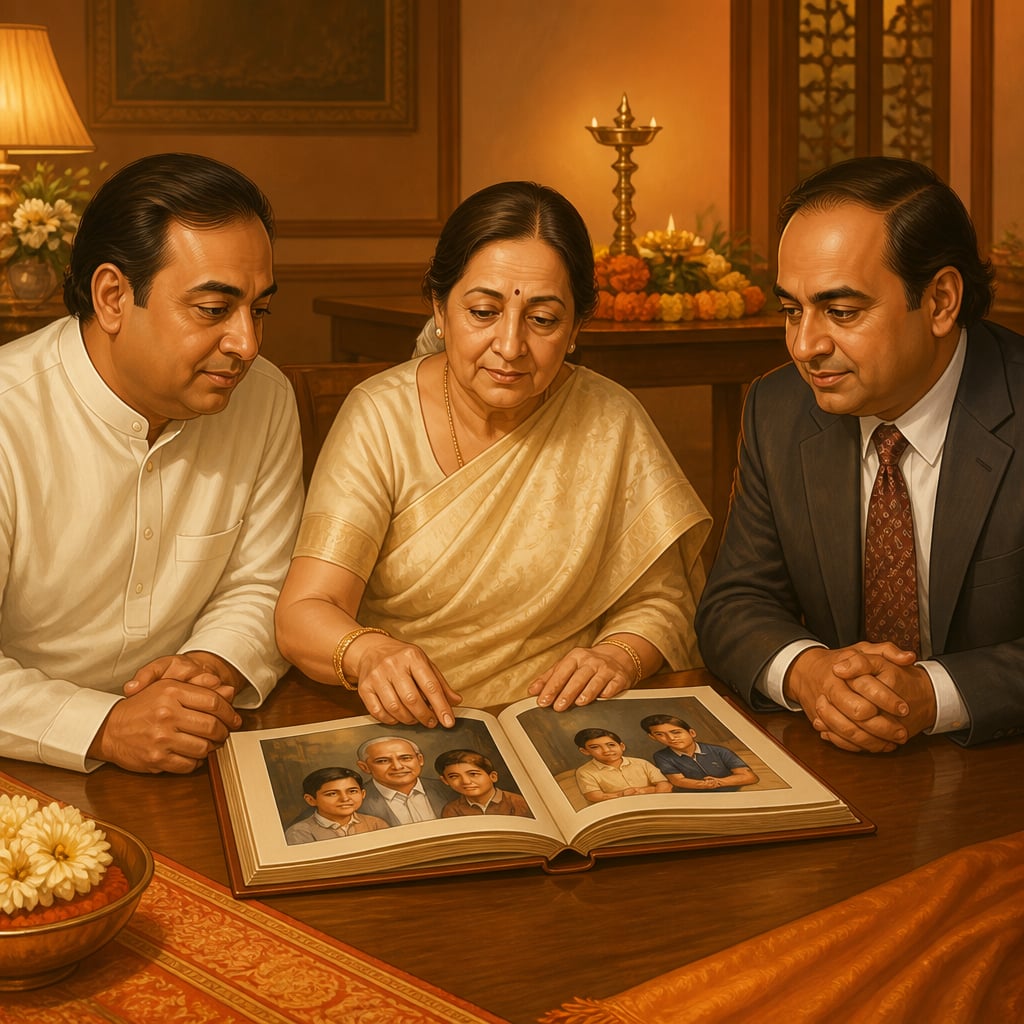
In the summer of 2002, Kokilaben Ambani faced an impossible task. Her husband Dhirubhai had just died without a will. Her sons Mukesh and Anil, both in their forties, both proven executives, were barely speaking. The media predicted a courtroom battle that would destroy Reliance Industries. Shareholders trembled. India watched.
What happened next surprised everyone: nothing visible. For three years, Kokilaben conducted quiet conversations. Family dinners. Private meetings. Shuttle diplomacy between two headstrong billionaires. No lawyers. No courts. No press leaks.
On June 18, 2005, the family announced a clean partition. Mukesh got petrochemicals and telecom. Anil got finance and infrastructure. The division was mediated, not litigated. The relationship was strained but not destroyed. And the combined empire, rather than shrinking through legal warfare, would multiply twentyfold over the next two decades.
This is Uttaradhikari-Niti, the dharmic science of succession. And it starts long before anyone dies.
The Dharmic Framework: Why Succession Isn't Just Estate Planning
Western estate planning asks: "How do I transfer assets at death with minimal taxes?"
Dharmic succession planning asks something deeper: "How do I prepare my heirs to receive, preserve, and grow what I've built?"
The Dharmashastras distinguish between:
Dāya (inheritance): The technical transfer of property rights Uttarādhikāra (succession): The comprehensive preparation of successors to carry forward responsibility
"Uttarādhikāriṇaṁ kāryakuśalaṁ niyojayet" "Appoint as successor one who is skilled in affairs."
This Arthashastra principle applies to kingdoms but translates directly to family business: succession is about competence, not just entitlement.
The Three Phases of Dharmic Succession
Traditional Indian succession planning unfolds across three phases, ideally spanning decades, not rushed in final months:
Phase 1: Parikṣā (Testing)
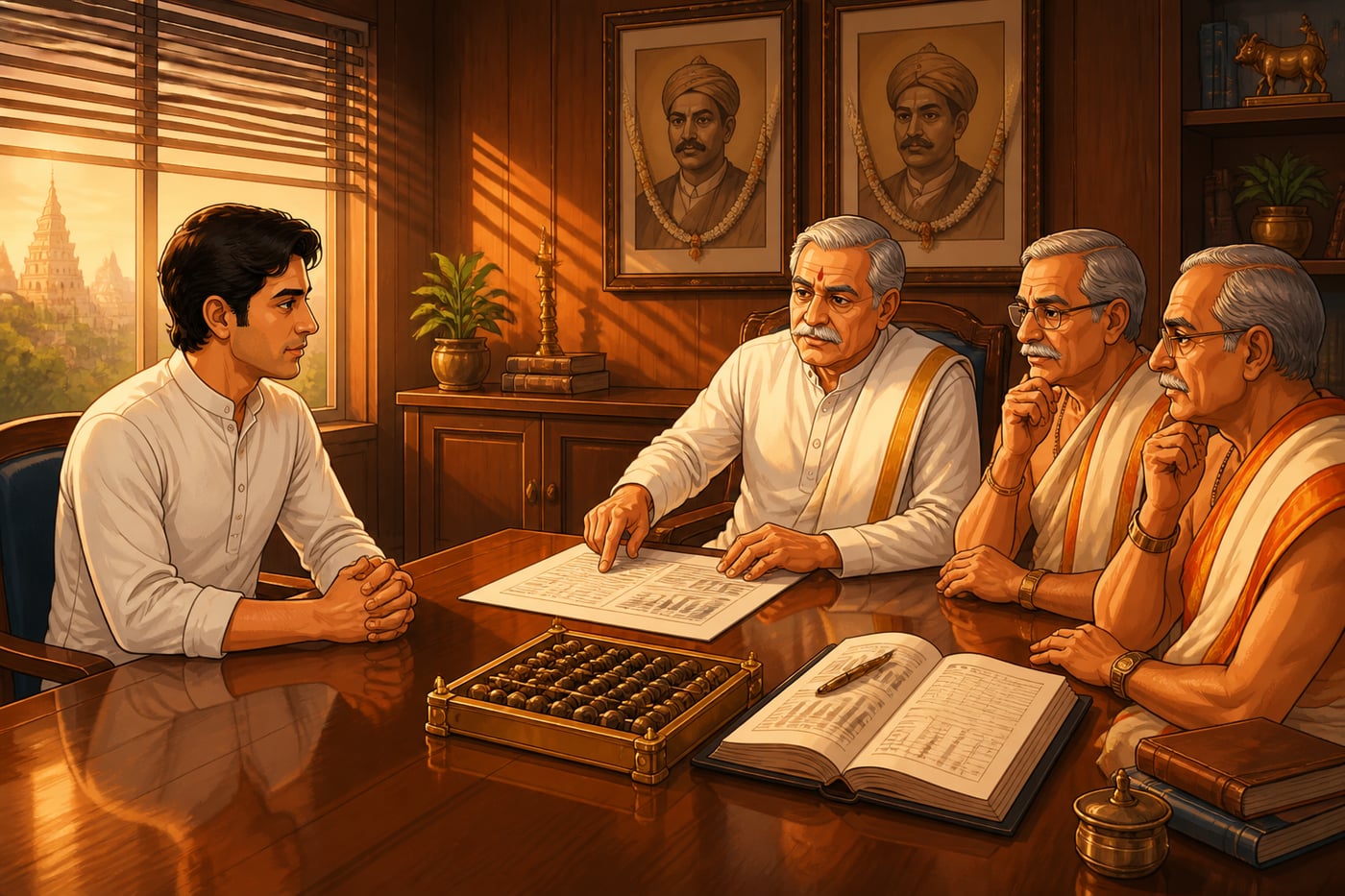
This phase assesses potential heirs across multiple dimensions:
Buddhir (intellect): Can they understand complex business? Vīrya (energy/courage): Will they make hard decisions? Smṛti (memory/learning): Do they absorb and apply lessons? Dakṣatā (competence): Can they execute, not just strategize? Śīla (character): Do they have integrity under pressure?
Rahul Bajaj tested his sons for years. Rajiv rotated through manufacturing roles; Sanjiv through finance. Their different temperaments emerged naturally, guiding eventual division.
Dhirubhai Ambani did test his sons, but perhaps for different roles than eventual reality required. Both Mukesh and Anil worked across Reliance operations. Both proved capable. The testing phase succeeded; the role-assignment phase was left incomplete.
Phase 2: Śikṣaṇa (Training)
Once tested, heirs must be trained, not just in skills, but in the family's specific business philosophy:
Vyāvahārika Jñāna (practical knowledge): Operations, finance, markets Kula-Dharma (family values): The specific principles that guide this family's business Sambandha-Nirmāṇa (relationship building): Networks, reputation, stakeholder trust
The Murugappa Group formalizes this through mandatory cross-functional rotations. A Murugappa family member must work in at least three different business units before senior leadership. This isn't hazing, it's systematic training that builds both competence and relationships across the conglomerate.
Phase 3: Ādhikāra-Sthāpana (Authority Establishment)

The final phase, often neglected, establishes the successor's authority while the patriarch still lives:
Public Acknowledgment: The family and business community recognize the successor Graduated Responsibility: Increasing scope before full handover Patriarch Withdrawal: The outgoing leader steps back, allowing the successor to lead
Dhirubhai's sudden death interrupted this phase. His sons had been tested and trained, but authority establishment was incomplete. Neither son had been publicly designated as primary successor. This gap created the conflict.
Global Perspectives on Succession Planning
John Ward identifies the transition from second to third generation as the "succession valley of death", 70% of family businesses fail at this juncture. His research shows that structured succession planning, ideally beginning 10-15 years before transition, dramatically improves survival odds.
The Walton Family used a different approach: Sam Walton distributed equal shares to his four children early, then gradually transitioned operating control to professional managers. By separating ownership (family) from management (professional), they avoided the "which child leads?" conflict entirely.
German Mittelstand companies often use the "shadow board" model: next-generation family members form a junior board that shadows the senior board for years before taking over. This institutionalizes Phase 2 (training) and Phase 3 (authority establishment).
| Model | Ownership Transfer | Management Transfer | Conflict Risk |
|---|---|---|---|
| Indian Traditional | At death or partition | To chosen heir | High if unclear |
| Walton Model | Early, equal | To professionals | Low (management separate) |
| German Shadow Board | Gradual | To trained family | Moderate |
| Bajaj Model | At structured partition | Split by competence | Low (matched to skills) |
The Ambani Case: What Worked, What Didn't
What Dhirubhai did right:
- Built an empire worth fighting for
- Trained both sons across operations
- Maintained family unity during his lifetime
- Trusted traditional HUF frameworks over Western estate planning
What was left incomplete:
- No clear succession designation
- No will (though in HUF this is partly structural)
- No mediated conversation about post-death arrangements
- Both sons expected primacy
What Kokilaben did right:
- Refused to let it go to court
- Took three years rather than rushing
- Matched assets to temperaments
- Preserved enough relationship for future cooperation
- Ensured each son could succeed independently
The dharmic principles at work:
Vibhāga with anumati (partition with consent): Kokilaben followed Narada Smriti's requirement that partition occurs through mutual consent, not imposition.
Svabhāva-matching: Each son received businesses matching his demonstrated strengths, Mukesh the capital-intensive industries, Anil the people-intensive services.
Santati-rakṣaṇa (lineage protection): The partition created two new HUFs, continuing family structure into the next generation.
Modern Tools for Dharmic Succession
Today's families can blend traditional wisdom with modern instruments:
Family Constitution: A written document codifying governance rules, succession criteria, and dispute resolution procedures. The Murugappas pioneered this in India in the 1950s.
Gradual Authority Transfer: Rather than sudden transition at death, use board seats, CEO transitions, and operational handovers spaced over years.
Competence Criteria: Define objective measures for succession, education, experience, performance, reducing subjective favoritism.
Mediation Protocols: Pre-agree that disputes will be mediated by trusted elders before litigation. Kokilaben's role was improvised; future families can institutionalize it.
Living Partition: Rather than waiting for death to trigger division, consider structured partition while the patriarch is alive and can guide the process.
When Succession Planning Fails: Warning Signs
Watch for these indicators that succession is heading toward disaster:
- The Undiscussable Topic: If succession is never openly discussed, conflict is building underground
- Favoritism Perception: If siblings believe parents favor one child, resentment compounds
- Competence-Entitlement Mismatch: When the entitled heir isn't the competent one
- External Spouses' Influence: In-laws with different values can complicate family dynamics
- Delayed Transition: A patriarch who won't let go forces heirs to wait, creating frustration
- No Exit Option: If the only path is staying, trapped family members become resentful
Your Turn: The Five Questions
Whether you're planning succession or expecting to inherit, ask yourself:
- Have you been tested? Not just given positions, but genuinely assessed across competencies?
- Are you being trained? Rotating through roles, building relationships, learning the family dharma?
- Is authority being established? Are you gradually being recognized as successor, or is it ambiguous?
- Do you know your role? In a multi-heir situation, do you know which part of the empire is yours?
- Can you exit gracefully? If family business isn't for you, is there a path out that preserves relationships?
Dharmic succession isn't about the moment of transfer, it's about the decades of preparation that make transfer seamless. Kokilaben's three years of mediation worked because Dhirubhai's decades of building had created something worth mediating about.
In the next lesson, we examine what happens when mediation fails, how to resolve disputes that threaten to tear families apart.
Modern succession planning uses competency models and development programs. McKinsey's succession research emphasizes 'readiness' across multiple dimensions. Ward's work prescribes 10-15 years of preparation.
The three-phase framework (parīkṣā-śikṣaṇa-ādhikāra) provides an integrated model that Western consulting firms separately rediscover. Testing, training, and authority establishment aren't sequential stages but overlapping processes that take decades.
A Credit Suisse study found that Indian family businesses with formalized succession processes (documented training, testing, transition) have 47% higher survival rates to third generation compared to those with informal processes.
Alternative Dispute Resolution (ADR) has become standard in commercial contexts. Family business mediation is a specialized field. But Western approaches often bring in external professionals; Indian tradition emphasizes family elders.
The family madhyastha has advantages no external mediator can match: deep knowledge of personalities, shared stake in family preservation, and moral authority born of relationship. Kokilaben's mediation worked because she was mother to both parties, not despite it.
Studies suggest mediated family business transitions preserve 30-50% more value than litigated ones, through faster resolution, lower legal costs, and reduced management distraction. The Ambani mediation likely preserved ₹50,000+ crore compared to litigation outcomes.
Key terms
- Uttarādhikāra
- Succession; the comprehensive process of preparing, selecting, and establishing successors, more than mere inheritance, it includes training and authority transfer
- Parīkṣā
- Testing, examination; the systematic assessment of potential heirs across multiple competencies before succession decisions
- Kula-Dharma
- Family duty; the specific values, principles, and practices that define a particular family's way of doing business
- Madhyastha
- Mediator; one who stands in the middle, facilitating resolution between conflicting parties, a crucial role in family succession disputes
Verses
उत्तराधिकारिणं कार्यकुशलं नियोजयेत्
uttarādhikāriṇaṁ kāryakuśalaṁ niyojayet
Choose for your heir one skilled in deeds, not merely born to inheritance.
This is ancient advocacy for meritocracy within family succession. While birth creates entitlement under Mitakshara, actual leadership should go to the competent. The Bajaj solution, dividing by competence rather than choosing one, honors both principles.
Arthashastra, Book 5, Chapter 6 (Based on R.P. Kangle translation)
शिक्षितः शास्त्रकुशलः सर्वार्थेषु विचक्षणः। उत्तराधिकारी भवेत् यः स राज्ये प्रतिष्ठितः॥
śikṣitaḥ śāstrakuśalaḥ sarvārtheṣu vicakṣaṇaḥ | uttarādhikārī bhavet yaḥ sa rājye pratiṣṭhitaḥ ||
Let the trained one, master of knowledge, discerning in all matters, he alone should stand as heir to the realm.
This multi-criteria approach to succession, training, knowledge, discernment, anticipates modern competency frameworks. Indian family businesses that systematically train heirs across multiple dimensions show higher succession success rates.
Mahabharata, Shanti Parva, 59.30 (Based on K.M. Ganguli translation)
पिता पुत्राय दद्याद्वा संविभागं समं तयोः
pitā putrāya dadyād vā saṁvibhāgaṁ samaṁ tayoḥ
The father may gift to one, or equally divide among all.
This verse provides dharmic authority for differentiated succession, allocating more to the more capable. While coparcenary ensures baseline equality, the patriarch's self-acquired wealth and living partition decisions can reward competence.
Brihaspati Smriti, Chapter on Inheritance (Based on Julius Jolly translation)
Key figures
Kokilaben Dhirubhai Ambani
1934-present
Bhishma Pitamaha
Mahabharata period (traditional dating ~3000 BCE; scholarly dating 1500-500 BCE)
John L. Ward
1945-present
Case studies
Ambani Succession: How Three Years of Mediation Saved an Empire
July 6, 2002: Dhirubhai Ambani, India's most famous entrepreneur, dies of a stroke at 69. He leaves no will. His empire, Reliance Industries, is worth over ₹75,000 crore, India's largest private company. His sons Mukesh (45) and Anil (43) have worked together for two decades but have fundamentally different personalities and visions. Mukesh is analytical, focused on heavy industry, refineries, petrochemicals. Anil is charismatic, drawn to consumer-facing businesses, telecom, finance, entertainment. Both have operated as co-equals, each expecting primacy. For months, tensions simmer. Board meetings become awkward. The media senses blood. Shareholders begin to panic, Reliance stock wobbles.
The situation demanded a madhyastha, and Kokilaben Ambani stepped into the role. Her approach followed dharmic principles: 1. **No courts**: She refused to let the dispute become litigation, preserving the possibility of relationship. 2. **Patient dialogue**: Three years of conversation, not rushing to resolution, but allowing each son to be heard fully. 3. **Svabhāva-matching**: Rather than forcing one son to subordinate, she designed a partition that matched each son's demonstrated strengths to different businesses. 4. **Preserving coparcenary structure**: Each son's family became a new HUF, continuing the framework for the next generation. 5. **Future optionality**: The partition wasn't punitive, both sides retained enough relationship for future cooperation when needed. The June 2005 announcement reflected this process: clean division, no lingering disputes, no public acrimony.
Immediate outcome: Mukesh retained Reliance Industries (petrochemicals, refining, retail). Anil received Reliance Communications, Reliance Energy, Reliance Capital, and entertainment assets. The partition was announced as 'amicable', unusual language for family business divisions. Long-term outcome: Mukesh's Reliance Industries grew from ₹75,000 crore (2002) to ₹20+ lakh crore (2024), a 25x increase. Anil's ventures struggled (telecoms competition, debt burden, regulatory issues), eventually collapsing in the 2010s. But the family relationship survived enough that Mukesh bailed out Anil in 2020 when Ericsson threatened contempt proceedings, paying ₹453 crore to prevent his brother's imprisonment. The succession that could have destroyed Reliance instead created India's richest man and preserved family bonds despite business divergence.
The Ambani case teaches that succession failures aren't about the moment of transition, they're about the decades before. Dhirubhai's incomplete succession planning created the crisis; Kokilaben's patient mediation resolved it. Families that wait for crisis to plan succession are already too late.
High-profile founder disputes at companies like Infosys (Murthy vs. Sikka), Flipkart (Sachin vs. Binny dynamics), and WeWork (Neumann vs. board) show that succession planning remains the weakest link in business continuity. The Ambani mediation model, where a family elder (Kokilaben) served as a trusted intermediary, highlights that informal authority often resolves what formal contracts cannot.
The three-year mediation cost essentially nothing in legal fees. Had the Ambanis litigated (like the ongoing 18+ year Birla Priyamvada case), estimates suggest 30-50% of value could have been destroyed through management distraction, investor uncertainty, and legal costs, potentially ₹25,000+ crore.
Historical context
Modern Indian Business (2002-2005)
The 2002-2005 period was transformative for Indian business, liberalization was deepening, valuations were rising, and traditional family structures faced new pressures. The Ambani succession became a test case for whether dharmic frameworks could handle contemporary complexity.
Contemporary global family business successions, Murdoch (News Corp), Redstone (Viacom), Pritzker (Hyatt), typically involved courts, lawyers, and prolonged public battles. The Ambani resolution through family mediation was unusual by global standards.
At the time of Dhirubhai's death, Reliance was worth approximately ₹75,000 crore. By 2024, Mukesh's portion alone exceeded ₹20 lakh crore, demonstrating that the partition enabled rather than destroyed value.
The Ambani case provides a live example of dharmic succession principles in action. It shows both the cost of incomplete planning (the crisis) and the power of traditional mediation (the resolution). Every Indian family business can learn from this case.
Living traditions
The Ambani succession has become a case study taught in business schools globally. It demonstrates that traditional family mediation can handle modern complexity, and that the costs of not planning succession far exceed the costs of planning it. The three-year mediation model has been referenced in subsequent Indian family business transitions.
- Family Councils: Formal bodies that meet regularly to discuss family business governance, succession, and disputes, institutionalizing traditional family decision-making
- Succession Planning Programs: Structured multi-year programs to test, train, and establish authority for next-generation family members, modernizing the three-phase dharmic approach
- Family Constitution Development: Written documents codifying governance rules, succession criteria, and dispute resolution, the Murugappa model, now widely adopted
- Indian School of Business, Hyderabad: Home of the Thomas Schmidheiny Centre for Family Enterprise, offering programs on succession planning for Indian family businesses
- SP Jain Institute, Mumbai: Offers specialized family business programs including succession planning modules blending Western frameworks with Indian family dynamics
- Siddhivinayak Temple: Mumbai's most visited temple, where business families seek Ganesha's blessings during succession transitions. The temple itself demonstrates successful institutional succession across generations of trustees.
- Reliance Corporate Campus Temple: The Ambani family maintains temple facilities at their Jamnagar complex, demonstrating how modern corporate families integrate spiritual practice with business governance.
Reflection
- Kokilaben Ambani took three years to mediate between her sons, refusing to rush despite enormous pressure. In what ways might patience be more valuable than speed in succession planning, and when might delay become dangerous?
- Design a three-phase succession plan for your own family or a family you know well. What specific tests would Phase 1 include? What training in Phase 2? How would Phase 3 establish authority before full transition?