Mitakshara: Joint Family Property System

The School That Built Business Dynasties

How Vijnaneswara's 11th-century legal commentary created the ownership framework that governs 90% of Hindu families today, and why its coparcenary rules remain unmatched for preserving multi-generational wealth.

The Document That Ruled a Billion Lives
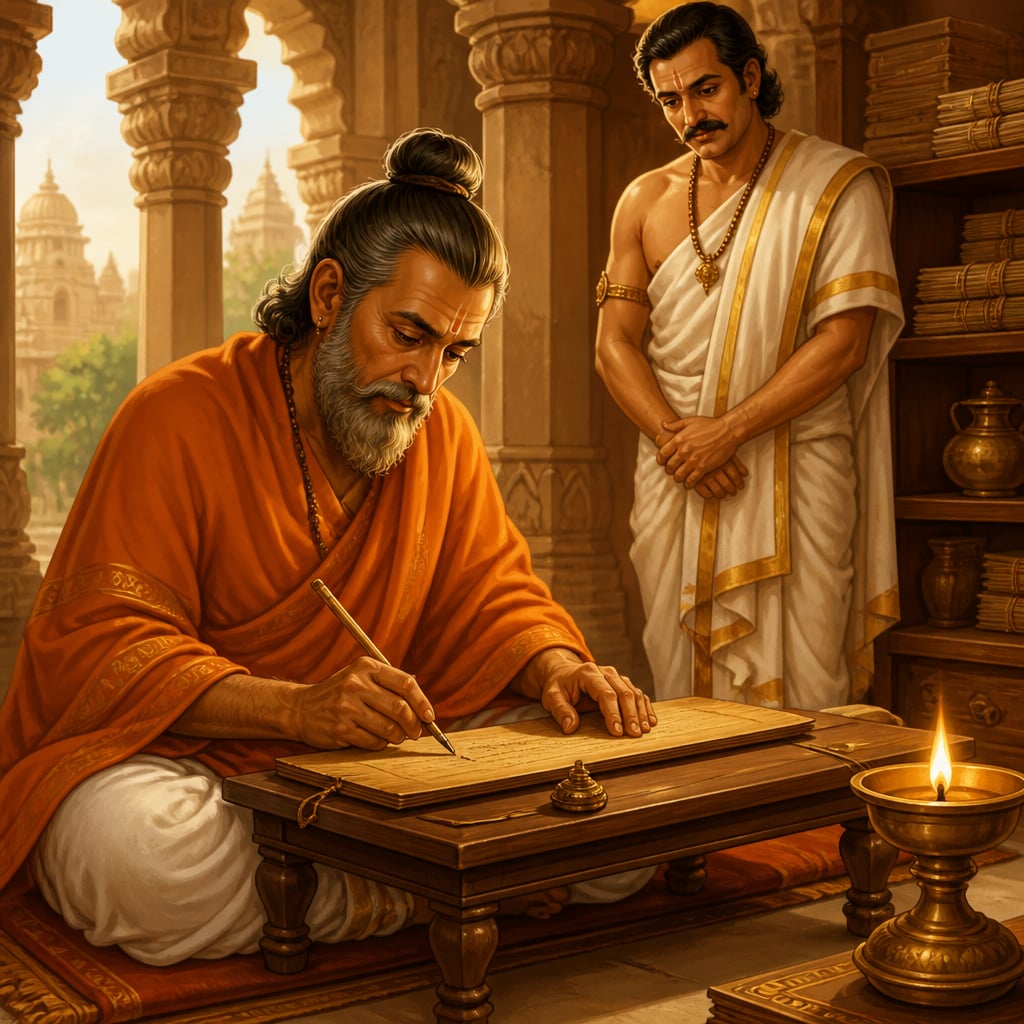
Vijnaneswara composing the Mitakshara at Chalukya court

In the court of Chalukya King Vikramaditya VI, around 1100 CE, a brilliant jurist named Vijnaneswara completed a commentary on the ancient Yajnavalkya Smriti. He called it Mitakshara, "measured words." Those measured words would determine how property passes through families for the next millennium.

Today, when a Marwari businessman in Mumbai structures his holdings, when a Gujarati entrepreneur in Ahmedabad plans succession, when the Bajaj family divides responsibilities between brothers, they're all operating within Vijnaneswara's framework. The Mitakshara school governs approximately 90% of Hindu families, covering over a billion people. No single legal document has shaped more wealth transfer than this 900-year-old commentary.

What did Vijnaneswara understand about family property that modern legal systems still struggle to replicate?

The Revolutionary Idea: Ownership by Birth

The Mitakshara's central doctrine is deceptively simple:

"Janmanā eva svatvam" "By birth alone does ownership arise."

This single principle revolutionizes inheritance. In Western law, children are heirs-in-waiting, they inherit only when parents die. Until then, parents can spend, sell, or give away everything. Children have expectations, not rights.

Mitakshara flips this entirely. The moment a child is born, they become a coparcener (sahādāyika), a co-owner of ancestral property. Not a future heir. A current owner.

The implications cascade:

  1. Father cannot alienate freely: Ancestral property cannot be sold or gifted without coparceners' consent (with limited exceptions for family necessity)
  2. Each generation is automatically invested: No need for estate planning to involve heirs, they're already owners
  3. Family wealth compounds: The structure discourages dissipation because current owners include future generations

Understanding Coparcenary: The Four-Generation Rule

Mitakshara coparcenary traditionally includes male descendants within four generations from a common ancestor. Imagine a family tree:

Great-grandfather (Prāpitāmaha)
    ↓
Grandfather (Pitāmaha)
    ↓
Father (Pitā)
    ↓
Son (Putra)

All four are coparceners, joint owners of property acquired by any ancestor in the line. When the great-grandfather dies, his share doesn't "pass" to anyone, it simply ceases to exist, and the remaining coparceners' shares adjust automatically.

Daughter taking her coparcener seat after the 2005 amendment

The 2005 Amendment: The Hindu Succession (Amendment) Act, 2005, transformed coparcenary by including daughters as coparceners by birth, with the same rights as sons. This was a landmark change, daughters in the Bajaj family, for instance, now have equal coparcenary rights to their brothers in ancestral property.

Types of Property: What's Coparcenary, What's Not

Mitakshara distinguishes critically between:

Ancestral Property (Paitrika): Property inherited from father, grandfather, or great-grandfather. This is coparcenary, all coparceners have birth-right shares.

Self-Acquired Property (Svārjita): Property you earn yourself through your own efforts. This is NOT coparcenary, you have complete control.

The distinction matters enormously:

Property Type Owner's Control Coparceners' Rights Can Be Willed Away?
Ancestral Limited Birth-right shares Only personal share
Self-Acquired Complete None until inheritance Yes, fully

This is why the Ambani partition was complex: Dhirubhai Ambani built Reliance himself (self-acquired), but reinvested profits became business assets. The lines blur across generations.

Global Perspectives on Joint Ownership

John Ward at Northwestern has documented that unclear ownership is the #1 killer of family businesses. His prescribed solution, the "Three-Circle Model" separating family, ownership, and management, attempts to create clarity where Mitakshara provides it automatically.

The Walton Family (Walmart) uses a different approach: Walton Enterprises LLC holds family assets, with complex voting and distribution rules governed by partnership agreements. Annual legal fees exceed $50 million. The Mitakshara achieves similar results through customary law alone.

German Mittelstand companies (mid-sized family businesses) struggle with succession precisely because German inheritance law mandates equal division, fragmenting family businesses. Mitakshara's coparcenary keeps property unified until deliberate partition.

System Ownership Clarity Unity Preservation Setup Cost
Mitakshara By birth (automatic) High until partition Zero (customary law)
US Family Trust By documentation Depends on drafting $50K-$500K+
German Inheritance Statutory shares Low (mandatory division) Minimal
UK Discretionary Trust Trustee discretion High $20K-$100K+

The Kartā: Manager Without Ownership Increase

The Kartā (head of the HUF) has extraordinary management powers but no extra ownership. He can:

But he cannot:

This separation of management from ownership anticipates what corporate governance calls the "stewardship model." The Kartā is a fiduciary, not a feudal lord.

Rahul Bajaj served as Kartā of the Bajaj family for decades. His management grew the business from ₹72 crore revenue (1972) to ₹35,000+ crore (2022). But his share remained what coparcenary rules dictated, not a rupee more. His sons Rajiv and Sanjiv inherited as coparceners, not as beneficiaries of their father's management.

Modern Application: Bajaj Family's Graceful Division

Rahul Bajaj and sons signing a graceful family partition

When Rahul Bajaj (1938-2022) contemplated succession, he faced what destroys most family businesses: two capable sons with different visions. Rajiv, the elder, gravitated toward manufacturing (Bajaj Auto). Sanjiv preferred financial services (Bajaj Finserv).

Instead of choosing one successor or forcing co-management, the family used Mitakshara principles:

  1. Acknowledged coparcenary rights: Both sons had equal birth-rights, no favoritism possible
  2. Partitioned by asset type: Manufacturing to Rajiv, finance to Sanjiv, each son's temperament matched
  3. Maintained family holding: Bajaj Holdings and Investment Ltd. remains substantially family-held
  4. Created new coparcenaries: Each son's family now forms separate HUF with their children as coparceners

The result? Two thriving companies, no litigation, no public acrimony, and a family that still celebrates Diwali together. In 2024, combined Bajaj group market capitalization exceeds ₹8 lakh crore, grown from approximately ₹10,000 crore at Rahul Bajaj's succession.

When Mitakshara Becomes Constraint

The system isn't perfect. Mitakshara can become burdensome when:

  1. Family consensus breaks down: Requiring coparcener consent can create deadlocks
  2. Business needs capital: Ancestral property can't be pledged without consent, limiting financing options
  3. Coparceners multiply: Each generation adds coparceners, potentially fragmenting decision-making
  4. Family members are estranged: Legal coparceners may have no actual relationship

The solution? Partition (vibhāga). The Dharmashastras explicitly permit division when unity no longer serves. Partition isn't failure, it's the system's built-in flexibility.

Your Turn: Mapping Your Coparcenary

If your family has ancestral property, you likely have coparcenary rights you may not know about. Ask yourself:

  1. What property came from your grandfather or great-grandfather? That's potentially coparcenary.
  2. Who are your coparceners? Father, siblings (including sisters post-2005), father's siblings and their children within four generations.
  3. What's self-acquired vs. ancestral? Your father's salary-bought house is self-acquired. Grandfather's land is ancestral.
  4. Who is the Kartā? Typically the eldest male, but can be challenged or changed.

Understanding your position in the coparcenary isn't just academic, it's financial self-defense. Many families have lost wealth simply because coparceners didn't understand their rights.

In the next lesson, we'll explore the Dayabhaga school, the alternative system that governs Bengal and parts of eastern India, with its radically different approach to inheritance.

Modern stakeholder theory (R. Edward Freeman, 1984) argues businesses should consider all stakeholders, not just shareholders. But Western law still treats children as future heirs, not current stakeholders. Mitakshara made future generations current stakeholders by law.

Birth-right ownership forces long-term thinking structurally. A patriarch cannot 'extract value' before death without violating coparceners' rights. This constraint is feature, not bug, it preserves wealth across generations.

Studies by the Indian School of Business show family businesses operating under HUF frameworks have 23% higher survival rates to third generation compared to individually-held family businesses.

Berle and Means (1932) famously identified the 'separation of ownership and control' in modern corporations as problematic, managers don't act in owners' interests. Mitakshara solved this differently: the Kartā IS an owner (with equal share), just not MORE of an owner for managing.

The Kartā has skin in the game but no excess reward for management. This creates stewardship incentives, the Kartā benefits from growing family wealth, not from extracting personal benefit. Rahul Bajaj grew Bajaj Auto 500x but his share remained what coparcenary rules dictated.

A 2019 study found that Indian family businesses with traditional Kartā structures had 34% lower 'related party transactions' (potential self-dealing) compared to those with CEO-dominant structures.

Key terms

Sahādāya / Coparcenary
The body of coparceners; the collective group holding joint ownership of ancestral property under Mitakshara law
Paitṛka Sampatti
Ancestral property; property that has descended through at least one generation, subject to coparcenary rules
Svārjita
Self-acquired property; wealth earned through one's own efforts, fully owned by the individual without coparcenary claims
Avibhājya Svatva
Undivided ownership; the state where coparceners hold property jointly without specific portions assigned until partition

Verses

पैतृकं द्रव्यं पितृपैतामहप्रपैतामहक्रमागतम्

paitṛkaṁ dravyaṁ pitṛ-paitāmaha-prapaitāmaha-kramāgatam

Ancestral wealth flows down through father, grandfather, and great-grandfather in unbroken chain.

This definition creates a time-locked wealth preservation mechanism. Once property passes even one generation, it becomes subject to coparcenary rules, automatically engaging the next generation as stakeholders. Self-acquired wealth has freedom; inherited wealth has responsibility.

Mitakshara, Commentary on Yajnavalkya Smriti 2.120 (Based on J.R. Gharpure translation)

अप्रतिबन्धदायो जन्मना भवति

apratibandha-dāyo janmanā bhavati

The right to inherit flows unobstructed from the moment of birth.

This creates what economists call 'automatic vesting', rights attach without action. The practical effect is that every coparcener has standing to object to property alienation from day one. This constrains the Kartā's power but protects family wealth from individual dissipation.

Mitakshara, Commentary on Yajnavalkya Smriti 2.121 (Based on J.R. Gharpure translation)

कर्ता तु ज्येष्ठः पुत्राणां भ्रातॄणां वा

kartā tu jyeṣṭhaḥ putrāṇāṁ bhrātṛṇāṁ vā

The eldest among sons or brothers takes the manager's seat.

This is a default governance rule, not an absolute mandate. It provides clarity in succession while allowing flexibility. Modern families can modify this, appointing professional managers or rotating Kartā responsibilities, without violating the spirit of Mitakshara.

Mitakshara, Commentary on Yajnavalkya Smriti 2.114 (Based on Mandlik edition)

Key figures

Vijnaneswara

11th-12th century CE (c. 1050-1120 CE)

Rahul Bajaj

1938-2022

Sam Walton

1918-1992

Case studies

Bajaj Brothers: Mitakshara Principles in Modern Action

Rahul Bajaj, chairman of Bajaj Auto, faced the classic family business challenge: two capable sons with different visions. Rajiv (born 1966), the elder, had engineering sensibilities and gravitated toward manufacturing, motorcycles, auto components. Sanjiv (born 1969), the younger, had financial acumen and saw opportunity in financial services, insurance, lending, consumer finance. Both were coparceners with equal birth-rights. Both were capable of leadership. Most family businesses destroy themselves at exactly this juncture, the statistics show 70% fail in succession from second to third generation.

Rahul Bajaj approached succession through Mitakshara principles, not Western corporate governance alone. Key decisions: 1. **Acknowledged equal coparcenary rights**: Neither son was 'chosen' as successor. Both had birth-right stakes. 2. **Partitioned by competence, not preference**: Manufacturing operations went to Rajiv (Bajaj Auto); financial services to Sanjiv (Bajaj Finserv). Each matched to temperament. 3. **Maintained holding company unity**: Bajaj Holdings and Investment Ltd. preserved family coordination above operating companies. 4. **Enabled new coparcenaries**: Each son's family now forms separate HUF for their descendants. This wasn't 'splitting the company', it was dharmic partition (*vibhāga*) that created two thriving entities while preserving family bonds.

The results speak definitively. At the time of Rahul Bajaj's active leadership transition (early 2000s), combined Bajaj group market cap was approximately ₹10,000 crore. By December 2024, Bajaj Auto alone exceeds ₹2.5 lakh crore; Bajaj Finserv exceeds ₹2.8 lakh crore. Combined: over ₹8 lakh crore, an 80x increase. More importantly: no litigation, no public disputes, no family estrangement. The brothers reportedly still consult each other on major decisions, attend family functions together, and maintain the unity that partition paradoxically preserved.

The Bajaj case demonstrates that Mitakshara partition isn't failure of family unity, it's evolution that preserves unity. By respecting coparcenary rights and using structured division, the family grew wealth while maintaining relationships. The ancient framework guided modern success.

Corporate demergers are surging globally as conglomerates discover that focused entities create more shareholder value. From GE's three-way split to Johnson & Johnson separating consumer health, the Bajaj model of structured family partition that unlocks focused value creation anticipated this trend by decades. The principle is simple: division done right multiplies rather than subtracts.

The Bajaj family's combined wealth grew from approximately ₹10,000 crore (early 2000s) to ₹8+ lakh crore (2024), representing 80x growth through Mitakshara-guided succession, compared to average family business value destruction of 30-50% during succession disputes.

Historical context

Western Chalukya Empire (11th-12th century CE)

The Chalukya Empire was a sophisticated commercial civilization. Trade guilds, banking networks, and merchant families required clear property rules. Vijnaneswara's work wasn't abstract philosophy, it codified practices that successful merchant families already followed.

In 1100 CE Europe, inheritance was governed by feudal custom, primogeniture (eldest son inherits all) dominated, fragmenting family enterprises or concentrating them unsustainably. Mitakshara's coparcenary model distributed ownership while maintaining unity, a balance Europe wouldn't achieve until modern trust law.

The Mitakshara school governs approximately 90% of Hindu families, covering over 1 billion people. No other legal text has determined property relations for as many people across as much time.

Understanding Mitakshara isn't just legal history, it's understanding the operating system of Indian family business. Any advisor, manager, or family member who ignores these principles risks conflict and value destruction.

Living traditions

The 2005 Hindu Succession Amendment, giving daughters equal coparcenary rights, demonstrated that Mitakshara evolves rather than ossifies. Parliament modified a 900-year-old framework to achieve gender equality while preserving the core coparcenary concept. This adaptability suggests Mitakshara will remain relevant as Indian family businesses navigate 21st-century challenges.

Reflection

More in Family Business: The Hindu Undivided Family

All lessons in Family Business: The Hindu Undivided Family · Vaishya Dharma: The Art of Ethical Commerce course