Parivarik-Vivada: Resolving Family Business Disputes

The Four Paths from Conflict to Resolution

When family business conflicts escalate beyond mediation, the Arthashastra's four-fold approach to dispute resolution, from conciliation to courts, and why choosing the right path determines whether your family survives intact.

The ₹453 Crore Act of Brotherhood
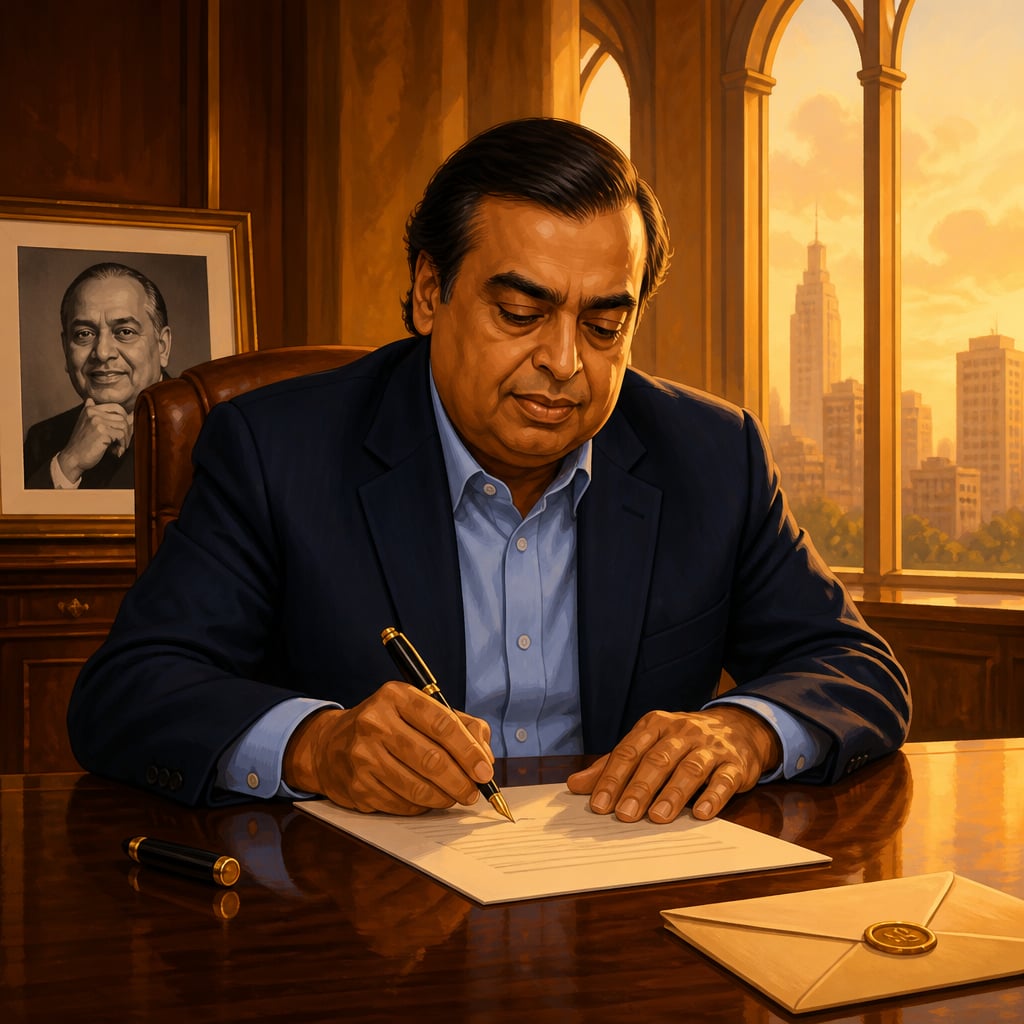
Mukesh Ambani signing the 453 crore release transfer

In February 2020, Anil Ambani faced contempt of court proceedings. Ericsson had won a judgment against his telecom company. He couldn't pay. Imprisonment loomed. The media prepared obituaries for his business career.

Then something unexpected happened: Mukesh Ambani, the brother he'd feuded with for years, paid ₹453 crore to clear the debt. No fanfare. No conditions. Just a wire transfer that saved his brother from jail.

This moment reveals something the 2005 partition had preserved: even after business separation, some family bond remained. The conflict had been resolved, not erased, through dharmic process. The brothers could disagree profoundly about business strategy while still recognizing family duty.

Not all family disputes end this way. Many destroy both wealth and relationships. The difference lies in how conflict is approached from the start.

The Arthashastra's Four-Fold Path

Kautilya's Arthashastra prescribes four methods for resolving conflicts, in escalating order:

"Sāma dāna bheda daṇḍāś ceti upāyāḥ" "Conciliation, accommodation, division, and force, these are the means."

This sequence wasn't arbitrary. Each method has costs and benefits:

Method Sanskrit Approach Cost When to Use
Sāma साम Conciliation, dialogue Lowest First attempt always
Dāna दान Accommodation, giving Low When one party can yield
Bheda भेद Division, separation Medium When unity is impossible
Daṇḍa दण्ड Force, legal action Highest Only when all else fails

The wisdom lies in trying methods in sequence, not jumping to courts (daṇḍa) when conciliation (sāma) might work.

Sāma: The Power of Patient Dialogue
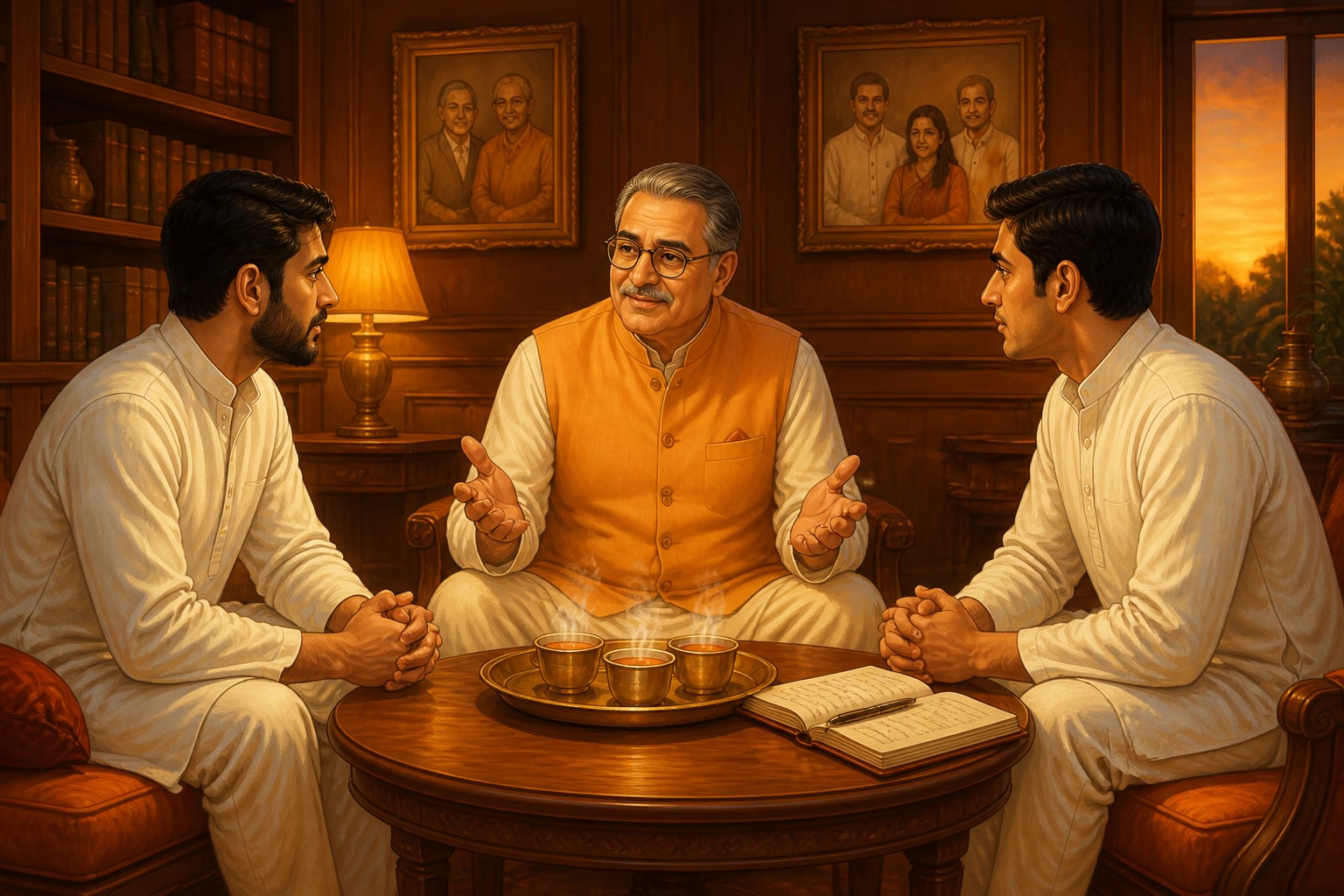
Senior uncle mediating sama between two brothers

Sāma means more than conversation, it means creating the conditions where agreement becomes possible:

Active Listening: Each party feels genuinely heard before any solution is proposed Interest Exploration: Moving beyond positions ("I want this asset") to interests ("I need financial security") Face-Saving Solutions: Options that let all parties claim victory Time and Space: Not rushing to resolution when emotions run high

Kokilaben's three-year mediation was pure sāma. She created a container for dialogue, allowing both sons to express frustration, fear, and aspiration. Only after being fully heard could they hear each other.

Dāna: Strategic Accommodation

Dāna in dispute resolution means one party yields something to break deadlock, not as defeat, but as strategic accommodation:

Identifying Asymmetries: What costs you little but matters greatly to them? Long-term Thinking: Yielding now may strengthen relationship for future benefit Precedent Setting: How you resolve this dispute shapes future conflicts

In the Ambani partition, some asset allocations involved dāna, Mukesh accepting certain compromises to preserve the larger deal. The 2020 ₹453 crore payment was ultimate dāna: Mukesh gave significantly to preserve something more valuable than money, his brother's freedom and their remaining relationship.

Bheda: Structured Division

When unity is genuinely impossible, bheda (division) becomes necessary:

Clean Boundaries: Clear separation of assets, responsibilities, and authority Mutual Exclusivity: Each party has autonomous domain without interference Preserved Optionality: Division that doesn't preclude future cooperation New Structures: Creating new entities (like new HUFs) rather than destroying the old

The Ambani partition was bheda done right. The Bajaj division similarly: Rajiv and Sanjiv received separate domains, clear boundaries, but preserved family holding company coordination.

Daṇḍa: When Courts Become Necessary

Family members on opposite sides of a Mumbai high court

Daṇḍa, force through legal process, should be last resort because:

Cost: Litigation destroys 30-50% of value through fees, time, and distraction Relationship Destruction: Court battles create public records of family conflict Uncertain Outcomes: Judges may not understand business dynamics Time: Indian courts take years; the Birla Priyamvada case continues after 18+ years

But sometimes daṇḍa is necessary:

Early Warning Signs of Escalating Conflict

Family business disputes rarely explode suddenly. Watch for these warning signs:

Communication Breakdown:

Position Hardening:

Coalition Formation:

Legal Preparation:

Early intervention, at the communication breakdown stage, is far more likely to succeed than waiting for coalition formation.

Global Perspectives on Family Dispute Resolution

John Ward's research shows that family businesses with pre-agreed dispute resolution mechanisms survive conflict better. His recommendation: establish mediation and arbitration protocols before disputes arise, not during them.

The Walton Family avoided direct conflict by separating family ownership from management, disputes about business strategy are handled by professional management, leaving family interactions for personal matters.

European Family Businesses often use independent family councils with binding arbitration authority. These institutionalize sāma (dialogue) and bheda (structured division) while avoiding daṇḍa (courts).

Approach Mechanism Strength Weakness
Indian Traditional Family elder mediation Relationship preservation Depends on individual mediator
Family Council Institutionalized dialogue Process continuity Requires buy-in
Professional Mediation External neutral Fresh perspective Lacks family knowledge
Arbitration Binding private judgment Faster than courts Still adversarial
Litigation Court process Enforceable Relationship destruction

The Dispute Resolution Protocol

Modern Indian family businesses increasingly adopt formal protocols:

Step 1: Direct Dialogue (7 days) Parties must attempt direct conversation before escalating. Many disputes dissolve when people simply talk face-to-face.

Step 2: Family Council (30 days) If direct dialogue fails, convene the family council, senior family members who aren't parties to the dispute. Their role: facilitate, not judge.

Step 3: Family Mediation (60 days) If the council can't resolve, bring in a designated family mediator, often a trusted uncle/aunt, family advisor, or professional. Kokilaben's role was this, improvised.

Step 4: Professional Arbitration (90 days) If mediation fails, move to binding arbitration by agreed professionals. This is private, faster than courts, and preserves some relationship.

Step 5: Litigation (unlimited) Only after exhausting all steps does litigation become acceptable. By this point, both parties understand they've chosen relationship destruction.

The protocol itself prevents escalation: knowing courts are genuinely last resort motivates earlier resolution.

Common Dispute Patterns and Dharmic Responses

The Competence Dispute

"He's not qualified to run the business."

Dharmic Response: Create objective competence criteria before the dispute. What qualifications does the role require? Has the person met them? If not, what training is needed? Make it about standards, not personalities.

The Contribution Dispute

"I built this; she just inherited."

Dharmic Response: Distinguish between svārjita (self-acquired) and paitrika (ancestral). Acknowledge that different contributions may warrant different arrangements while respecting coparcenary rights for ancestral property.

The Spouse Influence Dispute

"His wife is turning him against the family."

Dharmic Response: Create clear boundaries between family business governance and personal relationships. Spouses participate in family forums but business decisions follow defined processes.

The Exit Dispute

"I want out, but they won't let me."

Dharmic Response: Build exit mechanisms into family governance from the start. What happens if someone wants to leave? How are they bought out? At what valuation? Pre-agreement prevents coercion.

The Cost of Getting It Wrong

When families choose daṇḍa (litigation) prematurely, the costs compound:

Financial: Legal fees, management distraction, investor uncertainty, stock decline Temporal: Indian court cases average 3-10 years; complex family cases can exceed 15 years Relational: Public court records create permanent wounds Reputational: Family disputes become public knowledge, affecting business relationships Generational: Children inherit not just assets but ongoing conflicts

The Birla Priyamvada case, now past 18 years, has consumed enormous resources with no resolution. Compare this to the Ambani partition: three years of private mediation, clean resolution, and the empire grew twentyfold.

Your Turn: Building Your Dispute Protocol

Whether you're in a family business now or may be in the future, consider:

  1. Who would mediate? Identify potential madhyasthas before you need them.
  2. What process would you follow? The four-step escalation above, or your own variant?
  3. What's non-negotiable? Some matters (fraud, safety) bypass mediation.
  4. What's the exit option? If someone truly wants out, how does that work?
  5. How do you document agreements? Informal understandings need formal confirmation.

The time to build dispute resolution infrastructure is when relationships are good, not when conflict has already polarized the family.

In the next lesson, we examine modern governance structures that prevent disputes before they start, the intersection of traditional dharma and contemporary corporate governance.

Alternative Dispute Resolution (ADR) emerged in the West partly as response to litigation costs. Mediation-before-arbitration-before-litigation mirrors Kautilya's sequence. The insight predates Western ADR by two millennia.

Indian families with strong mediation traditions (family elders, community panchayats) have built-in sāma infrastructure. When used, it prevents disputes from escalating to costly daṇḍa. The Ambani resolution demonstrated this advantage.

American Bar Association data shows mediated business disputes resolve 40-60% faster than litigated ones, with 30-50% lower costs. Indian family businesses that use traditional mediation first show similar advantages.

Negotiation theory (Fisher and Ury's 'Getting to Yes') emphasizes 'expanding the pie' and 'trading across issues', yielding on low-value items to gain high-value ones. Kautilya's dāna is the same insight.

Indian culture's emphasis on family relationship as intrinsic value creates natural dāna motivation. Mukesh's ₹453 crore payment wasn't business logic, it was family dharma. This 'irrational' dāna preserved something business calculations would have written off.

Research on family business mediations shows that early, meaningful concessions by either party increase settlement probability by 60-70%. The willingness to give signals genuine interest in resolution.

Key terms

Sāma
Conciliation; the first method of dispute resolution involving dialogue, negotiation, and peaceful persuasion
Bheda
Division; the third method of dispute resolution involving structured separation when unity proves impossible
Daṇḍa
Force; the fourth and final method of dispute resolution involving coercive measures including legal action
Vyavahāra
Procedure; the formal process and rules by which disputes are resolved, ensuring fairness in method as well as outcome

Verses

साम दान भेद दण्डाश्चेति उपायाः

sāma dāna bheda daṇḍāś ceti upāyāḥ

First talk, then yield, then part, then force, these four are the ways.

This is a cost-benefit optimization framework. Each successive method is more costly and destructive. Rational actors should exhaust cheaper methods first. The Ambanis used sāma and bheda; they never needed daṇḍa.

Arthashastra, Book 2, Chapter 10 (Based on R.P. Kangle translation)

न विवादः सहोदराणां श्रेयस्करो भवेत्

na vivādaḥ sahodarāṇāṁ śreyaskaro bhavet

No good can come from brothers born of one womb at war.

This is a game-theory insight: sibling conflicts are negative-sum games. Even the 'winner' loses because the conflict destroys shared family value. The only winning move is to resolve without fighting.

Mahabharata, Shanti Parva, 138.22 (Based on K.M. Ganguli translation)

धर्मेण व्यवहारेण च अर्थस्य निर्णयो भवेत्

dharmeṇa vyavahāreṇa ca arthasya nirṇayo bhavet

Let dharma and due process together settle the matter.

This anticipates modern due process concepts: outcomes must be both substantively fair and procedurally legitimate. A mediated settlement that feels unfair won't hold; a court victory achieved through manipulation breeds resentment.

Narada Smriti, Introduction, Verse 12 (Based on Julius Jolly translation)

Key figures

Kautilya (Chanakya)

c. 350-275 BCE

Mukesh Dhirubhai Ambani

1957-present

Kenneth Feinberg

1945-present

Case studies

Ambani Conflict Resolution: From Potential Litigation to Brotherly Bailout

The Ambani conflict had all ingredients for disaster: two powerful brothers, no will, unclear succession, enormous stakes, and public pressure. From 2002-2005, tension escalated. Media reported boardroom confrontations. Shareholders feared litigation. At multiple points, either brother could have initiated legal proceedings. Lawyers were consulted. Positions hardened. India's business community watched, expecting the worst.

The resolution followed Kautilya's sequence precisely: **Sāma (2002-2005)**: Kokilaben initiated and sustained dialogue. Three years of family conversations, dinners, and shuttle diplomacy. No external mediators, no lawyers leading the process. Pure family-based sāma. **Dāna**: Both brothers made concessions. Specific asset allocations involved one brother yielding to the other. The final deal wasn't 'perfect' for either, both gave something. **Bheda (June 2005)**: When sāma and dāna couldn't produce unity, the family moved to structured division. But it was bheda by consent, not by court. Each brother received autonomous domain. **Daṇḍa avoided**: No litigation, no courts, no public battles. The most expensive method was never needed because cheaper methods succeeded. **Epilogue, Dāna redux (2020)**: When Anil faced contempt proceedings, Mukesh's ₹453 crore payment showed that bheda hadn't destroyed the underlying relationship. Strategic giving fifteen years after partition demonstrated enduring family dharma.

The process preserved approximately ₹50,000+ crore in value that litigation would have destroyed. Beyond money: the brothers maintained enough relationship for Mukesh to bail out Anil in 2020. Their children reportedly have cordial relationships. The family's reputation emerged intact, the 'amicable partition' narrative preserved business credibility. Compare this to the Birla Priyamvada case: 18+ years of litigation, enormous legal costs, no resolution, family relationships destroyed, and reputation tarnished. The difference? The Ambanis used sāma-dāna-bheda; the Birlas went directly to daṇḍa.

The Ambani resolution demonstrates that even the highest-stakes family conflicts can be resolved without courts, if parties commit to the escalation sequence. The key insight: invest in sāma early. Once positions harden and lawyers take over, the cost of resolution multiplies.

International arbitration cases have doubled in the last decade, yet resolution timelines keep growing. Corporate mediators report that 85% of disputes that reach litigation could have been resolved earlier through structured dialogue. The Ambani case proves that even conflicts involving hundreds of thousands of crores can be resolved through patient escalation, saving both money and relationships.

Estimated value preserved by avoiding litigation: ₹50,000+ crore. Estimated cost of three years of mediation: minimal (family time, no external professional fees). ROI on choosing sāma over daṇḍa: incalculable.

Historical context

Arthashastra Period (c. 300 BCE) to Modern Application

India has strong traditions of community-based dispute resolution, village panchayats, caste councils, family elder mediation. Modern legal systems overlay but haven't replaced these. Family businesses that use traditional methods first, courts last, show better outcomes.

Western Alternative Dispute Resolution (ADR) emerged in the 1970s-80s as response to litigation costs. It rediscovered principles Kautilya articulated 2,300 years earlier. Indian families have natural ADR infrastructure through traditional mediation, an advantage often underutilized.

Indian courts have over 4 crore pending cases (2024). Average family property disputes take 5-15 years for resolution. The cost of this backlog, in legal fees, opportunity cost, and relationship destruction, is incalculable. Traditional mediation avoids this entirely.

Understanding the four-fold framework empowers families to resolve conflicts before they become catastrophes. The choice between mediation and litigation isn't just financial, it determines whether family relationships survive the dispute.

Living traditions

The success of Ambani mediation has influenced subsequent Indian family business disputes. Professional family mediation has grown as a field. Business families increasingly include dispute resolution protocols in family constitutions, institutionalizing sāma before it's needed.

Reflection

More in Family Business: The Hindu Undivided Family

All lessons in Family Business: The Hindu Undivided Family · Vaishya Dharma: The Art of Ethical Commerce course