Adhunik-Shasan: Modern Family Business Governance
Where Traditional Dharma Meets Corporate Governance
How India's leading family businesses blend ancient governance principles with modern corporate structures, family councils, independent directors, and the art of professional management without losing family soul.
The Murugappa Miracle: 124 Years Without a Feud

In 1900, A.M. Murugappa Chettiar started a small trading business in Burma. Today, the Murugappa Group spans engineering, fertilizers, cycles, and finance, worth over ₹50,000 crore. More remarkable than the growth is what hasn't happened: in 124 years and five generations, the family has had no major disputes, no litigation, no public feuds.
How does a family of over 100 members, scattered across continents, manage a conglomerate without tearing itself apart?
The answer lies in a document drafted in the 1950s: India's first family constitution. Before the term existed in Western business literature, the Murugappas had codified their governance, blending Chettiar community traditions with emerging corporate practices. They created Adhunik-Shasan: modern governance rooted in dharmic foundations.
The Three Circles: Separating What Must Be Separated
John Ward's "Three Circle Model" distinguishes between three overlapping spheres in family business:
- Family: Relationships, values, identity
- Ownership: Property rights, dividends, control
- Management: Operations, strategy, execution
Conflict arises when these circles blur. A family member may expect management role because of ownership, or expect ownership benefits because of family membership.
Dharmic governance creates clear boundaries:
| Circle | Dharmic Principle | Modern Mechanism |
|---|---|---|
| Family | Kula-Dharma (family values) | Family Council |
| Ownership | Coparcenary rights (Mitakshara) | Shareholder agreement, HUF deed |
| Management | Kartā responsibilities | Board of Directors, CEO |
The Murugappas separate these explicitly:
- Family Council: All adult family members, meets quarterly, discusses family matters
- Family Assembly: Broader gatherings for relationship-building
- Board of Directors: Professional governance, includes independent directors
- Management Team: Professionals (including family members who qualify)
The Family Constitution: What It Contains
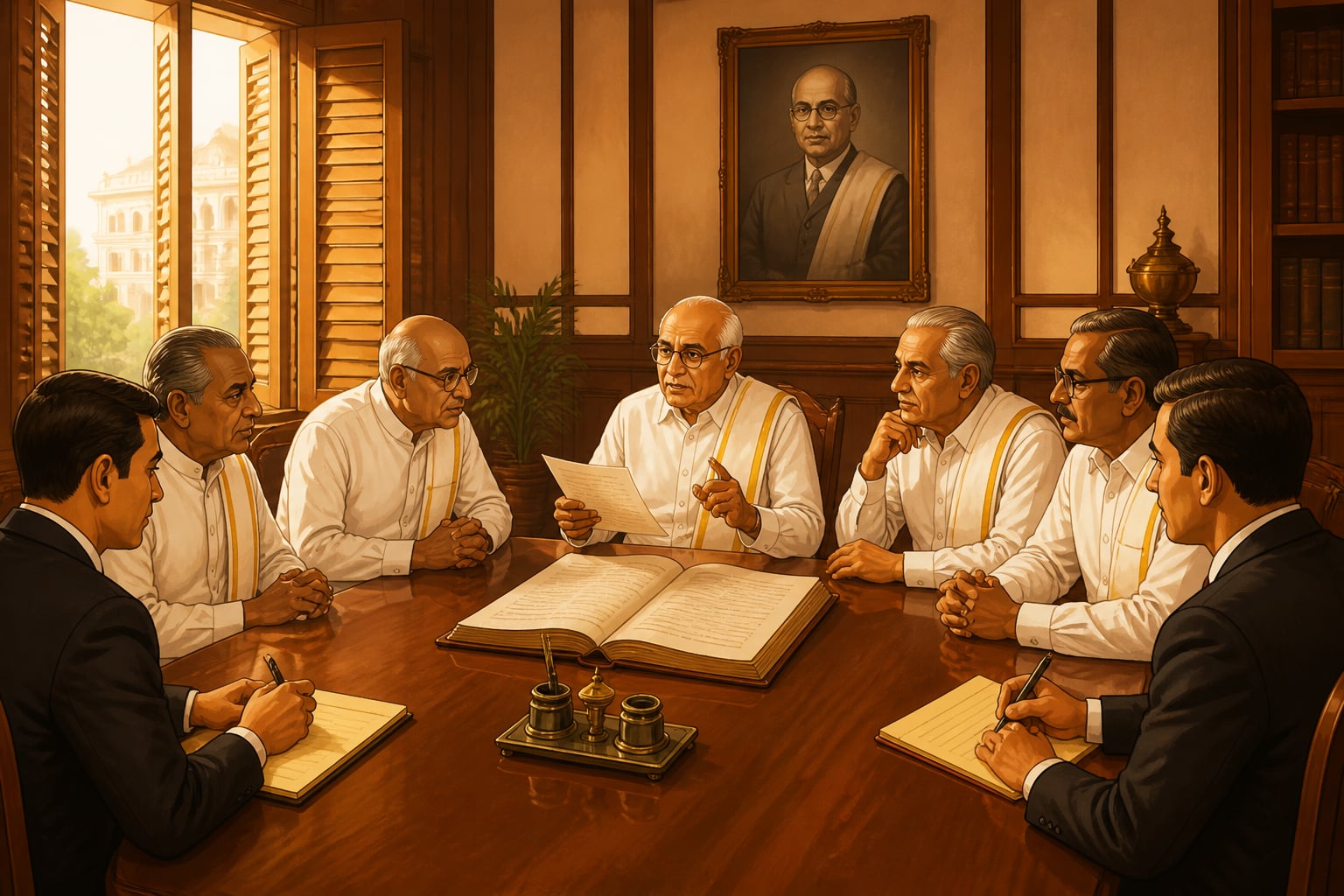
A family constitution codifies what was previously implicit. Key elements include:
Membership and Rights
- Who is a "family member" for governance purposes?
- What rights do members have (information, dividends, employment opportunity)?
- How do spouses and in-laws participate?
Governance Structures
- Family Council: composition, meeting frequency, decision-making process
- Relationship to corporate boards
- Role of patriarch/matriarch vs. collective governance
Employment Policies
- Education and experience requirements for family members to work in business
- Compensation principles (market rate vs. family premium)
- Performance evaluation (by whom, with what consequences)
Ownership Rules
- Can shares be sold outside family? Under what conditions?
- Valuation methodology for buyouts
- Dividend policy
Succession
- Criteria for leadership positions
- Selection process (family vote, board decision, patriarch choice)
- Transition timelines
Dispute Resolution
- Escalation sequence (sāma-dāna-bheda-daṇḍa formalized)
- Designated mediators
- When arbitration/litigation is permitted
Exit Provisions
- How can a family member exit ownership?
- Buyout rights and obligations
- Non-compete and confidentiality
The Bajaj Governance Model
The Bajaj family demonstrates another approach: professional management with family oversight.
When Rahul Bajaj structured the succession:
Corporate Level:
- Bajaj Auto and Bajaj Finserv are professionally managed
- Independent directors form majority of boards
- Family members earn executive compensation, not ownership premium
Family Level:
- Bajaj Holdings and Investment Ltd. coordinates family interests
- Family meetings address relationship, not operations
- Clear boundaries between Rajiv's and Sanjiv's domains
Dharmic Integration:
- Rajiv and Sanjiv have autonomous authority in their domains (respecting partition principles)
- Neither interferes in the other's sphere (bheda boundaries)
- Family gatherings maintain unity beyond business
This model shows that partition (bheda) can coexist with coordination, separate domains, but shared family identity.
Global Perspectives: Family Governance Worldwide
John Ward's research identifies key success factors in family business governance:
- Clear ownership and control boundaries
- Independent board oversight
- Family forums separate from business governance
- Explicit succession planning
- Professional management standards
The Walton Family (Walmart) uses Walton Enterprises as family holding company, with professional managers running retail operations. Family members sit on boards but don't manage day-to-day.
Hermès (France) combines foundation-based ownership with family involvement. The controlling foundation prevents hostile takeovers while family members maintain cultural stewardship.
Tata Group (India) demonstrates the ultimate separation: trust-based ownership (Tata Trusts hold 66%), professional management, and family as cultural stewards rather than operators.
| Model | Family Control | Professional Management | Governance Mechanism |
|---|---|---|---|
| Murugappa | Moderate | High | Family Constitution |
| Bajaj | Moderate | High | Holding Company |
| Walton | High | High | Family Partnership |
| Tata | Low | Very High | Trust Ownership |
Independent Directors: External Wisdom
The Companies Act 2013 requires listed companies to have independent directors. For family businesses, independents serve crucial functions:
What Independent Directors Provide:
- External perspective free from family dynamics
- Expertise not present in family
- Legitimacy for difficult decisions
- Protection for minority shareholders
What They Cannot Replace:
- Deep knowledge of family dynamics
- Long-term relationship with stakeholders
- Institutional memory
- Commitment beyond fiduciary duty
Dharmic Integration: Independent directors function like mantri (counselors) in traditional governance, providing wisdom and perspective while the rāja (family/owners) retain ultimate authority. The best independents understand this: advise robustly, but respect that family businesses operate on longer timelines than quarterly earnings.
Professional Management: When and How
Not all family businesses need professional CEOs. The choice depends on:
Family Management Works When:
- Family members are genuinely competent
- Business complexity matches family capability
- Family alignment is strong
- The industry rewards relationship-based leadership
Professional Management Works When:
- Business has outgrown family capability
- Professionalization requires external credentials
- Family conflict threatens operations
- Succession gap exists between generations
Hybrid Approaches:
- Family CEO with professional C-suite
- Family Chair with professional CEO
- Family in oversight roles, professionals in execution
The Tatas pioneered this: a succession of professional CEOs (J.R.D., Ratan, Mistry, Chandrasekaran) with family providing values and governance, not operations.
Dharmic Foundations of Modern Governance
Modern governance principles have dharmic roots:
Transparency (Satya): Open books, clear communication, honest reporting. The Arthashastra mandates transparent accounting for royal treasuries, the principle applies equally to family business.
Accountability (Kartavya): Clear responsibilities with consequences. The Kartā has authority but also accountability to coparceners. Modern governance formalizes this through board oversight and performance reviews.
Fairness (Nyāya): Equal treatment where equal, differentiated treatment where different. Coparcenary rights are equal; management authority goes to the qualified. Governance structures enforce both.
Long-term Thinking (Santati): Decisions consider multi-generational impact. Independent directors often push for quarterly results; family governance should balance this with longer horizons.
Building Your Governance Framework
Whether you're in a family business now or may be in the future, consider these steps:
Step 1: Map the Three Circles
- Who is family? Who are owners? Who manages?
- Where do circles overlap? Where are boundaries unclear?
- What conflicts arise from boundary confusion?
Step 2: Create Appropriate Forums
- Family meetings for family matters
- Board meetings for governance matters
- Management meetings for operational matters
- Don't mix these, confusion breeds conflict
Step 3: Codify Key Policies
- Employment criteria for family members
- Compensation philosophy
- Exit mechanisms
- Dispute resolution procedures
Step 4: Seek External Perspective
- Independent directors or advisors
- Family business consultants
- Peer networks with other family businesses
Step 5: Review and Revise
- Governance isn't static, families evolve
- Regular constitutional review (every 3-5 years)
- Engage next generation in governance development
The Future of Family Business Governance
Family business governance continues to evolve:
Increasing Professionalization: More family businesses adopt independent boards, professional executives, and formal governance structures.
ESG Integration: Environmental, social, and governance factors now shape family business strategy, often aligning with traditional dharmic values of sustainability and community responsibility.
Next-Gen Engagement: Gen-Z family members expect transparency, purpose, and participation, demanding governance evolution.
Digital Transformation: Technology enables better information flow, more transparent decision-making, and new governance tools.

The Murugappas, having governed successfully for 124 years, continue to evolve. Their constitution has been revised multiple times. Each generation adds its insights while preserving foundational principles.
In the final lesson, we examine how these ancient principles remain relevant in 2026, addressing startups, NRI succession, and the changing landscape of Indian family business.
Ward's Three Circle Model explicitly separates family, ownership, and management. Governance theorists (Berle & Means, Jensen & Meckling) identify role confusion as source of agency problems.
Traditional Indian family structures implicitly separate roles: the Kartā manages, coparceners own, and family elders advise. Formalizing these separations through family constitutions and board structures modernizes without abandoning wisdom.
Research shows that family businesses with explicit governance structures (family councils separate from boards, clear role definitions) have 40% higher survival rates than those with informal governance.
Independent directors, advisory boards, and external consultants serve the mantri function. Research shows boards with strong independents make better decisions and have fewer governance failures.
The dharmic mandate for consultation legitimizes independent input. Family patriarchs who might resist 'outside interference' can embrace 'mantri counsel' as traditional duty. The framing matters.
McKinsey research finds that boards with at least 50% independent directors have 35% better returns than those with family-dominated boards, the mantri principle validated empirically.
Key terms
- Pārivārika Saṁvidhāna
- Family constitution; a written document codifying family governance rules, membership criteria, dispute resolution procedures, and succession policies
- Mantri Pariṣad
- Council of advisors; in modern context, the board of directors or advisory board providing external perspective to family leadership
- Kula Sabhā
- Family assembly; the gathering of family members to discuss matters of family interest, separate from corporate governance
- Vyāvasāyika Prabandhan
- Professional management; the administration of business operations by qualified professionals, whether family members or external executives
Verses
मन्त्रिणः पुरोहितश्च राजा विमृश्य कार्यम् आचरेत्
mantriṇaḥ purohitaś ca rājā vimṛśya kāryam ācaret
The king, having consulted with ministers and wise advisors, should then act.
This anticipates modern corporate governance: decisions benefit from diverse perspectives. The family patriarch who consults mantri (advisors) makes better decisions than one who rules by fiat. Independent directors serve this ancient function.
Arthashastra, Book 1, Chapter 19 (Based on R.P. Kangle translation)
नैकः शासति राष्ट्रं यः सर्वं धर्मेण पश्यति
naikaḥ śāsati rāṣṭraṁ yaḥ sarvaṁ dharmeṇa paśyati
No one alone can govern, the wise see all matters through dharma.
This verse warns against the 'imperial patriarch' model where one person controls all decisions. The Murugappa model, collective family council plus professional board, implements this ancient wisdom.
Mahabharata, Shanti Parva, 78.5 (Based on K.M. Ganguli translation)
व्यवस्था सततं कार्या कुले धर्मप्रवर्तनम्
vyavasthā satataṁ kāryā kule dharmapravartanam
Constant ordering must be maintained, establishing dharma within the family.
This verse addresses the mistake of creating governance structures and forgetting them. The Murugappas have revised their constitution multiple times. Living governance adapts to changing family and business realities.
Shukraniti, Chapter on Administration (Based on B.K. Sarkar translation)
Key figures
A.M.M. Murugappa Chettiar
1900-present (founding; current fifth generation)
Ratan Naval Tata
1937-2024
John L. Ward
1945-present
Case studies
Murugappa Group: 124 Years of Conflict-Free Family Governance
The Murugappa Group, founded in 1900, spans 29 businesses including Tube Investments, Cholamandalam Finance, Coromandel Fertilizers, and Carborundum Universal. Five generations and over 100 family members are involved. The business operates across India and internationally, with revenues exceeding ₹50,000 crore. In most family businesses of this scale and age, conflict would be inevitable. Yet the Murugappas have had no major public disputes, no litigation among family members, and no succession crises.
The Murugappa governance model implements dharmic principles systematically: **Separation of Circles**: Family Council handles family matters; Board of Directors handles governance; Management handles operations. No confusion about which forum decides what. **Merit-Based Employment**: Family members must meet education and experience requirements before joining. They work outside the group first, proving themselves before returning. **Equal Voice**: In Family Council, all adult members have equal voice regardless of shareholding, respecting family dignity beyond ownership stakes. **Collective Leadership**: No single patriarch dominates; an Executive Committee of senior family members rotates leadership responsibilities. **Exit Provisions**: Family members who wish to exit ownership have clear buyout mechanisms, preventing forced togetherness. **Regular Review**: The family constitution has been revised multiple times as circumstances change, governance evolves with the family.
Results over 124 years: - Zero major family litigation - Five successful generational transitions - Growth from trading firm to ₹50,000+ crore conglomerate - Maintained family unity despite geographic dispersion - Professional management integrated without losing family control - Reputation for integrity that translates to business advantage The Murugappa model proves that large, multi-generational family businesses can thrive without the conflicts that destroy so many. The key: systematic governance rooted in dharmic principles, codified before conflict arises.
The Murugappa case demonstrates that family business conflict is not inevitable, it's a governance failure. With proper structures (family constitution, separated forums, clear criteria, dispute resolution), families can grow across generations without tearing apart. The investment in governance pays returns for decades.
With over 70% of Indian businesses being family-run and the majority approaching second or third generation transitions, the demand for family governance frameworks has never been higher. The Murugappa constitution is now a template used by family business consultants across India and Southeast Asia. The key insight for modern families: invest in governance architecture before conflict makes it necessary.
The Murugappa Group has navigated five generational transitions with zero major disputes. Compare to the average: 70% of family businesses fail in the second generation transition, and 90% by the third. The Murugappas are in their fifth generation.
Historical context
Modern Corporate Governance Era (1950s-present)
Indian family businesses developed governance intuitively, based on community traditions (Chettiar, Marwari, Gujarati practices) and dharmic principles. Formal codification came later, often inspired by Western frameworks but adapted to Indian family structures.
Western family business governance emerged from academic research (1970s-80s) and professional consulting. Indian families had been practicing similar principles for generations, formal constitutions like the Murugappas' predated academic frameworks.
India has an estimated 7 million family businesses, contributing over 70% of GDP. Yet less than 20% have formal governance structures. The gap between best practice (Murugappa, Bajaj) and average practice is enormous.
Understanding governance options enables conscious choice. Family businesses that drift into conflict usually lacked governance structures. Those that thrive usually invested in governance before they needed it. The lesson: build structures in good times.
Living traditions
The Murugappa model has influenced Indian family business governance for decades. Their success demonstrates that formal governance need not reduce family warmth, it can preserve it by preventing conflicts that destroy relationships. Young family businesses increasingly seek to implement governance before rather than after crisis.
- Family Constitution Development: Multi-stakeholder process to codify governance rules, typically facilitated by external consultants with family input across generations
- Family Council Meetings: Regular gatherings (typically quarterly) where family members discuss non-business matters, preserving relationship separate from corporate governance
- Next-Gen Programs: Structured development programs for younger family members, education, external experience, mentorship, before they join family business
- Murugappa Group Headquarters, Chennai: The corporate home of India's pioneer in family governance, visiting scholars and families often study their model
- Thomas Schmidheiny Centre for Family Enterprise, ISB: Leading academic center for family business in India, offering programs on governance design and implementation
- Karpaga Vinayagar Temple: The Murugappa family's ancestral temple, where generations have sought Ganesha's blessings for family harmony. The family's governance success is attributed partly to maintaining this spiritual connection.
- Meenakshi Amman Temple: One of India's most magnificent temples, demonstrating how institutional governance can maintain complex organizations across centuries. The temple trust offers governance lessons for family businesses.
Reflection
- The Murugappa family created India's first family constitution in the 1950s, decades before the concept became mainstream. What enabled them to invest in governance before crisis, while most families wait for conflict before addressing governance? What conditions allow families to be proactive rather than reactive?
- Design a basic governance structure for a hypothetical family business with three siblings, their spouses, and growing children. What would your Family Council look like? What employment criteria would apply? How would disputes be resolved?