What Do You Owe to Others?
Yajnavalkya's radical claim: you love others because the same Self looks out of their eyes.
Brihadaranyaka Upanishad vs Kant and Levinas. The Other is not other. Ethics is grounded in recognition of the shared Self, not duty alone and not an infinite debt to alterity.
The Day Yajnavalkya Called His Wives
At some point in the late Vedic period, probably in the eighth or seventh century BCE, in the forested kingdom of Videha in what is now north Bihar, a sage named Yajnavalkya told his senior wife that he was leaving. He had spent most of his long life running a household, debating philosophers in King Janaka's court, and teaching students who walked in from across the Gangetic plain. Now, he said, he was renouncing the householder life altogether and going to the forest for good. Before leaving, he wanted to divide his wealth fairly between his two wives, Katyayani and Maitreyi. He called them both and made the offer.
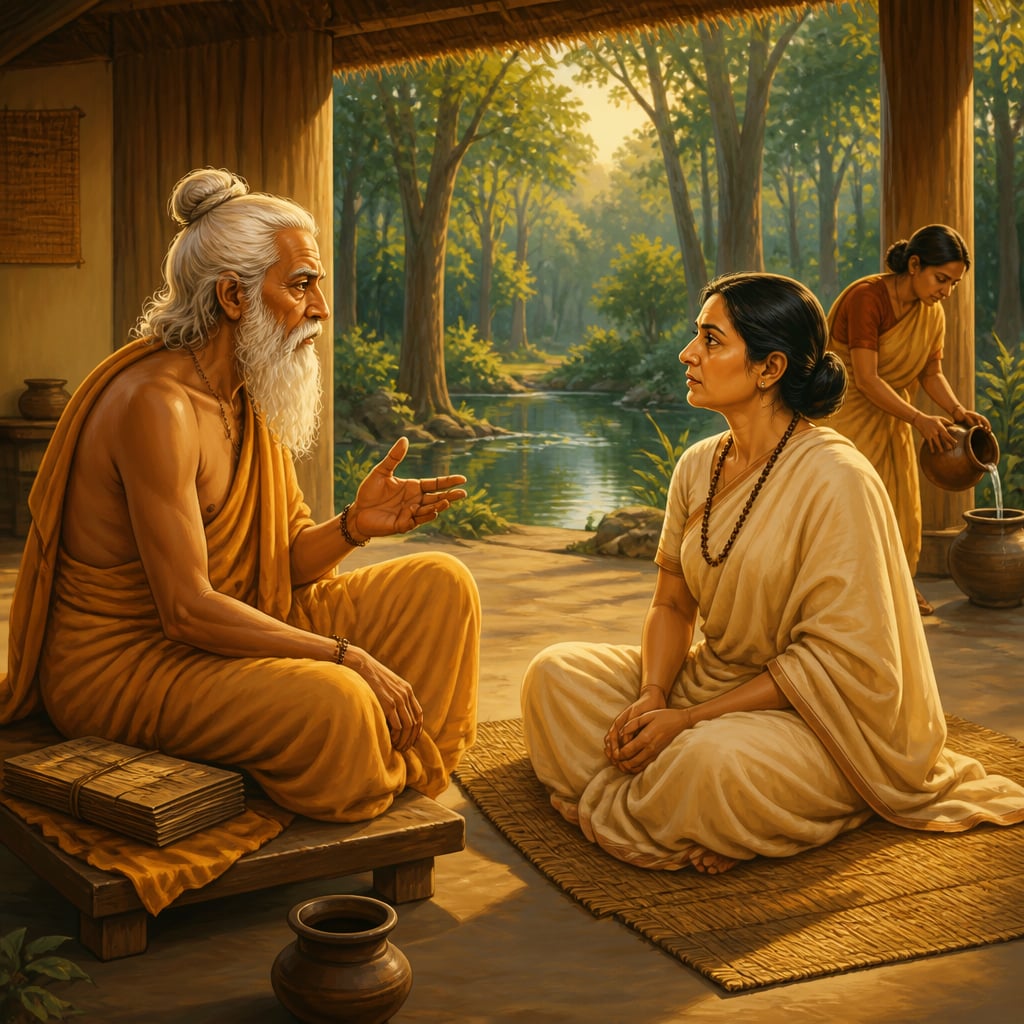
Katyayani accepted. Maitreyi did not.
'Sir,' she said, in a sentence the Brihadaranyaka Upanishad preserves almost verbatim, 'if this whole earth filled with wealth were mine, would I become immortal through it?'
'No,' Yajnavalkya answered. 'Your life would be like the life of the rich. There is no hope of immortality through wealth.'
'Then what shall I do with that by which I do not become immortal?' she said. 'Sir, tell me instead what you know.'
Yajnavalkya looked at his wife and understood that the question she had put to him, at the moment of his leaving, was the largest question he had ever been asked. He sat her down. What he said to her next is the single most influential passage in Indian ethics, and it begins with a claim that sounds on a first hearing like the most extreme statement of self-love in world literature. A husband, he told her, is not dear to his wife for the sake of the husband. A wife is not dear to her husband for the sake of the wife. Sons are not dear for the sake of sons, wealth not dear for the sake of wealth, worlds not dear for the sake of worlds, gods not dear for the sake of gods, beings not dear for the sake of beings. All of these are dear for the sake of the Self. Every affection you have ever felt, he told her, is at its root a refracted love of the Self that is shining through the beloved.
This is a claim that can be easily misread as narcissism. It is not. Yajnavalkya is not saying that you love people because you love yourself in the small, ego-bound sense. He is saying that what is actually loved in every act of love is the atman, the universal witness, and that this atman is not the property of any particular individual. It is the common ground that makes any relationship possible at all. When you are moved by a stranger's grief, when a child's laugh unexpectedly breaks you open, when a dying friend's hand in yours becomes the most important object in the universe for a moment, what is happening is not a calculation and not a commandment. It is the Self recognizing itself through the veil of apparent difference.
The ethical consequence of this picture is both immediate and disorienting. If the Self that looks out of your eyes is the same Self that looks out of every other pair of eyes, then every harm you do to another is a harm to yourself. Not metaphorically. Literally, in the sense that there is no other self to be harmed or benefited. The Isha Upanishad states this more compactly than any other Vedic text. The one who sees all beings in the Self and the Self in all beings hates no one. For the one who sees the oneness, says the Isha, what delusion and what grief can there be?
The hardest question in practical philosophy
Everyone has a theory of ethics until a stranger is suffering in front of them. At that moment the theory either helps or gets in the way. The question Yajnavalkya had just put to Maitreyi is the most practical question in philosophy and also the one on which the major traditions disagree most sharply. Some ground it in duty. Some ground it in the irreducible strangeness of the Other. The Upanishadic answer is older than either and, once you see it clearly, harder to dismiss. It is worth holding it beside the two most influential Western answers to the same question, Immanuel Kant in the late eighteenth century and Emmanuel Levinas in the twentieth. The comparison does not flatten any of the three. It sharpens all of them.
Kant builds a fortress out of pure reason
Twenty-five hundred years later, in Konigsberg, an East Prussian philosopher named Immanuel Kant was trying to answer the same question. Kant was writing in a Europe that was losing its religious certainties and looking for a rational foundation for morality that would not depend on any particular theology. His Groundwork of the Metaphysics of Morals appeared in 1785 and his Critique of Practical Reason in 1788, and together they form the most careful attempt in Western philosophy to derive ethics from reason alone.
Kant's answer is famously compressed into what he called the categorical imperative. Act only according to the maxim by which you can at the same time will that it should become a universal law. The second formulation is more widely quoted: act so as to treat humanity, whether in your own person or in the person of any other, always at the same time as an end and never merely as a means. This is the fortress Kant built for ethics. It is reason-based, it is universal, and it does not require any particular feeling. You owe other people the same respect you owe yourself because rationality itself demands it. The moral worth of an action lies not in its consequences and not in the warmth of the heart that performed it but in the fact that it was done out of duty, from a recognition of the law.
Kant's framework is extraordinary for what it rules out. No special pleading. No tribal exceptions. No one's interests rationally count less than another's. The homeless stranger in the cold and the president of a nation are owed the same fundamental respect because both are ends in themselves. This is a genuine achievement and it has shaped every modern human rights framework, most international law, and most secular Western moral education.
But there is a gap at the center of Kant that his readers noticed almost immediately. The categorical imperative tells you what you should do. It does not tell you why you would actually care to do it. Kant's answer is 'because reason demands it,' which is not quite enough for most people in a moment of crisis. His famous remark that an action performed out of love or inclination is less morally worthy than one performed grudgingly out of duty has struck generations of readers as both admirably rigorous and emotionally hollow. Kant built a fortress strong enough to withstand any argument. He did not build a fire strong enough to warm the people inside.
Levinas looks into the face of the Other

Almost two centuries after Kant, a Lithuanian-born French philosopher named Emmanuel Levinas returned to the question with a very different starting point. Levinas had studied Husserl and Heidegger in Freiburg in the 1920s. He spent most of the Second World War in a German prisoner of war camp. During his captivity, most of his family in Lithuania was murdered in the Holocaust. Levinas survived, returned to France, and spent the rest of his life writing a philosophy in which ethics was no longer a subfield of metaphysics but, as he put it, first philosophy.
His answer to the question of what we owe to others is built around a single phrase: the face of the Other. When another human being stands before you, Levinas argued, their face is not simply a visual object. It carries an irreducible command. The face says, silently and before any theory can get its hands on it, do not kill me. The demand is immediate. It precedes reason. It precedes choice. It precedes the self's own interests. You do not arrive at ethics by calculating or even by deciding. You find yourself already responsible for the Other the moment their face appears.
Levinas also insisted that the Other must remain radically Other. Kant's universal law tried to dissolve difference into reason. Heidegger's Being tried to absorb the Other into a common horizon. Levinas refused both moves. He thought that the moment you reduce the Other to a version of yourself, you lose exactly the ethical force that their difference contains. The Other must be irreducible, infinite, beyond any frame you could put around them. And your responsibility for them must be asymmetric, meaning you owe them without asking what they owe you.
This is a warmer philosophy than Kant's. It starts in the face-to-face encounter, not in an armchair deducing maxims. It was written by a man who had watched totalitarian reason turn neighbors into enemies and who knew that a safe philosophy had to protect the stranger from being absorbed into anyone's 'us.' Levinas shaped modern hermeneutics, Jewish philosophy, Christian theology, and continental ethics. His influence on how educated people now talk about the stranger, the face, and the infinite obligation is hard to overstate.
But Levinas also leaves a reader with a quiet difficulty. His philosophy is asymmetric in principle. You owe the Other, always. The Other remains infinitely beyond you. Ethics becomes an unpayable debt to an unreachable alterity. If you asked Levinas whether the Other is, in the end, the same as you at the deepest level, he would say no. The moment you collapse that difference, the ethical spark is lost. The cost of saving the spark is that you and the Other never actually meet.
What the Upanishad gets past both of them
Yajnavalkya's position sits at a strange angle to Kant and Levinas, and the angle is worth seeing clearly.
Against Kant, the Upanishad does not try to build ethics out of rational form alone. It does not ignore reason. It simply refuses to treat reason as the whole of the story. What Kant calls 'moral worth' and fears may be contaminated by feeling, the Upanishad calls self-recognition and treats as the actual engine of ethics. You do not owe the stranger because your reason has concluded that you must. You owe the stranger because something in you, when it grows quiet, already knows that the stranger is the same Self in a different body. The obligation is felt before it is reasoned, and the reasoning comes later to explain what the recognition has already delivered.
Against Levinas, the Upanishad does not anchor ethics in the irreducible alterity of the Other. It anchors it in a deeper sameness. This is the sharper and riskier move. Levinas would worry that once you say 'the Other is the same Self as me,' you have just imported the Other into your own horizon and made them manageable, predictable, graspable. You have committed the totalizing error he spent his life warning against. The Upanishad's answer is that the Self it is pointing to is not the ego-self, not any individual's possession, not anything that can 'absorb' another. The atman is not your self in the grasping sense. It is the common witness in which every 'your' and 'their' is already unfolding. To say that the Other is the same Self as you is not to reduce the Other. It is to recognize that the very ground of recognition is shared.
And then the Upanishad does something neither Kant nor Levinas could quite manage. It explains why you actually care. Kant struggled with the motivational question and had to fall back on the bare authority of reason. Levinas handled the motivational question by saying that the Other simply demands your care, asymmetrically, without needing an explanation. The Upanishad says: you care because you are already what you are caring about. The fact that a stranger's suffering reaches you at all, without your having chosen to feel it, is evidence of the recognition already operating beneath your ordinary sense of separation. The work of ethical life is not to install a motivation that is not there. It is to notice, and then extend, the motivation that is already there in fragmentary form.
Why this matters in an ordinary week

This can sound abstract until you test it against a specific week in an ordinary life. Kantian duty will tell you not to cut corners on a client, not to lie, not to treat your coworker as an obstacle to your own advancement. Levinasian ethics will tell you that the unfamiliar person you pass on the street carries an infinite claim on you the moment you register their face. Both are correct. Both are insufficient.
The Upanishadic addition is the diagnostic it gives you for the moments when you cannot make yourself care enough to act well. When you notice that you are about to snap at a family member, the Kantian move is to remember your duty. The Levinasian move is to stop and let their face interrupt you. The Upanishadic move is to notice that the irritation is not really irritation at them but irritation at what you take yourself to be in relation to them, and that loosening that identification makes the irritation dissolve faster than any argument about duty could do. The ethics flows from seeing, not from obligating.
This does not replace duty and it does not replace the moral weight of the stranger's face. It grounds both. A life built on Kant alone is correct but cold. A life built on Levinas alone is responsible but exhausted by infinite debt. A life built on Yajnavalkya's recognition is neither. It is the quiet understanding that you are not separate from what you are asked to care about, and that this is the best news practical ethics has ever been given.
Key figures
Yajnavalkya
Late Vedic Period (c. 800 to 700 BCE)
Immanuel Kant
Modern Enlightenment (1724 to 1804)
Emmanuel Levinas
Twentieth century (1906 to 1995)
Case studies
Levinas Writing Ethics in a POW Camp
In June 1940, Emmanuel Levinas was captured by the Germans while serving as a French Army interpreter. Because he was a uniformed soldier of France, he was sent to a prisoner of war camp near Fallingbostel rather than to an extermination camp. His wife and daughter survived in hiding in a French monastery. His mother, father, two brothers, and most of his extended family in Lithuania were murdered by the Einsatzgruppen. Levinas spent five years in the camp assigned to a forestry commando. He later said that during those years a dog named Bobby was the only being who acknowledged his dignity, because the guards had stopped treating him as human. After the war, he returned to France and began writing a philosophy in which ethics would no longer rest on rational deduction or on being-in-the-world. It would rest on the face of the Other.
Levinas's philosophy emerged from a direct confrontation with the failure of the Western philosophical tradition to protect the stranger. Kant's categorical imperative had not stopped the camps. Heidegger's being-in-the-world had not stopped the philosopher himself from joining the Nazi party. Levinas concluded that ethics could not be a consequence of a prior metaphysics. It had to come first. The face of the Other, he argued, carries an immediate demand that precedes any theory. The Upanishadic tradition would read Levinas's biography and recognize exactly the crisis he was responding to. The failure that produced the camps was the failure of seeing through apparent otherness to the shared Self. Kant had built a fortress of reason, but a fortress can be shut. Levinas built a philosophy of infinite openness to the stranger, but at the cost of preserving the stranger's alterity forever. The Upanishad would say: Levinas saw more than Kant, but stopped one step short. The face that makes the infinite demand is not the face of someone other than you. It is the face through which the same Self looks at itself from a different body. The recognition is what makes the demand felt at all.
Levinas's two major works, Totality and Infinity (1961) and Otherwise than Being (1974), became foundational texts for continental ethics, Holocaust studies, and post-modern theology. His influence extends from Jacques Derrida and Paul Ricoeur to modern peace and reconciliation studies. The phrase 'the face of the Other' has entered general academic and public usage in English and French. Levinas died in 1995, acknowledged by then as one of the most important ethical philosophers of the twentieth century and as the thinker who had forced philosophy to begin with the stranger rather than with Being.
A philosophy written from inside extreme suffering carries a different weight than one written from an armchair. Levinas's insistence on the Other's irreducible claim is the correction Western philosophy needed after the camps. The Upanishadic teaching is not a replacement for Levinas but an answer to the quiet difficulty his view leaves behind, which is that you and the stranger are asked to meet in responsibility without ever meeting in being. The Upanishad says: you were never separate in being. That is why the responsibility feels as immediate as it does.
Levinas spent 1940 to 1945 in the German POW camp Stalag 11B near Fallingbostel, Lower Saxony, while 850,000 Jews from Lithuania, including most of his family, were murdered in the Holocaust.
Gandhi's Satyagraha and the Ethics of Shared Self
On April 6, 1930, Mohandas Gandhi and seventy-eight followers reached the Arabian Sea at Dandi after a twenty-four day march and picked up salt from the beach in defiance of British law. The Salt Satyagraha launched the largest civil disobedience movement in modern history. Over the following months, tens of thousands of Indians were arrested for making salt illegally. Gandhi was arrested on May 4. The British response escalated. At Dharasana on May 21, columns of unarmed protesters walked toward the British-held salt works and were beaten to the ground in waves by police with steel-tipped lathis. The protesters did not raise a hand. They did not run. They absorbed the blows and kept coming.
Gandhi was not an abstract philosopher. He was a lawyer who had read the Gita daily since his student days in London and who cited the Isha Upanishad's sixth verse as the clearest statement of his ethics that he had ever encountered. His practice of satyagraha, which he translated as 'soul force' or 'truth force,' rested on a specific metaphysical claim that Gandhi borrowed directly from the Upanishads: the opponent and the satyagrahi share the same atman. The British police beating protesters at Dharasana were not a different species. They were the same Self temporarily identified with a uniform and an empire. Violence against them would reinforce the illusion of separation. Non-violent suffering endured openly would instead awaken the recognition of shared being in the person inflicting the blows. This is the Upanishadic account of ethics applied to the most politically hostile possible situation. Gandhi's innovation was not the principle. The principle is in the Isha Upanishad and the Brihadaranyaka. His innovation was applying it to mass politics at industrial scale and proving that it could work against an empire.
The Salt Satyagraha did not immediately end British rule, but it shifted the moral authority of the independence movement decisively and globally. Indian independence was formally achieved in 1947. Gandhi's non-violent method influenced the American civil rights movement, the anti-apartheid struggle in South Africa, the Solidarity movement in Poland, and dozens of other liberation movements in the twentieth century. Martin Luther King said explicitly that he had learned the method from Gandhi and that Gandhi had learned it from the Upanishadic tradition. The phrase 'satyagraha' has entered the international vocabulary of non-violent resistance and now appears in political science textbooks alongside 'civil disobedience.'
The Upanishadic claim that the same Self looks out of every pair of eyes is not just a metaphysical observation. It is an operational principle powerful enough to move an empire when applied consistently. Gandhi demonstrated that ethics grounded in identity with the opponent produces a kind of political force that ethics grounded only in duty or only in infinite debt cannot generate. The face that the Levinasian looks into and the face that Gandhi saw on the British constable at Dharasana are the same face. Gandhi said aloud what Levinas could not quite bring himself to say: behind that face is the same Self that is watching from your own.
More than 60,000 Indians were arrested during the 1930 to 1931 civil disobedience campaign that began with Gandhi's Salt March. Dharasana alone saw 320 protesters hospitalized in a single day, with two deaths, according to the eyewitness report of journalist Webb Miller, filed to United Press International.
Mirror Neurons and the Neural Grammar of Self in Other
In 1992, Giacomo Rizzolatti and his team at the University of Parma were studying motor neurons in the premotor cortex of macaque monkeys. They had implanted electrodes in a region called F5 and were recording which neurons fired when a monkey reached for food. One day, a researcher reached for a peanut while the monkey sat watching. The neurons in the monkey's brain fired exactly as if the monkey itself had reached for the peanut. The discovery was at first dismissed as instrumental error. When the team confirmed it with systematic experiments, they had found what would become one of the most discussed neural mechanisms in cognitive science: neurons that fire identically whether you perform an action or watch another perform it.
Rizzolatti's team named them mirror neurons, and the name caught on globally. In the three decades since, mirror systems have been found in humans using functional imaging and have been implicated in imitation learning, motor planning, empathy, and the capacity to infer another person's intentions. Several researchers, most notably V.S. Ramachandran, have argued that mirror neurons provide the neural grammar for empathy: we do not merely infer that another person feels pain, we literally activate the same circuits that pain activates in ourselves. Yajnavalkya would not have called this a discovery. He would have called it a specific anatomical confirmation of something he had already pointed to two and a half thousand years earlier. When he told Maitreyi that a beloved is dear for the sake of the Self, he was not making a poetic flourish. He was describing, in the vocabulary available to him, the experiential fact that the distinction between self and other is porous at its core. Rizzolatti's monkeys showed that the porousness exists at the level of single cells. The Upanishad had said it exists at the level of the knower itself. Both claims are pointing at the same underlying condition from different directions.
Mirror neuron research has become one of the most cited and most debated topics in neuroscience. Findings have been applied to studies of autism, language acquisition, motor rehabilitation, and moral development. Iacoboni's book Mirroring People and Ramachandran's The Tell-Tale Brain brought the research to a wide general audience. While some of the early claims have been tempered by more careful replication (the strength of the analogy between monkey mirror neurons and human empathy circuits remains an open question), the core finding stands: at the level of neural activity, watching another person do something involves the same machinery as doing it yourself. The neural boundary between self and other is not a wall. It is a permeable membrane.
The Upanishad's claim that the Other is the same Self is often dismissed as mystical language. Modern neuroscience has now found the specific cellular machinery that makes this claim experientially true for every waking brain. You did not invent the Upanishadic recognition. You are running on it. The only question is whether you will extend it deliberately, through practice and attention, or leave it operating only inside the narrow circle of people your evolutionary psychology was built to include.
Mirror neurons were first reported by Rizzolatti, Fadiga, Gallese, and Fogassi in 1992 from experiments at the University of Parma. Subsequent functional imaging studies have confirmed mirror activity in the human inferior frontal gyrus and inferior parietal lobule, among the most studied neural correlates of empathy in contemporary cognitive science.
Historical context
Late Vedic composition of the Brihadaranyaka and Isha Upanishads (c. 800 to 600 BCE), with comparative material from European Enlightenment philosophy, twentieth century continental ethics, and modern cognitive neuroscience
The Brihadaranyaka and the Isha belong to the same Shukla Yajurveda tradition and were composed in the philosophical heartland of the late Vedic world, the region that included Videha, Kosala, and Panchala. This was the period in which Indian thought made its decisive shift from ritual alone to interior inquiry, and in which the earliest systematic ethical teachings emerged directly from that inquiry. The non-violent ethic that would later shape Buddhism, Jainism, and Gandhi's public life has its clearest scriptural foundation in these two texts. The Maitreyi Brahmana and the Isha's sixth verse are the passages most often cited by later traditions as the source of Vedantic ethics.
The Upanishadic ethics of shared Self is the earliest systematic account of why human beings actually care about each other at all, rather than a list of rules they should obey. It predates Kant by approximately twenty-five centuries and Levinas by nearly three thousand years. Its influence runs through the Bhagavad Gita into classical Hinduism, through Gandhi into the modern political vocabulary of non-violence, and into contemporary discussions of empathy, moral motivation, and the neural basis of social cognition. It remains one of the few ethical foundations in world philosophy that addresses not only what you ought to do but also why you would already want to do it.
Living traditions
The Upanishadic ethics of shared Self is one of the few ancient ethical frameworks that remains directly influential in contemporary political, psychological, and neuroscientific conversations. Through Gandhi, it entered global political vocabulary as the foundation of non-violent resistance. Through Schopenhauer and the nineteenth century European reception of the Upanishads, it entered Western ethical philosophy as a quiet alternative to Kantian rationalism. Through modern consciousness studies and mirror neuron research, it has begun to find experimental confirmation for its central claim that self and other are not as separate as ordinary experience suggests. The framework survives because it does something no rival framework has fully matched: it grounds ethics in recognition rather than rule, and recognition, once it starts, tends to grow on its own.
- Daily Isha Upanishad Recitation: The Isha Upanishad is among the shortest principal Upanishads, at only eighteen verses, and is recited daily in many Advaita and Vaishnava households. The sixth and seventh verses on seeing all beings in the Self and the Self in all beings are considered the ethical heart of the text and are often memorized first. Gandhi made the Isha Upanishad's recitation a part of his morning prayers at Sabarmati Ashram and Sevagram and publicly said that if every other scripture were lost, the Isha alone would suffice.
- Gandhian Satyagraha Training: Gandhi's ashrams at Sabarmati and Sevagram developed systematic training for non-violent resistance built explicitly on the Upanishadic foundation. Satyagrahis were expected to understand that the opponent shared the same atman, to internalize ahimsa in body, speech, and mind, and to prepare for the endurance of suffering without reciprocating violence. This training format has been transmitted and adapted by the American civil rights movement under James Lawson and Martin Luther King, by the Polish Solidarity movement, and by contemporary peace and reconciliation programs.
- Sabarmati Ashram: The ashram Gandhi established on the banks of the Sabarmati River in 1917 and from which he launched the Dandi March in 1930. The ashram preserves his quarters, his spinning wheel, letters, photographs, and the prayer ground where he recited the Isha Upanishad daily. It is one of the most directly relevant pilgrimage sites for anyone wanting to see how Upanishadic ethics was translated into twentieth century political practice.
- Sevagram Ashram: The ashram Gandhi established in 1936 in central India after leaving Sabarmati, and the site from which he led the Quit India movement in 1942. Sevagram preserves his hut, his daily prayer ground, and a working archive. Traditional Gandhian training in non-violent action is still conducted here. Visitors can attend morning prayers that include the Isha Upanishad, the same recitation Gandhi kept for decades.
- Sringeri Sharada Peetham: The southern Shankaracharya matha, in continuous operation for more than twelve centuries, where the Brihadaranyaka and Isha Upanishads are studied daily in the traditional curriculum. Shankaracharya's commentary on the Maitreyi Brahmana is one of the central texts for advanced students, and the monastery preserves manuscripts and teaching lineages that transmit the Upanishadic ethical teaching in its classical form.
Reflection
- Think of the last time you treated another person badly, even in a small way. What were you taking yourself to be in that moment, and what were you taking them to be? If you had felt, just for a second, that the same Self was looking out of both sets of eyes, what would have changed?
- Kant says you should help others from duty. Levinas says the face of the Other commands you. Yajnavalkya says you care because the same Self looks out of their eyes. Which of these three answers most matches the way you actually feel when you are genuinely moved to help someone?
- Levinas worries that saying 'the Other is the same Self as me' collapses the Other into sameness and loses the ethical spark. The Upanishads say the opposite: only shared being makes the ethical spark possible at all. Where do you come down, and what is at stake in the choice?