Does Doing Good Require Knowing Good?

Socrates said virtue is knowledge. The Mundaka Upanishad agreed, then raised the bar.

Mundaka Upanishad vs Socrates and Aristotle. Two kinds of knowledge: lower (sciences) and higher (the imperishable). Only the higher transforms action.

Shaunaka Walks Up to Angiras

Somewhere in the forest belt of late Vedic north India, at a time when the Mundaka Upanishad was still a living oral teaching rather than a memorized text, a wealthy householder named Shaunaka left his estate and walked to the ashram of the rishi Angiras. He was not a beginner. The tradition calls him a mahashala, a 'great householder', a man with land, dependents, cattle, employees, and shelves of sacred texts he had memorized in boyhood. He came the formal way, carrying fuel-wood in his hands, the traditional gesture that signaled he was asking to be taught. He sat down on the ground in front of Angiras and asked one sentence. 'Kasmin nu bhagavo vijnate sarvam idam vijnatam bhavati?' Sir, by knowing what is all this known?
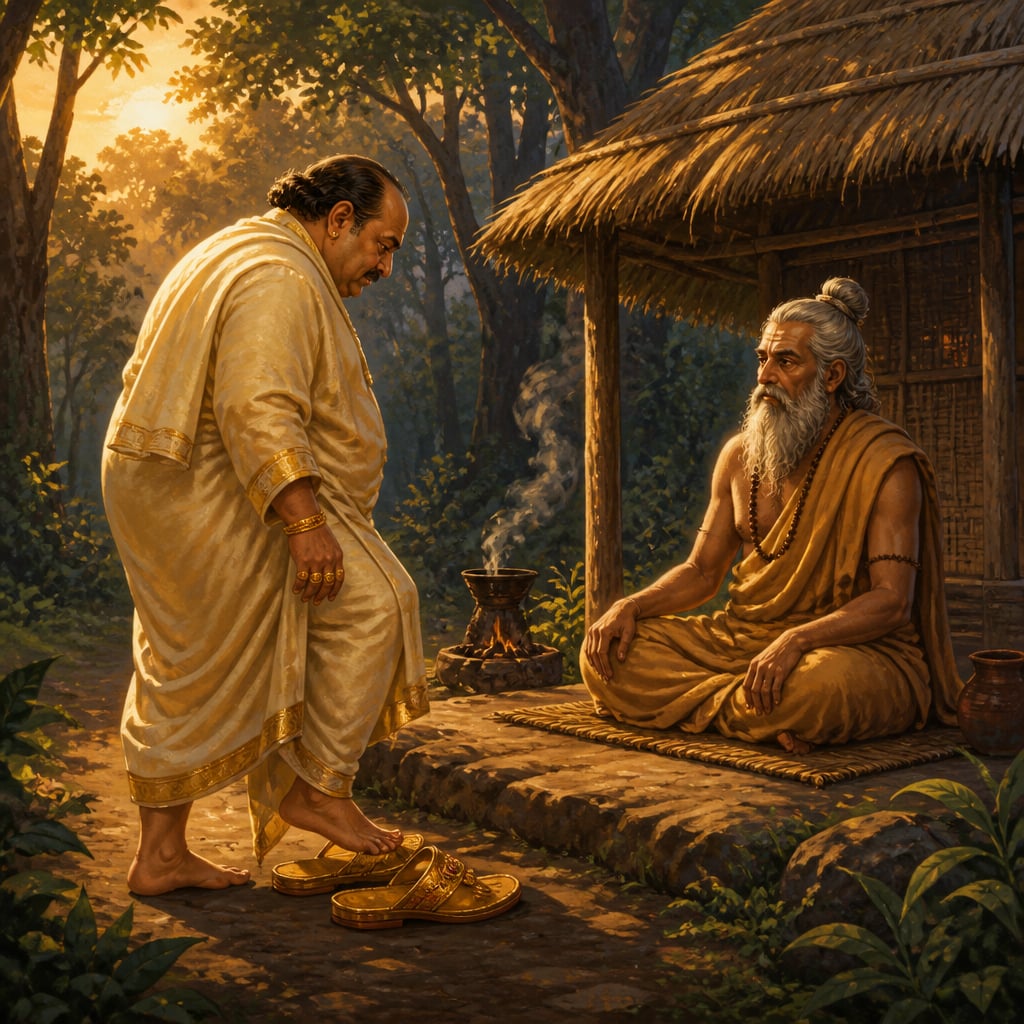
Shaunaka approaching the rishi Angiras at his forest ashram

It is the question of a busy, accomplished man who has finally realized that he cannot learn reality item by item. He has mastered the lower sciences, all of them, and they have not touched the thing he actually wants to know. He is not asking for another technique. He is asking for the master key.

Angiras did not dismiss him and did not flatter him. In his answer, compressed into the next few verses of what would become the Mundaka Upanishad, he reorganized the entire field of human learning into two categories, and he placed the four Vedas themselves on the wrong side of the line. Centuries later, and half a world away, Socrates would teach in the Athenian agora that virtue is knowledge. Angiras would not have disagreed with that sentence. He would have asked Socrates to specify, carefully, which kind of knowledge Socrates had in mind, and which kind he did not.

Two Vidyas

'Two vidyas are to be known,' Angiras said. 'So say those who know Brahman. Para and apara, the higher and the lower.'

Then comes the astonishing move. When Angiras lists the apara vidya, the 'lower' knowledge, he includes the Rig Veda, the Yajur Veda, the Sama Veda, and the Atharva Veda. He adds the six vedangas: phonetics, ritual, grammar, etymology, prosody, and astronomy. The entire classical Indian curriculum. Every sacred text, every technical discipline, every branch of traditional learning. All of it is apara. Lower. Useful, even essential, but not the thing Shaunaka is actually asking about.

And what is para vidya? Angiras is brief. 'That by which the imperishable is apprehended.' Not another book. Not another technique. A direct, first person recognition of what does not pass away.

Socrates Takes a Different Route

Socrates questioning citizens in the Athenian agora

Jump forward to Athens in the 5th century BCE. Socrates, walking the agora, corners a man named Meno in a famous dialogue by Plato. Meno has asked whether virtue can be taught. Socrates turns the question around and asks whether Meno even knows what virtue is. Meno offers several definitions. Socrates dismantles each one. Eventually Socrates makes his central claim. No one does wrong willingly. When people act badly, it is because they mistake a harmful thing for a good one, or a bad one for a neutral one. Correct the knowledge and the action corrects itself.

Socrates' picture of the mind is intellectualist. The will is not an independent faculty that can overrule the intellect. To know the good is already to be drawn toward it. Doing wrong is not a moral failure. It is a cognitive failure. Give people the right definitions and the right arguments, and good action will follow.

This is not a silly view. It explains a great deal. Most people who steal really have not thought seriously about what a community requires to function. Most people who lie really have forgotten what trust actually costs. Socrates was not naive about human weakness. He was making a structural claim: where there is true, full knowledge, wrong action becomes impossible. Where wrong action persists, there was never true knowledge in the first place. Many Western ethicists, from the Stoics through Spinoza, took versions of this seriously.

Where Socrates Stopped and the Mundaka Kept Walking

Here is the place where the two traditions diverge. Socrates never distinguished kinds of knowledge the way Angiras did. For Socrates, knowledge was a single ladder: ignorance at the bottom, partial opinion in the middle, true understanding at the top. He assumed that if you climbed high enough, the action would come along for free.

The Mundaka flatly says this is wrong about the lower ladder. You can climb all the way up in the Vedas themselves, master the grammar, the ritual, the astronomy, and still not be transformed. The Mundaka is not being dismissive of the Vedas. It is paying them the greatest compliment possible: it is admitting that even the most sacred technical knowledge is still technical. Knowing more about it does not by itself change who you are.

So what does change who you are? The Mundaka names a second, different kind of knowing. Para vidya is not more information, and it is not more skill. It is a direct recognition of what is imperishable in you and in everything. The rishi will not describe it in positive terms. It is 'that which the eye does not see, yet by which the eye is seen. That which the mind does not think, yet by which the mind is thought.' The recognition of the witness behind all the knowing.

This distinction is the Upanishadic refinement of Socrates' claim. Yes, knowledge transforms action. Yes, nobody who really sees the good acts against it. But 'really sees' is doing an enormous amount of work in that sentence, and Socrates under specified it. The Mundaka insists that the transformation Socrates expected from ordinary learning actually comes only from a kind of knowing that most formal education does not deliver. You can hold a PhD in ethics and still be cruel. You can memorize the entire Yajur Veda and still be greedy. The lower vidya, even at its peak, does not touch the place where action comes from.

Para vidya does. And the Mundaka claims, without apology, that any good done without at least a seed of para vidya is unstable. It will hold up in easy weather. It will not hold up in hard weather.

Why This Matters Today

Oppenheimer at the edge of the Trinity desert after dawn

The modern world has produced a staggering amount of apara vidya. Every technical field. Every branch of science. Every professional ethics code. Every TED talk. If Socrates had been right in his simple form, we would be the most virtuous civilization in history. We are not, and it is not because people are stupid.

The Mundaka offers a diagnosis we do not often hear. It is possible to be extremely well educated and to have essentially no para vidya. You can know what is right and not be moved by it, because the knowing is all taking place on the wrong ladder. This is not a failure of intelligence or access to information. It is a failure to recognize the one thing Angiras said was actually worth asking about: what is imperishable in you, and what changes when you recognize it?

You do not have to become a rishi to take the point. The next time you feel the gap between what you know and what you do, the Mundaka's suggestion is not to shame yourself with more information. It is to ask a quieter question. Is the knowing that would actually change this located in the kind of learning you have been collecting? Or is it the other kind, the kind that does not live in books, the kind that Shaunaka, with his big estate and all his responsibilities, finally stopped and asked about?

Case studies

Angiras and Shaunaka: The Question a Busy Man Finally Asked

The Mundaka Upanishad opens with a deliberately ordinary scene. Shaunaka, a wealthy householder described as a mahashala, a man with estates, dependents, and responsibilities, approaches the rishi Angiras 'in the proper manner.' He does not ask for a blessing or a ritual. He asks a single sharp question. 'Sir, by knowing what is all this known?' He has realized he cannot master reality item by item and he wants the master key. Angiras answers with the para and apara distinction. What Shaunaka is looking for, Angiras says, is not on the shelf with the Vedas and the sciences. It is on a different shelf entirely.

The scene is the Mundaka's own framing of its central claim. A fully competent Vedic scholar could have handed Shaunaka a list of texts to study. Angiras refuses. He tells him that the list is the apara vidya and that apara vidya, even at its peak, will not answer what he actually asked. This is not a rejection of learning. It is a distinction between two kinds of learning, and an insistence that mistaking one for the other is the original mistake from which most unresolved spiritual frustration flows.

The rest of the Mundaka Upanishad is Angiras's unfolding answer. He does not say para vidya is easy. He says it is the only answer to the question Shaunaka actually asked. Later Vedantic tradition treats the Mundaka as one of the clearest statements of this distinction, and Shaunaka's question becomes the archetype for every sincere householder who stumbles into the limit of technical learning and feels, without yet having words for it, that there must be something else.

Before you ask how to learn more, ask what kind of learning you are actually asking for. Shaunaka's original question was the breakthrough. The answer came naturally once the question was honest.

Oppenheimer After Trinity: Competence Without Consolation

J. Robert Oppenheimer, director of the Manhattan Project, watched the first atomic bomb detonate at the Trinity test site in New Mexico on July 16, 1945. In the moments afterward, he recalled a line from the Bhagavad Gita, a text he had studied in the original Sanskrit for years. 'Now I am become death, the destroyer of worlds.' Oppenheimer was not a religious man in any ordinary sense. He was one of the most technically brilliant physicists of his century. He knew the physics of the device with a completeness almost nobody else possessed. That knowledge did not touch the thing he felt the moment the light came up in the desert.

The Mundaka's framework names what happened. Oppenheimer had apara vidya in abundance. He had the Rig Veda of his field: the theoretical papers, the neutron cross sections, the engineering specifications. What he did not have, and what the Gita line in his mouth was reaching for, was para vidya. He knew the physics. He did not know the imperishable. The inability to rest in what he had just done was not a failure of information. It was a gap the information could not close.

Oppenheimer spent the rest of his life in an uneasy relationship with what he had helped make. He advocated against the hydrogen bomb, lost his security clearance in 1954, and spoke in interviews about the limits of technical knowing in the face of existential questions. His colleagues who stayed purely inside apara vidya often judged him harshly for this, as if he were failing at physics. A Mundaka reader would see the opposite. Oppenheimer knew exactly which ladder his distress lived on.

Mastery of apara vidya does not insulate you from the question para vidya is the answer to. Sometimes mastery sharpens the question. Do not mistake a Mundaka sized wound for a failure of competence.

Oppenheimer learned Sanskrit at Berkeley in the 1930s specifically to read the Gita in the original. Of all the Gita verses available to him in July 1945, the one that surfaced unbidden was the one about the destroyer of worlds.

Eichmann in Jerusalem: The Terrifying Adequacy of the Lower Ladder

In 1961, Adolf Eichmann was tried in Jerusalem for organizing the transportation of millions of Jews to extermination camps during the Holocaust. The philosopher Hannah Arendt covered the trial for The New Yorker and later wrote 'Eichmann in Jerusalem: A Report on the Banality of Evil.' Her observation shocked readers. Eichmann was not a raving fanatic. He was a competent bureaucrat. He was good at his job. He used the right vocabulary. He followed procedure. What was missing, Arendt argued, was not intelligence or information. It was the capacity to think from the standpoint of the lives his paperwork was moving. His apara vidya, as a logistics professional, was fully functional. The thing that might have stopped him was not on that shelf at all.

Arendt never used the Mundaka's vocabulary, but she was naming exactly what Angiras named. A person can be a skilled user of every technique his society trains him in and still have no para vidya whatsoever. The terrifying implication of Arendt's report is that a civilization can mass produce apara vidya and leave para vidya to private chance. When it does, the results can include Eichmanns who never even suspected there was a second kind of knowing they were missing. The Mundaka's warning is that Socrates' 'virtue is knowledge' is dangerously incomplete if you do not specify which knowledge.

Eichmann was convicted and executed in 1962. Arendt's book, initially controversial, is now a standard text in moral philosophy and political theory. It is one of the clearest case studies of the specific failure the Mundaka diagnoses: total competence on the lower ladder combined with total absence of the higher one. Her phrase 'banality of evil' names a category a purely Socratic ethics has trouble even seeing.

The scariest moral failures are not stupid. They are competent. When a system trains people in apara vidya and treats para vidya as optional garnish, it is not neutral. It is preparing the ground for the specific disaster Arendt described.

Reflection

More in How Should I Live? Ethics, Action, and the Good Life

All lessons in How Should I Live? Ethics, Action, and the Good Life ยท The Big Questions: Upanishads and the Philosophers Who Followed course