Can You Act Without Being Trapped by the Results?

The Isha Upanishad, Nietzsche's amor fati, and Marcus Aurelius walk into a lesson.

Isha Upanishad vs Nietzsche and the Stoics. Act vigorously, but do not let outcomes own you. This is freedom, not resignation.

The Walk to Pochampally

On 18 April 1951, in the village of Pochampally in the Nalgonda district of what was then Hyderabad State, a thin 55-year-old man in a homespun khadi dhoti sat down in a circle of landless Dalit labourers. He had walked in that morning from the previous village with a small group of followers carrying begging bowls and a few books. His name was Vinoba Bhave. Gandhi, his teacher, had been dead three years. The countryside he was walking through was on the edge of an armed peasant uprising that the Communist Party had been leading since 1946. Landless families had taken up rifles. Police had burned villages in reprisal. The red earth of Pochampally that April morning carried the tension of a place already halfway to becoming a battlefield.
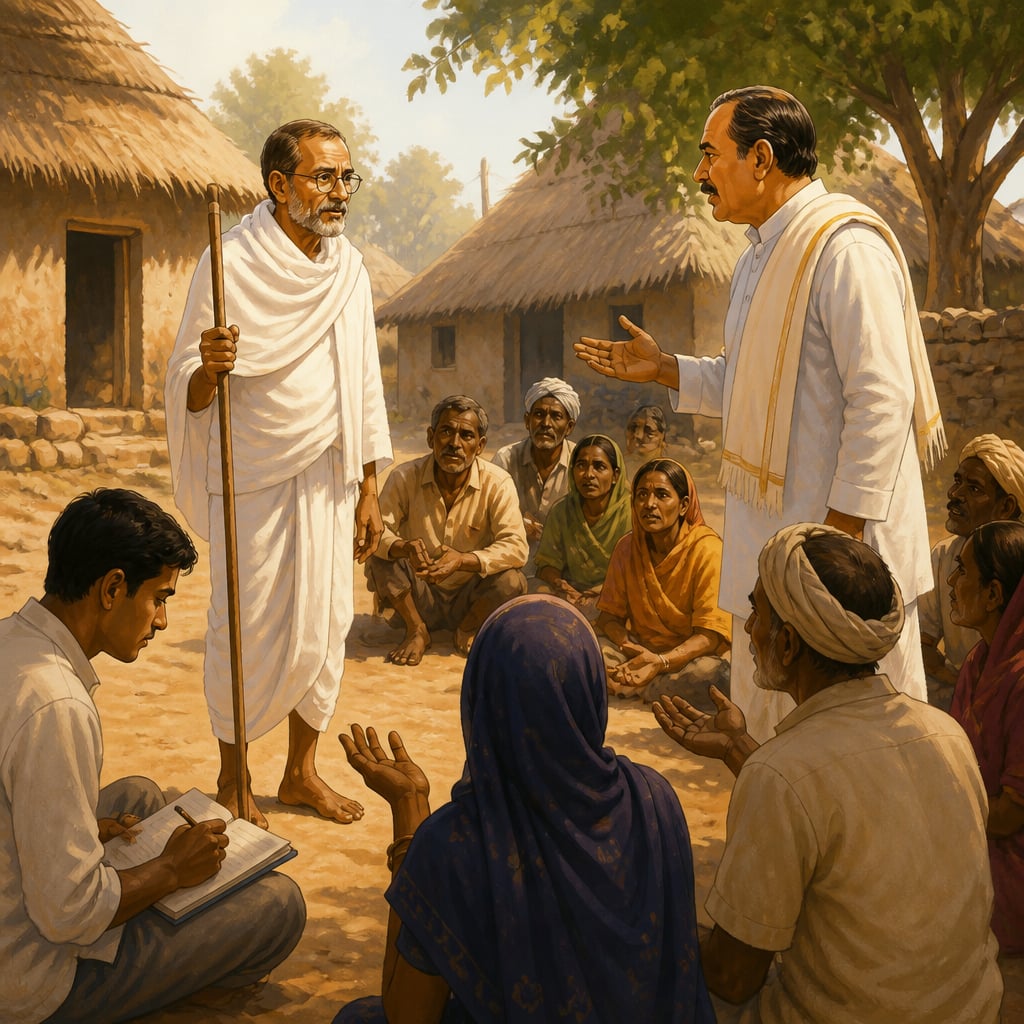
Vinoba Bhave standing in the Pochampally village courtyard

The labourers told Vinoba what they needed. Eighty acres of land for forty families. They were willing to fight for it. Vinoba listened. Then he stood up and asked, aloud, whether anyone in the village would give eighty acres of land freely, as a gift, with no expectation of return. A landowner named Ramchandra Reddy rose and said he would give a hundred. Vinoba accepted quietly. He had not come with a plan. He had not come with a programme. He had walked in with a begging bowl and walked out with a hundred acres of land transferred to the poorest people in the village, without a single rupee changing hands, without a single law invoked, without a single concession demanded in return.

What he started that morning would grow into a thirteen-year foot march across India that collected over four million acres of donated land. It would embody, in the middle of twentieth-century politics, the exact posture the Isha Upanishad had prescribed three thousand years earlier. Act vigorously. Release the result. Hold nothing as your own. The movement was called Bhoodan, the gift of the land. What follows is the Upanishadic frame it was actually built on.

The Isha's Compressed Argument

The Isha opens with a line that sets the frame for everything that follows. Īśāvāsyam idaṃ sarvaṃ yat kiñca jagatyāṃ jagat. Tena tyaktena bhuñjīthā, mā gṛdhaḥ kasya svid dhanam. All this, whatever moves in the moving world, is pervaded by the Lord. Enjoy through renunciation. Do not covet, for whose wealth is it anyway? In two sentences the Upanishad has done three things. It has declared that everything is already the property of a single presence. It has told you that the correct posture toward such a world is enjoyment through letting go. And it has dismantled the question of ownership by pointing out that the question has no coherent answer if the first sentence is true.

The second verse finishes the job. Kurvann eveha karmāṇi jijīviṣec chataṃ samāḥ. Evaṃ tvayi nānyatheto 'sti na karma lipyate nare. Doing your work here, wish to live a hundred years. In this way, and no other, does the action not cling to the one who acts. The Isha is not prescribing withdrawal. It is prescribing a hundred-year engagement. Work vigorously. Intend longevity. Wish for a long life in which you keep working. And within that engagement, practice the move that keeps the work from sticking to you.

The metaphysical basis is given in verse 6: yas tu sarvāṇi bhūtāny ātmany evānupaśyati, sarvabhūteṣu cātmānaṃ tato na vijugupsate. He who sees all beings in the Self, and the Self in all beings, does not shrink from anything. This is where the Isha's non-attachment gets its particular flavor. You are not detaching because detachment is a virtue. You are detaching because there is no one outside the Self to cling on behalf of. The Self is already in the one doing the work, in the one receiving the work, and in the results. Clinging is not wrong. Clinging is confused.

The Roman and the German

Marcus Aurelius writing in his war tent on the Danube

Marcus Aurelius and Friedrich Nietzsche both arrived at versions of this teaching. Marcus got there first. Between 170 and 180 CE, while running the Roman Empire and leading its longest war on the Danube frontier, he wrote a private notebook of Stoic exercises in separating action from outcome. The Meditations returns to the same theme dozens of times. Do your duty carefully, vigorously, and gently. Do not do it as if it were a matter of great importance. Release the outcome to nature. Marcus was not recommending passivity. He was recommending the exact posture the Isha describes: full engagement, no grip.

Nietzsche reached a related idea by a different route. In The Gay Science he offered what he called amor fati, love of fate. He wanted to be one of those who see what is necessary in things as beautiful, and therefore loved it. Do not merely endure what is, say yes to it. For Nietzsche this was a remedy for the resentment and the complaint that he saw poisoning modern life. Loving your fate does not mean clinging to it. It means refusing to wish it were otherwise. The structure of that move is the same as the Isha's tena tyaktena bhuñjīthāḥ. Enjoy by giving up. The Nietzschean formulation is hot where the Isha is cool, and proud where the Isha is quiet, but both are pointing at the same door.

Both Marcus and Nietzsche were doing serious philosophical work. Neither is being caricatured by the comparison. Marcus's Stoic discipline is one of the few pre-modern Western teachings that can still be read as a practical manual without translation losses. Nietzsche's amor fati has kept several generations of readers sane through situations in which resentment would have consumed them. The question the Isha forces is not whether they were wrong. The question is where they stopped.

What the Isha Has That They Do Not

There are two differences, and both are structural.

The first is the source of the non-attachment. For Marcus, non-attachment is a product of will. You train yourself to release the outcome because holding the outcome makes you miserable and ineffective. The work is therapeutic and pragmatic. It succeeds by repetition. For Nietzsche, amor fati is a product of reframing. You change your relationship to necessity by adopting a new attitude toward it. The work is artistic. It succeeds by perspective. For the Isha, non-attachment is a product of seeing. If the Self pervades the actor, the action, and the outcome, then there is nothing separate to cling on behalf of. The work is metaphysical. It succeeds by recognition. You do not force yourself to let go. You see what is actually there, and the grip falls open by itself.

The second difference is the temperature. Stoic discipline, pushed too far, can slide into coldness. You can end up detached from the very people whose suffering you are trying to serve. Nietzschean amor fati, pushed too far, can slide into a macho fate-worship that stops caring whether the fate was just. The Isha has a built-in guard against both. Because the same Self is in every face in front of you, service is warm by default. Because the same Self wrote the outcome you are releasing, there is no room for triumphalism about what happened. The Isha's non-attachment is neither Stoic nor Nietzschean. It is relational in a way neither of them could quite permit, because it starts from a unity neither of them had a vocabulary for.

Why It Still Matters

Jonas Salk holding the polio vaccine vial in his lab

Most modern work has been reorganized around outcome tracking. Dashboards, KPIs, likes, scores, annual reviews. The assumption underneath all of them is that the person doing the work needs to be glued to the results in order to produce them. The Isha's claim is that the opposite is true. Gluing yourself to the result is how the work becomes worse. The best tennis players, the best surgeons, the best teachers, and the best parents all end up describing the same practice: full effort, released outcome. They are not quoting a Sanskrit Upanishad. They are describing what it feels like to work the way the Isha says work is supposed to feel. The text is still open. The eighteen verses are still there. The only thing the reader is asked to do is to try the move for one hour of honest work and see whether what comes back is tiredness or relief.

Case studies

Rafael Nadal's Next Point: The Isha Applied to a Clay Court

Rafael Nadal has won 22 Grand Slam singles titles, including a record 14 French Opens on the clay of Roland Garros. Anyone who has watched him play has seen the same sequence between points: he bounces the ball the same number of times, tucks his hair behind both ears, touches his face, tugs his shorts, and steps to the line. The routine is famous. What is less famous is what he says the routine is for. In a 2010 interview with 60 Minutes he described it as a protocol for deleting the previous point. 'After every point you have to be ready for the next one. What happened before, you cannot change. I try to find a solution for the next point.' When he wins a point he does not celebrate. When he loses one he does not brood. The routine is the mechanism by which the outcome of each point is released before the next one begins.

The Isha Upanishad prescribes exactly this posture in its first two verses. Kurvann eveha karmāṇi: doing your work here. Full engagement. Tena tyaktena bhuñjīthāḥ: enjoy through renunciation. Full release. Nadal has found, by a completely independent route, the practical form of the Isha's paradox. A point played for its own sake is played better than a point played for the scoreline, because the scoreline is a distraction the body does not need. The Upanishad would recognize Nadal's routine as a ritual. Its purpose is to hold action and non-attachment together in the same moment.

Nadal's career tells the story. 22 Grand Slam titles. Two career Grand Slams. An Olympic singles gold. A playing style so punishing that many coaches warned he would not last. He lasted. In his Roland Garros farewell in 2024, he said the hardest thing he had ever trained was not the forehand or the footwork. It was the ability to let go of the last point.

The Isha's teaching is not that you should be indifferent to results. It is that results are a separate thing from the action that produces them, and that grasping one interferes with the other. Apply the principle anywhere you care about doing good work and you will recover energy you did not know was being leaked.

Between 2005 and 2024, Nadal compiled a 112 win and 4 loss record at Roland Garros. Each of those matches began the same way: on the next point.

Marcus Aurelius: The Emperor Who Wrote Meditations in a War Tent

Between 170 and 180 CE, while running the Roman Empire and leading its longest war on the Danube frontier, Marcus Aurelius wrote a private notebook for himself in Greek. It was never meant for publication. He addressed it to himself, titled it Ta eis Heauton (Things to Oneself), and used it as a training log for his own mind. The twelve books of Meditations are a series of Stoic exercises in separating action from outcome. Marcus had every reason to cling. He was responsible for the lives of millions, fighting a war against Germanic tribes, navigating the Antonine plague that may have killed five million people, and burying child after child. What he wrote, again and again, is a version of the same sentence: do your duty, then release it. 'Do what is set before you, as right reason prescribes, carefully, vigorously, gently. Not as if it were a matter of great importance.' This is the Isha's kurvann eveha karmāṇi in a Roman syntax.

The Isha Upanishad offers the same instruction with a different metaphysical backing. Marcus's detachment was a product of discipline. He held the line against despair by constant practice. The Isha grounds the same behavior in a vision: the Self is in all beings, so action in the world is action within a single Self that is already there. That shifts the flavor of the detachment. Marcus's version can tilt toward coldness. The Isha's version is warmer because the act of service is addressed to the Self wearing every face in front of you. Both arrive at 'do what must be done and let go of the rest.' The Isha arrives by seeing. Marcus arrives by will.

Marcus Aurelius died on campaign at Vindobona (modern Vienna) in 180 CE. The Meditations survived by a chain so thin that for nearly a thousand years only a few Byzantine scholars knew the book existed. When it finally reached Western Europe in the 16th century, it became one of the most quietly influential books ever written. The idea that you can act fully and release the outcome has a long and distinguished Western pedigree. It also has an older Upanishadic one.

A truth does not become less true by being reached through a different route. Marcus walked to the Isha's conclusion across a Stoic bridge. Anyone who can only hear the teaching in one language will miss how many languages it has been spoken in.

Jonas Salk: 'Could You Patent the Sun?'

In 1955, Jonas Salk and his team at the University of Pittsburgh announced a safe and effective polio vaccine. Polio had been crippling and killing children at devastating rates. In the United States alone, 1952 had recorded nearly 58,000 cases. When the vaccine was declared successful on April 12, 1955, church bells rang in American cities, factories stopped work, and Salk became overnight one of the most famous living scientists. A few weeks later, in a television interview with Edward R. Murrow, Murrow asked him who owned the patent on the vaccine. Salk answered, 'Well, the people, I would say. There is no patent. Could you patent the sun?' He had done the work at the highest intensity a human being can sustain. He then declined to own the results. Estimates later placed the unpatented value of the vaccine in the billions of dollars. Salk walked away from all of it.

The first verse of the Isha says that everything in the moving world is pervaded by the Lord. The instruction that follows in the same verse is 'tena tyaktena bhuñjīthāḥ, mā gṛdhaḥ kasya svid dhanam': enjoy through renunciation, do not covet, for whose wealth is it anyway? Salk's answer to Murrow is a near-literal restatement. The sun belongs to no one. The vaccine belongs to everyone. He had used his hands to do work that was never his to own. The Upanishadic move is not a refusal of action. It is a redirection of ownership. The work was done with total seriousness because the One being served was the same One seeing through every eye it would protect.

The Global Polio Eradication Initiative, launched in 1988, has since reduced wild polio cases by over 99 percent. Salk spent the rest of his life at the Salk Institute working on HIV and other problems. He never became rich. When asked later whether he regretted not patenting, he said simply, 'There is no patent. How could you patent the sun?'

The Isha's claim is not that you should avoid outcomes. It is that you should avoid owning them. Done right, the avoidance makes the work better, not worse, because the grasping was the part that was slowing you down.

Forbes later estimated the unpatented Salk vaccine would have been worth roughly 7 billion dollars if its creator had chosen to own it. Salk's estimate of its value was different: he said it belonged to the people.

Reflection

More in How Should I Live? Ethics, Action, and the Good Life

All lessons in How Should I Live? Ethics, Action, and the Good Life · The Big Questions: Upanishads and the Philosophers Who Followed course