Is Suffering Necessary for Wisdom?

Nachiketa was tested by Death. Nietzsche said what doesn't kill you makes you stronger.

Katha Upanishad vs Nietzsche and Kierkegaard. The fire of honest inquiry burns away everything except what is real.

A Boy at the Door of Death

The Katha Upanishad opens with a scene that would get a modern parent arrested. A man named Vajashravas is performing a great sacrifice, the kind that requires giving away all your worldly goods. But Vajashravas is cutting corners. The cattle he is donating are old, barren, blind, broken. His young son Nachiketa watches and feels something go wrong in his chest. This is not right. My father is cheating at a holy thing.
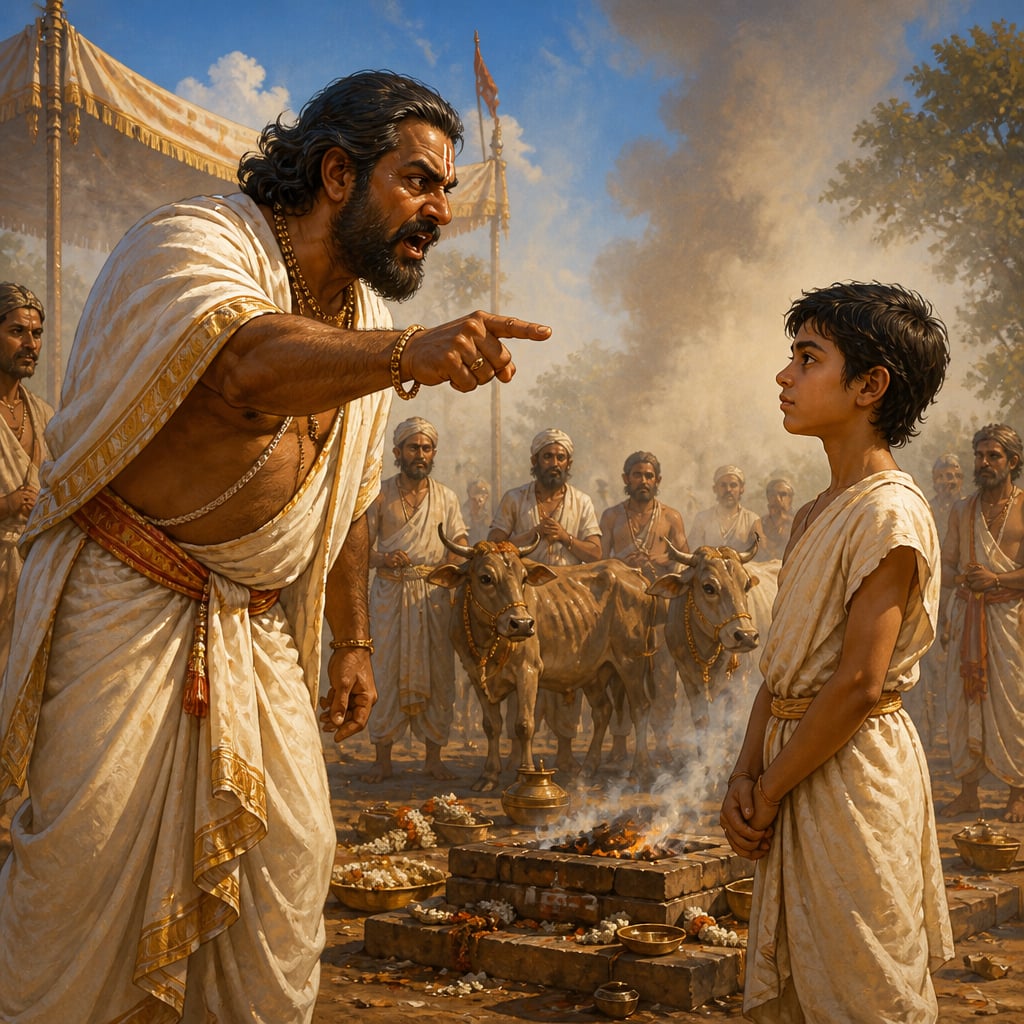
Vajashravas shouting at his young son Nachiketa at the sacrifice

The boy walks up to his father and asks a question. 'Father, to whom will you give me?' Vajashravas ignores him. Nachiketa asks again. Ignored. A third time. And Vajashravas, out of patience, spits: 'To Death. I give thee to Death.'

He says it the way a furious parent says 'go to your room.' He does not mean it. But Nachiketa takes it literally. He leaves. He walks to the house of Yama, the god of death, and waits at the threshold. Yama is out hunting. Nachiketa waits three nights without food, without water, without hospitality. When Yama finally returns, he is horrified. A Brahmin guest at his own door, neglected for three days. This is a grave violation of dharma even for Death.

Yama offers three boons to make amends. Nachiketa chooses carefully. The first boon: peace in his father's heart, forgiveness when he returns home. Granted. The second boon: teach me the secret of the sacred fire that leads to heaven. Granted. And then the third boon, the one the entire Upanishad turns on: 'Tell me what happens to a person after death. Some say the self survives. Some say nothing remains. I want to know which is true.'

Yama tries to dodge. He tells Nachiketa this is a question even the gods find hard. He offers a replacement: 'Ask me for anything else. Sons and grandsons who live a hundred years. Cattle, elephants, gold, vast tracts of land. A kingdom. Celestial maidens with chariots. Anything your heart desires. But do not press me on this one question.'

And here the test begins. Not the test Nachiketa had been through, waiting three nights at the threshold. A deeper test. Yama has just offered him every reward a human being could want, and Nachiketa has to refuse it.

Nachiketa's Answer

He refuses. 'These pleasures last only till tomorrow,' he says. 'They wear out the senses that enjoy them. A human life is short. Even if it were long, what is a long life of diminishing returns compared to the one answer that would tell me what all of it meant? Keep your chariots and your nymphs, O Yama. Tell me of the eternal.'

This is not the reply of someone who likes suffering. It is the reply of someone who has already noticed that comfort is a bribe the universe keeps offering in exchange for not asking the real question. Nachiketa is maybe twelve years old in the traditional reading. He has not suffered extensively. What he has is an unusual clarity about the difference between what is pleasant and what is actually worth having. The Upanishad gives this distinction its technical vocabulary at the start of chapter two: śreyas, the good, and preyas, the pleasant. They look similar. They feel similar in the moment. They are not the same. The wise, the Katha says, choose śreyas. The foolish, clutching at preyas, miss what matters and end up with neither.

Yama, seeing that he cannot deflect the boy, finally teaches. What follows is some of the most compressed spiritual philosophy in the Upanishadic corpus. The Self is not born and does not die. The chariot of the body is drawn by the horses of the senses, steered by the mind as reins, guided by the intellect as charioteer, with the Self as passenger. The path to liberation is sharp as a razor's edge, hard to traverse, the poets say. Arise, awake, and learn from those who know.

At the very end, Nachiketa receives the knowledge, returns, and the Upanishad closes. He never actually dies in the narrative. But he has walked into Death's house, refused Death's bribes, and come out knowing something no comfortable person could have known. The Katha is unambiguous on this point: what Nachiketa gained was available to him only because he first refused what everyone else would have taken.

Nietzsche: What Does Not Kill You

Nietzsche walking alone in the Swiss Alps at late afternoon

Two and a half thousand years later, in Genoa and Nice and Turin, a German philosopher named Friedrich Nietzsche was writing sentences that sound, at first, like a modern Nachiketa. 'What does not kill me makes me stronger.' 'You must have chaos in yourself to give birth to a dancing star.' 'To live is to suffer. To survive is to find meaning in the suffering.' (That last one, often attributed to Nietzsche, is actually Viktor Frankl's summary of Nietzsche's view, but the view is real.) Nietzsche was building a philosophy around the claim that suffering is not an obstacle to the meaningful life but its raw material. Amor fati, he called it. Love of fate. Do not merely endure what happens to you. Say yes to it. Not because it is good, but because it is what there is, and a life that keeps refusing what there is will never become anything.

Nietzsche is often read as glorifying suffering. This is a misreading. He was not glorifying anything. He was refusing to accept the Christian framing in which suffering is a problem to be solved by a redeemer who takes it away. For Nietzsche, the attempt to abolish suffering was itself the disease. A human being who successfully abolished suffering would be a flat, sedated, fundamentally diminished creature. The task was not to abolish it but to undergo it in a way that transformed you. Nietzsche was pointing at the same fork in the road that Nachiketa pointed at: preyas, the easy path, leads to a smaller life. Śreyas, the harder path, demands that you walk toward the thing you fear and let it change you.

Here is where the comparison starts to matter. Nietzsche had Nachiketa's clarity about the fork. He did not have Nachiketa's structure for walking it. Nietzsche's amor fati is a personal posture, sustained by willpower, with no guide and no company. If it works, it produces an Übermensch who stands alone in a godless cosmos and affirms everything. If it does not work, it produces a breakdown. Nietzsche himself broke down. In January 1889, in a square in Turin, he reportedly saw a horse being beaten, threw his arms around the animal's neck, and collapsed into eleven years of mental silence. His sister wheeled him around in a dressing gown for photographers. Whatever amor fati was supposed to produce, that was not it.

Kierkegaard: The Sickness Unto Death

A generation before Nietzsche, a Danish writer named Søren Kierkegaard had worked the same territory from a different angle. Kierkegaard's book The Sickness Unto Death (1849) is a short, difficult treatise on despair. Kierkegaard's central move is to reframe despair. It is not a feeling. It is not a symptom. It is a revelation of what you actually are when the distractions are stripped away. Everyone, Kierkegaard argued, is in despair. Most people just do not know it. They are anesthetized by busyness, by ambition, by love affairs, by nationalism, by whatever happens to be at hand. The person who becomes aware of despair has not caught a new illness. They have woken up to a condition that was there all along.

Why is this good news? Because despair, for Kierkegaard, is the opening through which the self finally meets the ground on which it rests. A comfortable person never has to ask what they are. A person gripped by despair cannot avoid the question. And asking the question, honestly, is the only way any real answer ever arrives. Kierkegaard is explicit: suffering is not redemptive in itself. The mere fact of having suffered teaches nothing. What teaches is the suffering undergone with the question still alive. Pain plus blindness produces bitterness. Pain plus inquiry produces clarity.

This is closer to the Katha than Nietzsche's amor fati. For Kierkegaard, the fire of suffering burns something, and what it burns is the illusion that the self is a finished thing held together by its preferences. When the preferences are broken, the self sees what it actually rests on. Or does not, and stays broken. There is no guarantee. But without the burning, the recognition is not available.

Where the Katha Goes Further

Both Nietzsche and Kierkegaard stop short of the Katha in the same place, though they stop for different reasons. Both treat suffering as an individual spiritual trial. The sufferer is alone. The meaning is wrested by the sufferer's own effort. Nietzsche's model is heroic will. Kierkegaard's model is wrestling with God in solitude. In both, the suffering is the transaction, and the wisdom is the payment.

The Katha frames it differently. Nachiketa is not paying for his insight with suffering. The three nights at Yama's threshold are not coinage. They are the condition that rendered Nachiketa still enough to refuse the bribes when the bribes came. The hunger and the waiting stripped away his ordinary reactivity. When Yama offered him a hundred years of chariots and nymphs, the boy who had just spent three days at Death's door was the only person in the universe capable of hearing that offer and answering correctly. The suffering was not the wisdom. The suffering was the preparation that made a particular kind of refusal possible.

This is a finer distinction than it looks. If suffering were the currency of wisdom, then the greatest sufferers would be the greatest sages. They are not. History is full of people broken by pain into bitterness, despair, or violence. The Katha does not claim that suffering produces insight. The Katha claims that suffering, in the presence of a particular kind of disciplined attention (tapas) and a particular kind of unshakable asking (śraddhā), can set up conditions under which insight becomes possible. Take away the attention and the asking and you have pain without fruit. This is the usual human situation.

There is also the question of the teacher. Nachiketa does not figure this out alone. He waits, refuses, and is then taught by Yama himself. The tradition is structural. There is a method, there is a guide, there is a lineage of answers that have survived the question before. Nietzsche had none of this. Kierkegaard had some of it (the Bible, the long Christian contemplative tradition) but was cutting against it in places. Neither had what Nachiketa had: a teaching structure designed precisely for the moment when a person becomes serious enough to receive it.

Why This Matters Now

Viktor Frankl at dawn in an Auschwitz roll-call square

Modern life has gotten extraordinarily good at anesthesia. Not just pharmaceutical anesthesia, though that is part of it. The deeper anesthesia is structural. Notifications, streaming content, constant low grade social stimulation. The conditions under which a person has to sit still long enough to notice the condition they are actually in have become rare. Most people, most of the time, are Yama's offer, accepted. Chariots and pleasures, one day at a time, forever.

The Katha's warning is not that the offer is evil. The offer is fine for what it is. The warning is that accepting it indefinitely means never being still enough to discover what you would have asked if you had been. Nachiketa's story is not an argument for going looking for suffering. Nobody in the tradition recommends that. It is an argument for not running from whatever suffering the universe happens to bring you. When the three nights at the threshold come (and for most of us they come, in the form of illness, grief, failure, the end of a love, the slow realization that something we built our life on was not real) the question is whether you will spend them asking the real question or whether you will distract yourself until they end.

The promise of the Katha is not that suffering is necessary for wisdom. The promise is that wisdom, when it comes, tends to come through a door that suffering opened. Shut the door and you stay comfortable and you stay ignorant. Walk through it, with attention and with the real question alive, and the teaching shows up. Yama, it turns out, teaches only those who have waited.

Case studies

Nachiketa's Three Nights at Yama's Threshold

The Katha's opening narrative is built with unusual care. Nachiketa arrives at Yama's house alone, as a child, sent there by his father's angry words. Yama is out, hunting. Nachiketa does not knock on another door. He does not go home. He does not beg for food from a neighbor. He sits at the threshold and waits. Three nights pass without food, water, or the normal hospitality due a Brahmin guest. When Yama returns, he is told by his household what has happened and is visibly distressed. In the Vedic world, neglecting a guest is a grave violation of dharma. Yama's offer of three boons is specifically framed as compensation for the three nights of neglected hospitality.

Read the waiting as the test and the bribes as the real test. The three nights are the first filter. Most seekers would not last three nights. They would rationalize leaving: 'Death is not home, this is pointless, I should come back tomorrow.' Nachiketa has already committed to not leaving until the question is asked. That is the first layer of śraddhā. The bribes that come next are the second filter. Yama does not simply teach once Nachiketa has waited. He first tries to buy him off. A hundred years of sons. Chariots. Nymphs. Vast domains. The offer is not cruel. It is a genuine offer of everything a finite human life could want. Nachiketa's refusal is the point of the entire story. A student who accepts the offer is a student who never wanted the real answer, only the appearance of wanting it. A student who refuses has shown that he wanted the answer more than he wanted any of the things that make refusal easy.

Yama, defeated by Nachiketa's refusal, finally teaches. The teaching includes the chariot metaphor, the immortality of the Self, the razor's edge, and some of the most influential verses in Upanishadic philosophy. Nachiketa receives the knowledge and, in some readings of the text, returns to his father's house. The narrative does not dwell on his return. It does not need to. The transformation has already happened at the threshold, and the rest of his life, whatever it contains, is now lived in the light of what he learned there.

The suffering in the story is not the hunger of three nights. The suffering is the effort of refusing comfort when comfort is being offered by the most authoritative voice in the universe. This is the distinction modern readers usually miss. Nachiketa's fast is minor. The real cost is what he gives up when Yama offers him the world. The Katha's claim about suffering and wisdom is therefore narrower than the lesson title suggests. Wisdom does not come from hunger or pain. Wisdom comes from the refusal of the bribes that hunger and pain put you in a position to see clearly. Comfortable people do not face the bribes. Only people who have been stripped of their defaults face them. That is why suffering is traditionally a doorway, not a currency.

Every serious spiritual tradition has a version of this test. Buddhism has Mara's offers to the Buddha under the bodhi tree. Christianity has Satan's offers to Jesus in the wilderness. Sufism has its khalwa, the forty day retreat designed to create exactly the condition Nachiketa found himself in. The structure is the same in every case: the aspirant is stripped of distractions, and then the distractions are offered back in concentrated form to test whether the aspirant's refusal was real. The Katha is unusual only in its frankness about what is happening and who is offering the bribes.

The Nachiketa episode is referenced not only in the Katha Upanishad but also in the Mahabharata's Anushasana Parva and in several Puranic texts, which preserve variant details of the three nights. The core structure, the waiting, the three boons, the refusal, and the teaching, is stable across all retellings.

Kierkegaard's The Sickness Unto Death

In 1849, Søren Kierkegaard published a short book under the pseudonym Anti Climacus. He called it The Sickness Unto Death. The phrase is taken from the Gospel of John: 'This sickness is not unto death.' Kierkegaard inverts the Biblical line. His claim is that there is indeed a sickness unto death, and it is despair. Not despair as an occasional feeling. Despair as the hidden structural condition of every human self that has not yet come to rest in its own ground. Kierkegaard works through the forms of despair methodically: the despair of not knowing one is in despair, the despair of weakness (wanting to be rid of oneself), the despair of defiance (willing oneself in isolation). Each form, examined carefully, turns out to be a refusal of the relationship to the ground that would complete the self. The book is dense, often frustrating, but philosophically exact.

Read alongside the Katha, Kierkegaard's book is a Western rehearsal of the same claim without the narrative machinery. Kierkegaard does not have a Yama figure. He does not have a Nachiketa figure. He has a single analytical voice dissecting the reader's own condition. But the structural argument is the same: the comfortable person is not better off than the despairing person. The comfortable person is simply unaware of the sickness they already have. Kierkegaard is explicit that awareness is the beginning of health, even though the awareness is itself painful. The suffering of despair is not redemptive in itself. It is revelatory. What it reveals is the self as it actually is, which is a relation that cannot sustain itself, and which must find its ground elsewhere. This is Kierkegaard's Protestant Christian language for what the Katha calls the Self beyond the empirical self. The names are different. The move is nearly identical.

Kierkegaard died in 1855 at age 42, largely unread outside Denmark. His reception grew slowly and then exploded in the twentieth century. By the 1930s he was recognized as the foundational figure of existentialist philosophy. Jaspers and Heidegger built their own work on him. Sartre and Camus responded to him, sometimes hostilely. The Sickness Unto Death remains one of his most widely read books, taught in philosophy and theology departments around the world. Its influence on how modern Westerners think about anxiety, despair, and the self has been enormous, even among readers who have never opened Kierkegaard's own text.

Kierkegaard matters for this lesson because he makes the Katha's claim defensible in a purely philosophical register. You do not need to believe in Yama to accept Kierkegaard's argument. You do not need to accept the guru shishya structure. You only need to notice that despair, when it comes, tells you something about your condition that comfort could not have told you, and that listening to what it says honestly is the only way a genuine orientation of the self becomes possible. The Katha and Kierkegaard are working different vocabularies on the same problem, and they reach remarkably similar conclusions. The Upanishad's advantage is the narrative frame, which makes the claim memorable and transmissible. Kierkegaard's advantage is the analytical rigor, which makes the claim harder to dismiss as mere story.

Modern clinical psychology has begun, slowly and without acknowledging its sources, to rediscover something close to Kierkegaard's position. Acceptance and commitment therapy treats psychological pain not as pathology to be eliminated but as information to be honored. Meaning centered therapies, descending from Frankl, make the same move. The field has not yet returned to the full Kierkegaardian claim (that despair is a revelation of the self's actual ground) but it is closer than it was in the 1960s. The Katha is closer still, because it names both the condition and the ground in a single compressed teaching.

The Sickness Unto Death has never gone out of print in any major European language since its first translation into German in the early twentieth century. Its influence on twentieth century theology, psychology, and philosophy is traceable through Paul Tillich, Karl Barth, Rollo May, and a long list of figures who took its central claim about despair as revelation seriously enough to build their own work on it.

Viktor Frankl in Auschwitz

Viktor Frankl was an Austrian psychiatrist who was arrested in 1942 and spent three years as a prisoner in four Nazi concentration camps, including Auschwitz. His parents, his brother, and his pregnant wife all died in the camps. He survived. He returned to Vienna in 1945, resumed his psychiatric practice, and in the same year dictated a book in nine consecutive days. It was published in German as Trotzdem Ja zum Leben Sagen (Saying Yes to Life Despite Everything) and later in English as Man's Search for Meaning. The book combines an unsparing account of camp life with a clinical thesis that emerged from what Frankl observed among his fellow prisoners.

Frankl noticed something while he was still a prisoner. Under the same conditions of starvation, exposure, and terror, some men kept something alive inside them and some did not. The ones who kept something alive were not necessarily the physically strongest. They were the ones who had a reason that reached beyond the camp: a person waiting for them, a book unfinished, a task unfulfilled. The ones who lost that reason often died within days, sometimes of nothing the doctors could identify. Frankl's clinical conclusion, which became the foundation of his later school of psychotherapy (logotherapy), was that the search for meaning is not a luxury of the comfortable but the load bearing structure of human survival under the worst conditions imaginable. He quoted Nietzsche's line ('He who has a why to live for can bear with almost any how') and made it his operating principle. But he went further than Nietzsche. He had empirical data, gathered under conditions that no ethical researcher could replicate, that the principle was true.

Man's Search for Meaning has sold an estimated sixteen million copies in more than fifty languages. Frankl spent the rest of his life developing logotherapy, the third major school of Viennese psychotherapy after Freud's psychoanalysis and Adler's individual psychology. He was awarded twenty nine honorary doctorates, treated thousands of patients, and kept insisting that his central claim was not philosophical speculation but clinical observation made under the most extreme conditions available to twentieth century science. He died in 1997, having seen logotherapy become a recognized branch of humanistic psychology worldwide.

Frankl is the twentieth century empirical validation of the Katha's claim, performed under conditions nobody would wish on anyone. What he found was that suffering alone does not produce wisdom, that some prisoners under identical conditions came out deeper and some came out destroyed, and that the difference was whether the suffering was undergone with a question still alive. The prisoners who came out deeper were, in Katha terms, the ones who had śraddhā. The prisoners who were destroyed were the ones who had been running from the question all along and had nothing to fall back on when the distractions were stripped away. Frankl's work does not prove the Katha in any metaphysical sense. It confirms the narrower psychological claim that the Katha's framing is consistent with what can be observed when human beings are pushed to the limit of what is endurable.

Post traumatic growth research, a subfield of psychology that emerged in the 1990s, has repeatedly found that a significant minority of people who undergo severe trauma report lasting positive changes in their values, priorities, and sense of meaning. The effect is not universal. Many survivors are simply damaged. The difference between growth and damage maps almost exactly onto the distinction Frankl was drawing. It is also close to what the Katha calls the difference between suffering with śraddhā and suffering without it. The science is catching up to the claim the Upanishad made twenty five centuries ago.

In 1991, the Library of Congress and the Book of the Month Club jointly surveyed American readers to identify the ten books that had made the most difference in their lives. Man's Search for Meaning was one of the ten. Frankl's central observation, that prisoners with a reason to live had dramatically higher survival rates under identical physical conditions, has been supported by subsequent research on survivors of chronic illness, bereavement, and trauma.

Historical context

c. 600 to 400 BCE (Katha Upanishad) / 1813 to 1900 (Kierkegaard and Nietzsche)

The Katha Upanishad belongs to the Krishna Yajur Veda and is one of the middle period principal Upanishads, composed somewhere between the sixth and fourth centuries BCE. Its story draws on an even older Vedic source, the Nachiketa fire ritual mentioned in the Taittiriya Brahmana, but the dialogue form and the philosophical framing are distinctively Upanishadic. The Katha is short (two adhyayas, six vallis) but extraordinarily dense. It introduces the chariot metaphor for the body and the Self, the distinction between śreyas and preyas, the razor's edge image for the spiritual path, and one of the clearest Upanishadic statements of the Self's immortality. All of this arrives inside a single dramatic narrative, which is why the Katha has remained one of the most read Upanishads across every subsequent century of Hindu thought.

Understanding the context explains the narrative frame. The Katha is not a treatise. It is a story built around a question that a grown philosopher could not ask without compromising. Only a child could refuse Yama's bribes without being a liar or a hypocrite. A world weary adult would look calculating. A sage would look performative. A twelve year old boy who has not yet learned to want what the world teaches him to want is the only narrator through whom the refusal becomes credible. The Upanishad's dramatic structure is doing philosophical work that an argument alone could not do.

Reflection

More in How Should I Live? Ethics, Action, and the Good Life

All lessons in How Should I Live? Ethics, Action, and the Good Life · The Big Questions: Upanishads and the Philosophers Who Followed course