Should You Withdraw from the World or Engage with It?

The Isha Upanishad's first verse inspired Emerson and Thoreau across an ocean.

Īśā Upaniṣad vs Emerson and Thoreau. Live in the world, act fully, but do not cling. American Transcendentalism was built partly on this principle, read across an ocean in translation.

The Study in Concord
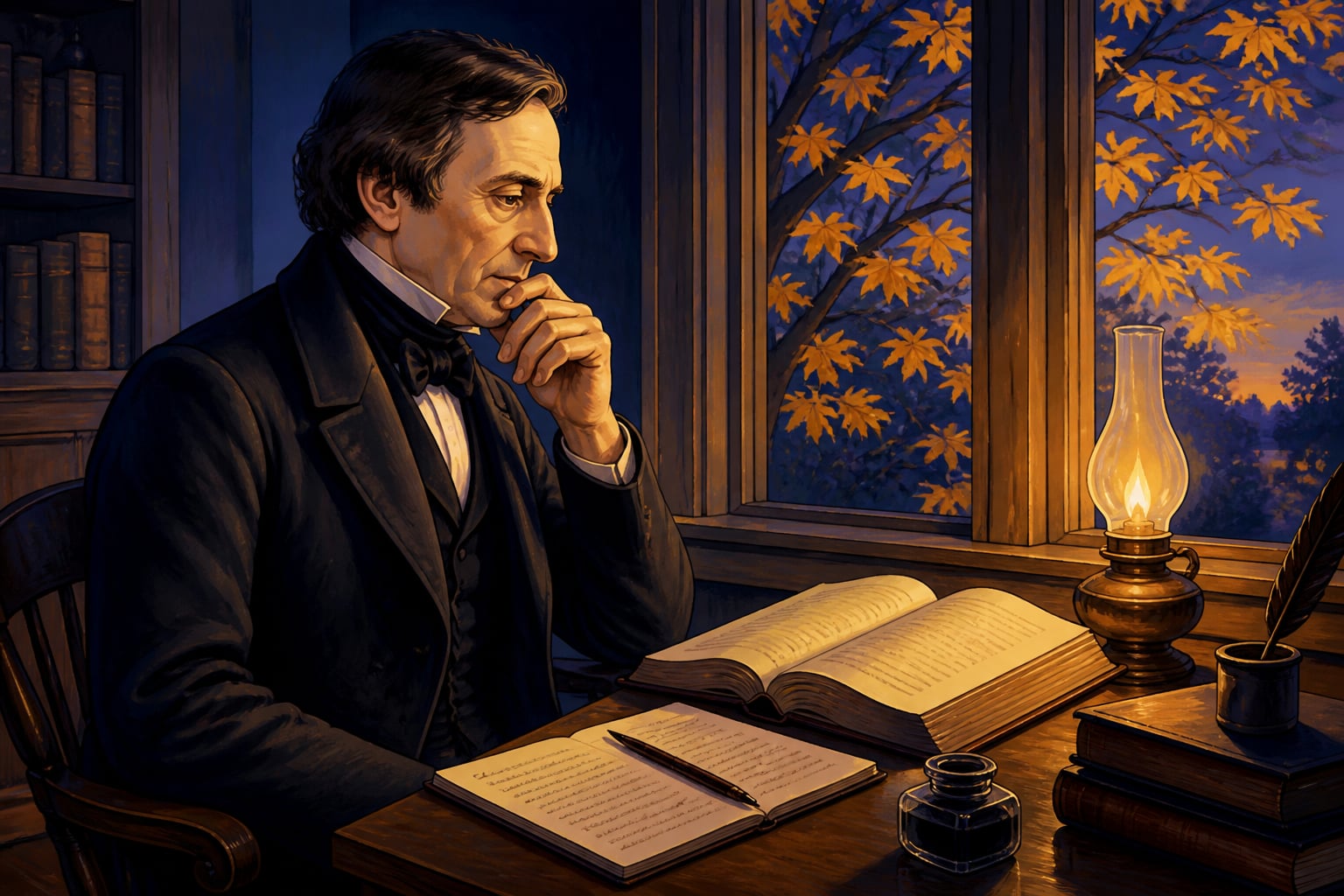
Emerson reading the Gita in his Concord study at evening

On an evening in the summer of 1845, in a small New England village called Concord, Massachusetts, a 42-year-old former Unitarian minister named Ralph Waldo Emerson sat down in his study with a borrowed book. The book was an English translation of the Bhagavad Gita, printed in 1785 by Charles Wilkins, a clerk of the British East India Company. It had traveled from Bengal to London, from London to Boston, and finally to the shelves of the Emerson family library in Concord. The lamp was lit. The house was quiet. On the desk lay his journal, a half-finished essay, and a stack of letters he had not yet answered.

Emerson had spent most of the past decade looking for a spirituality that was not Christian in the narrow sectarian sense, not dependent on any church, and that treated the interior life as the central fact of religion. He had given up the ministry in 1832 after refusing to administer communion. He was forty-two years old and still looking.

That summer he wrote in his journal, in a hand now preserved at the Houghton Library at Harvard, that the Gita was 'the first of books', 'as if an empire spake to us, nothing small or unworthy, but large, serene, consistent, the voice of an old intelligence which in another age and climate had pondered and thus disposed of the same questions which exercise us.' Reading it, Emerson felt he had met someone who, three thousand years earlier, had already answered the question he was still trying to form.

That question is the subject of this lesson. Emerson caught half of its answer. He did not catch the other half. The gap between the Upanishad and the American who fell in love with it is what the rest of the lesson is about.

The Upanishadic Answer

The Īśā Upaniṣad is one of the shortest and oldest of the principal Upaniṣads. Its 18 verses form the final chapter of the Vājasaneyī Saṃhitā of the Śukla Yajur Veda, which means it sits inside the Vedic ritual corpus itself. Its opening line is not a later philosophical addition. It comes from the heart of Vedic ritual life.

The opening verse is fourteen Sanskrit words that may be the most compressed piece of ethical philosophy ever written.

ईशावास्यमिदं सर्वं यत्किञ्च जगत्यां जगत्। तेन त्यक्तेन भुञ्जीथा मा गृधः कस्यस्विद्धनम्॥

īśāvāsyam idaṃ sarvaṃ yat kiñca jagatyāṃ jagat tena tyaktena bhuñjīthā mā gṛdhaḥ kasya svid dhanam

All this, whatever moves in the moving world, is pervaded by the Lord. Enjoy by renouncing. Do not covet, for whose wealth is it anyway?

Īśā Upaniṣad, verse 1

Every word is load-bearing. The world is God-clothed through and through. The correct posture toward such a world is enjoyment, but enjoyment specifically through letting go. And the closing question dissolves the very idea of ownership: if everything is pervaded by the Lord, whose wealth would you even be coveting?

Verse 2 then closes the hermit door. Kurvann eveha karmāṇi jijīviṣec chataṃ samāḥ. Performing actions here, may you wish to live a hundred years. Act. Keep acting. Want a full long life inside the work of the world. The Upaniṣad does not ask you to stop doing anything. It asks you to do everything with a different interior posture. Centuries later the Bhagavad Gītā will build its entire karma-yoga teaching on these two verses. Śaṅkara, in his commentary, called the Īśā the Upaniṣad that offers a 'householder's path', a way of liberation that does not require you to leave.

Verse 6 gives the metaphysical ground. 'He who sees all beings in the Self, and the Self in all beings, does not turn away from anything.' Non-attachment is grounded in non-separation. You do not cling to your wealth because it is not separate from you. You do not turn away from others because they are not separate from you either. The detachment is not coldness. It is the opposite of coldness.

Verse 11 refuses to rank knowledge and action. 'One who knows both vidyā and avidyā together crosses death through avidyā and attains immortality through vidyā.' Neither alone is enough. You need to engage with the world, and you need to rest in the knowledge of the Self, in the same lifetime.

That is the Upanishadic answer. The world is God-clothed. Act fully inside it. Hold nothing as your own. See yourself in everything you meet. Integrate knowledge and action rather than choose between them.

The Western Echo

Emerson had not reached the Gita alone. The translations had travelled a long way. Raja Rammohan Roy had published English translations of several Upaniṣads in Calcutta in the early 1820s. Charles Wilkins had translated the Bhagavad Gītā in 1785 under Warren Hastings's patronage. German Romantics and Schopenhauer had read them and been transformed. By the 1840s the same texts had crossed the Atlantic to Harvard and to Emerson's desk.

Thoreau among bean shoots beside Walden Pond

What Emerson began in essays and poetry, his younger friend Henry David Thoreau tried to live. On 4 July 1845, Thoreau moved into a one-room cabin he had built himself on the shore of Walden Pond, on land borrowed from Emerson. He stayed for two years, two months, and two days, planting a bean field and reading the Bhagavad Gītā in the Wilkins translation borrowed from the Emerson family library. In Walden he wrote what may be the most beautiful single sentence ever written by an American about the Indian scriptures: 'In the morning I bathe my intellect in the stupendous and cosmogonal philosophy of the Bhagavat Geeta, since whose composition years of the gods have elapsed, and in comparison with which our modern world and its literature seem puny and trivial.'

In 1857, Emerson published a poem called 'Brahma' in the first issue of the Atlantic Monthly. Its opening lines, 'If the red slayer think he slays, / Or if the slain think he is slain, / They know not well the subtle ways / I keep, and pass, and turn again', are a direct paraphrase of Bhagavad Gītā 2.19, itself quoting Kaṭha Upaniṣad 1.2.19. An American writer had taken an Upanishadic teaching and published it in a national magazine for a readership that had never heard of the source.

Give Emerson and Thoreau their full credit. Working with fragmentary translations, no living teacher, and no Sanskrit, they took Īśā 1 seriously enough to rebuild their lives around it. That alone places them among the most honest readers of the Upaniṣads the West has ever produced.

The Gap

The Transcendentalists got the first half of the Īśā's teaching. They understood the problem with clinging, the importance of non-attachment, and the trap of ordinary material ambition. Emerson's essays on self-reliance, compensation, and the oversoul all circle this recognition. Walden is a sustained meditation on the same theme.

They did not get the second half.

The Īśā's first verse says to enjoy by renouncing. The second verse says to act for a hundred years. The two belong together. Emerson understood the internal move. Thoreau tried to embody it, but he embodied it by physically withdrawing to a cabin in the woods, returning to town to have his mother do his laundry, and treating engagement with ordinary society as a distraction. Walden itself is one of the most beautiful romanticizations of withdrawal in any literature.

The Īśā rishi would have said, gently, that Thoreau had solved an easier problem than the one the Upaniṣad was asking about. It is relatively easy to feel non-attached when you live in a one-room cabin by a pond with no dependents and no duties. It is much harder to feel non-attached while running a kingdom, raising children, managing a business, or making a decision that affects other people's lives. The Īśā is not a text for hermits. It is a text for King Janaka of Videha, the philosopher-king whose court Yājñavalkya taught in, a man fully engaged in the mess of ruling and fully realised in the interior.

King Janaka hearing a petition in his open court

Three specific moves the Upaniṣad makes that Transcendentalism missed:

The gap is not a gap of sincerity. Emerson and Thoreau were extraordinarily sincere. It is a gap of completeness. They caught half of a two-sided teaching and built a movement on the half they caught.

Modern Echoes

This is the most practical of all the Upanishadic questions. Every literate person alive in 2026 has to answer it in some form. You are working too much and suspect you should withdraw. Or you have withdrawn and suspect you should re-engage. Or you are somewhere in the middle, trying to keep a job and a family and an interior life going at once, and feeling each is being cheated by the others. Every form of contemporary burnout is a failure to answer the Īśā's question. Every form of contemporary escapism is a refusal to answer it.

The Īśā's diagnosis of the modern burnout-to-escape cycle is that it is the same mistake twice. The young professional who works seventy hours a week clinging to every promotion, burns out, then quits and moves to Goa to teach yoga has not solved anything. The first mistake was clinging to the job. The second is clinging to the escape. Both are gṛdh. The actual answer is not a new location. It is a shift in how the same work is held.

Ratan Tata, who died in 2024, inherited the Tata Group's Gandhian trusteeship tradition. Two-thirds of Tata Sons is owned by charitable trusts. The Tata family has no grand personal fortune relative to the scale of the enterprise. This is not monastic poverty. It is the Īśā applied at the scale of a $370 billion business. The family is fully engaged, the company fully runs, and yet the posture is one of holding rather than owning. Tena tyaktena bhuñjīthāḥ, at industrial scale. Mahatma Gandhi, whose own translation of the Bhagavad Gītā was titled Anāsakti Yoga, the yoga of non-attachment, said that if every Upaniṣad were lost and only the first verse of the Īśā remained, Hinduism would live forever. The Tata family's trusteeship is that first verse made operational.

That is the gap Emerson and Thoreau could not close. They caught the non-attachment. They did not catch that the non-attachment was supposed to be practised in the middle of the kingdom, not at the edge of a pond. Back in Concord, Emerson's journal remains at the Houghton Library, his pencilled wonder at the Gita still legible. He had heard the first half of the answer to the question he was trying to form. The other half was in the same book, a few verses further in, waiting for any reader willing to read the whole thing.

Key figures

The Rishi of the Īśā Upaniṣad

Late Vedic period, traditional composition within the Vājasaneyī Saṃhitā of the Śukla Yajur Veda (mid to late 1st millennium BCE)

Ralph Waldo Emerson

1803 to 1882 CE, Concord, Massachusetts

Henry David Thoreau

1817 to 1862 CE, Concord, Massachusetts

Case studies

King Janaka of Videha: The Philosopher-King the Īśā Was Written For

Some time in the middle of the first millennium BCE, the kingdom of Videha, in the region now called Mithila, was ruled by a king named Janaka. Janaka is not a mythological figure. He is the continuous subject of a long thread of Upanishadic dialogue, appearing in the Bṛhadāraṇyaka, the Chāndogya, and indirectly in the Śatapatha Brāhmaṇa. He ran a functioning kingdom. He hosted the philosophical assemblies where Yājñavalkya debated and won the prize cow with a thousand gold coins tied to her horns. He is the paradigmatic rājarṣi, the royal sage, a man whose day job was government and whose interior life was Vedic inquiry at its highest. The Bhagavad Gītā, in chapter 3, verse 20, cites him by name: 'It was by action alone that Janaka and others attained perfection.' Janaka is held up, in the text that later systematized the Īśā's teaching, as the proof that action and liberation are compatible.

Janaka is the Upanishadic answer to the question this lesson asks. The Īśā's instruction is not 'leave the throne and go to the forest'. It is 'sit on the throne and rule wisely, without clinging to the throne'. Janaka did exactly this. He held court, made judicial decisions, administered the kingdom, received visitors from rival kingdoms, and also sat through night-long philosophical debates in which his own sovereignty of another kind (his knowledge of the Self) was tested by sages like Yājñavalkya. He is the ancestor of every later Indian figure who held that realization and responsibility are not in tension: the Gupta-era philosopher-kings, the medieval Bhakti poets who were also craftsmen and weavers, and ultimately modern figures like the Tata family who hold wealth in trust rather than ownership. When Śaṅkara, in his Īśāvāsya Upaniṣad Bhāṣya, says the Īśā offers a 'householder's path', Janaka is the model he has in mind.

The figure of Janaka became the template for a kind of life the West has historically found hard to imagine: full engagement in political and economic power combined with a fully realized interior life, with neither side compromising the other. This template produced, over the centuries, the rajarishi tradition that gave India philosopher-kings, sage-advisors, and a long lineage of householder teachers from the Yoga Vāsiṣṭha onward. Where Western spirituality has often pushed its most serious seekers toward the monastery, the Upaniṣadic tradition, following Janaka, kept them in the court, the marketplace, and the family. This is why the Īśā could be written at all. It was written for people like Janaka, who did not have the option of withdrawing and did not want one.

Realization does not require a change of role. It requires a change of interior posture inside the role you already have. Janaka did not quit being king in order to become wise. He became wise inside being king. Before you plan your escape from whatever life you are in, run the Upaniṣadic check: is there a way to be inside this life without being owned by it? Almost always the answer is yes, and the change that actually matters is interior, not geographic.

Emerson in Concord, 1845: An American Writer Reads the Upaniṣads

In the early 1840s, Ralph Waldo Emerson began receiving English translations of Indian scripture through his contacts at Harvard. The translations had a long journey behind them. Raja Rammohan Roy had published English translations of several Upaniṣads in Calcutta in the early 1820s. Charles Wilkins had translated the Bhagavad Gītā in 1785. August Wilhelm Schlegel had translated portions into Latin in the 1820s. Somewhere in the collision of Bengali renaissance scholarship, British colonial libraries, German Romanticism, and American curiosity, the Upaniṣads ended up on Emerson's desk in Concord. His journals from 1845 record the moment of contact. He had spent his adult life looking for a spirituality that was not scripturally Christian, not sectarian, and that took the interior life as the central fact of religion. In the Upaniṣads he found someone who had, three thousand years earlier, already given that answer. He wrote in his journal that the Bhagavad Gītā was 'the first of books', 'an empire speaking to us', 'large, serene, consistent, the voice of an old intelligence which in another age and climate had pondered and thus disposed of the same questions which exercise us'. Twelve years later he published 'Brahma' in the inaugural issue of the Atlantic Monthly, a poem that is effectively a paraphrase of Kaṭha Upaniṣad 1.2.19 and Bhagavad Gītā 2.19. American readers were baffled. Emerson had, with no fanfare, put an Upanishadic teaching into the mainstream of American literature.

Emerson is one of the most honest Western readers the Upaniṣads have ever had. He got, directly and without apparatus, the central claim of Īśā 1: that the world is pervaded by a single pervading awareness, and that clinging is a kind of category error. His essay The Over-Soul (1841) is a fragmentary Western statement of exactly what the Upaniṣad points at in verse 6 ('He who sees all beings in the Self, and the Self in all beings, turns away from nothing'). What Emerson did not have, and could not have had working from partial translations without a teacher, was the second half of the Īśā: the instruction that engagement with the world is compulsory, and that action is the medium through which the interior realization has to be worked out. His essays point toward the oversoul but do not quite land on the householder's path. Emerson's own life was a compromise: he gave up the ministry, became a public lecturer and essayist, lived at the edge of his society rather than inside its center. He was closer to the Upaniṣadic ideal than the monastics he was reacting against, but he was not Janaka.

Emerson's essays and poems became the most influential single channel through which Upanishadic thought entered American culture. They shaped Whitman, who read Emerson and absorbed the same Upanishadic voice into Leaves of Grass. They shaped Thoreau, who took Emerson's ideas to Walden Pond. They shaped William James, who in turn shaped American psychology. Every American spirituality that is not directly Christian has, as one of its deep roots, the Concord circle's encounter with the Upaniṣads, and every Concord encounter with the Upaniṣads ultimately traces to Emerson's desk in 1845. He is one of the most important transmitters of Indian thought outside India. He is also a study in what happens when a transmission catches half of a two-sided teaching: the half that comes through reshapes a culture, and the half that does not come through leaves a gap that the culture then spends decades trying to fill with its own materials.

A partial transmission is still a transmission. Emerson did not need a Sanskrit degree or a guru to hear the Īśā. He needed an honest mind and an imperfect translation and the willingness to take what he read seriously. Before you wait for perfect conditions to engage with a tradition outside your own, remember that one of the most consequential encounters between East and West happened when a former Unitarian minister in a Massachusetts village read a book in translation and was willing to say, in writing, that it was larger than the books he had been trained on.

Thoreau at Walden Pond, 1845 to 1847: The Bhagavad Gītā and the Bean Field

On 4 July 1845, Henry David Thoreau moved into a one-room cabin he had built himself on land belonging to Emerson, at the edge of Walden Pond in Concord, Massachusetts. He was 27 years old. He had no salary. He planted two and a half acres of beans for a cash crop. He read, walked, observed the pond, and wrote. He stayed for two years, two months, and two days. During this period he read the Bhagavad Gītā in Charles Wilkins's 1785 English translation, borrowed from the Emerson family library. The reading was not a sideline. In Walden, published seven years after he left the pond, he wrote: 'In the morning I bathe my intellect in the stupendous and cosmogonal philosophy of the Bhagavat Geeta, since whose composition years of the gods have elapsed, and in comparison with which our modern world and its literature seem puny and trivial.' He also wrote, in the chapter on the pond, that he imagined Brahmins and yogis on the banks of the Ganges reading the same text at the same moment he was reading it in New England, as if Walden and the Ganges were connected by the act of shared attention. The image is deliberate. Thoreau understood, at some level, that the text was not foreign to what he was doing; he was treating Walden as an ashram.

Thoreau is the most interesting test case of the Īśā's teaching in American history. He read the Gītā, which is itself a direct expansion of Īśā 1 and 2. He tried to live the interior instructions of the text. He cultivated attention, simplicity, and non-attachment. He even produced one of the purest American statements of the Upaniṣadic posture when he wrote, in the conclusion of Walden, 'Love your life, poor as it is. You may perhaps have some pleasant, thrilling, glorious hours, even in a poor-house.' That is Īśā 1's 'enjoy by renouncing' translated into Massachusetts English. And yet Thoreau embodied this teaching by withdrawing. He chose a cabin over a household, bean seedlings over children, solitude over court. The Īśā, by contrast, was written for someone who had the court and the children and the kingdom and was being asked to hold them without clinging. Thoreau's experiment is the Īśā's first verse executed with hermit instincts. It is beautiful, and it is not quite what the verse is pointing at. Walden is less Janaka than it is a Massachusetts version of a Buddhist forest monk, which is a different tradition the Īśā was explicitly rejecting in verse 2 when it said 'performing actions here, may one wish to live a hundred years'.

Thoreau's Walden became, over the next century and a half, one of the central documents of American environmental and contemplative thought. It inspired Gandhi, who read it in South Africa and drew from it the idea of civil disobedience as a form of spiritual action. It inspired Martin Luther King, who in turn read Gandhi. It has shaped every American who has ever considered 'downshifting', 'getting off the grid', or 'walking away'. The pattern it established, withdrawal as spiritual correction, is so deep in American culture that it is now almost invisible: the tech worker who quits to hike the Pacific Crest Trail, the executive who moves to the woods, the burnt-out professional who flies to a silent retreat. All of these are Thoreau's descendants. The Īśā would say, gently, that these are beautiful half-solutions. They catch the non-attachment but miss the 'hundred years of action'. They fix the clinging by removing the thing one was clinging to, which is one way to succeed but not the way the Upaniṣad recommends.

Withdrawal is the easier half of the Upaniṣadic instruction, and American culture has mastered it. The harder half is to stop clinging without removing the thing you were clinging to. You cannot practice non-attachment from a job by quitting the job. You cannot practice non-attachment from a relationship by leaving it. Those moves teach you to be unattached to things that are no longer there. The Īśā is asking for something more demanding: stay in the job, stay in the relationship, stay in the kingdom, and practice the interior renunciation right where the pressure actually exists. Before you book your cabin by the pond, ask whether the harder practice is available in the life you already have.

Historical context

Late Vedic period for the Īśā Upaniṣad (mid to late 1st millennium BCE); Early American Renaissance for the Transcendentalists (c. 1835 to 1862 CE)

The Īśā Upaniṣad was composed in the late Vedic period as the final chapter of the Vājasaneyī Saṃhitā of the Śukla Yajur Veda. It is one of the very few principal Upaniṣads that sits inside the Saṃhitā layer rather than in the later Brāhmaṇa or Āraṇyaka layers, which means the text was part of the core ritual corpus from the beginning. Its geographical heartland is the kingdom of Videha, where King Janaka's court hosted Yājñavalkya's debates. Videha was the intellectual capital of late Vedic north India, and the Īśā's teaching of householder non-attachment is written in a world where philosopher-kings, rather than forest monks, were the most admired models of a realized life.

When the New England Transcendentalists encountered the Upaniṣads in the 1840s, they had almost no context for this householder tradition. They read the texts through the lens of their own Christian-Romantic background, in which the serious seeker is a hermit, a mystic, a withdrawn figure. They took the Īśā's first half (non-attachment) and missed its second half (compulsory engagement), because their own cultural vocabulary did not have Janaka. The gap is not a failure of intelligence. It is a direct measurement of what a cultural tradition's available models will let a reader hear. The Īśā's teaching is intact in the Sanskrit. The Transcendentalist reading of it is shaped by what Emerson and Thoreau could imagine doing with it inside a New England village.

Living traditions

The Īśā Upaniṣad's opening verse is arguably the most influential single sentence in the history of engaged spirituality. It shaped the Bhagavad Gītā's doctrine of karma-yoga. It shaped Śaṅkara's reading of householder practice. It reached Emerson and Thoreau across an ocean in 1845 and planted the seed of American Transcendentalism. Mahatma Gandhi called the Īśā the key to all of Hindu philosophy and said that if all the Upaniṣads were lost and only its first verse remained, Hinduism would live forever. Gandhi's reading of the Bhagavad Gītā, published as Anāsakti Yoga (The Yoga of Non-Attachment), is a sustained commentary on the Īśā's teaching applied to political action. The Tata Group's trusteeship philosophy, in which wealth is held in trust for society rather than owned as personal property, is a direct modern application at industrial scale. Every contemporary discussion of work-life integration, mindful capitalism, and sustainable engagement is an attempt, often unknowingly, to recover what the Īśā stated in 14 Sanskrit words.

Reflection

More in How Should I Live? Ethics, Action, and the Good Life

All lessons in How Should I Live? Ethics, Action, and the Good Life · The Big Questions: Upanishads and the Philosophers Who Followed course