What the System Actually Was
Pre-Colonial Reality, Social Mobility, and Bhakti Reform
Before 'caste' was weaponized, India had Varna (a functional framework defined by qualities and actions, not birth) and Jati (occupational communities with real mobility across generations). The proof of this fluidity lives in the civilization's own foundations: Valmiki, a former robber, composed the Ramayana; Vyasa, son of a fisherwoman, compiled the Vedas. The Bhakti movement, emerging entirely from within, produced history's most powerful indigenous social reform, where a cobbler-saint like Ravidas could become guru to a Rajput princess like Mirabai. Understanding what the system actually was reveals how much the colonial narrative had to distort.
The Word That Changed Everything
Before we can understand how India's social system was weaponized, we need to understand what the system actually was. And the first thing to know is this: the word "caste" is not Indian.
The Portuguese word casta (meaning breed, race, or lineage) was imposed on Indian social reality by European colonizers who needed a familiar framework to understand an unfamiliar civilization. What they found in India was something far more complex, far more fluid, and far more sophisticated than the rigid racial hierarchy they projected onto it.
India had two distinct concepts that the single word "caste" collapsed into one: Varna and Jati.
Varna: The Functional Framework
The Vedic concept of Varna describes four broad functional categories in society:
- Brahmana: knowledge-keepers, teachers, priests
- Kshatriya: protectors, warriors, rulers
- Vaishya: producers, traders, agriculturalists
- Shudra: service providers, craftspeople
The critical point that colonial scholarship deliberately obscured: Varna was originally understood as functional, not hereditary. The Bhagavad Gita states this explicitly:
chatur-varnyam maya srishtam guna-karma-vibhagashah (4.13) "The four varnas were created by Me according to the division of qualities (guna) and actions (karma)."
Not birth. Not bloodline. Qualities and actions.
This is not a marginal verse. It is Krishna speaking directly to Arjuna about the nature of social organization. The foundational text of Hindu philosophy explicitly defines varna by conduct and capability, not by parentage.
Jati: The Living System
While Varna provided the theoretical framework, Jati was the lived reality. Jatis were occupational communities, something closer to guilds than to "castes." India had thousands of jatis, each with its own customs, dietary practices, and internal governance.
Key features of the jati system that colonial accounts erased:
Mobility was real. Jatis could and did rise and fall in social status over generations. A community that took up martial roles could gain Kshatriya status. A community that produced scholars could achieve Brahmin recognition. This process, which scholars call "Sanskritization," was not a modern invention. It was a continuous feature of Indian civilization for millennia.
Hierarchy was local and contextual. The same jati might occupy different positions in different regions. There was no single, all-India hierarchy. A community considered "high" in one village might be "middle" in a neighboring district.
Boundaries were porous. Inter-jati marriages, shared dining, and occupational switching, while not universal, were far more common than colonial records suggested. The system was more like a network of overlapping communities than a rigid pyramid.
The Proof Is in the Foundational Texts
The strongest evidence that India's social system was not birth-locked comes from the very heart of its civilization: the authors of its greatest texts.
Valmiki: From Robber to Adi Kavi
The Ramayana, one of the two foundational epics of Hindu civilization, was composed by Valmiki. And who was Valmiki? By the tradition's own account, he was Ratnakara, a hunter and highway robber who lived by violence. Through spiritual transformation triggered by the sage Narada, he underwent such intense tapas that an anthill (valmika) grew around him. He emerged as Maharishi Valmiki, the Adi Kavi (First Poet).
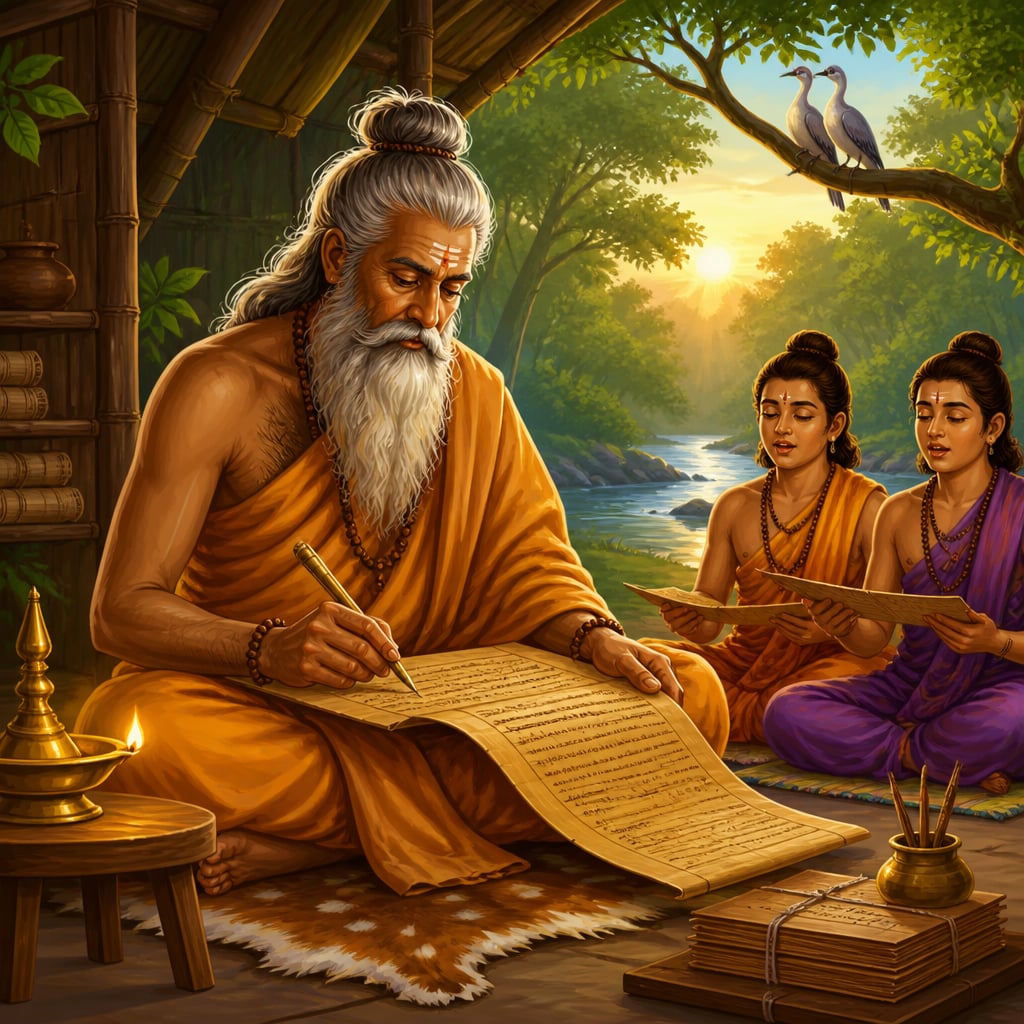
Consider what this means. Hindu civilization does not hide Valmiki's origins. It celebrates them. The very first poet in the tradition, the man who gave India its moral compass through Rama's story, came from the most "impure" background imaginable by any rigid caste reading. If the system were truly designed to lock people by birth, why would it celebrate this story? Why would it give the highest honor to someone who violated every birth-based norm?
Vyasa: Son of a Fisherwoman
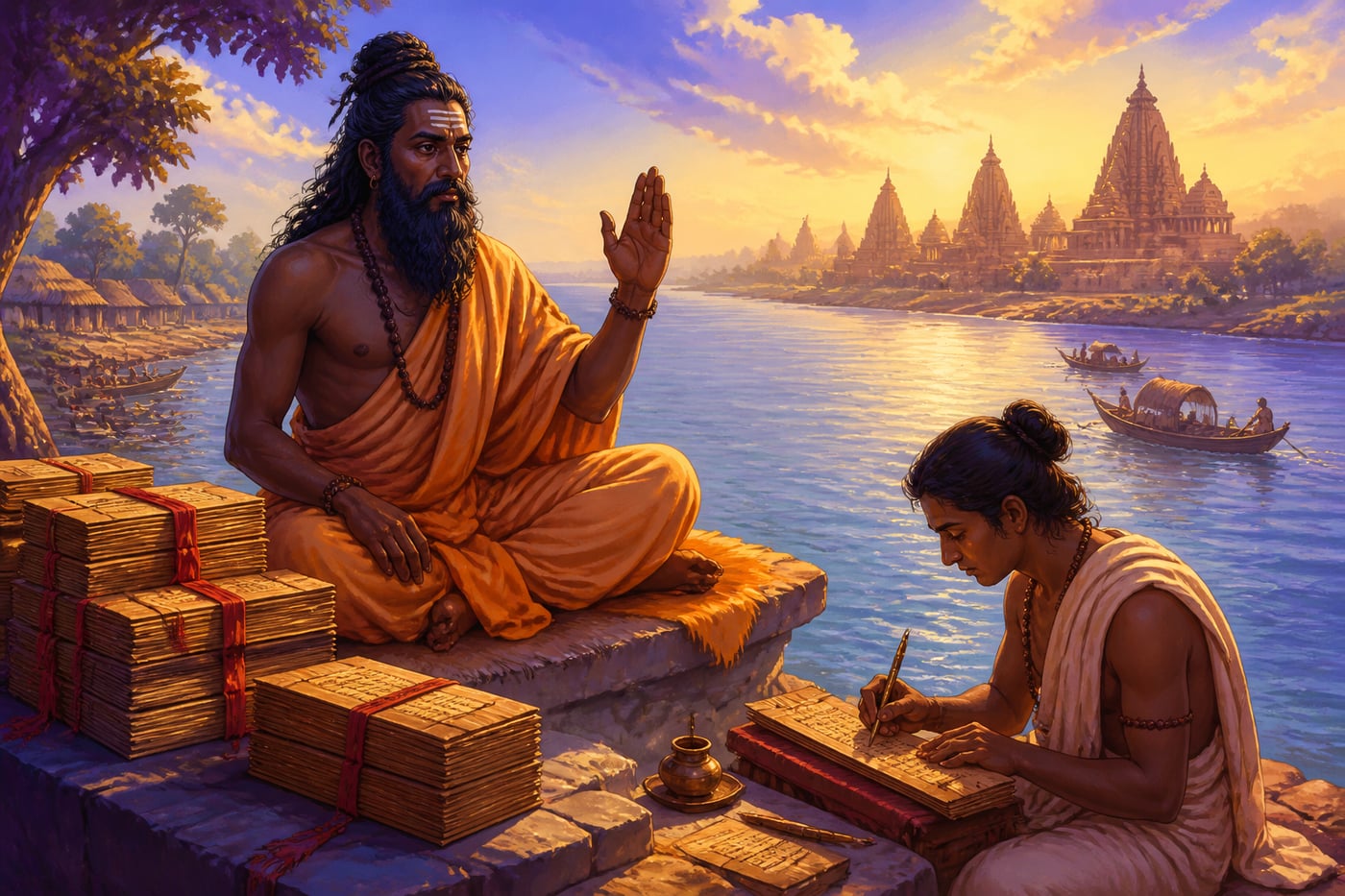
The case of Vyasa is even more striking. Krishna Dvaipayana Vyasa, the compiler of the Vedas, author of the Mahabharata, and composer of the Puranas, was the son of Satyavati, a fisherwoman. His father was the sage Parashara, but Vyasa was raised among fisherfolk. He was dark-skinned (Krishna), born on an island (Dvaipayana), and from the most humble material circumstances.
Yet this man is credited with organizing ALL of Vedic knowledge. He is called Veda Vyasa. The entire intellectual foundation of Hindu civilization, as it has been received and transmitted, passed through his hands. The Brahma Sutra, the Mahabharata, the Bhagavata Purana: all attributed to the son of a fisherwoman.
No birth-based system would place its highest intellectual achievements in the hands of someone outside the "priestly class" and then celebrate that fact for three thousand years.
The Pattern Is Unmistakable
These are not isolated exceptions. Chandragupta Maurya, from uncertain origins, founded India's largest empire under the guidance of the Brahmin Chanakya. Shivaji Bhonsle, from a Maratha farming community, was crowned Chhatrapati. Vidura, born of a servant woman, was the wisest counselor in the Mahabharata's royal court. Kalidasa, by tradition a simple woodcutter, became Sanskrit's greatest poet.
The pattern tells us something crucial: the system had genuine, celebrated pathways for social mobility based on merit, spiritual attainment, and capability.
Bhakti: The Indigenous Reform Engine
But what about the real inequities that did exist? Here is where the narrative of "Hinduism needed outside intervention to reform" collapses entirely.
Starting from at least the 7th century CE in Tamil Nadu and spreading across the subcontinent over the next thousand years, the Bhakti movement represented the most powerful indigenous reform tradition in world history. Its central claim was radical: that the divine was accessible to every human being regardless of birth, and that devotion (bhakti) trumped ritual, lineage, and social position.
This was not an import. Not a response to Islam or Christianity. Not a reaction to colonial criticism. The Alvars and Nayanars of Tamil Nadu were challenging social hierarchies centuries before any foreign reformer set foot in India.
The Ravidas-Mirabai Revolution
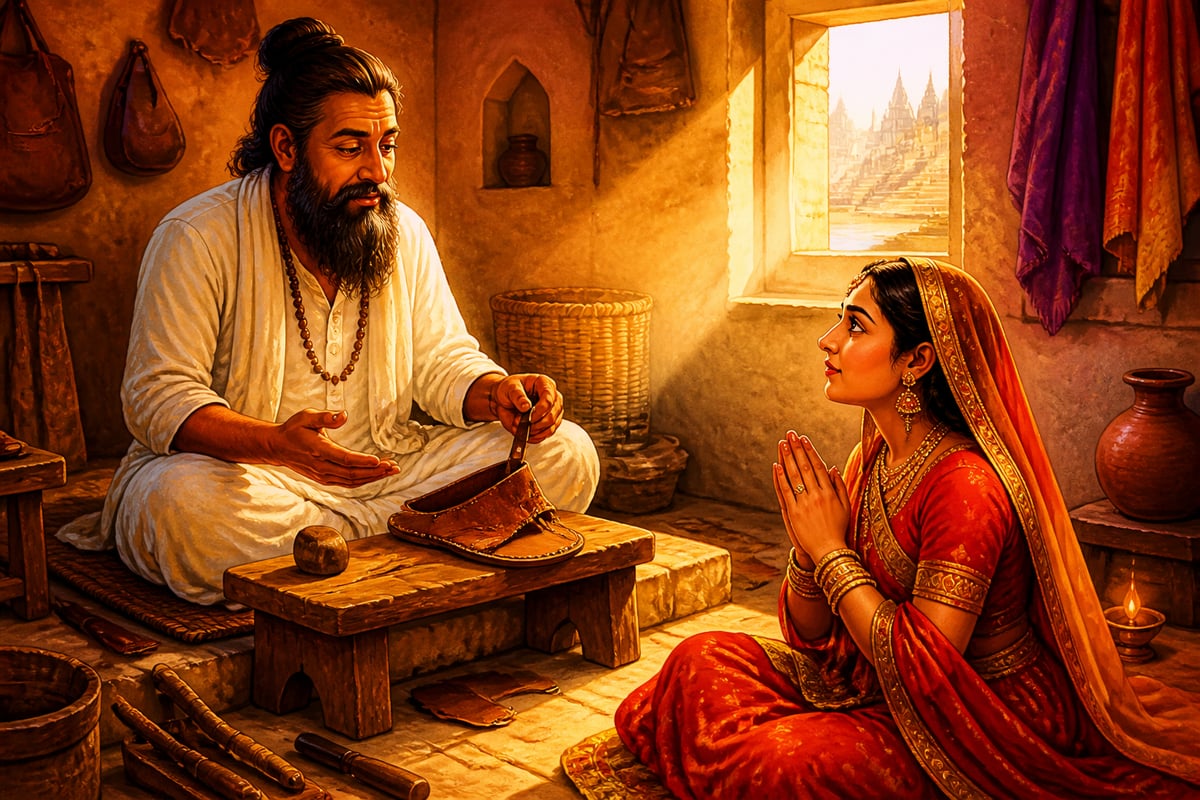
No example captures Bhakti's social revolution more powerfully than the guru-disciple relationship between Ravidas and Mirabai.
Ravidas (Sant Ravidas, Raidas) was a chamar, a cobbler and leatherworker, among the most stigmatized occupations in the social hierarchy. By every rigid reading of "caste," he should have been invisible, voiceless, excluded from spiritual authority.
Instead, he became one of the most revered saints of the Bhakti tradition. His verses are included in the Guru Granth Sahib. His spiritual authority was so profound that Mirabai, a Rajput princess of Mewar, one of the highest-born women in India, accepted him as her guru.
A princess of the Rajput warrior aristocracy, voluntarily submitting to the spiritual authority of a cobbler. Not in secret, not with shame, but as a celebrated fact of Indian spiritual history. Mirabai sings openly of her guru Ravidas. The tradition honors, not hides, this relationship.
This is not a system that was rigidly locked by birth. This is a system that had powerful built-in mechanisms for recognizing spiritual merit regardless of social position.
The Breadth of Bhakti Reform
Ravidas and Mirabai are the most dramatic example, but the Bhakti tradition produced reformers across every region:
- Basaveshwara (12th century, Karnataka): Created the Anubhava Mantapa, a "parliament of experience" where people from all backgrounds debated philosophy as equals
- Chaitanya Mahaprabhu (15th century, Bengal): Embraced followers from all social strata, initiated people regardless of background
- Tiruppaan Alvar (Tamil Nadu): A Panar (musician community) whose devotion was so intense that a Brahmin temple priest carried him on his own shoulders into the Ranganatha temple
- Tukaram (17th century, Maharashtra): A Kunbi (farmer) whose abhangas challenged ritualism and demanded direct connection with the divine
- Akka Mahadevi (12th century, Karnataka): A woman who renounced all social convention to pursue the divine, challenging both caste and gender hierarchies simultaneously
Every one of these reformers emerged from within the Hindu tradition. Every one of them was eventually honored, their teachings preserved, their followers respected. This is a civilization that generated its own antibodies against social rigidity.
What This Means
The pre-colonial Indian social system was complex, imperfect, and sometimes unjust. No honest account should pretend otherwise. There were real barriers, real exclusions, real suffering.
But it was emphatically NOT:
- A rigid, unchanging hierarchy frozen since the Vedic age
- A system equivalent to racial apartheid or European feudal serfdom
- A system without internal mechanisms for reform and correction
- A system that required foreign intervention to become humane
Understanding what the system actually was matters because the gap between reality and the colonial narrative is exactly where the faultline was manufactured. The next lesson will show how British administrators, armed with racial theory and census technology, took a fluid, contextual, self-correcting social system and froze it into the rigid "caste" that the modern world recognizes.
They did not discover caste. They constructed it.
Case studies
The Adi Kavi and the Veda Vyasa: Social Mobility at Civilization's Core
Hindu civilization's two foundational texts were authored by men who, under any rigid birth-based reading, should never have been allowed near intellectual authority. Valmiki, by the tradition's own account, was Ratnakara, a highway robber who survived by violence and theft. After a transformative encounter with the sage Narada, he undertook tapas so intense that an anthill (valmika) grew around his body. He emerged as Maharishi Valmiki and composed the Ramayana, the epic that gave India its moral template through the character of Rama. Vyasa (Krishna Dvaipayana) was the son of Satyavati, a fisherwoman who worked on the banks of the Yamuna. Dark-skinned and born on a river island, Vyasa grew up among fisherfolk. Yet he is credited with compiling all four Vedas, composing the Mahabharata (the world's longest epic), authoring the Brahma Sutra, and narrating the Bhagavata Purana. Between them, these two men produced virtually the entire scriptural and literary foundation of Hindu civilization.
The Bhagavad Gita's definition of Varna by guna (quality) and karma (action), not janma (birth), is not abstract philosophy. Valmiki and Vyasa ARE the proof. The tradition did not merely theorize about merit-based social recognition. It placed its most sacred texts in the hands of a former robber and a fisherwoman's son, and then celebrated those origins for three millennia. The Mahabharata itself (Shanti Parva 188.5) states: 'There is no distinction of varnas. This whole world is Brahman, created by Brahma. By action alone, it became classified into varnas.' The authors embody the scripture they wrote.
Valmiki is worshipped as the Adi Kavi (First Poet) across India to this day. Vyasa is honored on Guru Purnima as the original guru. Neither figure's humble origins diminished their authority. Instead, those origins became central to the tradition's self-understanding: that spiritual and intellectual achievement transcends birth circumstances.
A civilization that places its highest intellectual achievements in the hands of a robber-turned-sage and a fisherwoman's son, then celebrates those facts for thousands of years, is not a civilization built on birth-based exclusion. The proof is in the foundational texts themselves.
The authorship of India's foundational texts by Valmiki and Vyasa directly undermines the colonial narrative of a rigidly birth-based Hindu hierarchy. This evidence is increasingly cited in academic and public discourse to challenge the Eurocentric framing of caste as a system designed solely for exclusion.
The Mahabharata at ~100,000 verses is roughly 10 times the length of the Iliad and Odyssey combined, making Vyasa (a fisherwoman's son) the author of the most voluminous literary work in human history.
The Cobbler's Disciple: Ravidas and Mirabai
In 15th-16th century North India, Sant Ravidas was born into the chamar community of Varanasi, leatherworkers and cobblers who occupied one of the most stigmatized positions in the social hierarchy. Leather work involved contact with dead animals, making it ritually 'polluting' by orthodox standards. By every rigid reading of social hierarchy, Ravidas should have remained invisible. Instead, he became one of the most influential poet-saints of the Bhakti movement. His devotional verses (padas) were so profound that 41 of them were included in the Guru Granth Sahib. His spiritual reputation spread far beyond Varanasi. Mirabai, a Rajput princess of the Mewar royal house (one of the most elite Kshatriya lineages in India), accepted Ravidas as her spiritual guru. This was not a casual association. Mirabai explicitly names Ravidas as her guru in her own compositions. She submitted to the spiritual authority of a cobbler, publicly and without reservation.
The Bhakti tradition operationalized what the Gita theorized. Ravidas himself articulated this principle in a famous verse: 'Ravidas, be not sad that you were born among the lowly. When you depart, the world will sing your praises.' His theology drew on the Upanishadic insight that Brahman resides in all beings equally. The guru-shishya parampara (teacher-student lineage) had always recognized spiritual authority independently of social position. Ravidas and Mirabai proved this was not merely aspirational but functional: a princess could recognize a cobbler's spiritual superiority and act on it without the tradition condemning her.
Ravidas is today revered across North India, with temples dedicated to him in Varanasi, Punjab, and beyond. Mirabai is among the most beloved figures in Indian devotional literature. Their guru-disciple relationship is celebrated, not suppressed, proving the tradition had active mechanisms for recognizing spiritual merit across all social boundaries. The Ravidassia community carries forward his legacy with millions of followers.
The Bhakti movement was not an external reform imposed on Hinduism. It was an indigenous correction generated from within. When a Rajput princess voluntarily accepts a cobbler as her guru, it reveals a civilization with built-in mechanisms for spiritual egalitarianism that no outside intervention needed to provide.
The Ravidas-Mirabai guru-disciple relationship challenges the modern assumption that cross-caste spiritual authority required external reform movements. The Bhakti tradition's indigenous egalitarianism is now highlighted by scholars pushing back against narratives that credit only colonial or Marxist frameworks with social reform in India.
41 hymns of Ravidas are included in the Guru Granth Sahib, placing a chamar cobbler's words alongside those of Guru Nanak in one of the world's most sacred texts.
Living traditions
The Bhakti saints' legacy is woven into the fabric of modern India. Dr. B.R. Ambedkar cited Ravidas and Kabir as predecessors in the fight for social equality. The Indian Constitution's commitment to the abolition of untouchability draws on the same tradition that Bhakti saints championed from within. Ravidas Jayanti is a gazetted holiday in multiple states. Guru Purnima is observed across every educational institution in the country. The Dera Sachkhand Ballan (Jalandhar) serves as a major center of the Ravidassia community with millions of followers worldwide. Valmiki Jayanti is a national celebration. These are not museum relics. They are living, growing traditions that prove Indian civilization's self-correcting mechanisms did not stop working. They are still active.
- Guru Purnima (Vyasa Purnima): The annual celebration of the guru-shishya tradition, held on the full moon of Ashadha month (June-July). Named after Vyasa, the son of a fisherwoman, who is honored as the Adi Guru (original teacher). Students across India pay respects to their teachers, spiritual lineages hold special gatherings, and ashrams conduct discourses. The festival transcends all community and regional boundaries.
- Shri Guru Ravidas Janam Asthan Mandir: The birthplace temple of Sant Ravidas. The complex includes the main shrine, a museum with historical documentation of his life and verses, and a community hall. Visit during Ravidas Jayanti (Magh Purnima) to see the scale of devotion a cobbler-saint still commands. The neighborhood of Seer Govardhanpur itself reflects the living community that carries forward his legacy.
- Valmiki Ashram and Temple: Traditional site where Maharishi Valmiki composed the Ramayana and where Sita took refuge after her exile from Ayodhya. The ashram sits on the banks of the Ganga and includes the Valmiki temple, ancient ghats, and the site where Lava and Kusha are said to have been born. A tangible reminder that the author of India's moral epic came from the humblest origins.
- Shri Guru Ravidas Janam Asthan Mandir: The birthplace temple of Sant Ravidas, marking the exact site where the cobbler-saint was born in the 15th century. The temple complex includes a prayer hall, a museum documenting Ravidas's life and teachings, and a community kitchen. The temple draws pilgrims from across India, particularly during Ravidas Jayanti when hundreds of thousands gather.
Reflection
- When you think about your own identity, how much of it is defined by what you were born into (family, community, region) versus what you have chosen to do, learn, and become? Which definition feels more true to who you actually are?
- The Bhakti movement produced centuries of indigenous social reform, yet many educated Indians today believe that social equality was an idea introduced by colonial reformers or Western liberalism. Why do civilizations sometimes forget their own self-correcting traditions, and what are the consequences of that forgetting?
- Does it matter whether we describe India's pre-colonial social system as 'imperfect but self-correcting' versus 'inherently oppressive'? How does the framing we choose shape the kind of reform we pursue today?